

April 6, 2026
In brooding, the first few days are when birds are least able to regulate their own body temperature, so the margin for error is small. University of Georgia guidance notes that chicks can be stressed by very small body-temperature changes and that performance can suffer when birds have to compensate. That’s why 24-hour heating should be treated as an engineering control problem, not just a “setpoint” problem.
Combustion Research Corporation (Combustion Research Corporation) approaches brood-barn heating from the floor up because that’s where chicks live, where litter temperature matters, and where cold zones show up first.
The Thermal Reservoir: Why Radiant Beats Forced Air at Floor Level
Forced-air systems aim to heat the full air volume, but hot air rises. In high-bay agricultural buildings, that means the warmest air collects above the occupied zone while the floor and litter can lag behind. When ventilation runs to manage ammonia and moisture, that air-based heat is also the first thing to leave the building.
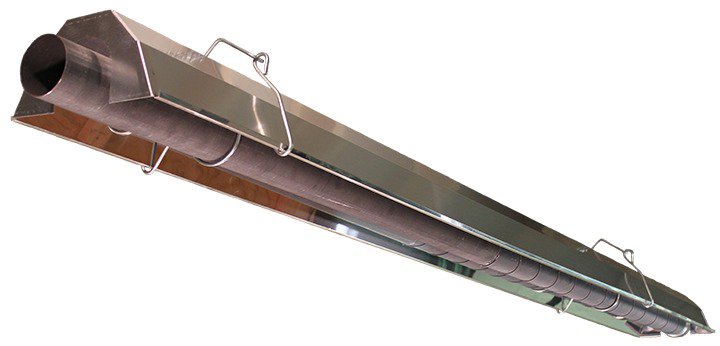
Infrared radiant systems flip the heat path. A low-intensity radiant tube heater transfers energy primarily to surfaces (concrete, bedding, drinker lines, and the birds themselves) so the occupied zone gets the benefit without waiting for perfect air mixing.

This is also where the “battery” concept becomes real: when thermal mass is warmed, it can continue releasing heat and reduce how quickly conditions swing during normal cycling.
What This Means for Brooder Design
In a brooder, the design target is stable conditions where chicks actually live: litter surface temperature, floor-level comfort, and uniformity across the brooding zone. That shifts the engineer’s focus from mixing and CFM to emitter layout, zoning, and how the system behaves during ventilation cycles.
From a practical design standpoint, treat radiant as a floor-zone system: you’re warming the litter and slab so they act like a thermal reservoir that “bridges” short ventilation events. To make that reliable, layout decisions need to be made early, especially where brood rings, feeder/drinker lines, and typical bird distribution create uneven loads.
Here are the key design moves that keep 24-hour brooding stable:
- Zone by function, not just square footage: Brood areas, perimeter zones, and service aisles rarely need the same output. Zoning lets you protect chick comfort without overheating unused space.
- Design around ventilation reality: Minimum ventilation is non-negotiable for moisture and ammonia control, so plan heater placement and staging to maintain floor-level stability while fans cycle. The goal is fewer temperature swings in the occupied zone.
- Map emitter coverage to chick density patterns: Chicks don’t distribute perfectly evenly. Place coverage where the flock will actually spend time (brood rings early on, then expansion areas), so the “warm zone” isn’t accidentally offset.
- Specify controls that protect uniformity: Use multiple sensing points (or zone sensors) so one warm corner doesn’t “satisfy” the whole barn while another area drifts cold. In brood barns, the worst failures are localized cold spots that don’t show up in a single average reading.
- Call out install constraints in the spec: Mounting height, clearances, and tube orientation matter. Put these requirements into the submittal criteria so the system you modeled is the system that gets installed.
Engineering for the Dirty Reality of Brooders
Dust, dander, and feathers punish equipment. Any design that depends on consumables or frequent cleaning to keep combustion air flowing is likely to create nuisance shutdowns and middle-of-the-night calls.
Combustion Research Corporation directly addresses this with a filter-free approach: Combustion Research Corporation states that Omega II® and Reflect-O-Ray® systems are engineered so combustion air filters are not required, avoiding a maintenance dependency that can turn into lockouts when it’s missed.
The second reliability lever is tube longevity. Combustion Research Corporation’s “optimum efficiency” framing is meant to avoid operating conditions that create internal condensate that can damage radiant tubing over time.
Rather than chasing “maximum efficiency” messaging that can ignore dew-point risk, Combustion Research Corporation emphasizes operating outcomes tied to long service life.
Field Checklist for 24-Hour Heating Reliability
Use these questions during design review and submittals:
- Does the heater require intake filters or frequent combustion-air maintenance to avoid shutdowns?
- Is the manufacturer explicit about design intent that avoids internal condensation risk across the full tube run?
- Can you zone brood areas so you’re not overheating unused square footage during early brooding?
Choosing Your Fuel: Gas vs. Oil for Brooding Sites
Fuel constraints are common in rural and remote operations. Combustion Research Corporation’s product families give engineers options without forcing a switch back to air-only heating.
- Reflect-O-Ray® Gas Fired: Combustion Research Corporation documentation describes Reflect-O-Ray burners operating under negative (vacuum) pressure, which changes the failure mode in the event of a breach (air tends to be drawn in rather than pushed out).
- Reflect-O-Ray® Oil Fired: Combustion Research Corporation offers an oil-fired Reflect-O-Ray line for sites using #2 fuel oil, keeping an infrared approach available where natural gas isn’t practical.

Technical Comparison for Specifiers
The table below summarizes why 24-hour brooder performance often improves when the design focus moves from ceiling air to floor-zone stability, while also reducing routine service triggers.
| Feature | Standard Forced Air | Combustion Research Corporation Radiant (Omega II® / Reflect-O-Ray®) |
|---|---|---|
| Heat distribution | Ceiling-focused (stratification risk) | Floor-focused heat delivery intent (surfaces warmed directly) |
| Maintenance drivers | Filter cleaning and airflow-related faults are common risk points | Filters not required (engineered out as a dependency) |
| Ventilation penalty | Heated air is lost quickly during exchanges | Thermal mass can store heat and buffer swings |
| Durability signal | Mid-life surprises often come from environment + duty cycle mismatch | Published 10-year tube warranty against internally created corrosion (Omega II® 9K) |
The Specification Edge: Risk Mitigation, Not Marketing
For architects, engineers, and facilities teams, brooder heating is a risk decision. The high cost isn’t the heater; it’s lost performance, emergency calls, and unstable conditions during the most sensitive stage of growth. Cobb’s brooding guidance, for example, highlights how concrete temperature at placement correlates with early mortality and early weight outcomes, reinforcing why floor-zone conditions matter.
Combustion Research Corporation’s position as a family-owned U.S. manufacturer (since 1952) is built around this same logic: design for long service life, reduce routine maintenance dependencies, and support projects with hands-on engineering involvement instead of pushing complexity into the maintenance log.
Get Help Designing a 24-Hour Heating Layout for Your Brooder
If you’re planning a brooder project and want support with zoning, layout, and application fit for 24-Hour Heating, start with Combustion Research Corporation here.