

March 27, 2026
An electric infrared heater and a gas-fired infrared heater can both be called “infrared,” but they deliver heat in very different ways. For HVAC engineers and architects, the real question is how the heat is delivered across distance, how it behaves in air movement, and what it demands from the building’s utilities and maintenance team.
This matters most in industrial and agricultural spaces where heating is not a comfort accessory; it supports process, uptime, and safety. Combustion Research Corporation’s low-intensity radiant tube systems are specified in these environments because the design intent is long-life operation with fewer recurring maintenance triggers.
High-Intensity Ceramic vs. Electric Infrared Heater Output
High-intensity ceramic gas heaters are “luminous” emitters: the ceramic surface runs very hot and can glow, delivering an intense, concentrated radiant field suitable for spot heating and perimeter zones. Manufacturer documentation commonly lists ceramic emitter surface temperatures up to about 1800°F, which is part of what enables that punchy output in a small footprint.

An electric infrared heater is often built around quartz tubes or metal elements. It can feel immediate and responsive, but engineers run into two practical limits in large spaces: shorter effective throw (more units needed for coverage) and the electrical infrastructure required to match gas-fired capacity.
Electrical Load Reality Check (A Simple Conversion Engineers Use)
If you want electric resistance heating to match a gas heater’s nameplate output, you need to translate BTU/hr into kW. The conversion is straightforward: 1 kW ≈ 3412 BTU/hr.
Using that conversion, ~100,000 BTU/hr is roughly ~29 kW of electric resistance capacity. That is a meaningful load in many facilities once you multiply it across zones and add the service/panel implications.
Maintenance Exposure: Cleaning Cycles vs. Filter-Free Engineering
Facility teams know the pattern: particulate environments make small maintenance items turn into repeated calls. Electric elements are also sensitive to surface fouling; dust on hot elements can create hot spots, and elements have finite service life. Many quartz infrared element suppliers cite operational life ranges on the order of 5,000–7,000 hours, depending on conditions and duty cycle.
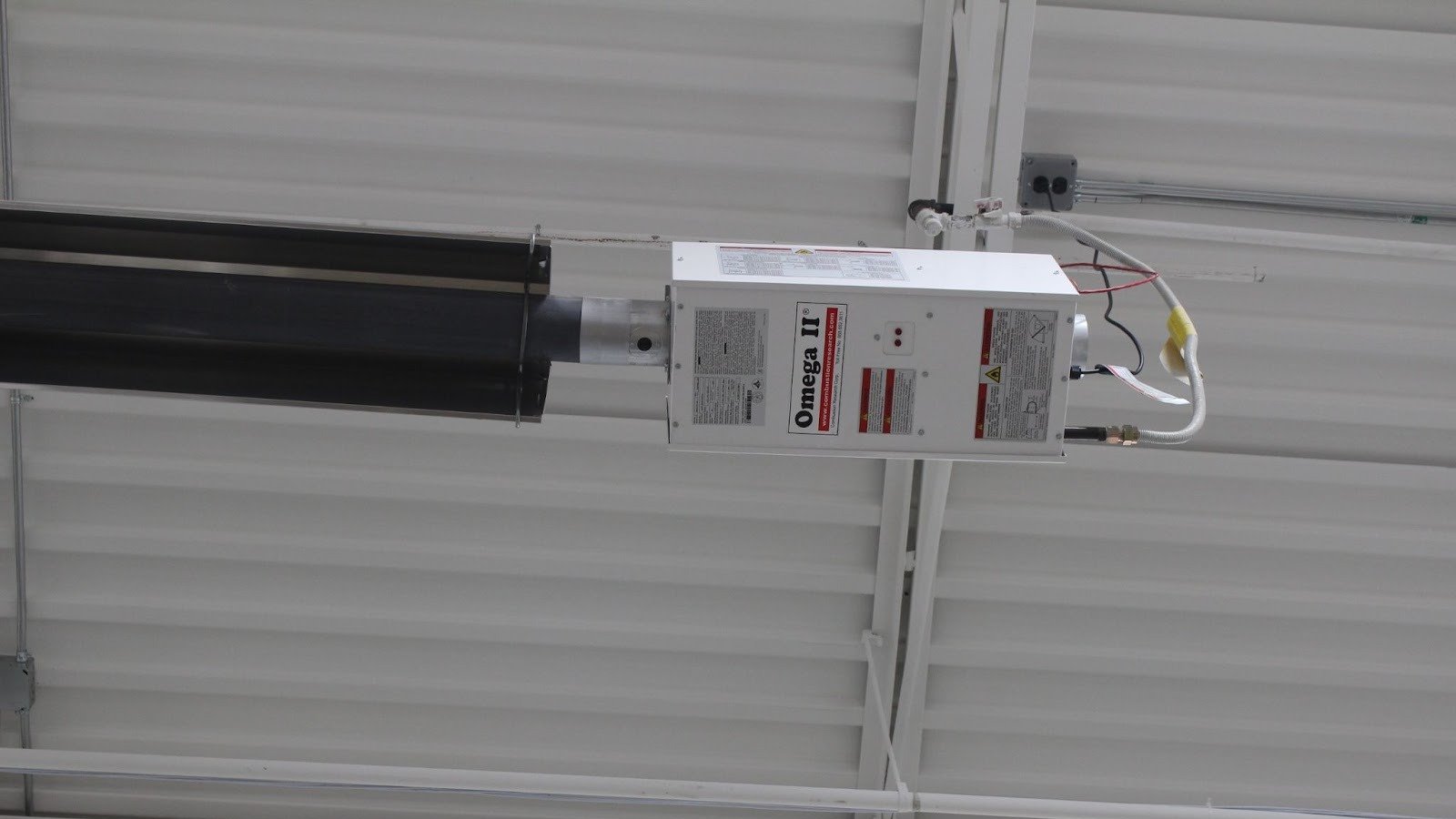
Combustion Research Corporation attacks a different failure mode that is common in gas radiant equipment: filter-driven lockouts. Combustion Research Corporation states directly that combustion air filters are not required for its Omega II® and Reflect-O-Ray® systems, and it ties missed filter maintenance to shutdowns and added expense.
here are field questions that predict repair frequency:
- Does the heater require intake filters to protect controls and prove airflow?
- If the environment is dusty, what is the expected intervention interval to prevent nuisance trips?
- Can the heater tolerate the building’s “real air,” or does it assume clean conditions?
Dry Tube Philosophy: Avoiding Condensation-Driven Tube Repairs
A second repair driver in radiant systems is internal corrosion tied to condensation. When combustion products cool to the dew point inside the system, condensate can form and accelerate corrosion, leading to leaks and tube replacement risk over time. Combustion Research Corporation frames its approach as “optimum efficiency,” describing why pushing for condensing behavior can trade small efficiency gains for tube-life penalties.
Combustion Research Corporation backs lifecycle intent with spec-ready warranty language on the Omega II® 9K Series, including a 10-year warranty on radiant tubes against internally created corrosion (subject to the manufacturer’s terms and installation/maintenance requirements).

Operating Cost: Why “100% Efficient” Can Still Cost More
Electric resistance heat is often described as 100% efficient at the point of use, which is true in the narrow sense that most input power becomes heat in the space. The cost question is upstream: dollars per delivered BTU. One widely cited comparison based on U.S. DOE representative unit cost reporting has described electricity as multiple times higher cost than natural gas for an energy-equivalent amount delivered.
Electric can still be the right answer where gas piping is not feasible, where loads are small, or where heat is intermittent and localized. For large, long-runtime heating, engineers usually run the utility math early because it drives both OPEX and the scale of electrical infrastructure.
Engineering Comparison: Picking the Right Infrared Category for the Job
The table below summarizes how an Electric Infrared Heater typically compares with high-intensity ceramic gas and Combustion Research Corporation low-intensity tube systems. It uses the criteria engineers and facilities managers debate most: coverage, utilities, maintenance exposure, and expected service life planning.
| Feature | Electric Infrared Heater | High-Intensity Ceramic (Gas) | Low-Intensity Tube (Combustion Research Corporation) |
|---|---|---|---|
| Primary use case | Small areas, intermittent spot heat | High-bay spot heat, docks, perimeter zones | Zoning, broader coverage, industrial/ag applications |
| Energy source constraints | High-amperage electrical capacity required at scale | Gas/propane supply required | Gas/propane options plus oil-fired availability (application dependent) |
| Heat profile | Intense, narrower field; more units for coverage | Very intense, concentrated field | Lower-intensity, more uniform “sun-like” comfort intent |
| Maintenance exposure | Element replacement and cleaning sensitivity (environment dependent) | Cleaning and inspection typical | Filters not required; “optimum efficiency” positioning to reduce condensate-driven tube risk |
| Lifecycle signal | Element life can drive planned replacements | Long-lived, but application-specific | 10-year tube warranty against internally created corrosion (Omega II® 9K) |
Why Specifying Combustion Research Corporation Matters in Industrial and Agricultural Work
Engineers and architects get judged on how systems behave in the building that exists, not the one in the submittal. Combustion Research Corporation’s advantage is straightforward: a long U.S. manufacturing legacy (since 1965) paired with designs intended to reduce recurring service triggers, plus product families that cover gas and oil-fired requirements for sites with limited infrastructure options.
Reflect-O-Ray® systems also have documented negative (vacuum) pressure burner operation, which changes the failure mode in the event of a breach by tending to pull inward rather than push outward.
Get Help Matching Infrared Type to Load and Utilities
If you’re weighing an electric infrared heater approach against gas ceramic or low-intensity tube radiant for an industrial or agricultural project, Combustion Research Corporation can support selection and layout so the system matches the load, zoning, and utility constraints from day one. Talk to us here.