

March 18, 2026
When facilities managers hear boiler installation and repair, they usually think beyond the equipment line item. They think about the mechanical room footprint, specialized service coordination, water-treatment programs, inspection cycles, and the “what happens if it goes down” problem that turns a cold morning into an operational incident.
Infrared heating is often selected because it changes the risk profile. Combustion Research Corporation’s low-intensity radiant systems are designed around modular coverage, documented “optimum efficiency” (not “maximum efficiency”), and design choices intended to reduce recurring maintenance dependencies over the life of the system.
Single Point of Failure Versus Zoned Reliability
Central boiler plants concentrate risk. If a boiler is offline or a primary component in the distribution system fails, large portions of the facility can lose heat at once, forcing urgent corrective work and disrupting production schedules. National Board guidance also notes that jurisdictions and insurance companies commonly recommend annual boiler inspections, reinforcing that boilers live in a compliance and inspection framework that must be actively managed.
Combustion Research Corporation infrared layouts distribute heat generation across multiple units and zones. In a large warehouse or manufacturing space, this means one unit can be serviced without turning the entire building into a triage project, which is a practical uptime advantage in peak season.

What to Ask During System Selection
Facilities teams and engineers can pressure-test reliability early with a few questions:
- If one heater is offline, what percentage of the building loses heat?
- Can critical areas (shipping, QA, maintenance bays) maintain minimum temperatures while repairs happen?
- Does the system design support staged replacement without shutting down the entire plant?
Maintenance Exposure: Water Chemistry Versus Filter-Free Infrared
Boiler systems bring a known set of maintenance requirements: water treatment to manage scale and corrosion, plus ongoing checks of multiple system components and safety controls. ASHRAE Journal’s “Water Treatment 101” frames water treatment in HVAC systems around corrosion and scale control, emphasizing that it exists to protect equipment performance and longevity.
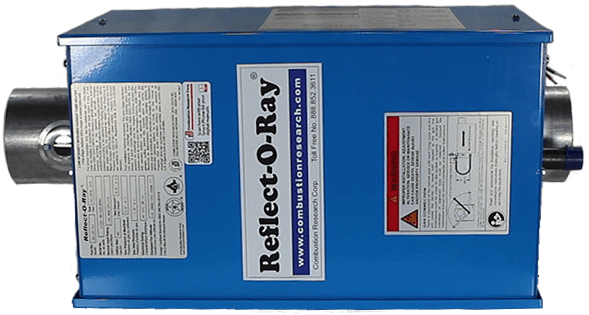
Combustion Research Corporation’s approach is to remove common service multipliers that show up with combustion equipment in dirty environments. Combustion Research Corporation states that Omega II® and Reflect-O-Ray® systems are engineered so combustion air filters are not required, avoiding a consumable-driven maintenance interval that can trigger nuisance shutdowns if neglected.
“Dry Tube” Longevity and Why Optimum Efficiency Matters
Boiler plants and air-handling coils typically deliver heat through convection, warming air that will stratify and escape through air exchange. Radiant infrared systems work differently, warming floors and objects so the occupied zone gets heat without relying on mixing the entire air volume first. Combustion Research Corporation describes this ground-level heat-delivery intent in its infrared overview.
Combustion Research Corporation also makes a specific durability argument: “optimum efficiency” protects radiant tube longevity by avoiding operating conditions that continuously create condensate inside the tube. Combustion Research Corporation notes that the gain from condensing can be small, while the corrosive effects can destroy radiant tubing over time.
This matters for facilities because mid-life tube failures are not just a parts expense. They trigger lift access, downtime coordination, and the uncomfortable question of why the “efficient” system needed major work earlier than planned.
Stack Effect and Energy Waste in High-Bay Facilities
High ceilings magnify convection losses. Stack effect occurs because warmer indoor air is less dense and rises, creating pressure differences that can drive air movement and heat loss through openings higher in the building.
Infrared reduces how much you depend on hot air at the ceiling to keep people comfortable at the floor. Combustion Research Corporation’s application guidance also states that forced-air applications often benefit from gas-fired radiant infrared systems, citing potential annual fuel savings in the 30%–50% range depending on the facility and operating profile.
Where Facilities Notice it Fast
If your facility has frequent door cycles, large air changes, or wide open production areas, the “reheat the whole air volume” penalty shows up every day. Infrared can lower that penalty because the floor and equipment surfaces retain heat and continue to release it after air exchange events.
Installation Complexity and Capital Planning
Boiler Installation and Repair decisions are often tied to capital planning realities: mechanical room build-out, distribution piping, insulation, pumps, valves, and access for future service. Those are legitimate systems, but they can be labor-heavy and space-consuming.
Ceiling-mounted infrared typically avoids a dedicated mechanical room footprint for heat generation. Combustion Research Corporation’s product library emphasizes system specifications, manuals, and application support that help teams plan installation details with fewer unknowns during construction.
Fuel Constraints: When Natural Gas Is Not Available
Many facilities are constrained by fuel infrastructure. Combustion Research Corporation’s Reflect-O-Ray® Oil Fired line is designed for sites that rely on No. 2 fuel oil, and Combustion Research Corporation lists oil-fired system attributes including “#2 Fuel Oil,” “vacuum fired systems,” and published “Energy Savings of 30–50% over Conventional Heating Systems” (application dependent).

For agricultural or remote locations, this can keep the project in an infrared strategy without forcing a return to air-only heating because of gas availability.
Quick Comparison: Lifetime Operational Impact
The table below summarizes the operational differences that tend to drive facilities decisions, focusing on risk, service coordination, and space usage rather than brochure claims.
| Feature | Central Boiler and Distribution | Combustion Research Corporation Radiant Tube Heaters |
|---|---|---|
| Outage impact | Centralized failures can affect large areas at once | Modular coverage; one unit can be serviced while others run (application dependent) |
| Maintenance program | Water treatment and inspection cycles are a recurring requirement | Filters not required for Omega II® / Reflect-O-Ray® combustion air |
| Stratification exposure | Warm air rises; stack effect drives heat loss | Radiant heat targets floors/objects more directly |
| Floor space | Mechanical room footprint and access needs | Ceiling-mounted systems preserve floor area (project dependent) |
| Service access | Specialized boiler service coordination is common | Unit-level access and zoning; published manuals/specs support planning |
De-Risk Heating Without Overbuilding Maintenance
If you’re evaluating alternatives to boiler installation and repair overhead, or you want Combustion Research Corporation reviewed as an approved alternate for an industrial/commercial project, request application and layout support here.