


June 1, 2026
Commercial greenhouse operations live and die by temperature consistency. A greenhouse heater that can't hold stable root-zone and canopy temperatures through a cold snap doesn't just stress plants. It erases the yield gains that justify the season extension in the first place.
Forced-air systems are the default choice in many agricultural facilities, but they create problems specific to greenhouse environments. The air movement generates drafts that accelerate plant transpiration, drawing moisture from leaves faster than roots can replace it. When the system cycles off, temperatures drop and condensation forms on plant surfaces, creating favorable conditions for fungal pathogens. The result is crop stress, disease pressure, and uneven growth across the same house.
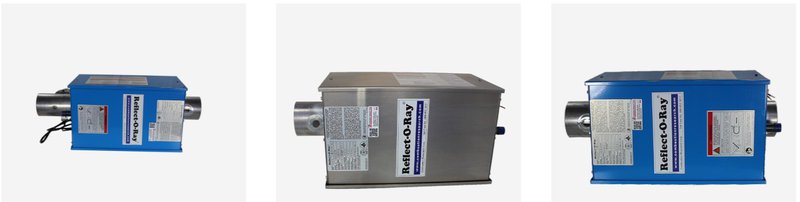
Combustion Research Corporation (CRC) has engineered infrared radiant heating systems since 1965. Its Reflect-O-Ray® and Omega II® systems are purpose-built for commercial greenhouse environments.
Why a Radiant Greenhouse Heater Outperforms Forced Air
Infrared radiant heating works on the same principle as sunlight. Rather than warming the air, it heats the objects and surfaces in its path directly: soil, plant beds, benches, and root zones. Those surfaces absorb the energy and release it gradually, creating a stable thermal environment that persists between burner cycles.
That stability matters for crop yield. Forced-air systems cycle between hot blasts and cooler periods, creating temperature variation across the growing zone. Plants near the air discharge run warmer and drier. Plants at the far end of the house sit in cooler, stagnant air. That variation produces uneven growth that's difficult to correct at harvest.
A radiant greenhouse heater eliminates that variation by distributing heat evenly without air movement. Root-zone temperatures stay consistent. Canopy temperatures don't spike and drop with burner cycles. Disease pressure drops because there's no forced air movement to distribute pathogens or trigger the condensation cycles that fungal infections need. For more on how radiant energy distribution affects crop performance, greenhouse heating applications at CRC cover the key principles.
The Reflect-O-Ray® in Commercial Greenhouse Applications
CRC's Reflect-O-Ray® is a low-intensity vacuum-vented radiant tube system designed for demanding agricultural environments. Its sealed combustion design draws combustion air from outside the greenhouse rather than from the growing space. That keeps combustion byproducts out of the plant environment entirely. This situation matters in sensitive crops where even trace exhaust gases can affect tissue quality.
The system's patented spiral low-mass tubing reaches optimum radiant emitter output faster than conventional tube designs. In early spring and late fall, a slow-responding greenhouse heater can allow temperatures to drop below the crop's critical threshold before the burner catches up. Spiral tubing reduces that risk by shortening heat recovery time after each burner cycle.
CRC's dry-tube design avoids the condensate damage that shortens tube life in systems engineered for maximum thermal extraction. Unlike competing systems that produce corrosive condensate as a byproduct, the Reflect-O-Ray® operates at exhaust temperatures that keep the tube dry throughout its service life. CRC backs that with a ten-year radiant tube warranty. USDA research documents the direct relationship between temperature consistency and disease incidence in controlled environment crop production.
The Omega II® for Precise Microclimate Control
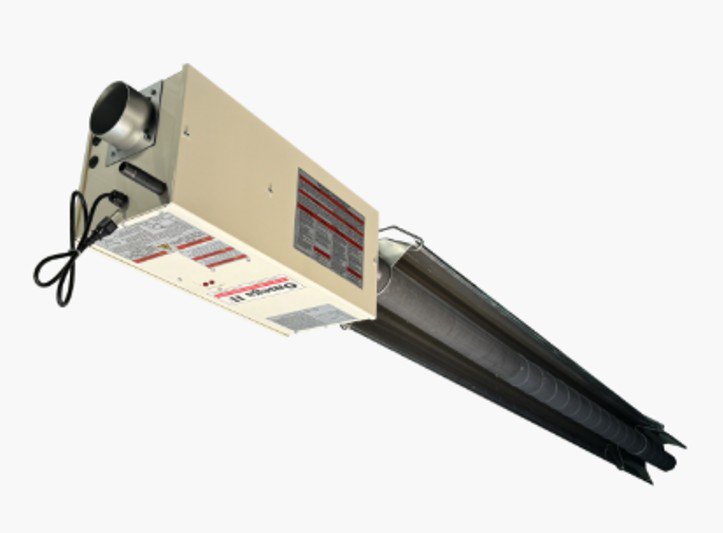
The Omega II® power-vented system brings the same spiral low-mass tubing technology to installations where positive-pressure exhaust suits the structural configuration. Its dual-input firing option allows staged British Thermal Unit (BTU) output across two levels, which improves efficiency during partial-load conditions. Greenhouse operators gain finer control over zone temperatures without overshooting setpoints.
That level of control matters in multi-crop facilities where different sections require different temperature profiles. A propagation area running at 70°F and a finishing greenhouse heater zone running at 58°F operate independently on the same system rather than sharing a single setpoint. For more on how single-stage and dual-input configurations compare on efficiency, system configuration comparisons for agricultural applications cover the key variables.
Extending the Season With a High-Efficiency Greenhouse Heater
The economic case for a radiant greenhouse heater is strongest at the shoulder seasons. In early spring and late fall, night temperatures are volatile. A single cold event can wipe out a crop that a reliable heating system would have protected.
Forced-air systems in leaky greenhouse structures often can't maintain target temperatures during sharp overnight drops because the envelope loses heat faster than the system can replace it. Infrared holds its ground better because it heats the thermal mass of the floor, benches, and growing structures rather than the air. Stored heat in those surfaces continues to radiate into the growing zone when outdoor temperatures drop sharply. That buffering effect gives the burner time to recover and keeps the crop above its critical temperature threshold.
CRC's systems consistently deliver fuel savings of 30 to 50 percent compared to forced-air alternatives. In a commercial greenhouse where heating is a significant operating cost, that range translates to meaningful margin improvement over a full season. Also worth noting: CRC's filter-free design removes a recurring maintenance burden that forced-air greenhouse systems accumulate quickly in dusty growing environments. For a closer look at how radiant heating supports season extension, CRC’s agricultural heating solutions cover the application in detail.
If your greenhouse operation is losing yield to temperature inconsistency or cold snaps, the CRC team can help you spec a system built for the demands of commercial crop production.