

August 10, 2026
Cold outside? Restaurant owners will usually add a second patio heater to a busy outdoor dining area, then a third the following winter. However, most won’t bother with a matching upgrade to the gas line underneath. Restaurant operators tend to add commercial patio heaters incrementally because outdoor seating footprints expand gradually. Unfortunately, the gas distribution system feeding that seating does not expand on its own. The mechanical system either had the capacity for the eventual peak load from the start, or it lacked it entirely.
Pressure drop represents the most common symptom of an undersized fuel infrastructure system. This deficiency shows up clearly during peak service hours. Operators might notice a heater that will not reach its full thermal output. A pilot flame might fail to stay lit. Burners often cycle unevenly when several units fire simultaneously during a cold Friday night rush.
Swapping out parts or adding more British thermal units (BTUs) to the heater frame will not fix the problem. Instead, technicians must confirm the physical dimensions of the supply network. The pipe diameter, total run length, and the specific number of fittings between the meter and the farthest appliance dictate delivery capacity. The distribution system must deliver the required design pressure under full demand. It cannot simply match the small consumption rate of the first single unit installed.
Sizing Tables and Connected Load Calculation Requirements of Commercial Patio Heaters
The National Fuel Gas Code sets the engineering basis for sizing gas piping networks. The National Fire Protection Association (NFPA) maintains this structural standard for commercial and light industrial settings. The code tables evaluate the total connected building load, horizontal pipe length, and the total friction loss from elbows and tees. It also calculates the allowable pressure drop across the entire delivery loop rather than evaluating a single appliance.

Restaurants frequently violate the engineering intent of that calculation. Operators treat each new commercial patio heater installation as an isolated, separate asset. They must re-run the layout math for the full connected demand every time a technician mounts a unit. Neglecting this cumulative total causes a quiet pressure decline across the upstream manifold segments.
Facilities that burn liquid propane (LP) gas instead of using a municipal natural gas main manage separate mechanical codes. Federal LP-gas regulations dictate how operators store cylinders and bulk storage tanks. The rules mandate specific safety distances from building structural openings and potential ignition sources. They also define what piping materials and pressure ratings must connect the tank to the burner assembly.
A simple propane setup built for a single tabletop unit lacks the flow capacity for permanent commercial patio heaters. It also lacks the proper excess-flow protection mechanisms required along a structural patio rail. Upgrading to high-output systems requires a complete recalculation of the high-pressure regulator settings and vapor delivery rates.
Preventive Maintenance and Troubleshooting Undersized Manifolds
A unit that suffers from chronic low gas pressure does more than underperform in cold weather. The pressure deficit generates frequent, expensive service calls. These symptoms match the common complaints found in patio heater parts troubleshooting guides. Technicians encounter pilot assemblies that fail to hold a stable flame. Thermocouples frequently register a false millivolt fault.
Burner ports accumulate heavy soot deposits because low pressure causes incomplete combustion cycles. Most of these issues trace directly back to a gas supply deficiency rather than a manufacturing defect. Consequently, a components swap fixes nothing over time if the underlying pressure issue remains uncorrected. Facilities save money by fixing the pipe infrastructure before purchasing replacement components.
Single-stage and dual-input gas heaters respond differently to marginal infrastructure pressure. This operational distinction matters when a restaurant details its capacity plan for an upcoming winter season. Dual-input configurations allow two-stage firing options. The system can throttle back thermal output during milder autumn days.
This stepping control reduces the peak volumetric draw on the main gas system. It avoids the sudden pressure shocks that occur when multiple single-stage units activate at maximum draw. Modulating the fuel flow preserves line stability and balances delivery across long horizontal branches.
Combustion Mechanics and Ventilation Design Choices
Most traditional open-flame patio heaters draw their combustion air directly from the surrounding dining zone. This atmospheric intake design functions reliably in calm environments. However, wind gusts, heavy rain, or a nearby building exhaust fan can quickly disrupt the flame pattern. Low-intensity heating systems engineered around sealed combustion mechanisms completely isolate the burner from the guest space.
These assemblies pull clean intake air and exhaust combustion byproducts through a dedicated, isolated pathway. They do not rely on variable ambient air currents to stabilize the burner core. For a covered courtyard or a semi-enclosed patio structure, this structural engineering separation preserves safety and ensures consistent warmth.
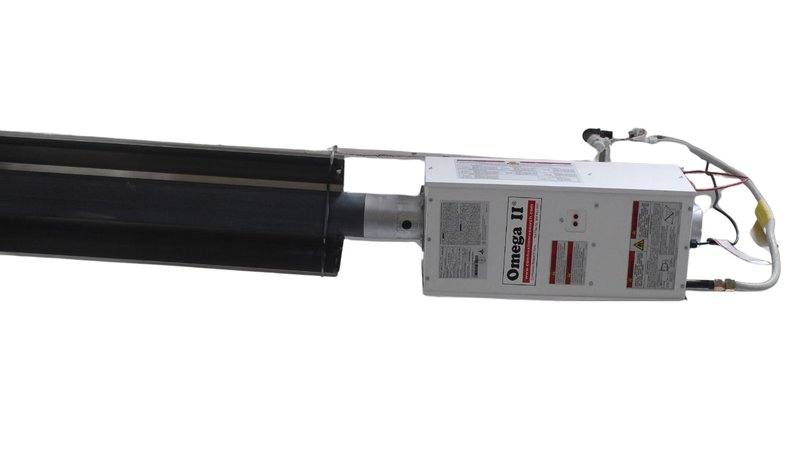
Vacuum-vented infrared systems also deliver higher thermal efficiency than standard power-vented alternatives. Negative pressure naturally pulls the hot exhaust gas through the radiant tube assembly. This design eliminates the parasitic electrical load of an active motorized blower fighting positive static pressure. For a business tracking the overhead costs of an outdoor dining season, this efficiency variance accumulates substantial utility savings.
Gas line engineering for a commercial patio layout requires ongoing evaluation. It is a mechanical calculation that operators must update whenever the seating footprint changes. Facilities that skip this review usually discover the structural bottleneck on the coldest, busiest night of the winter. Combustion Research Corporation can review your load calculations before you connect your next heater to the patio grid. Contact us today so we can answer your questions.