

March 16, 2026
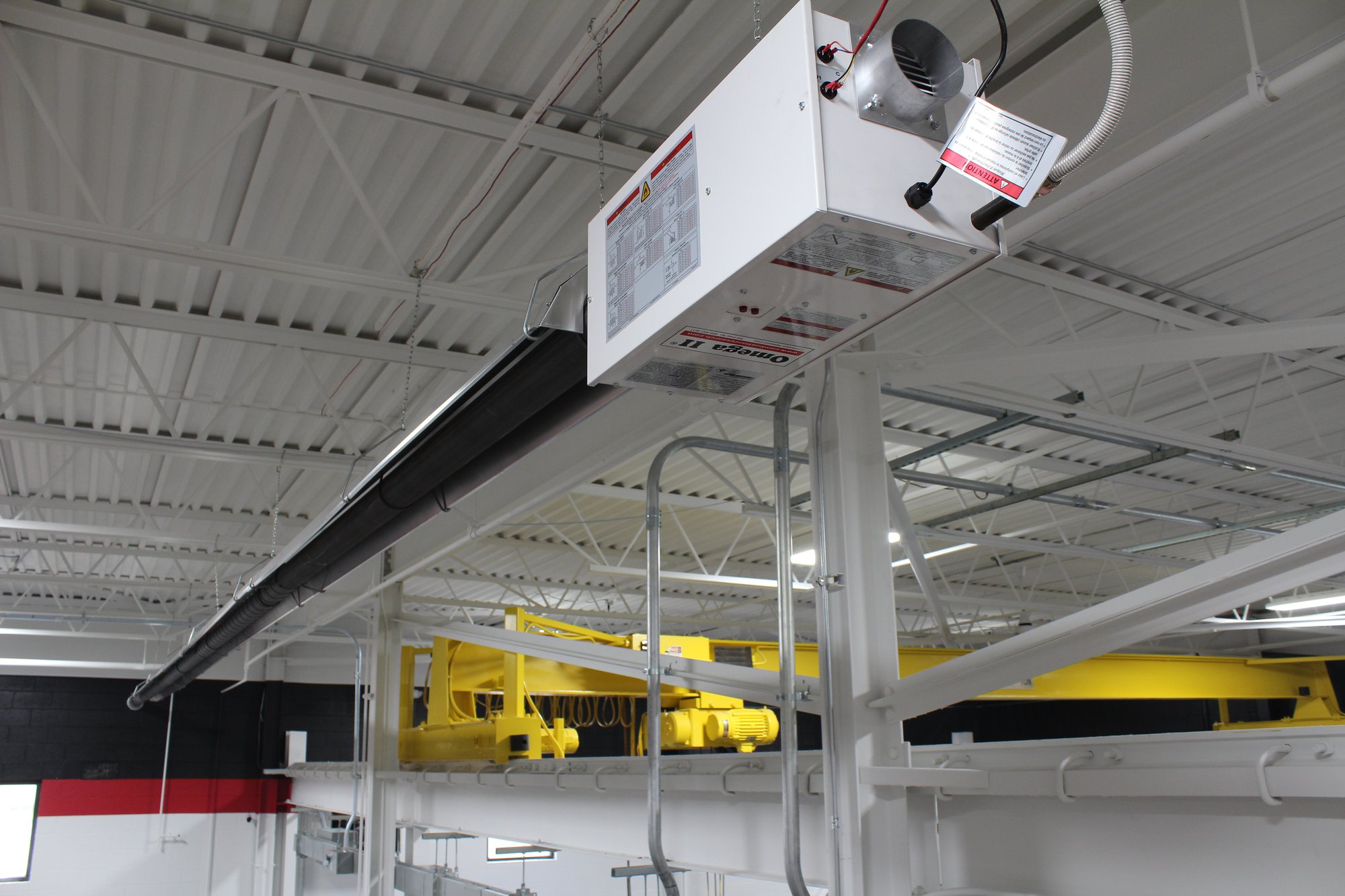
When an engineer or architect evaluates an infrared heater indoors for an industrial space, “safety” is bigger than clearances and guarding. It includes indoor air quality (IAQ), how the venting behaves during a fault, and whether the heater design adds routine failure points that turn into downtime and after-hours maintenance.
Combustion Research Corporation’s approach is built around de-risking the common industrial pain points: avoid filter-driven lockouts, use documented venting/pressure strategies where they fit, and engineer for long service life rather than short-cycle replacements.
Indoor Air Quality and the Infrared Heater: Indoor Advantage
Many industrial buildings are full of airborne particulates: dust, fibers, metal fines, process residue. Forced-air heating can move a lot of air to deliver heat, and that movement can also keep particulates suspended and circulating longer than they otherwise would. In spaces that include sensitive assembly, finishing, packaging, or areas where housekeeping is a daily battle, limiting unnecessary air movement can be a practical IAQ win.
Radiant infrared heat behaves differently. It transfers energy primarily by radiation, like light, so you can deliver comfort without needing high air velocity as the main heat delivery mechanism. Combustion Research Corporation’s infrared guidance describes this “heat-to-the-floor/objects” intent, which is why radiant is often selected for high-bay, draft-prone applications.

Filter-Free Engineering as an IAQ and Reliability Decision
Filters can make sense in many HVAC contexts, but an infrared heater located indoors, which depends on intake filters to operate, eventually becomes a service schedule, especially in dirty environments.
Combustion Research Corporation states directly that Reflect-O-Ray® and Omega II® systems are engineered so combustion air filters are not required, and it ties missed filter maintenance to reduced effectiveness and increased failure risk.
That matters for IAQ in a straightforward way: fewer consumables and fewer “must-do” monthly tasks at mounting height means fewer opportunities for neglected maintenance to become a shutdown or a performance issue during peak season.
Vacuum-Vented Safety and the Fail-Safe Question
One of the most important questions an engineer can ask is: What happens if the tube or vent path is compromised? The pressure regime of the system changes the failure mode.
With positive-pressure approaches, the system is pushing products of combustion through the path. If there is a breach, the risk profile centers on outward leakage into the space. With vacuum/negative-pressure designs, the system is pulling, which tends to draw air inward during a fault rather than pushing combustion products outward.
Combustion Research Corporation’s Reflect-O-Ray® gas-fired engineering documentation specifies that the burners operate under a negative (vacuum) pressure.
What This Means in an Indoor Industrial Spec
For many indoor industrial applications, negative pressure is a clean, spec-friendly way to communicate safety intent. It’s also a detail that’s easy to include in a basis-of-design narrative or an “approved alternate” comparison because it is written into product documentation.
Condensation, Corrosion, and “Dry Tube” Structural Reliability
“Clean heat” also means keeping the combustion system structurally sound over time. A common long-term risk for tube-type systems is condensation inside the tube when operating conditions drive flue gases to the dew point. Once condensate forms, corrosion risk rises, and corrosion eventually becomes a leak-risk discussion, especially in indoor workspaces.
Combustion Research Corporation frames this as an “optimum efficiency” approach: avoid design choices that create a condensing environment inside the tube, so the system stays dry and durable in real operating conditions.
Combustion Research Corporation also publishes durability signals engineers can use in specs and owner conversations:
- Omega II® 9K lists a 10-year warranty on radiant tubes for internally created corrosion.
- Certain Omega II® configurations list an aluminized titanium alloy combustion chamber and heavy-duty 12-gauge heat exchanger construction, which supports long-life intent at a high-stress location in the heater.

Why This Is a Safety Conversation, Not Just a Maintenance Conversation
A tube that stays dry and intact reduces the chance of nuisance faults turning into a combustion-products issue. It also reduces the “mid-winter replacement” scenario that forces rushed access work in active production areas.
Fuel Flexibility and Indoor Heating for Remote Sites
Not every facility has natural gas available, and not every site wants to depend on temporary solutions. Combustion Research Corporation’s Reflect-O-Ray® oil-fired line is designed for #2 fuel oil and is positioned for indoor infrared applications where fuel constraints exist.
For facilities managers, fuel flexibility can be part of a safety plan: fewer temporary workarounds, more stable operations planning, and a documented path for indoor heating even when utilities are limited.
Technical Specification Comparison for Indoor Industrial Use
The table below summarizes what engineers and facilities teams usually want to reduce: particulate disruption, exhaust leak risk during a fault, corrosion exposure, and high-frequency maintenance access.
| Safety & Cleanliness Feature | Standard Forced Air | Combustion Research Corporation Infrared (Omega II® / Reflect-O-Ray®) |
|---|---|---|
| Particulate stir-up | Higher air movement as heat delivery | Radiant heat delivery reduces dependence on air movement for comfort |
| Exhaust leak risk | Airside systems aren’t the issue; combustion appliances vary by design | Reflect-O-Ray® burners specified to operate under negative (vacuum) pressure |
| Tube corrosion exposure | Not applicable in the same way, but coils/ducts add upkeep | Combustion Research Corporation “no filters required” and dry-tube/optimum efficiency framing reduces common radiant failure triggers |
| Maintenance access | Filters and duct upkeep can add recurring tasks | Filters not required; Omega II® 9K includes 10-year tube warranty against internally created corrosion |
The Combustion Research Corporation Commitment: Safety That Reduces Operational Surprises
Combustion Research Corporation is a family-owned U.S. manufacturer (since 1952) focused on building heaters that stay out of the maintenance log as much as the application allows. The point of specifying Combustion Research Corporation for an infrared heater indoor project is to reduce common failure triggers, document safer venting behavior where appropriate, and keep performance stable over decades.
Bring Combustion Research Corporation In Early on an Indoor Infrared Design
If you’re selecting an infrared heater indoor for an industrial facility and want help with application fit, venting approach, and a spec-ready basis-of-design narrative, connect with Combustion Research Corporation here.