

July 10, 2026
Most shop owners size their heating systems by square footage. That approach, however, misses the most important variable: British Thermal Unit (BTU) input relative to tube length. That ratio, therefore, determines whether a tube heater for shop installations performs efficiently or wastes fuel. Carry too much BTU input relative to tube length, and the system exhausts heat it cannot absorb. Operating costs rise, components wear faster, and fuel waste compounds across every heating season.
Why the BTU-to-Tube-Length Ratio Drives System Performance
Low-intensity radiant tube heaters convert gas fuel into infrared energy. That energy heats the floor mass and occupants directly rather than warming the surrounding air. The conversion efficiency, however, depends on how much tube length the system has relative to its BTU input. When that ratio is wrong, exhaust temperatures climb above 450 degrees Fahrenheit. Pre-dilution exhaust at that level indicates poor system design and direct fuel waste. In a well-designed system, by contrast, exhaust does not require dilution air at all. This is why Combustion Research Corporation (CRC) engineers design every system around an optimum BTU-to-tube-length ratio to prevent that waste entirely.
The payoff is measurable. CRC infrared systems can deliver fuel savings of 30 to 50 percent compared to forced-air alternatives.
Matching the Right Tube Heater for Shop Configurations
Not every shop has the same ceiling height, floor area, or construction type. For that reason, the right tube heater for shop conditions requires matching the system to the specific structure.
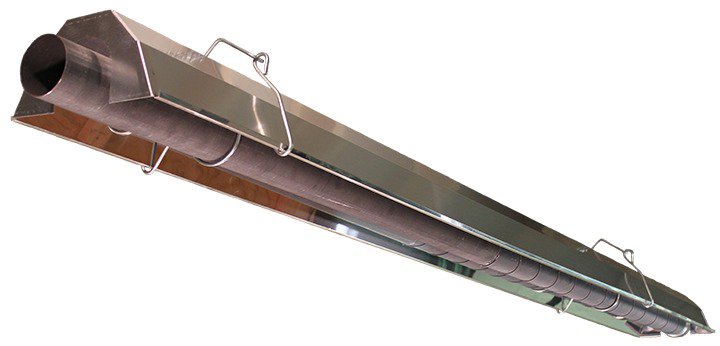
For lower-ceiling shops and automotive service bays, the Reflect-O-Ray Engineered Design System (EDS) 4.0 provides strong coverage. CRC optimizes its BTU-to-tube-length ratio for that ceiling height range. High-bay shops with ceilings above 20 feet, however, need more tube length to distribute heat effectively. For those spaces, CRC engineers the Reflect-O-Ray 6.0 EDS specifically for high-bay industrial applications.
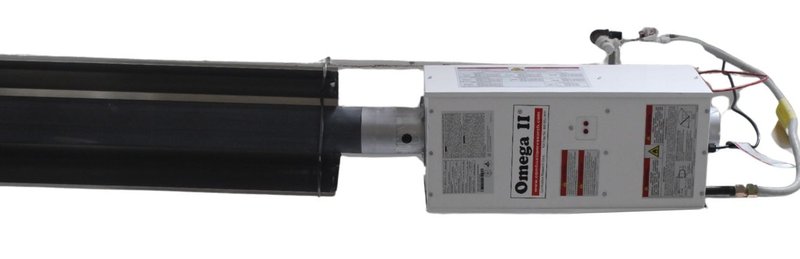
The Omega II Pre-Engineered Package (PEP) offers a power-vented alternative. It suits shops where vacuum exhaust routing is impractical due to structural constraints. Its dual-input configuration supports two-stage firing, which is useful when heat demand shifts between occupied and unoccupied periods.
Calculating Heat Load for a Shop Space
Specifying a tube heater for shop use requires a heat loss calculation tailored to the building. Heating, ventilation, and air conditioning (HVAC) engineers should not rely on square footage alone. Square footage does not capture what the system will actually face.
Ceiling height matters because heat demand scales with volume, not floor area. Construction material U-values determine how quickly heat escapes the building envelope. Door frequency and roll-up bays, moreover, create rapid heat loss events during normal operation. In cold climates, designing for worst-case outdoor temperatures is also standard practice. Each variable, therefore, feeds the calculation. A system sized without all of them will either underperform or waste fuel cycling to excess.
The floor's thermal mass is similarly relevant. Concrete slabs absorb infrared energy and re-radiate it steadily. A system running consistently maintains floor-level comfort more efficiently than one cycling on and off to chase stratified air. For shops with irregular hours, that characteristic has direct implications for staging and setpoint strategy.
Filter-Free Design and Shop-Environment Reliability
Woodworking shops, metal fabrication bays, and auto service facilities generate airborne particulates that stress mechanical systems over time. For that reason, combustion air management is a key factor in long-term reliability.
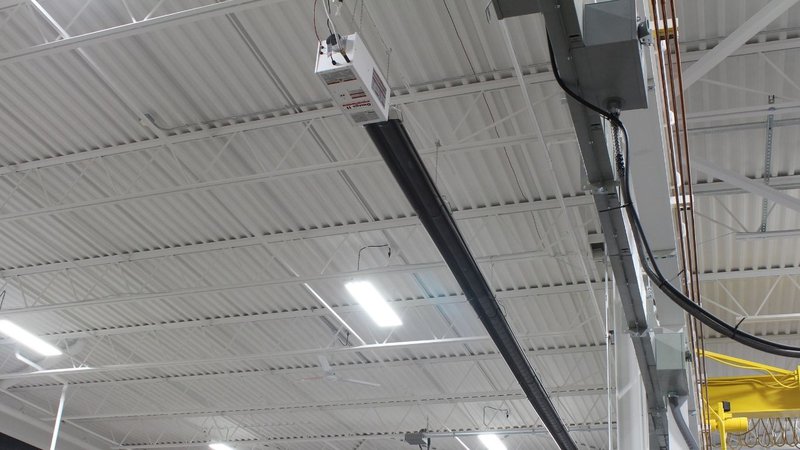
CRC designs its Reflect-O-Ray and Omega II systems without combustion air filters. By contrast, filter-dependent systems accumulate airborne debris and reduce effective airflow. They also trigger pressure switch trips that shut down heat when shops need it most. Filter-free design eliminates that maintenance burden, and that article covers the cost picture in full.
CRC also avoids the condensate failure mode. Some manufacturers push exhaust temperatures low enough to produce condensate in pursuit of maximum thermal efficiency. That condensate is acidic. It destroys radiant tubing from the inside out over time. CRC prioritizes optimum efficiency instead, which produces strong performance without the corrosion risk. The radiant tube longevity article explains the warranty structure in full. In short, every unit carries a ten-year radiant tube warranty, a three-year burner control warranty, and ships after individual testing rather than spot-checking.
Clearances, Compliance, and CNG Shop Requirements
Tube heater placement in a shop must meet minimum clearance distances from combustible materials, work surfaces, and walls. Those clearances satisfy code requirements and protect the workspace. Reflector angle also affects the heat distribution pattern on the floor below. System placement, therefore, should concentrate heat where occupants spend the most time.
Shops servicing compressed natural gas (CNG) or liquefied natural gas (LNG) vehicles face an additional compliance requirement. NFPA standard 30A section 7.6.6 limits tube and surface temperatures to 750 degrees Fahrenheit in specialty fuel vehicle repair buildings. CRC manufactures Reflect-O-Ray units certified to that standard. Moreover, CRC is one of the few manufacturers with products approved for CNG and LNG service facilities.
Avoiding the Over-Specification and Under-Specification Traps
Undersized systems run at full capacity without reaching setpoint. As a result, they consume fuel continuously and accumulate wear. Meanwhile, oversized systems short-cycle stress burner controls, and create inconsistent floor-level temperatures that defeat the advantage of radiant heat. Ultimately, both problems stem from the same root cause: skipping a proper heat loss calculation.
The correct sizing approach accounts for building construction, insulation values, and regional design temperatures. CRC provides engineering resources and representative support for shop sizing decisions. HVAC engineers can also reference CRC's MASTERSPEC listing to confirm system compatibility. For an independent reference on heat loss methodology, HVAC engineers can furthermore consult the Building Technologies Office at the United States Department of Energy.
Getting the BTU-to-tube-length ratio right is the first decision. Selecting a configuration matched to the ceiling height is the second. Choosing a system designed for the particulate environment it will operate in is the third. Together, those three choices determine whether the system holds performance for twenty years or becomes a recurring service problem. To explore sizing options for your specific shop, contact us for more information or to request a quote.