Introduction
Heating is one of the most expensive line items in commercial greenhouse operations. According to Virginia Tech Extension, fuel costs normally account for 7–10% of production costs — climbing to 20–25% during severe winters. Michigan State University Extension reports that 88% of all greenhouse energy use goes directly to heating.
Most operators rely on natural gas, propane, or fuel oil. Cost is part of the problem. Volatility is the other part. EIA data shows commercial natural gas prices swung from $7.35/Mcf in early 2021 to $14.55/Mcf by September 2022, nearly doubling in under two years. Propane followed a similar trajectory.
This guide covers five alternate heat sources commercial growers are adopting to cut fuel dependence, lower cost-per-BTU, and avoid getting squeezed when energy markets spike.
Key Takeaways
- Fuel costs represent 7–25% of greenhouse production costs — heating strategy is a margin decision, not just an equipment decision
- The five most viable alternate heat sources: wood/biomass, geothermal, waste heat recovery, biogas/methane, and infrared heating
- Selection depends on local fuel access, installation cost, labor requirements, and payback period
- Infrared heating delivers radiant energy directly to plants and surfaces without circulating air — saving up to 30% versus forced-air systems per Virginia Tech Extension
- Simple payback period (system cost ÷ annual savings) is the most reliable first filter when comparing heating options
Conventional Greenhouse Heating and Why Operators Are Looking for Alternatives
The Three Standard Fuels
Commercial greenhouses run on three primary fuels, each with distinct trade-offs:
| Fuel | Advantages | Disadvantages |
|---|---|---|
| Natural gas | Lowest cost-per-BTU when pipe-delivered | Limited availability in rural areas |
| Propane | Accessible anywhere; on-site storage | More expensive than gas; requires tanks |
| Fuel oil | High energy density | Above-ground tanks; maintenance-intensive |
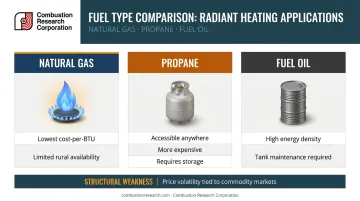
All three share the same structural weakness: price volatility tied to commodity markets and supply chains outside a grower's control.
The Commercial-Scale Problem
Large greenhouse structures — with their extensive glazing surface area and minimal thermal mass — lose heat fast. A prolonged cold snap doesn't just raise fuel bills for a few days; it compounds across the entire heating season. When energy costs can consume over 10% of sales revenue (a figure documented in University of Wisconsin Extension research), fuel price swings erode profit margins directly.
The business case for alternate heat sources is straightforward: reduce exposure to a single fuel's price swings. Most growers aren't scrapping their existing systems — they're looking to:
- Lower the blended cost-per-BTU by mixing in cheaper or on-site energy
- Maintain operations when supply tightens or pricing spikes
- Build in redundancy before the next cold season forces the issue
Top Alternate Heat Sources for Commercial Greenhouses
These five options have been deployed at commercial greenhouse scale. Each involves different trade-offs across BTU output, fuel availability, installation complexity, operational labor, and long-term savings potential.
Wood and Biomass Fuels
Wood and biomass — cordwood, chips, and pellets — are widely available in forested regions and offer a substantially lower cost-per-BTU than conventional fuels.
Energy content matters here. UConn Extension data shows dry wood chips at 10% moisture deliver 14.8 MMBtu/ton, while green chips at 50% moisture drop to just 8.0 MMBtu/ton. Moisture content at purchase has a direct impact on delivered energy value.
Wood pellets are the most practical commercial option — uniform sizing enables automated feeding and consistent heat output that cordwood and chips can't match.
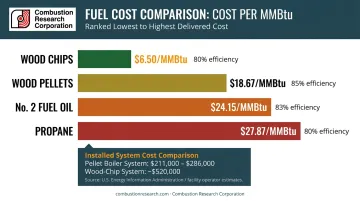
Representative fuel cost comparison (University of Wisconsin Extension historical data):
| Fuel | Cost per MMBtu |
|---|---|
| Wood chips ($50/ton, 80% efficiency) | $6.50 |
| Wood pellets ($230/ton, 80% efficiency) | $18.67 |
| Propane ($2.00/gal, 78% efficiency) | $27.87 |
| No. 2 fuel oil ($2.50/gal, 75% efficiency) | $24.15 |
These are representative historical values, not current pricing — but the spread between wood chips and delivered fossil fuels illustrates why biomass appeals to growers with local wood access.
The catch is capital cost. A Wisconsin Extension case study of a 33,000 sq ft greenhouse found installed pellet boiler systems ranging from $211,000–$286,000, with wood-chip systems reaching approximately $520,000 — roughly double the pellet option.
| Attribute | Detail |
|---|---|
| Fuel sources | Wood pellets, chips, cordwood, sawdust |
| Operational requirements | Regular loading, ash disposal, covered storage; pellet systems partially automated |
| Best suited for | Forested/rural regions with low-cost wood access; medium-to-large operations |
Geothermal Heat Systems
Soil at 10–12 feet below the surface stays stable year-round. UMass Extension reports approximately 50°F year-round in temperate climates, varying only about 6°F seasonally. Ground-source heat pumps (GSHPs) extract this low-grade warmth and upgrade it to usable heating temperatures. Earth tubes take a simpler approach, drawing ventilation air through buried pipes to pre-heat it before it enters the greenhouse.
Efficiency is the headline advantage. DOE documentation states geothermal heat pumps move 3–5 times the energy they consume, reaching effective efficiencies of 300–600% on cold winter nights. No combustion fuel can match that ratio.
The trade-off is upfront investment. Geothermal requires excavation, ground loop installation, or deep well drilling — all of which require professional engineering and site-specific cost estimates. There's no reliable universal benchmark for commercial greenhouse installed cost per square foot; every project needs its own engineering assessment.
GSHPs can also reverse direction for summer cooling, which gives large year-round operations a second application from the same infrastructure investment.
| Attribute | Detail |
|---|---|
| Energy source | Earth's subsurface heat via ground loops or deep wells |
| Installation complexity | High — excavation, ground loop or well drilling, professional engineering required |
| Best suited for | Large commercial greenhouses in stable-climate regions; operations with 10–20 year investment horizons |
Waste Heat Recovery
Waste heat is thermal energy generated as a byproduct of industrial processes — power plants, manufacturing facilities, CHP (combined heat and power) systems — that would otherwise vent unused. When a greenhouse sits near one of these sources, that heat can be delivered as hot water, steam, or low-grade thermal energy directly into an in-floor radiant system or through a heat exchanger.
Real examples exist at commercial scale. DOE Better Buildings documentation profiles Houweling's Tomatoes in California operating a 12.5–13 MW CHP system across 125 acres of glass greenhouse, and Intergrow Greenhouses in New York running a 2.4 MW CHP system supporting 40–70 acres of tomato production.
Fuel cost is essentially zero when access exists, making the economics hard to ignore. But siting constraints are significant:
- The greenhouse must be close enough to the heat source for cost-effective thermal delivery
- Supply reliability depends entirely on the host facility's operating schedule
- Heat exchanger installation and supply agreements add upfront complexity
Waste heat works best as a strategic siting decision for new construction, not a retrofit. Operators building new facilities should evaluate nearby industrial or municipal energy infrastructure before finalizing site selection.
| Attribute | Detail |
|---|---|
| Energy source | Byproduct heat from industrial facilities, power plants, or CHP systems |
| Installation complexity | Moderate to high — proximity required, heat exchanger installation, supply agreements |
| Best suited for | New greenhouse developments sited near industrial or municipal energy facilities |
Biogas and Methane
Methane captured from landfills or anaerobic digestion of animal manure can be burned directly in a compatible boiler or furnace. Landfill gas (LFG) contains roughly 50% methane — giving it approximately 500 BTU/cu.ft., about half the energy density of pure natural gas — but it can be combusted as-is in compatible equipment.
For farms with significant livestock, anaerobic digestion creates a closed-loop energy system: manure generates biogas, biogas heats the greenhouse. Penn State Extension reports a manure digester serving 100 cows produces a net 1,460,000 cu.ft. of biogas per year — a meaningful heat contribution for a mid-size greenhouse operation.
Viability depends heavily on geography and co-location:
- Landfill gas: EPA LMOP confirms LFG can be piped directly to greenhouse boilers, but distance and gas cleanup requirements are site-specific
- Manure-based biogas: Only practical for greenhouse operations integrated with or adjacent to livestock farms
Equipment requirements — gas collection and purification infrastructure, combustion-compatible equipment, and ongoing monitoring — make these decidedly non-turnkey installations.
| Attribute | Detail |
|---|---|
| Energy source | Captured landfill gas or anaerobic digestion of animal manure |
| Operational requirements | Gas collection infrastructure, compatible combustion equipment, ongoing monitoring; digesters require active management |
| Best suited for | Integrated farm operations with livestock, or greenhouses near municipal landfill gas programs |
Infrared Heating Systems
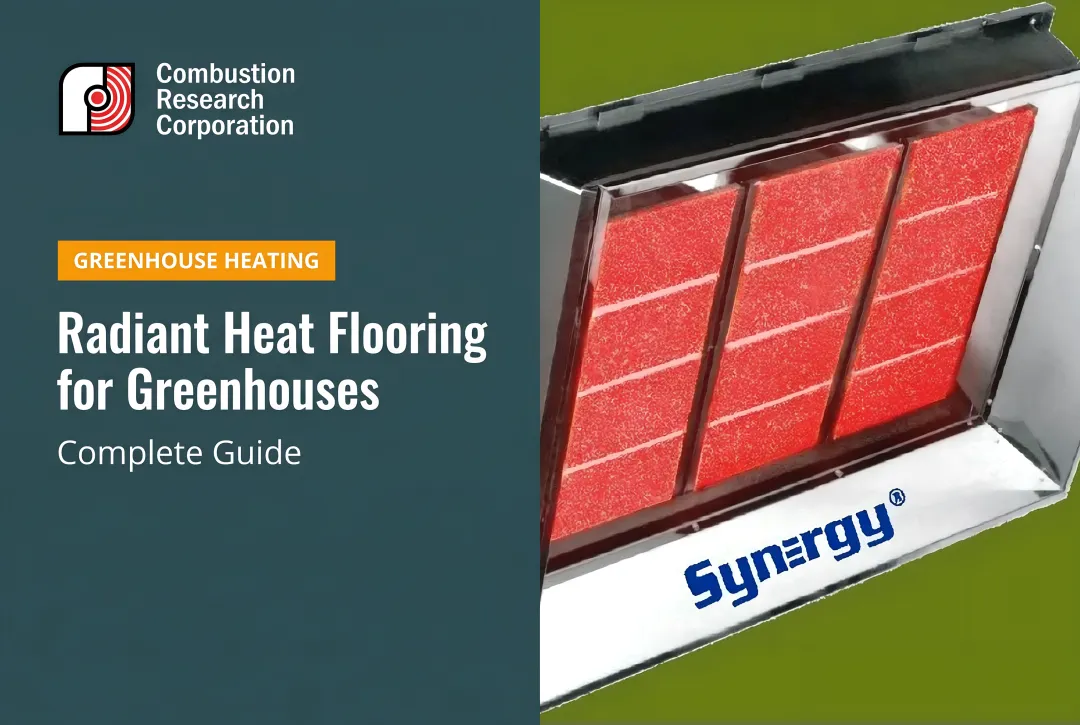
Infrared heating is different from the other four options: it's a heat delivery technology rather than a fuel source. Low-intensity infrared tube heaters run on natural gas or propane, but they convert that fuel into radiant energy that warms plants, soil, and surfaces directly, without heating large volumes of air first.
Why that distinction matters in a greenhouse:
- Forced-air systems heat air, which stratifies — warmth rises to the roof while plants at floor level stay cooler
- Infrared energy travels in a straight line to surfaces, similar to sunlight, delivering heat where crops actually need it
- Because infrared doesn't rely on air circulation to move heat, it avoids stirring dust, organic matter, and airborne particulates through the growing space
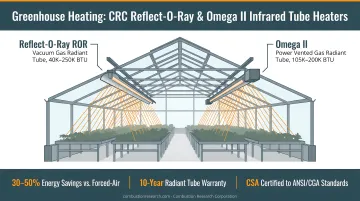
Virginia Tech Extension documents fuel savings of up to 30% for infrared radiant systems compared with forced-air unit heaters. CRC's product specifications for the Reflect-O-Ray and Omega II lines cite 30–50% savings over conventional heating.
Combustion Research Corporation's infrared systems for greenhouse applications:
- Ceiling-mounted Reflect-O-Ray (vacuum-vented) and Omega II (power-vented) models preserve all floor space for growing operations, with BTU inputs spanning 30,000 to 220,000 BTU/hr across both lines
- Stainless steel construction is the recommended configuration for greenhouse environments — CRC offers stainless steel burner housings built for corrosive, high-humidity conditions
- The Omega II 9K Series modulating two-stage models allow precise temperature band control, which matters when crop health depends on avoiding temperature swings
- Both product lines carry CSA International certification and a 10-year limited warranty on combustion and heat exchanger tubes, including coverage for internally created corrosion
- The vacuum-vented Reflect-O-Ray configuration allows multiple units to share a common exhaust manifold and a single roof penetration, reducing installation complexity in structures with extensive glazing
| Attribute | Detail |
|---|---|
| Energy source | Natural gas or propane (radiant delivery) |
| Key advantages | Directional heat without air circulation; floor space preserved; no dust/particulate stirring; 30–50% energy savings over conventional heating |
| Best suited for | Commercial greenhouses of all sizes; particularly effective in high-clearance structures or operations sensitive to air quality and plant health |
How to Choose the Right Alternate Heat Source for Your Greenhouse
Start With What's Physically Available
Local resource access eliminates most options before the economics matter:
- Wood/biomass: Requires nearby timber supply and covered on-site storage
- Geothermal: Requires appropriate soil/geology and land for loop fields
- Waste heat: Requires proximity to an industrial or CHP source
- Biogas: Requires a manure feedstock or a landfill gas partnership
- Infrared: Available anywhere natural gas or propane can be delivered
Map what's accessible before running any numbers.
Calculate Your Actual BTU Load
Every system selection should start from a calculated heat load, not a rule-of-thumb estimate. The standard formula used in greenhouse engineering:
BTU/hr = Surface Area × U-value × Temperature Difference (inside design – outside design)
Each variable in the formula:
- Surface area: All glazed surfaces combined
- U-value: The heat transfer coefficient of your glazing (single-layer polyfilm, double-layer, and glass each have different values)
- Temperature difference: Your local winter design temperature subtracted from your inside setpoint
University of Georgia Extension and Greenhouse Management both confirm this as the standard method. An infrared heating specialist or HVAC engineer can assist with sizing once you have these inputs.
Factor in Labor and Operational Complexity
Not all systems carry the same daily management burden:
- High labor: Cordwood boilers, biogas digesters
- Moderate labor: Wood chip boilers (loading and ash removal), pellet boilers (partially automated)
- Low labor: Geothermal heat pumps, infrared tube heaters, waste heat connections
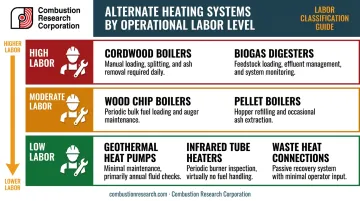
For operations where labor is already a significant budget line, the total cost of ownership of a high-maintenance system can erase the fuel cost advantage entirely.
Run the Simple Payback Calculation
Ohio State University Extension defines simple payback as:
Payback period (years) = System installation cost ÷ Annual fuel savings
To calculate annual fuel savings, compare your current cost per MMBtu against the alternate system's cost per MMBtu, then multiply by your annual BTU consumption. UConn Extension provides heat content and $/MMBtu formulas for all major fuel types — running those numbers tells you whether a system's payback period falls within a range worth pursuing, or whether the fuel savings alone won't justify the capital outlay.
Avoid the Most Common Sizing Mistake
Operators frequently size supplemental systems to handle partial load — then discover they still need full conventional capacity during the coldest nights. A better approach: size the alternate system to handle baseload heating (the majority of season hours), and retain conventional equipment only for peak-demand backup. This strategy maximizes annual savings instead of just trimming the edges.
Conclusion
Choosing an alternate heat source for a commercial greenhouse depends on available resources, greenhouse scale, labor capacity, and how long you're willing to wait for payback. Biomass makes sense in timber-rich regions with available labor. Geothermal suits large operations with a long investment horizon. Waste heat and biogas require the right geography and partnerships. Infrared heating is the most broadly accessible option, available wherever gas or propane is delivered without dedicated fuel storage infrastructure.
Before committing capital, run a full economic analysis across four areas:
- Installation cost and projected payback period
- Cost per BTU for both your current and alternate fuel source
- Annual maintenance requirements and associated labor
- Realistic labor estimates for ongoing system operation
The numbers that matter most aren't always visible in the upfront quote.
For commercial greenhouse operators evaluating high-efficiency heating, Combustion Research Corporation's low-intensity infrared tube heaters — the Reflect-O-Ray and Omega II product lines — offer CSA-certified, commercially proven systems backed by over 50 years of industrial heating experience. Contact CRC at 888-852-3611 or info@combustionresearch.com for engineering support and system specifications tailored to your greenhouse application.
Frequently Asked Questions
How do you heat a commercial greenhouse?
Commercial greenhouses are most commonly heated using gas-fired unit heaters, central boilers, or infrared tube heaters fueled by natural gas or propane. Many operations supplement these primary systems with alternate sources like biomass, geothermal, or waste heat to reduce costs and improve energy resilience across the heating season.
What are the alternative heating options for greenhouses?
The main alternatives are wood/biomass boilers, geothermal heat systems, waste heat recovery, biogas/methane, and infrared heating systems. These are used as primary or supplemental heat sources alongside conventional fuels, depending on local site conditions, resource availability, and capital budget.
What is the most cost-effective heating system for a commercial greenhouse?
Cost-effectiveness depends on local fuel prices and availability. Low-intensity infrared heating and biomass boilers (where wood is locally sourced) typically offer the lowest cost-per-BTU when fuel and operational costs are factored together across a full heating season.
Is infrared heating good for greenhouses?
Infrared heating is well-suited for greenhouses because it warms plants and surfaces directly without circulating air, which reduces energy loss from heat stratification and avoids disturbing dust and particulates in the growing environment. Virginia Tech Extension documents fuel savings of up to 30% versus forced-air unit heaters.
How do I calculate heating requirements for a commercial greenhouse?
Greenhouse heating load uses the formula: BTU/hour = surface area × U-value of glazing × temperature difference between inside and outside design temperatures. Combustion Research Corporation provides engineering support through the specification process, which can help with system sizing for both new construction and greenhouse retrofits.
Can geothermal energy heat a commercial greenhouse?
Yes. Ground-source heat pumps and earth tubes can provide reliable baseload heating, particularly in regions with stable subsurface temperatures. DOE reports geothermal heat pumps deliver 3–5 times the energy they consume, though high upfront installation costs mean they're best evaluated over a 10–20 year investment horizon.