The honest answer: running costs vary enormously. A 500W electric panel in a small office and a multi-burner gas tube system in a 100,000 sq. ft. warehouse operate on entirely different cost structures. Conflating the two leads to underbudgeting, wrong equipment selection, and systems that never deliver the efficiency they promised.
This guide breaks down actual running cost ranges for both electric and gas infrared heaters using current EIA energy rates, explains the factors that drive costs up or down, and walks through the full lifecycle cost picture — so you can build a realistic budget before buying anything.
Key Takeaways
- Electric infrared heaters cost $0.07–$0.41/hr to run; gas tube heaters cost $0.52–$2.62/hr but deliver far more heat output
- Natural gas runs $1.31 per 100,000 BTU delivered versus $3.96 for electricity — a 3x fuel cost gap that dominates economics in large facilities
- Correctly specified gas infrared tube systems cut heating fuel costs 20–50% compared to forced-air unit heaters
- Common cost mistakes: sizing by square footage alone, ignoring ceiling height, and under-specifying the system
- Replacing inefficient forced-air systems with properly specified gas infrared tube heaters typically pays back in 2–5 years
How Much Does It Cost to Run an Infrared Heater?
There is no single universal running cost. The range spans from a few dollars a day for a small electric panel to thousands of dollars per month for a large industrial gas system — and both are accurate for their respective contexts.
Two miscalculations account for most budgeting failures:
- Budgeting for purchase price only while ignoring fuel costs, which often exceed equipment cost within the first two heating seasons
- Sizing by square footage alone without factoring in ceiling height, insulation quality, door cycling frequency, or usage hours
The tables below put real numbers to both fuel types — starting with electric, then gas — so you can compare against your facility's actual operating profile.
Electric Infrared Heater Running Costs
Using the current U.S. commercial electricity rate of $0.1351/kWh (EIA, April 2026), electric infrared running costs at common wattage levels are:
| Wattage | Per Hour | 8-Hour Day | 22-Day Month |
|---|---|---|---|
| 500W | $0.07 | $0.54 | $11.89 |
| 1,000W | $0.14 | $1.08 | $23.78 |
| 1,500W | $0.20 | $1.62 | $35.67 |
| 3,000W | $0.41 | $3.24 | $71.33 |
These figures cover electricity only. They exclude installation, maintenance, and — critically — the cost of trying to heat a large, poorly insulated, or high-ceiling space with electric units, where electric infrared simply isn't the right tool.
Gas Infrared Tube Heater Running Costs
Using the current commercial natural gas rate of $1.192/therm ($12.36/Mcf, EIA April 2026), operating costs for gas-fired low-intensity tube heaters across common BTU outputs are:
| Delivered Load | Input Therms/Hr | Natural Gas $/Hr |
|---|---|---|
| 40,000 BTU/hr | 0.440 | $0.52 |
| 75,000 BTU/hr | 0.824 | $0.98 |
| 100,000 BTU/hr | 1.099 | $1.31 |
| 150,000 BTU/hr | 1.648 | $1.97 |
| 200,000 BTU/hr | 2.198 | $2.62 |
Three representative facility scenarios (assuming 1,056–1,584 operating hours per heating season):
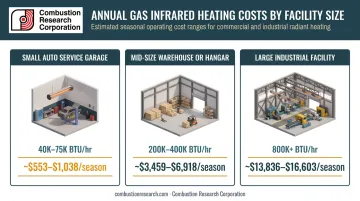
- Small auto service garage (40,000–75,000 BTU/hr): ~$553–$1,038/season with gas infrared — versus $791–$2,075 for a comparable forced-air setup
- Mid-size warehouse or aircraft hangar (200,000–400,000 BTU/hr, multiple units): ~$3,459–$6,918/season
- Large industrial facility (800,000+ BTU/hr, full system): ~$13,836–$16,603/season
Independent case studies from ACEEE's industrial heating research document an auto service operation saving over 7,800 therms and $8,300 annually after switching to infrared, and a maintenance hangar reducing consumption by 30% or more. Facility-specific results vary, but gas infrared consistently outperforms forced-air on operating cost in high-ceiling, door-cycling commercial environments.
Key Factors That Affect the Cost of Running an Infrared Heater
Running costs are shaped by equipment specs, operational habits, and facility conditions. Getting any one of these wrong shifts costs significantly.
Fuel Type and Energy Rates
This is the single largest variable in any cost comparison.
At current national averages:
- Electricity: $0.1351/kWh → $3.96 per 100,000 BTU delivered
- Natural gas: $1.192/therm → $1.31 per 100,000 BTU delivered
Gas costs roughly one-third of electricity per unit of heat delivered. That differential compounds quickly in large commercial and industrial facilities running 8–12 hours per day across a full heating season. It's the primary reason warehouses, hangars, and manufacturing facilities overwhelmingly favor gas-fired systems — the operating economics don't don't favor electric at scale.
Electric infrared makes sense for smaller, enclosed spaces with limited heating hours and no gas infrastructure. Where natural gas or propane is available and heating loads are substantial, gas wins on operating cost every time.
Heater Output and Facility Match
An undersized heater runs at full load continuously. That's the most expensive operating mode — and it eliminates the efficiency advantage of infrared heating entirely.
Correctly sized systems cycle and modulate. Dual-modulating heaters — like the Omega II DI PEP from Combustion Research Corporation — fire at a reduced input stage (as much as 33% below full fire) when less heat is needed, cutting fuel consumption without sacrificing comfort. The practical effect: you're not paying full fuel cost every hour the heater runs.
Oversized systems create their own problems: higher upfront cost, frequent short-cycling, and uneven heat distribution. The right answer is a load calculation, not a rough estimate.
Space Conditions: Insulation, Ceiling Height, and Building Type
That load calculation depends heavily on what the facility actually is. Gas infrared tube heaters heat objects and surfaces directly — floors, equipment, people — rather than the air column, making them more resilient than forced-air systems to drafts and high ceilings. But facility conditions still drive BTU requirements significantly:
| Facility Type | BTU/sq ft Guideline |
|---|---|
| Insulated low-bay warehouse (~16 ft ceilings) | 25–40 BTU/sq ft |
| Uninsulated high-bay warehouse (20–30 ft ceilings) | 40–65 BTU/sq ft |
| Poorly insulated or high door-cycling facilities | 65+ BTU/sq ft |
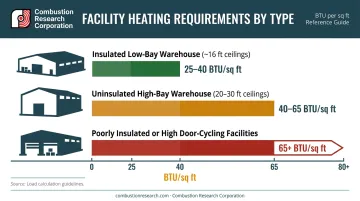
An aircraft hangar with oversized doors cycling frequently needs nearly triple the BTU density of a well-insulated distribution center of similar square footage. Miss that calculation and no amount of controls or efficiency features will offset the gap — the system runs flat out to compensate.
Usage Hours and Thermostat Control
Two control strategies have an outsized effect on seasonal fuel costs:
- Zonal control: Running heaters only in occupied zones — rather than heating the entire facility uniformly — cuts consumption sharply in facilities with variable occupancy patterns
- Programmable thermostats: Preventing heat delivery during off-hours, weekends, and shift gaps eliminates waste that compounds across an entire heating season
In a facility running two shifts with four unoccupied hours between them, setback control alone can recover thousands of dollars in annual fuel costs.
Full Cost Breakdown of an Infrared Heater System
Fuel bills are the biggest recurring cost — but they're not the whole picture. Here's the complete lifecycle cost structure.
Initial Purchase Cost
Electric infrared heaters (portable and commercial panel units):
- Portable 1,500W units: widely available in the $100–$400 range
- Commercial panel systems: $500–$2,000+ depending on wattage and mounting configuration
Gas-fired low-intensity tube heaters (commercial and industrial):
- 40,000–75,000 BTU/hr units: approximately $1,350–$1,994
- 100,000–150,000 BTU/hr units: approximately $2,021–$3,625
- 175,000–250,000 BTU/hr units: approximately $2,623–$4,955
These are distributor-observed prices for single units. Industrial-grade systems from manufacturers like Combustion Research Corporation are priced per facility based on BTU sizing, ceiling height, fuel type, and construction finish — contact a representative for system-level pricing.
Installation and Setup Cost
- Portable electric units: Near-zero installation cost. Plug in and run.
- Ceiling-mounted commercial electric: Minimal — standard electrical branch wiring and mounting hardware.
- Gas tube heater systems: Professional installation required, including:
- Gas main sizing, pressure regulation, and appliance connections
- Structural suspension and mounting at height
- Venting configuration (power-vented or vacuum)
- Electrical controls, thermostats, and multi-zone wiring
- Code compliance, permitting, and commissioning
Installation complexity varies between a power-vented unitary system (Omega II) and a custom-engineered vacuum system (Reflect-O-Ray). The Reflect-O-Ray's vacuum design lets multiple units share a common exhaust manifold and a single roof penetration — which can cut installation cost considerably in large facilities. No standardized line-item pricing exists for gas tube heater installation; get local contractor quotes rather than relying on published estimates.
Operating Costs
Annual fuel costs for representative scenarios at current energy rates:
- Small garage (40K–75K BTU/hr, 1,056 season hours): ~$553–$1,038/year
- Mid-size warehouse/hangar (200K–400K BTU/hr): ~$3,459–$6,918/year
- Large industrial (800K+ BTU/hr): ~$13,836–$16,603/year
Those figures shift substantially when switching from forced-air. Facilities that replace unit heaters with properly specified gas infrared tube systems have documented fuel savings of 20% to 50%, depending on facility type, ceiling height, and prior system efficiency. The ACEEE research on industrial heating applications and a 2013 Plant Engineering report both support savings in this range — with the higher end achievable in high-bay, door-cycling facilities where forced-air loses the most energy.
Maintenance Costs
Maintenance cost differences between gas infrared tube heaters and forced-air systems are concrete — and they compound over time.
Forced-air unit heaters require:
- Periodic combustion air filter inspection and replacement
- Fan and blower belt maintenance
- Condensate management
- Frequent nuisance shutdown risk from clogged filters in dusty environments
CRC gas tube heaters (Omega II, Reflect-O-Ray):
- No combustion air filters required — eliminates an entire maintenance category
- Dry-tube design avoids condensation-related internal corrosion under normal operating conditions
- Backed by a 10-year radiant tube warranty (internally created corrosion) and a 3-year burner control warranty
In high-particulate environments — metal fabrication, woodworking, agriculture, packaging — forced-air filter maintenance can mean quarterly service calls at mounting height. CRC's filter-free design removes that cycle entirely, with the 10-year tube warranty backing the durability claim.
Gas Infrared Tube Heaters vs. Electric: Which Costs Less to Run?
Gas and electric infrared heaters share a name, but their operating costs diverge sharply — especially at commercial scale.
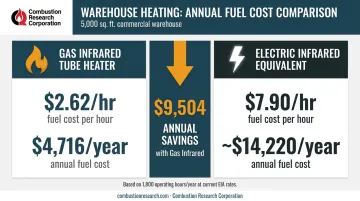
Illustrative comparison — 5,000 sq. ft. warehouse, 10 hours/day, 6 months/year (1,800 hours):
Assume 200,000 BTU/hr of delivered heat required.
| System Type | Fuel Cost/Hour | Annual Fuel Cost |
|---|---|---|
| Gas infrared tube heater | $2.62/hr | ~$4,716/year |
| Electric infrared equivalent | ~$7.90/hr* | ~$14,220/year |
*200,000 BTU/hr ÷ 3,412 BTU/kWh × $0.1351/kWh
The gap is roughly $9,500 per year for a single mid-size space. Across a 10–15 year equipment life, that's a six-figure difference in cumulative fuel spend.
When electric infrared makes sense:
- Small, enclosed spaces with limited heating hours
- No gas infrastructure available (CRC's Solaira Alpha serves this niche)
- Outdoor or semi-outdoor commercial settings (covered patios, dealership canopies, loading docks) where gas venting is impractical
When gas infrared tube heaters are the clear choice:
- Warehouses, hangars, service garages, manufacturing plants
- Facilities with extended or continuous heating seasons
- Any application where long-term operating cost matters more than lowest upfront price
For the facilities Combustion Research Corporation primarily serves — aircraft hangars, distribution centers, auto dealership service bays, manufacturing floors — that $9,500 annual gap per heating zone is the number that drives gas infrared tube heater adoption.
How to Estimate the Right Budget for Your Facility
Building the right budget starts with inputs, not with hunting for the cheapest unit price.
Key inputs for an accurate heating load estimate:
- Facility square footage and ceiling height
- Target indoor temperature and local outdoor design temperature
- Building insulation quality and envelope leakage
- Door type, size, and daily cycling frequency
- Planned operating hours per day and heating season length
- Natural gas vs. propane availability
- Number of heating zones required
For simple facilities, CRC's online BTU calculators can generate a preliminary sizing estimate. For warehouses, hangars, or any facility with high ceilings, frequent door cycling, or complex zone requirements, working directly with a manufacturer's engineering team during specification produces more accurate results. This prevents costly over- or under-specification that an online calculator won't catch.
Combustion Research Corporation provides engineering support through specification, including heat loss calculations and custom system design for both new construction and retrofit projects.
Budget framing that changes the conversation:
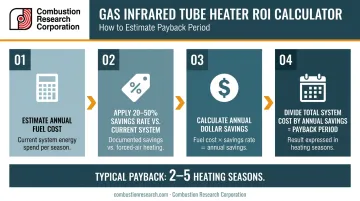
Calculate total cost of ownership — not just purchase price:
- Estimate annual fuel cost for your facility using the BTU tables above
- Apply the 20–50% savings range versus your current system
- Calculate annual savings in dollars
- Divide total system cost (equipment + installation) by annual savings
Gas infrared tube systems achieving 30–50% fuel savings typically recover full installation costs within 2–5 heating seasons. At that rate, the system pays for itself before most capital equipment loans mature.
What Most Buyers Get Wrong About Infrared Heater Costs
Three patterns account for most of the budget miscalculations we see:
Sticker price vs. system cost. Total deployment cost — equipment, installation, and ongoing fuel — is what matters. A heater that needs additional gas line runs, complex venting, or an early retrofit because it was undersized will cost far more than its purchase price suggests.
Treating all infrared heaters as interchangeable. A 1,500W consumer panel and a 200,000 BTU/hr commercial gas tube system are both technically "infrared heaters." Selecting on unit cost alone — without weighing build quality, warranty coverage, and service life — is how facilities end up replacing systems in year three instead of year fifteen.
Skipping professional sizing. Sizing by square footage alone, without accounting for ceiling height, building envelope, door cycling, and occupancy patterns, routinely produces undersized systems that run at full load continuously — eliminating the efficiency advantage and locking in elevated fuel costs long-term.
Frequently Asked Questions
Are infrared heaters cheaper to run than electric heaters?
Gas-fired infrared tube heaters are substantially cheaper to run than electric infrared in commercial settings — natural gas costs roughly one-third of electricity per BTU delivered. At any meaningful operating scale, gas wins on fuel cost.
Do infrared heaters use a lot of electricity?
Commercial electric infrared heaters consume electricity in direct proportion to their rated wattage. Gas-fired infrared tube heaters — the standard for warehouses, hangars, and manufacturing facilities — run on natural gas or propane, so grid consumption is minimal for that class of heater.
How much does it cost to run a gas infrared tube heater per hour?
At current commercial natural gas rates ($1.192/therm), hourly fuel cost ranges from roughly $0.52/hr for a 40,000 BTU/hr unit to $2.62/hr for a 200,000 BTU/hr unit. Actual cost varies with local gas rates, the heater's BTU output, and whether the unit is running at full or modulated output.
How do infrared tube heaters compare to forced-air heating in annual operating costs?
Independent research supports fuel cost reductions of 20–50% versus forced-air unit heaters of equivalent output, depending on facility type and ceiling height. Radiant heat warms occupants and surfaces directly without losing energy to air stratification, drafts, or door cycling — the conditions where forced-air systems bleed the most energy.
What is the payback period for switching to infrared tube heaters?
Payback depends on facility size, existing system efficiency, local energy rates, and usage hours. A DOE commercial HVAC analysis estimated a 3.1-year market-level payback for gas-fired infrared. ACEEE case studies documented payback under 5 years for a $40,000 auto service installation. Calculate based on your facility's actual numbers.
How many infrared tube heaters do I need for my facility?
Unit count follows from a BTU load calculation that accounts for square footage, ceiling height, insulation, local design temperature, and door cycling frequency — not from square footage alone. Working with a manufacturer's engineering team or a qualified HVAC designer is the most reliable way to land on the right quantity and placement.