U.S. industrial electricity averaged $0.0813/kWh in 2024, and the EIA projects nominal prices to continue rising through 2026. For facilities running multiple heaters across large floor areas, the heater you choose directly affects your operating budget — not just your comfort.
This guide covers the most efficient electric heater types for industrial use, the leading products worth evaluating, and the selection mistakes that turn a reasonable capital investment into a recurring operational drain.
Key Takeaways
- All electric heaters convert close to 100% of electricity to heat ; true efficiency depends on how and where that heat reaches its target, not wattage alone
- Infrared radiant heaters work best in high-bay spaces with open doors: they heat people and objects directly, not the surrounding air
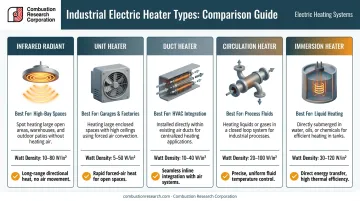
- Unit heaters, duct heaters, and process heaters each fit different applications — the single biggest efficiency decision is choosing the right type for your space
- Key selection factors: watt density, voltage compatibility, enclosure rating, control integration, and duty cycle
- For very large facilities, gas-fired low-intensity infrared tube heaters often offer better economics than electric systems at scale
Why Electric Heating Matters in Industrial Settings
An industrial electric heater isn't just a bigger version of a space heater. The distinction is application-based: multi-kW capacity, 3-phase voltage options (208/480/600V), continuous-duty construction, certified enclosures, and controls compatible with building or process automation.
According to the U.S. Department of Energy, process heating accounts for about 36% of total energy used in industrial manufacturing — reaching as high as 80% in industries like glass manufacturing. The EIA also identifies electricity as one of the most expensive energy sources in manufacturing — which means heater selection carries real financial weight.
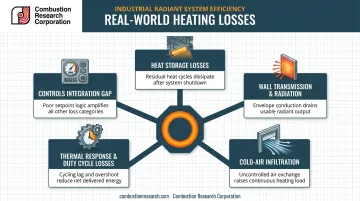
Efficiency goes beyond simple watt-to-heat conversion. The DOE identifies several factors that determine real-world heating system performance:
- Heat storage losses in building structures
- Wall transmission and radiation losses
- Cold-air infiltration in facilities with frequent door openings
- Thermal response time and duty cycle losses
- Integration with process or building controls
A heater rated at 100% thermal efficiency can still underperform — wrong heater type, poor zoning, or no integration with building controls will erode those gains quickly. Choosing the right system starts with understanding which electric heater types actually suit industrial conditions.
The Most Efficient Electric Heaters for Industrial Applications
The following heaters were evaluated on energy conversion efficiency, industrial-grade construction, safety certifications, control capabilities, and application fit. Each entry targets a distinct industrial use case — from high-bay warehouse radiant heating to precision process fluid control — so the right choice depends on what your facility actually demands.
Schwank Electric Infrared Radiant Heaters
Schwank manufactures the eSchwank Titan Series, a shortwave electric infrared heater built for industrial and commercial high-bay spaces including warehouses, distribution centers, and manufacturing facilities.
The core efficiency argument for infrared is straightforward: instead of heating the full air volume of a 40-foot-high space, the heater warms surfaces and occupants directly. In facilities with high ceilings or frequent door openings, forced air rises and escapes quickly — infrared doesn't. Schwank claims up to 65% energy savings versus traditional warm-air or forced-air systems based on this mechanism.
| Feature | Details |
|---|---|
| Heating Technology | Shortwave infrared |
| Capacity | 6 kW and 12 kW models |
| Voltage | 208V / 480V / 600V, 3-phase |
| Mounting Height | 10–17 ft (6 kW), 12–20 ft (12 kW) |
| Enclosure | Marine-grade aluminum, IP65 rated |
| Certification | cETLus |
| Emissions | Zero CO₂ and NOₓ at point of use |
| Best-Fit Applications | Warehouses, distribution centers, manufacturing floors, loading docks |
QMark Industrial Unit Heaters (Marley Engineered Products)
QMark, a brand under Marley Engineered Products, offers the IUH Industrial Unit Heater and MUH Unit Heater series — forced-air ceiling-mounted units designed for factories, garages, maintenance rooms, and shipping docks.
Key differentiators include automatic fan delay (prevents cold air blasts at startup), a 22-gauge welded steel cabinet with phosphate corrosion treatment and polyester powder coat, non-glowing nickel-chromium resistance wire in a metal sheath, and high-limit thermal cutout for safety. The IUH handles industrial voltages up to 600V, making it compatible with most factory electrical infrastructure.
| Feature | Details |
|---|---|
| Wattage Range | IUH: 5–30 kW; MUH: 2.2–50 kW |
| Voltage Options | 208 / 240 / 480 / 600V, single or 3-phase |
| Airflow | IUH: 270–1,800 CFM; MUH: 350–3,000 CFM |
| Cabinet | 22-gauge welded steel, polyester powder coat |
| Certification | UL and cUL listed (IUH), wall or ceiling mounting |
| Safety | Thermal cutout high-limit, auto fan delay |
| Best-Fit Applications | Factories, garages, maintenance rooms, warehouses, service stations |
Chromalox Industrial Duct and Process Heaters
Chromalox is a process heating specialist. Their portfolio covers duct heaters, screw-plug immersion heaters, circulation heaters, and hazardous-location units — serving petrochemical, food processing, and manufacturing environments where process fluid temperatures and contamination control matter more than space heating.
Their ADH/ADHT flanged duct heaters reach up to 1,200°F. Screw-plug immersion heaters are selected based on watt density matched to the fluid being heated. SCR power controllers handle loads up to 250 amps, and remote sensor panels can monitor up to 252 heat-trace temperature inputs — this level of integration makes Chromalox a fit for facilities running centralized process control across multiple heating zones.
| Feature | Details |
|---|---|
| Heater Types | Duct, immersion, circulation, process, hazardous-location |
| Watt Density Range | 6 W/in² (high-viscosity oil) to 45 W/in² (clean water) |
| Sheath Materials | INCOLOY 800, 304 stainless steel, copper, titanium, MONEL |
| Max Temperature | Up to 1,200°F (ADHT duct heater) |
| Controls | SCR power controllers up to 250A at 480/600/690V |
| Hazardous Location | CXH series, UL/cCSAus and CSA certifications |
| Best-Fit Applications | Chemical processing, food production, oil and gas, process fluid heating, HVAC duct systems |
Watlow Industrial Process Heaters
Watlow is a U.S.-based manufacturer of circulation heaters, heat exchangers, and inline fluid heaters for applications where temperature deviation carries real production risk — semiconductor fabrication, pharmaceutical processing, and food and beverage production. Their OPTIMAX Heat Exchanger and FLUENT In-line Heater series are the primary industrial product lines.
Watlow's circulation heaters reach up to 3 MW, watt densities up to 120 W/in², and temperatures up to 1,600°F. Their thermal-loop approach combines heaters, sensors, and controllers into an integrated system, enabling faster heating and cooling cycles with optimized soak times. Efficiency gains come from eliminating temperature overshoot and cutting cycle time losses — not from a single published savings figure.
| Feature | Details |
|---|---|
| Product Lines | OPTIMAX, FLUENT, circulation heaters, flange immersion heaters |
| Max Wattage | Up to 3 MW (circulation heaters) |
| Max Temperature | Up to 1,600°F |
| Sheath Material | Passivated 316 stainless steel (verified) |
| Controls | Integrated thermal controllers, ramp/soak profiles, power controllers |
| Efficiency Approach | Precise temperature control, optimized soak times, lower total cost of ownership |
| Best-Fit Applications | Semiconductor fabs, pharmaceutical processing, food and beverage, precision manufacturing |
King Electric Industrial and Commercial Heaters
King Electric manufactures commercial and industrial-grade unit heaters — including the KBS stainless steel unit heater, KBP garage/shop heater, and PCKW industrial portable wheeled unit — covering wattage from 950 W up to 6,000 W with single and three-phase configurations across the line.
480V options are available, and all models are UL/cUL listed. The KBS stainless steel model is built specifically for corrosive or high-humidity environments — car washes, agricultural buildings, and similar facilities where standard steel cabinets would degrade.
| Feature | Details |
|---|---|
| Product Lines | KBS (stainless), KBP (garage/shop), PCKW (portable industrial) |
| Output Range | 950–6,000 W (unit heater category) |
| Voltage | 208/240/480V; single and 3-phase by model |
| Certifications | UL/cUL listed by model |
| Construction | Stainless steel (KBS), standard steel (KBP) |
| Best-Fit Applications | Service garages, workshops, car washes, smaller warehouses, greenhouses |
How We Chose These Electric Heaters
These five were shortlisted on energy conversion efficiency, industrial-grade construction, safety certifications, proven performance across industrial environments, and breadth of application fit.
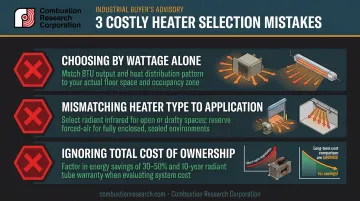
The most common selection mistakes:
- Choosing by watt rating alone — a 30 kW unit heater in a drafty open warehouse will underperform a 12 kW infrared unit delivering heat directly to the occupied zone
- Mismatching heater type to application — forced-air in a facility with constant door openings, or a space heater-style unit where precise fluid temperature control is required
- Ignoring total cost of ownership — a low purchase price means little if the unit runs 16 hours a day without programmable controls or short-cycles repeatedly, which degrades service life at cycle intervals under 30–60 seconds
The right choice depends on:
- Ceiling height and air infiltration rate
- Duty cycle and daily run hours
- Whether you're heating a space or a process fluid
- Controls integration requirements
Rated specifications matter — but only when matched to the actual application.
Conclusion
Efficient industrial electric heating has no universal answer. A shortwave infrared unit ideal for a warehouse loading dock is the wrong tool for a chemical circulation loop. A precision process heater suited to a semiconductor fab is overkill in a service garage.
Evaluate total cost of ownership — energy consumption, maintenance requirements, installation, and control complexity — rather than upfront price. A heater that integrates with programmable thermostats or a building management system will outperform a higher-rated but uncontrolled unit over a multi-year operation cycle.
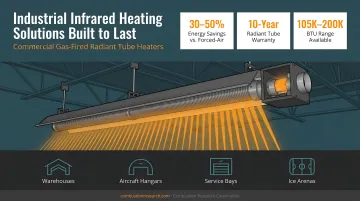
That TCO calculus shifts significantly at scale. For large facilities — warehouses, aircraft hangars, shipping docks, or agricultural buildings — where electric operating costs compound across thousands of square feet, gas-fired low-intensity infrared tube heaters often deliver better economics. Combustion Research Corporation has manufactured industrial infrared heating systems for over 50 years, with configurations engineered to cut heating costs by 30–50% compared to conventional heating. Contact CRC's engineering team at 888-852-3611 or info@combustionresearch.com to discuss the right system for your facility.
Frequently Asked Questions
What type of energy-efficient industrial heater is most cost-effective?
It depends on scale and application. Infrared radiant heaters — electric or gas-fired — typically deliver the best ROI in large, open industrial spaces by heating objects directly rather than wasting energy on air volume. For liquid or fluid heating, immersion or circulation heaters are the most efficient option.
How many BTUs are needed to heat a 40×60 shop?
A 40×60 shop with 10-foot ceilings (24,000 ft³) typically requires 45,000–80,000 BTU/hr, assuming a 60°F temperature rise and average insulation. The final number shifts depending on ceiling height, air infiltration, and how well the building is sealed.
How much does it cost to run a 1,500W industrial heater for 24 hours?
At the current EIA industrial average of $0.0858/kWh: 1.5 kW × 24 hours × $0.0858 = ~$3.09/day. Running 10 units continuously adds up to roughly $900–$1,100/month.
What is the most energy-efficient electric heater for a large warehouse?
High-bay infrared radiant heaters are generally the most efficient choice for large warehouses. They deliver heat directly to floor level and occupants without losing energy to hot air that stratifies at the ceiling. Combustion Research Corporation's gas-fired tube heaters and electric Solaira systems are both built specifically for high-bay industrial environments where ceiling height amplifies this efficiency advantage.
Are electric infrared heaters suitable for industrial environments?
Yes, for many applications. They produce no emissions at the point of use, have fewer moving parts than forced-air units, and can be ceiling-mounted to free up floor space. For very large facilities, gas-fired infrared systems often offer better economics due to lower fuel costs at scale.
How long do industrial electric heaters typically last?
Quality industrial electric heaters generally last 10–20 years depending on heater type, duty cycle, and environment. Infrared and immersion heater elements tend to outlast forced-air units with blower motors. Heaters operating in corrosive or high-humidity environments benefit significantly from stainless steel or coated enclosures.