The stakes are higher in industrial settings than in offices or retail spaces. Open doors, high ceilings, dust-sensitive environments, and limited floor space all change the equation significantly. This article breaks down exactly how radiant and forced air heating compare across those conditions — so you can make the right call for your facility.
Key Takeaways
- Radiant heat warms objects and people directly via infrared energy — it doesn't depend on heating the air first
- Forced air loses its advantage fast when bay doors open frequently or ceilings exceed 10–12 feet
- Radiant tube heaters use roughly 30–50% less energy than unit heaters in high-bay applications, based on documented commercial deployments
- Ceiling-mounted radiant systems preserve floor space and reduce dust circulation concerns
- The right choice depends on ceiling height, door-open frequency, air quality needs, and long-term cost priorities
Radiant Heat vs. Forced Air: Quick Comparison
Here's how the two systems stack up across the factors that matter most in commercial and industrial facilities.
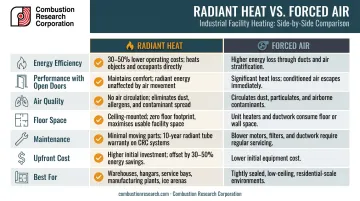
| Factor | Radiant Heat | Forced Air |
|---|---|---|
| Energy efficiency | Heats objects directly; lower stratification losses | Warm air rises; duct leakage adds 9–26% energy loss in large systems |
| Performance with open doors | Warmth retained in surfaces after doors open | Heated air escapes immediately on each door cycle |
| Air quality | No bulk air movement; dust and particulates stay settled | Continuously circulates air, stirring dust and fumes |
| Floor space | Ceiling-mounted; zero floor footprint | Ductwork and unit placement consume floor/wall space |
| Maintenance | No filters; fewer moving parts; minimal scheduled service | Quarterly filter checks, fan/belt service, duct cleaning required |
| Upfront cost | Varies by system size; offset by long-term savings | Lower unit cost; ductwork retrofit can be expensive in large facilities |
| Best for | High bays, open doors, dust-sensitive environments | Small, sealed, climate-controlled offices with existing ductwork |
What Is Radiant Heat?
Radiant heating transfers thermal energy via infrared electromagnetic waves directly to objects, surfaces, and people — similar to feeling warmth from sunlight on your skin even on a cold day. The air itself is not the primary target. ASHRAE confirms that thermal radiation travels in straight lines and exchanges energy primarily between a source and surfaces, not the surrounding air volume.
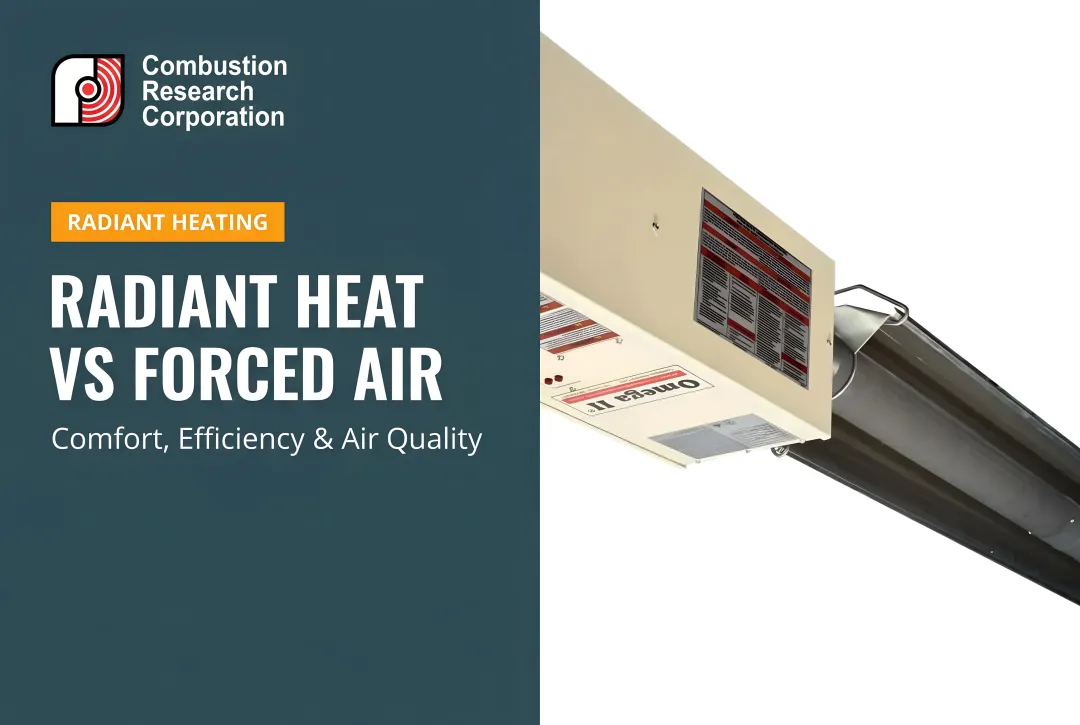
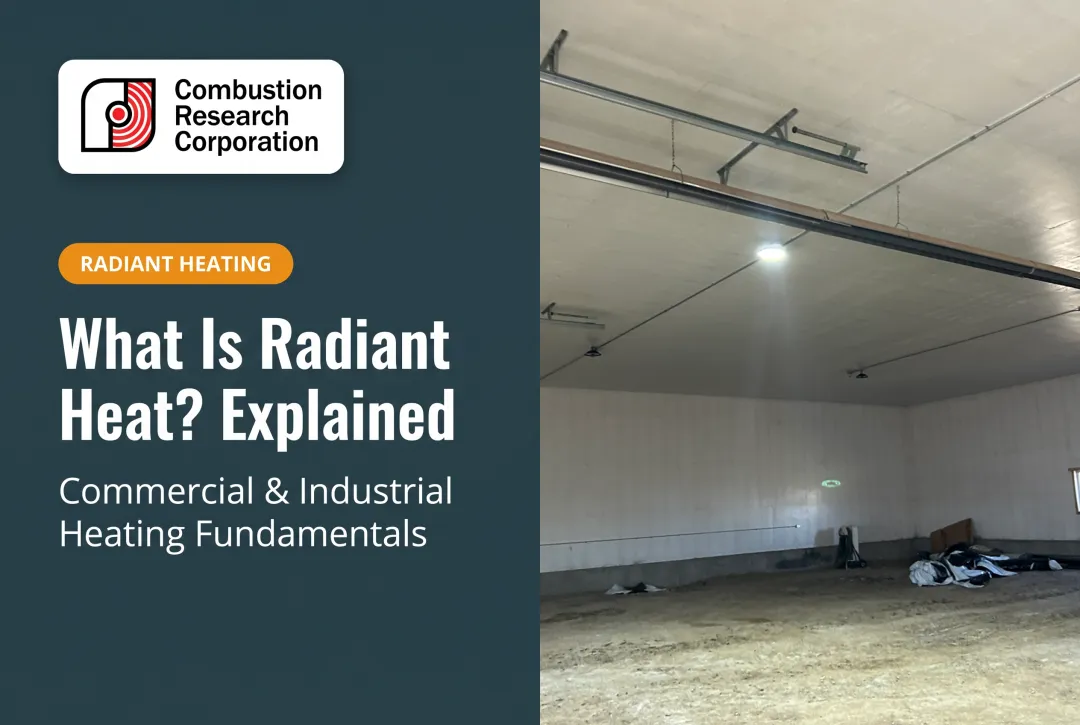
For commercial and industrial facilities, the most relevant form is the low-intensity infrared tube heater — a ceiling-mounted system that uses gas combustion to heat a long metal tube, which then radiates heat downward across a broad zone.
Why This Matters in High-Bay Buildings
A peer-reviewed survey of eight heated aircraft hangars measured floor-to-ceiling temperature differentials of 4–11°C (7–19°F) under forced air. That's the energy you're paying for but not delivering to your workers. Radiant tube heaters deposit heat at occupant level, not at the ceiling.
In industrial environments, three operational advantages matter most:
- No air movement means dust, particulates, and fumes stay settled — especially important in automotive shops, paint bays, and food-adjacent facilities
- Ceiling-mounted installation preserves all floor space and eliminates accidental contact risks with forklifts and material-handling equipment
- Zoning capability lets you heat only occupied bays or sections, rather than running the entire system for one active area
Where Radiant Heat Performs Best
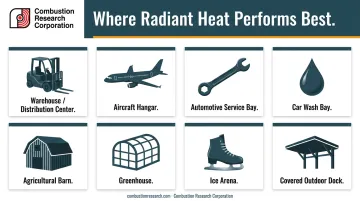
Radiant consistently outperforms forced air in these environments:
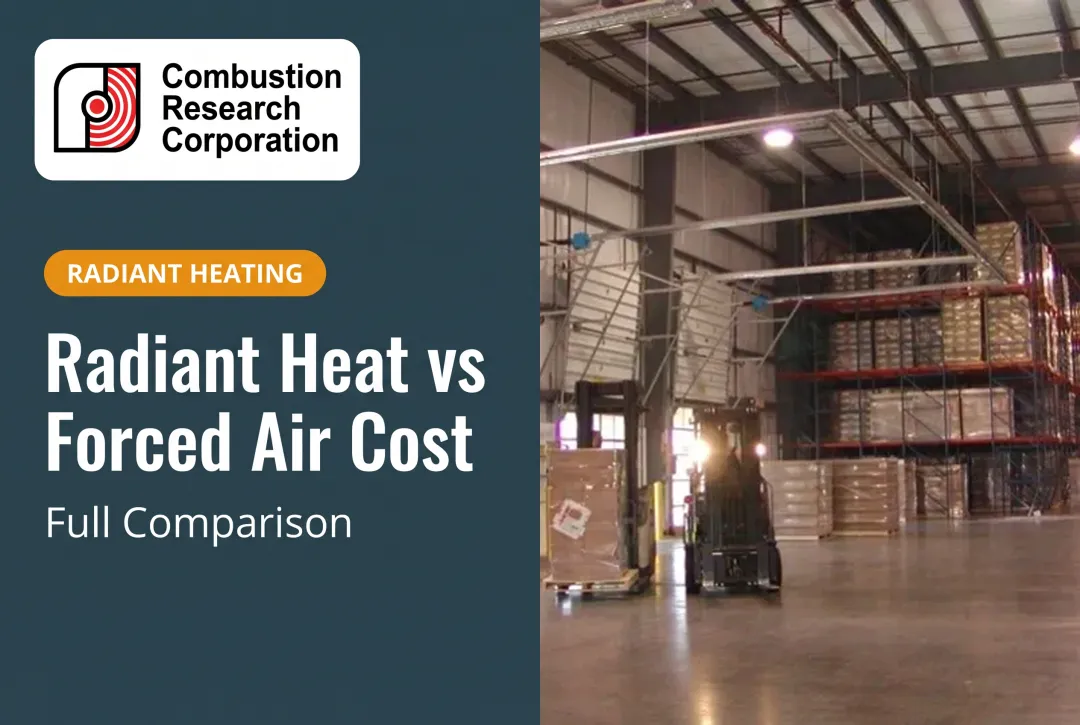
- Warehouses and distribution centers with loading docks
- Aircraft hangars (FBO, MRO, military)
- Automotive service bays and auto dealerships
- Car and truck wash bays
- Agricultural barns, greenhouses, and brooder facilities
- Ice arenas and natatoriums
- Covered outdoor areas — shipping docks, dealership canopies, loading areas
Any facility where large doors open frequently is a strong radiant candidate. When a bay door opens, heated air from a forced-air system escapes immediately. With radiant, the warmth already absorbed by floors, vehicles, tooling, and surfaces stays in place and continues radiating back into the space.
What Is Forced Air Heating?
Forced air heats the air itself using a furnace, heat pump, or unit heater, then distributes that warm air through fans, blowers, and ductwork. It's the most common heating method in North American commercial buildings — and in the right setting, it works well.
The problem in industrial spaces comes down to physics. Warm air rises. In a facility with 20- or 30-foot ceilings, a significant portion of your heating energy pools well above where workers, inventory, and equipment actually are. LBNL research on commercial duct systems found that seven of ten large commercial systems leaked 9–26% of inlet airflow — a measurable energy penalty before the air even reaches the space.
Door cycles compound the problem. Every time a bay door opens, the heated air mass escapes and must be rebuilt from scratch. For a service garage where doors cycle every few minutes, or a warehouse loading dock running all day, that's a continuous energy loss with no recovery between cycles.
Where Forced Air Still Makes Sense
Forced air isn't the wrong choice in every context. It performs adequately when:
- The space is small and well-insulated, with ceilings under 10 feet
- Existing ductwork infrastructure is already in place
- Combined heating and cooling is required in a single system
- Doors are rarely opened and the space stays sealed
For commercial offices, small retail spaces, and climate-controlled environments inside larger facilities, forced air remains a functional, widely available option. Once ceilings climb above 10–12 feet, floor areas expand, or doors start cycling regularly, forced air's limitations outweigh its convenience.
Which Is Better for Industrial and Commercial Spaces?
For most industrial applications, radiant wins — but the decision depends on specific facility conditions, not a blanket rule.
Key Decision Factors
Choose radiant heat if your facility has:
- Ceilings 12 feet or higher (the ASHRAE Journal identifies 16+ feet as a particularly advantageous application)
- Frequently opening bay doors — loading docks, hangars, service bays
- Dust, fume, or air quality concerns
- Large open floor areas that need to stay clear of equipment
- A goal of reducing long-term energy costs
Choose forced air if your facility has:
- Small, well-sealed spaces with ceilings under 10 feet
- Existing ductwork infrastructure already in place
- A requirement for integrated heating and cooling
- Climate-controlled office or retail spaces within a larger facility
The Cost Picture
No universal per-square-foot installed cost benchmark exists for either system — costs vary too much by facility size, ceiling height, fuel type, and configuration. Operating costs, however, are well documented.
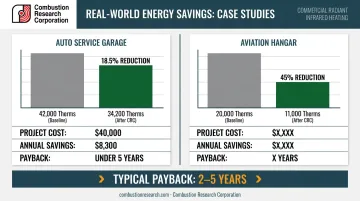
A utility-published case study from a Seattle-area auto service garage showed annual gas consumption dropping from 42,000 to 34,200 therms after switching from forced-air unit heaters to infrared — an 18.5% reduction. The project cost approximately $40,000 and delivered more than $8,300 in annual fuel savings, with a simple payback under five years.
A separate trade-published account of an aviation hangar retrofit reported a 45% reduction in gas use, from 20,000 to 11,000 therms annually.
Combustion Research Corporation documents 2–5 year payback periods as typical across commercial deployments, with local utility rebates available through many natural gas efficiency programs potentially shortening that window further.
One important counterexample from that same ACEEE study: a paper-machine-parts plant where incorrectly sized and poorly laid out infrared heaters failed to maintain temperature, requiring forced-air supplementation. Technology choice doesn't overcome a bad load calculation. Get the load calculation right before specifying any system.
Real-World Performance: Why Industrial Facilities Choose Radiant
The physics argument for radiant in high-bay, high-traffic environments is strong — but field performance data matters too.
Across warehouse, hangar, and automotive service applications, Combustion Research Corporation documents 30–50% energy savings compared to conventional forced-air systems. That range is consistent with controlled test data: an ASHRAE Journal analysis of a gas-fired radiant tube system versus unit heaters in a 20-foot test building found radiant consumed approximately half as much energy, with a conservative estimate of 33% after accounting for building insulation variables.
Three facility types illustrate where radiant consistently outperforms:
- Automotive service bays: Overhead doors cycling every few minutes make forced-air systems nearly unable to maintain steady temperatures. Heat is gone within seconds of each door cycle, while radiant systems recover thermally as soon as the door closes. CRC describes this as "radiant's strongest commercial application."
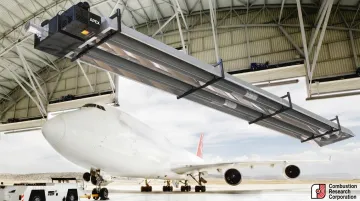
- Aircraft hangars: Oversized hangar doors, 20-foot-plus ceilings, and workers spread across large open volumes make stratification management critical. CRC's Reflect-O-Ray 6.0 EDS is engineered specifically for these high-bay conditions. Its 6-inch diameter tubing reduces utility drop installations by up to two-thirds versus competing systems — a meaningful installation cost offset in large hangars.
- Warehouses with high dock-door activity: Zoning capability and surface-level heat retention address both problems at once: pay only for zones in use, and recover quickly after each door cycle. Individual bays can be set back when unoccupied, then brought to comfort quickly when workers arrive.
Facility owners evaluating a new installation or retrofit can reach CRC's engineering team directly for heat loss calculations and system design. With over 50 years of manufacturing experience and CSA International Design Certification to ANSI/CGA Standards, CRC works with your local mechanical contractor from spec through installation. Contact them at combustionresearch.com or call 888-852-3611.
Conclusion
Radiant heat isn't the right fit for every facility — but for most industrial and commercial applications, particularly high-ceiling, high-traffic, or dust-sensitive environments, infrared radiant heating consistently outperforms forced air on energy efficiency, air quality, operational safety, and long-term cost.
Forced air remains a viable choice for smaller, sealed, climate-controlled spaces where combined heating and cooling and lower upfront costs are the priority.
For facility managers weighing the decision, the outcomes that drive the choice toward radiant are consistent across applications:
- Lower utility bills through documented 30–50% energy savings vs. forced air
- Healthier work environments with no circulated dust, allergens, or pathogens
- Preserved floor space with ceiling-mounted systems that stay out of traffic lanes
- Reduced maintenance burden with no filters, ductwork, or condensation-prone components
- Consistent comfort even when bay doors are open or frequently cycled
If your facility runs high ceilings, open doors, or sensitivity to air quality, radiant is the stronger long-term investment. Combustion Research Corporation has engineered gas-fired and electric infrared systems for exactly these conditions for over 50 years — reach out to discuss which configuration fits your application.
Frequently Asked Questions
Why is my electric bill so high with radiant heat?
High operating costs with radiant are usually caused by an oversized or incorrectly specified system, missing zone controls, or use of electric resistance heating where gas-fired infrared tube heaters would be far more efficient. Proper BTU sizing and thermostat controls are the first things to audit.
Can radiant tube heaters be the primary heat source in a large warehouse?
Yes. Properly specified low-intensity infrared tube heaters are designed for exactly this purpose — ceiling-mounted systems can serve as the sole heat source in warehouses from a few thousand to over one million square feet. CRC's engineering team can help ensure correct coverage and BTU sizing.
How high do ceilings need to be for radiant tube heaters?
Low-intensity infrared tube heaters typically mount at heights of 10–30 feet, with the Reflect-O-Ray 6.0 EDS specifically designed for facilities with ceilings of 20 feet and above. Required clearances vary by model and BTU output ; consult the product submittal sheet or contact a CRC representative for specifics.
Which system performs better in facilities where large doors open frequently?
Radiant heat wins here. Because it warms objects, floors, and occupants directly rather than the air, opening a bay door doesn't immediately eliminate warmth. Forced-air heat escapes within seconds of each door cycle and must be rebuilt from scratch.
Is radiant heat safer than forced air in industrial environments?
Ceiling-mounted radiant systems reduce workplace hazards by keeping equipment off the floor, eliminating air circulation that could spread dust or chemical fumes, and providing consistent low-maintenance operation with no filters or condensation-prone components.
What maintenance does a radiant tube heater require compared to forced air?
Low-intensity infrared tube heaters have no combustion air filters to replace, no ductwork to clean, and no blower motors to service. CRC's Omega II and Reflect-O-Ray lines are specifically engineered without filters, and the systems are backed by a 10-year radiant tube warranty and a 3-year burner control warranty.