The wrong choice isn't just uncomfortable. It means animals burning extra calories to stay warm, water lines freezing, respiratory problems from humidity buildup, or a fire hazard near dry bedding. Getting it right requires more than picking a BTU number off a box.
This guide covers whether your barn actually needs supplemental heat, how to size a system properly, which heater types perform best in agricultural environments, and the most common mistakes that undermine otherwise solid installations.
Key Takeaways
- Not every barn needs heat — large, healthy cattle and horses tolerate cold well if sheltered from wind and moisture
- BTU sizing starts with cubic feet, not square footage — ceiling height changes everything
- Infrared tube heaters warm animals and surfaces directly — without circulating dust or pathogens the way forced-air systems do
- An uninsulated barn can cost 2–3× more to heat than an insulated equivalent of the same size
- Ceiling-mounted systems preserve floor space, reduce contact hazards, and deliver more even heat distribution
Does Your Barn Actually Need Heating?
Whether your barn needs heat depends on what's inside it — and your local winter conditions.
Large, acclimated animals are more cold-tolerant than most people assume. According to NDSU's cold stress guidelines, the lower critical temperature for beef cattle with a dry, heavy winter coat sits around 18°F — the point at which they begin burning extra energy to stay warm. Horses with a winter coat have a similar threshold. A well-bedded, draft-free barn may be all they need.
Heating requirements shift significantly for other animals and use cases:
- Young and newborn animals — newborn piglets require 90–100°F at the nest; day-old chicks need 88°F under the brooder
- Sheep and goats — freshly shorn sheep have a lower critical temperature around 50°F; wet goats need supplemental heat above 32°F
- Rabbits — optimal environment is 61–72°F per Merck veterinary guidance
- Water lines and troughs — freeze protection requires maintaining above 32°F at the pipe level
- Barn-as-workspace — any human activity in sustained sub-freezing temperatures creates a heating requirement
That said, more heat isn't always better. Heat stress in sows and finishing pigs begins around 70°F, and sealed or poorly ventilated barns with combustion heaters accumulate humidity and carbon monoxide — directly raising respiratory disease risk in livestock.
The target is a controlled minimum temperature matched to your specific animals, not blanket warmth throughout the structure.
How to Heat a Barn: A Step-by-Step Guide
Step 1: Calculate Your Barn's BTU Requirement
BTU sizing is where barn heating plans succeed or fail. The most common mistake is sizing by square footage — barn volume (cubic feet) is the correct starting metric because ceiling height has a direct, proportional impact on heat load.
A widely used shortcut formula for uninsulated barns:
Cubic feet × temperature rise (°F) × 0.133 = minimum BTU/hr
Using a common barn size — 40×60 with a 14-ft ceiling:
- Volume: 40 × 60 × 14 = 33,600 cubic feet
- Target temperature: 50°F; outdoor design low: -10°F; temperature rise: 60°F
- Calculation: 33,600 × 60 × 0.133 = ~268,000 BTU/hr
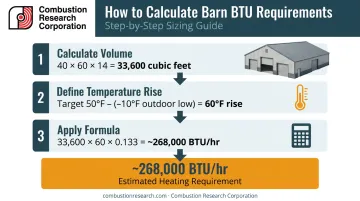
Treat that number as a starting point, not a final answer. Purdue Extension's agricultural engineering guidance calculates barn heat load as a balance of envelope losses + ventilation losses − animal heat generated — a more rigorous method that this shortcut approximates. For commercial livestock operations, a proper load calculation is worth the investment.
CRC's engineering documentation uses BTU/sqft rules of thumb that reinforce the insulation variable:
- Insulated, low-bay buildings: 25–40 BTU/sqft
- High-bay, uninsulated structures: 40–65 BTU/sqft
- Poorly insulated or high door-cycle facilities: 65+ BTU/sqft
Step 2: Determine Your Target Temperature and Design Conditions
Target temperature varies significantly by barn use:
| Barn Use | Target Temperature |
|---|---|
| Mature cattle/horses | 35–40°F minimum |
| Swine finishing | 60°F optimum |
| Lactating sows | 60°F optimum |
| Newborn piglets (nest area) | 90–100°F |
| Poultry brooders (day 1) | 88°F under brooder |
| Workshop/equipment storage | 35–38°F (above freezing) |
Anchor your BTU calculation to your region's 99% heating design temperature — the outdoor temperature that your location stays above 99% of the year. This is the standard engineering baseline, not a record low or average winter temperature. The ASHRAE Weather Data Center covers over 12,400 stations and is the authoritative source for this data. Agricultural energy audit materials also specify this 99% design value as the correct planning benchmark.
Step 3: Evaluate Insulation and Air Sealing
Insulation directly controls your operating costs. Purdue Extension documents 60–70% lower propane requirements after insulating an uninsulated 20-sow farrowing house to recommended levels — a reduction that typically pays back the insulation investment within a few heating seasons.
Purdue recommends at minimum R-13 walls and R-20 ceilings for actively heated livestock buildings. What this means practically:
Good air sealing looks like:
- Continuous vapor barrier with sealed joints and penetrations
- No visible daylight gaps around doors or at roof-wall junctions
- No frost accumulation on interior wall surfaces in winter
Poor air sealing looks like:
- Cold drafts at ground level near doors and foundation
- Frost or condensation on interior wall surfaces
- Noticeable wind-driven air movement inside during storms
Air infiltration bypasses insulation entirely and is often the single largest heat loss pathway in an agricultural building. Sealing major gaps costs far less than adding BTU capacity to compensate for them — fix the envelope before you finalize your heater size.
Step 4: Select, Install, and Commission Your System
Size your heater after completing the BTU calculation, not before. Once you have a heat load number, match it to a unit with appropriate output, fuel type, and mounting configuration for your barn layout.
Installation safety non-negotiables:
- Follow manufacturer clearance specs — for low-intensity radiant tube heaters, typical clearances to combustibles range from 12 to 60 inches depending on model and orientation
- Ensure proper venting — both power-vented and vacuum-vented combustion systems must exhaust gases outside the structure
- Install CO detectors in enclosed combustion-heated spaces; consult your local Authority Having Jurisdiction (AHJ) for specific requirements
- Secure gas lines and electrical connections against animal interference
- Coordinate with your AHJ — agricultural structures with hay and bedding may face additional clearance requirements beyond manufacturer minimums
Commissioning before winter:
- Verify thermostat response and system cycling at both high and low settings
- Walk the barn floor to confirm even heat distribution
- Test the system under realistic conditions — door cycling, ventilation running — before relying on it through the coldest months
Choosing the Right Type of Barn Heater
Infrared Tube Heaters
Low-intensity infrared tube heaters are the strongest option for most livestock barns. A gas burner heats a long metal tube, which radiates warmth downward toward animals and surfaces rather than heating the air. Ceiling mounting keeps heat at the occupant level, eliminates contact hazards, and preserves all floor space.
The specific advantages for livestock environments:
- Keeps dust, organic particles, and pathogens in place — no fan-driven air movement to push contaminants through the space
- Warms animals and bedding directly through radiant energy absorption, the same mechanism as sunlight warming the ground
- Recovers quickly after door cycling — thermal mass re-radiates heat as soon as cold air enters, without waiting for the entire air volume to reheat
- Silent operation — important for livestock that are sensitive to noise
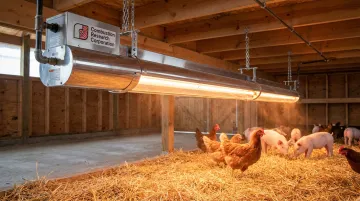
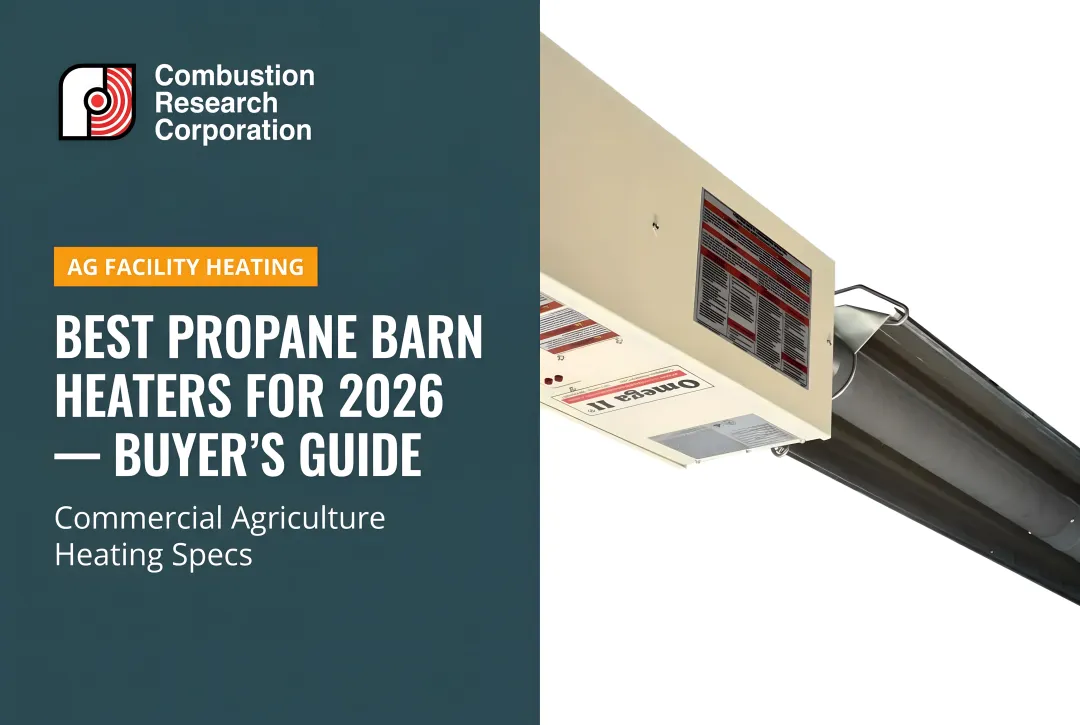
Combustion Research Corporation's low-intensity infrared tube heaters — the Serengeti-IR (40K–60K BTU for smaller barns and brooder houses), Omega II (105K–200K BTU for mid-to-large barns), and Reflect-O-Ray vacuum systems (40K–250K BTU, custom-engineered for large agricultural operations) — are all CSA-certified to ANSI/CGA standards and explicitly listed for pole barns, animal confinement, and brooder applications. An oil-fired variant of the Reflect-O-Ray is available for off-grid or rural locations without natural gas access.
Forced-Air Unit Heaters
Forced-air heaters (gas or propane, with a blower) heat a space quickly and work well for general-purpose barns, workshops, or equipment storage where fast warm-up matters more than air quality. The trade-offs for livestock environments are real:
- Air movement increases dust and pathogen circulation through bedding and organic material
- Heat stratifies toward the ceiling in high-bay spaces — NC State Extension documents ceiling-to-floor temperature differences of 13–20°F in poultry houses with forced-air systems
- Higher noise levels compared to radiant systems
- More vulnerable to operating cost increases as barn height increases
Radiant Floor Heating
Hydronic radiant floor systems (hot water circulated through in-slab tubing) deliver highly uniform heat from the ground up — ideal for animals that spend time lying on concrete. The heat rises naturally through the occupied zone rather than pooling near the ceiling. The practical limitation: high upfront installation cost and not feasible as a retrofit in most existing barns with existing slabs.
Wood and Pellet Stoves
A lower-cost fuel option for small hobby barns or off-grid situations, but with clear limitations. They require chimney installation, a consistent fuel supply, and regular cleaning — and pose a real fire risk in any space with dry hay or bedding. For large or commercial operations, a dedicated heating system is the more reliable path.
Electric Heaters
Simple to install and well-suited for spot heating or very small spaces. At barn scale, however, electricity costs add up fast — most operators find them practical only as supplemental heat rather than a primary system.
Key Variables That Affect Barn Heating Performance
Barn Volume and Ceiling Height
Heat rises. The higher the ceiling, the larger the volume of unconditioned air above the animals — and the more BTUs required to maintain usable floor-level temperatures. A 14-ft ceiling barn of the same footprint requires considerably more heating capacity than an 8-ft ceiling equivalent.
Ceiling-mounted radiant heaters address this by directing energy downward rather than heating air that immediately stratifies upward. In a forced-air system, that 13–20°F ceiling-to-floor differential represents fuel burned with no benefit to the animals below.
Livestock Type and Stocking Density
Animals generate body heat that offsets supplemental heating requirements. Purdue Extension's published data gives useful reference points:
| Animal | Heat Output |
|---|---|
| Dairy cow at 50°F | 3,220 BTU/hr |
| Sow and litter at 70°F | 1,100 BTU/hr |
| Dairy calf at 70°F | 600 BTU/hr |
| 150–220 lb finishing pig at 60°F | 350 BTU/hr |
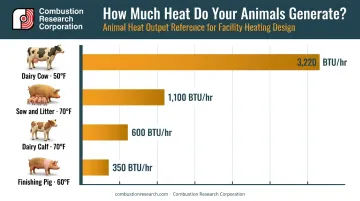
A densely stocked beef or dairy barn generates substantial ambient warmth. A lightly stocked small-animal barn contributes almost nothing. When stocking is light, size your system for the full design load — don't assume animal heat will close the gap.
Local Climate and Wind Exposure
The ASHRAE 99% design temperature is your baseline — but a barn in an exposed, wind-swept location will experience higher infiltration rates than the formula accounts for. Wind increases air pressure differentials across the building envelope, forcing more cold air through every gap and seam.
Two site factors worth noting before finalizing your BTU estimate:
- Wind exposure: Open, elevated, or coastal sites can push actual infiltration 20–30% above standard calculations
- Prevailing wind direction: Orienting doors and ventilation openings away from dominant wind patterns reduces heat loss meaningfully
Review your estimate with a contractor or manufacturer's representative who knows your region's conditions.
Common Barn Heating Mistakes to Avoid
- Size by cubic feet, not square footage — ceiling height changes everything; ignoring it produces undersized systems that run constantly and still underperform
- Skipping clearance requirements: insufficient distance from hay bales, wood framing, and bedding is one of the most common fire hazards in barn heating. Always verify against the model-specific submittal sheet and coordinate with your AHJ before installation.
- Sealing the barn without ventilation: combustion heaters in tightly sealed barns accumulate CO and excess humidity. Veterinary research identifies relative humidity above 75% as a respiratory disease risk for livestock — adequate air exchange is non-negotiable.
- Choosing the cheapest unit upfront: fuel costs dwarf purchase price over a full season. EIA 2024 data puts commercial natural gas at ~$0.97 per 100,000 BTU vs. ~$3.74 for electricity — a nearly 4× gap that compounds fast.
Frequently Asked Questions
Do barns need to be heated?
Not always. Large, healthy livestock with winter coats tolerate temperatures well below freezing when sheltered from wind and wet conditions. Heating becomes necessary for young or newborn animals, poultry, sustained sub-freezing temperatures, water line protection, or when the barn doubles as a workspace.
What is the best type of heater for a livestock barn?
Low-intensity infrared tube heaters are the most effective option for livestock environments. They heat animals and surfaces directly without circulating air, dust, or pathogens — and they eliminate the ceiling stratification problem that makes forced-air systems inefficient in high-bay spaces.
How many BTUs do I need to heat a barn?
A common starting formula: cubic feet × temperature rise (°F) × 0.133 = minimum BTU/hr for an uninsulated barn. Adjust downward for insulated buildings, upward for high air infiltration. A proper heat loss calculation from a manufacturer's representative or agricultural engineer gives the most accurate result.
Is infrared heating safe for animals?
Yes, when properly installed. Ceiling-mounted infrared tube heaters produce no open flame at animal level and no air movement that spreads pathogens. CRC's agricultural-listed models carry CSA certification and are 100% factory tested before shipment.
How much does it cost to heat a barn in winter?
It depends on barn size, insulation, local fuel prices, and climate. To estimate operating cost: divide your heater's BTU output by the fuel's BTU content, multiply by hours of operation, then multiply by fuel cost per unit. Natural gas is typically the most cost-effective fuel where available; electric resistance heating costs roughly 4× more per BTU delivered.
Can I heat an uninsulated pole barn effectively?
Yes — but expect to size for 40–65 BTU/sqft or higher depending on ceiling height and door cycling frequency. Adding insulation to the roof and sealing major air gaps before installing the heating system is one of the highest-ROI steps available; it directly reduces the BTU capacity you need to purchase and the fuel you'll burn every winter.