Radiant heat flooring addresses the problem from the ground up — literally. This guide covers how radiant floor systems work, why they suit greenhouse environments particularly well, which system type fits your operation, and where overhead infrared heaters make more sense than floor installation.
TL;DR: Key Takeaways
- Radiant floor heat warms plants from the root zone up, delivering more consistent temperatures than forced-air systems
- Hydronic (water-based) systems suit large commercial greenhouses; electric mats are more practical for small setups or dedicated propagation benches
- Insulation beneath the tubing is non-negotiable — without it, heat transfers into the ground, not upward
- Floor systems respond slowly to temperature drops — pair them with a supplemental heater so you can recover quickly on cold nights
- Ceiling-mounted infrared tube heaters are a practical alternative when floor excavation isn't an option — and they heat the space without occupying any floor area
What Is Radiant Heat Flooring for Greenhouses?
Radiant heat works differently from convection heating. Instead of warming air and relying on circulation, it transfers thermal energy directly from a warm surface to cooler objects — plants, soil, benches — via infrared radiation. The result is more consistent root-zone temperatures without the humidity swings and pathogen risks that come with forced-air systems.
Hydronic In-Floor Systems
Hot water circulates through PEX tubing embedded in the floor. A complete hydronic root-zone system includes several core components working together:
- Water heater or boiler running at 90–110°F for root-zone applications (well below the 180–190°F of traditional hot-water systems)
- Circulating pump, supply/return headers, and controls to manage flow and temperature zones
- PEX tubing with an oxygen diffusion barrier — the standard choice where oxygen exposure risks corrosion
- Glycol additive for any lines running through unheated spaces to prevent freezing
Electric In-Floor Systems
Heating cables or mats are laid beneath the floor surface and connected to an electrical supply. The setup is simpler than hydronic — no boiler, no glycol, no pump — which makes electric systems attractive for small hobby greenhouses or targeted propagation areas.
Operating costs are the main drawback. Electric resistance heat is expensive to run continuously across large areas, so these systems work best for spot heating rather than whole-greenhouse coverage.
The Role of Thermal Mass
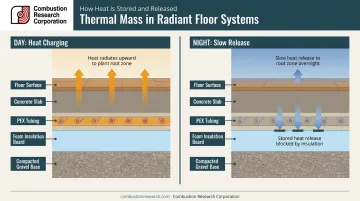
A concrete slab over the tubing absorbs heat during the day and releases it gradually at night. This passive reservoir helps stabilize overnight temperatures — valuable during cold snaps when outdoor temperatures drop faster than a heating system can respond. That thermal stability comes with a trade-off: Rutgers' greenhouse floor heating research found that concrete's mass slows system response — heat can take several hours to reach the floor surface when conditions change suddenly.
Why Radiant Heat Works So Well for Greenhouses
Root-Zone Temperature Is Where Crop Performance Lives
Plant root systems are far more sensitive to temperature than most growers account for. Cold roots slow nutrient uptake and growth even when air temperatures look adequate on the thermostat.
UMass Extension states that maintaining the ideal 70–75°F root temperature for optimum growth is difficult to achieve with air heat alone. Most greenhouse crops fall within a target range of 55–75°F, with germination and rooting of cuttings requiring the upper end of that range. For reference, the optimum germination temperature for tomato seed is 75°F — a target that forced-air systems routinely miss at floor level on cold nights.
The practical benefit: supplying heat under the crop can allow greenhouse air temperature to run 5–15°F cooler than a forced-air system requires, reducing heat loss through the glazing.
Disease Pressure and Air Quality
Radiant floor heat doesn't circulate air, which changes the disease dynamics in a greenhouse. Botrytis and similar fungal pathogens spread via airborne spores, and infection is strongly linked to free moisture on plant tissues and relative humidity above 93% for extended periods. Heating strategy affects humidity, leaf wetness duration, and air movement patterns throughout the structure.
Floor heat alone won't eliminate disease pressure — growers still need active ventilation and humidity management. Removing a system that constantly moves air through the canopy does, however, reduce one meaningful variable from the equation.
Energy Efficiency vs. Forced-Air
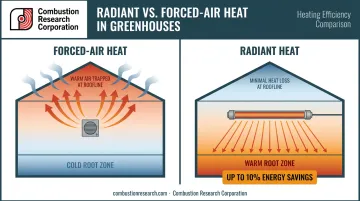
Beyond disease management, avoiding forced air pays off in another measurable way: energy costs. In a standard forced-air greenhouse, warm air rises to the roof (the furthest point from the plants) before escaping through the glazing. Radiant systems deliver heat directly to the root zone, allowing lower air setpoints and reducing the total heat load required.
Key efficiency advantages include:
- Lower air setpoints reduce heat loss through glazing
- Heat concentrates where crops need it, not at the roofline
- Reduced run time lowers fuel consumption over the season
- Overhead radiant infrared tube heaters can deliver comparable root-zone warmth without the installation complexity of in-floor systems
Farm Energy/eXtension estimates energy savings of as much as 10% through lower air temperature setpoints alone. That figure is conservative; climate, glazing type, and crop requirements all affect the actual outcome.
Types of Radiant Heating Systems for Greenhouses
Hydronic In-Floor Systems
Components: PEX tubing, manifold, boiler or water heater, circulation pump, thermostat or environmental controller, and glycol antifreeze for any exposed lines.
Best for: Large commercial greenhouses, in-ground growing beds, new construction where floor excavation is planned from the start. Hydronic systems carry the highest upfront cost but the lowest long-term operating cost, particularly when natural gas is the fuel source.
Pipe spacing: Rutgers' greenhouse floor heating documentation references common configurations of ¾-inch nominal pipe at 12-inch spacing or ½-inch pipe at 9-inch spacing in concrete.
Electric In-Floor Systems
Heating cables or mats are installed beneath the floor surface. Lower installation cost and simpler setup than hydronic, with no boiler or pump required.
Best for: Small hobby greenhouses, seed germination areas, under-bench root-zone heating for propagation trays. Not cost-effective for continuous operation across large commercial areas.
Under-Bench Radiant Systems
Radiant heat doesn't have to live in the main floor. PEX tubing or electric mats placed beneath growing benches warm the root zone of potted plants or trays directly. Farm Energy/eXtension describes 6–9 inch pipe spacing with 3–4 inches of wet sand to produce even temperatures in bench applications.
This is a practical lower-cost route to targeted root-zone warmth without a full floor installation — particularly useful when retrofitting an existing greenhouse.
Overhead Infrared Tube Heaters
Ceiling-mounted infrared tube heaters work on the same radiant principle as floor systems — heating objects directly rather than warming air — but from above. UF IFAS notes that infrared heaters transfer heat energy directly to objects in the greenhouse rather than first heating the air, and can keep plant leaf surfaces above air temperature.
For greenhouse operators who cannot install in-floor systems — retrofit situations, existing concrete floors, rented structures — overhead infrared tube heaters are often the more practical choice. Key practical advantages:
- Preserve all floor and bench space for cultivation
- Heat up and cool down faster than hydronic floor systems
- Can be zoned for specific growing areas without floor work
- No risk of pipes leaking beneath a concrete slab
Combustion Research Corporation's Reflect-O-Ray and Omega II infrared tube heaters are built for exactly these conditions. The Reflect-O-Ray vacuum-fired systems range from 30,000 to 220,000 BTU/hr, covering operations from small hobby structures to large commercial ranges. Stainless steel construction handles the high-humidity environment, and the systems are designed without combustion air filters — a meaningful advantage in organic-dust-heavy greenhouse conditions where filter maintenance adds up fast.
Installation: Planning Your Greenhouse Radiant Heating System
Floor Preparation and Insulation
The most commonly skipped step in greenhouse floor heating is under-slab insulation. Without a foam board layer between the tubing and the subbase, a significant portion of heat conducts downward into the ground rather than radiating upward.
Standard installation stack:
- Compacted gravel or crushed-stone base (drainage layer)
- Foam insulation board — UMass recommends 1–2 inches of extruded polystyrene
- PEX tubing at designed spacing
- Poured concrete slab, typically 3–4 inches thick, with drainage slopes
NRAES greenhouse engineering guidance adds that perimeter insulation extending 24 inches into the ground can reduce edge heat loss by approximately half compared to uninsulated edges.
Sizing the System
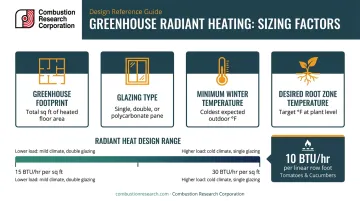
BTU requirements depend on more than floor area. Key factors:
- Greenhouse footprint and total envelope surface area
- Glazing type — double-wall polycarbonate holds heat much better than single-pane glass
- Local minimum winter design temperature
- Desired crop temperature at the root zone
UMass gives a general design output range of 15–30 BTU/hr per sq ft of floor or bench area. Farm Energy/eXtension estimates 10 BTU/hr per linear foot of row for crops like tomatoes and cucumbers, plus roughly 10% for supply-pipe heat loss.
Use a greenhouse heater sizing calculator or consult a heating specialist rather than using residential sizing rules — greenhouse structures lose heat far faster than insulated buildings.
Controls and Supplemental Heat
Once sizing is complete, controls determine how precisely the system responds. Common configurations include:
- Single-zone thermostat with a remote bulb placed in the growing medium (not in the air)
- Multi-zone solenoid valves with individual bed-level sensors for larger operations
Important: floor systems alone cannot keep pace with rapid overnight temperature drops. UMass data shows root-zone heating typically provides 25–75% of total greenhouse heat needs, with the balance supplied by overhead or perimeter systems. Plan for supplemental heat from the start.
Radiant Floor Heat vs. Overhead Infrared Heaters
| Situation | Better Choice |
|---|---|
| New construction with planned concrete floor | Hydronic in-floor |
| In-ground growing beds, commercial scale | Hydronic in-floor |
| Existing greenhouse, no floor excavation planned | Overhead infrared tube heaters |
| Raised bench growing (floor heat doesn't reach plants) | Overhead infrared or under-bench systems |
| Fast heat response needed | Overhead infrared tube heaters |
| Retrofit without structural changes | Overhead infrared tube heaters |
| Propagation / germination areas only | Electric mats or under-bench hydronic |
For new commercial greenhouse construction where a concrete slab is part of the plan, hydronic in-floor heating makes strong long-term economic sense. The thermal mass benefit is real, and lower operating costs justify the higher installation investment over multiple growing seasons.
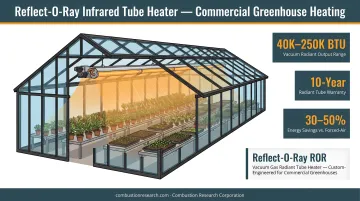
For retrofit projects, overhead infrared tube heaters are usually the more practical answer. Combustion Research Corporation's ceiling-mounted Reflect-O-Ray and Omega II systems offer several advantages for greenhouse operators who can't — or don't want to — break ground:
- No floor work required — systems mount at ceiling height, preserving all growing and aisle space
- 30–50% energy savings over conventional heating, based on field reports from growers using these systems
- CSA certified to ANSI/CGA standards, with over 50 years of manufacturing experience behind each unit
- Built for year-round greenhouse conditions — high humidity, temperature cycling, and continuous operation
- Engineering support available for heat-loss calculations and system sizing through CRC's representative network
Common Limitations of Radiant Floor Heating
Slow thermal response is the most common operational complaint. Concrete slab systems cannot react quickly to sudden temperature drops. Run the system continuously at a baseline setpoint rather than cycling it, and pair it with a supplemental overhead heater for rapid-response backup on the coldest nights.
Heat stratification with raised benches. Radiant floor heat rises, which means the warmest zone is at floor level. If crops sit on elevated benches, they may not benefit as directly as plants growing at floor level. Strategies:
- Low-speed circulation fans to gently lift floor heat without creating damaging airflow
- Under-bench supplemental heating for bench-grown crops
- Locate temperature-sensitive seedlings at floor level during extreme cold periods
Upfront installation cost is the steepest barrier. Hydronic in-floor systems require excavation, tubing, a boiler, concrete, and controls — a significant upfront investment. A 2005 Arizona/Rutgers estimate put materials-only costs at $1.82/sq ft for a 24 × 96 ft greenhouse, excluding labor and the water heater.
Current installed costs run substantially higher and vary by region. When evaluating payback, factor in your actual current heating costs — in many operations, energy savings offset that investment within several growing seasons.
Frequently Asked Questions
Are radiant heaters good for a greenhouse?
Yes. Radiant heaters deliver heat directly to plants and the root zone without forcing air circulation, which reduces disease pressure and improves energy efficiency compared to forced-air systems. Both in-floor hydronic and ceiling-mounted infrared tube heaters are effective ; the right choice depends on your greenhouse setup and whether floor installation is practical.
Can a greenhouse go on gravel?
A gravel base is a standard greenhouse foundation that provides excellent drainage and stability. For in-floor radiant heating, a compacted gravel sub-base is part of the recommended installation stack, followed by foam insulation board, PEX tubing, and a poured concrete slab.
What is the best type of radiant heat for a greenhouse?
For new construction commercial greenhouses, hydronic in-floor systems offer the best long-term efficiency. For retrofit projects or bench-based growing operations, ceiling-mounted infrared tube heaters or under-bench electric systems are typically more practical and cost-effective without requiring floor modifications.
How much does radiant floor heating cost for a greenhouse?
Installed costs vary by region, greenhouse size, and fuel source. A 2005 Arizona/Rutgers estimate put materials alone at roughly $1.82/sq ft; current installed costs (including labor, boiler, and controls) run considerably higher. Get project-specific bids and factor in ongoing operating costs based on whether you're using natural gas, propane, or electricity.
Does radiant floor heating work in uninsulated greenhouses?
It functions, but loses efficiency through the glazing. Under-slab insulation is critical; without it, heat transfers into the ground rather than upward. In a poorly insulated structure, floor heat alone won't compensate for glazing heat loss during extreme cold, so supplemental heating is still needed.
Can radiant heat be added to an existing greenhouse?
Adding hydronic in-floor heat to an existing greenhouse typically means excavating and replacing the floor — a costly undertaking that few retrofit projects justify. Less invasive alternatives include under-bench electric heating mats for propagation areas and ceiling-mounted infrared tube heaters, both of which can be retrofitted without any floor work.