Radiant heating works differently. Like the sun warming you on a cool day, it heats objects and people directly — not the air in between. Both electric and gas radiant systems deliver this benefit, but they serve very different scales and economics.
This article breaks down both systems — what they are, where each one excels, and how to pick the right technology for your facility's ceiling height, square footage, and energy budget.
Key Takeaways
- Electric radiant heating uses resistance elements to emit infrared heat — best for small zones, residential use, and locations without gas access
- Gas infrared tube heaters combust natural gas or propane to produce radiant energy — designed for large commercial and industrial spaces
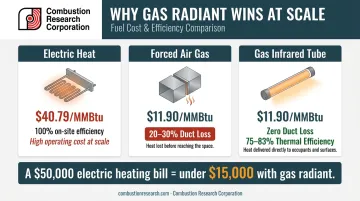
- Commercial natural gas costs roughly $11.90/MMBtu vs. $40.79/MMBtu for electricity — a 3.4x cost difference before equipment efficiency
- Gas radiant systems eliminate duct losses entirely and can reduce energy costs 30–50% versus conventional forced-air heating
- The deciding factors: space size, ceiling height, fuel availability, and whether you need spot heating or whole-facility coverage
Electric vs. Gas Radiant Heating: Quick Comparison
Here's how the two systems compare across the factors that matter most for commercial and industrial applications:
| Factor | Electric Radiant | Gas Infrared Tube |
|---|---|---|
| Installation Cost | Lower for small areas; panel upgrades required at scale | Higher upfront; cost distributes efficiently across large floor areas |
| Operating Cost | ~$40.79/MMBtu (commercial electricity) | ~$11.90/MMBtu (commercial natural gas) |
| Efficiency | 100% energy-to-heat conversion; no distribution losses | 75–83% thermal efficiency; no duct losses |
| Maintenance | Minimal — no moving parts, no combustion components | Periodic burner and combustion checks required |
| Best Fit | Small spaces, spot heating, residential, no-gas locations | Warehouses, hangars, service garages, high-bay facilities |
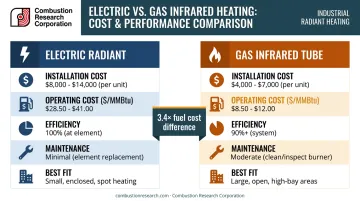
The cost-per-MMBtu gap is the central issue at scale. Delivered electricity costs 3.4× more per MMBtu than commercial natural gas at current U.S. averages — and that gap widens further once equipment efficiency differences are factored in.
What Is Electric Radiant Heating?
Electric radiant heating generates infrared energy through resistance — electrical current passes through cables, mats, or panel elements, which warm and emit radiant heat into the space. Three main forms exist:
- In-floor cables or mats — installed beneath tile, stone, or concrete; common in bathrooms and small commercial floors
- Ceiling and wall radiant panels — surface-mounted units for room or zone heating
- Portable electric infrared units — plug-in spot heaters for workstations or small areas
The Department of Energy confirms that electric resistance heating converts 100% of incoming energy to heat at point of use — no combustion, no flue, no on-site emissions.
Where Electric Radiant Works Well
- No gas lines required — straightforward installation in buildings without gas infrastructure
- Individual zone control — each circuit or panel operates independently via standard thermostat, so unused rooms or workstations aren't heated
- Silent operation — no burner, no blower noise at the heat source
- Zero on-site emissions — relevant for facilities with indoor air quality requirements or sustainability reporting goals
The Scaling Problem
At $40.79/MMBtu for commercial electricity versus $11.90/MMBtu for natural gas, that 100% efficiency rating carries a steep premium. For a small bathroom floor or office addition, the cost difference is manageable. For a 50,000 sq. ft. warehouse running heat through a Michigan winter, it's prohibitive.
Use Cases for Electric Radiant
Electric radiant excels in:
- Bathroom floor warming
- Small office additions and retail zones
- Individual workstation spot heating
- Low-ceiling residential or light commercial spaces
- Facilities without natural gas access
Scale changes the equation. Once a facility crosses into high-bay or large-footprint territory, operating costs outpace any installation savings.
Electric radiant falls short in:
- High-bay warehouses and distribution centers
- Aircraft hangars
- Service garages and automotive facilities
- Large spaces requiring continuous heat through cold-weather months
What Is Gas Radiant Heating?
Gas radiant heating — specifically low-intensity infrared tube heaters — burns natural gas or propane inside a burner that heats a long metal tube suspended from the ceiling. That tube emits infrared energy downward into the occupied zone, warming floors, equipment, vehicles, and people rather than the air column above them.
Two types exist:
- Low-intensity tube heaters — ceiling-mounted, distribute heat across large areas, operate at lower surface temperatures; the standard for commercial and industrial facilities
- High-intensity spot heaters — shorter, higher surface temperature, used for targeted spot heating or outdoor/semi-outdoor applications
Why Gas Makes Economic Sense at Scale
The fuel cost math is straightforward. Gas runs at $11.90/MMBtu versus electricity at $40.79/MMBtu. A facility spending $50,000 annually on electric heat would run equivalent gas radiant for under $15,000, before accounting for the efficiency gains of modern tube heater designs, which achieve 75–83% thermal efficiency depending on model.
Gas infrared tube heaters also eliminate duct losses entirely. ENERGY STAR estimates that 20–30% of conditioned air is lost through leaks and poorly connected ducts in typical forced-air systems — losses that don't exist in a radiant system with no ductwork at all.
Safety and Operational Advantages in Industrial Environments
Ceiling-mounted tube heaters offer specific advantages in high-traffic facilities:
- No floor-level obstructions — systems mount overhead, preserving all floor space for forklifts, material handling, and equipment
- Reduced contact risk — heat source is ceiling-mounted, out of reach of vehicles and machinery
- No air circulation — infrared heat doesn't stir up dust, debris, or airborne particulates, which matters in automotive, agricultural, and food-adjacent facilities
- Door-opening resilience — because radiant heat warms surfaces rather than air, frequent bay door openings don't reset the thermal environment the way they do with forced air
Combustion Research Corporation's Gas Infrared Systems
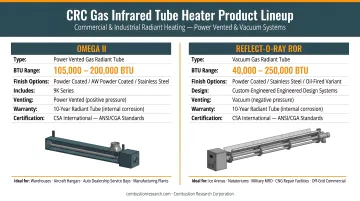
Combustion Research Corporation has manufactured low-intensity infrared tube heaters for over 50 years, with systems CSA-certified to ANSI Z83.20 / CSA 2.34 standards. Their product lines cover two primary configurations:
- Omega II (Power Vented) — 40,000 to 200,000 BTU/hr; pre-engineered packages for auto dealerships, service garages, and commercial spaces
- Reflect-O-Ray (Vacuum) — 40,000 to 250,000 BTU/hr; engineered design systems for aircraft hangars, large warehouses, and facilities up to one million square feet
Both lines carry a 10-year limited warranty on radiant tubes for internally created corrosion, with tubes built from corrosion-resistant aluminized steel.
The Omega II DI (dual-input) models offer true dual-stage modulation of both gas and air, not just gas. By matching output precisely to demand rather than cycling at full capacity, they can deliver up to 75% in energy cost savings versus conventional heating.
Use Cases for Gas Radiant Heating
Gas infrared tube heaters are the dominant choice in:
- Large warehouses and distribution centers
- Aircraft hangars (ceiling heights from 8 ft to 70+ ft depending on model)
- Auto dealerships and service garages
- Agricultural facilities — barns, brooders, pole barns, animal confinement
- Car and truck wash bays
- Ice arenas and natatoriums (stainless steel construction available for corrosive pool environments)
- Shipping and receiving docks
High ceilings and frequent door openings favor gas radiant over every alternative. Unlike forced air, infrared heat isn't disrupted by air movement: the warmth is stored in the floor, equipment, and occupants rather than the air volume.
Electric vs. Gas Radiant Heating: Which Is Right for You?
No single system wins across all scenarios. These five factors narrow it down for your specific situation:
1. Space Size and Ceiling Height
- Electric radiant: Practical for spaces under roughly 500–1,000 sq. ft. with standard ceiling heights
- Gas infrared tube heaters: Designed for high-bay spaces and large open facilities; mounting heights range from 8 ft in garages to 70+ ft in aircraft hangars depending on model
There is no universal ceiling-height cutoff. The right answer comes from a load calculation — but as a rule, if you're heating above 10,000 sq. ft. continuously through winter, gas economics almost always win.
2. Fuel Availability and Local Energy Rates
U.S. commercial natural gas averages $11.90/MMBtu nationally, though regional variation is significant — Arizona averaged $9.69/Mcf while California reached $16.29/Mcf in March 2026. Commercial electricity averages $40.79/MMBtu nationwide.
Where gas is cheap and available, it will almost always be more economical at scale. In locations without gas access — or where grid electricity comes predominantly from renewables — electric may be competitive depending on local tariffs and system size.
3. Installation Context
- New commercial/industrial construction: Gas infrared systems ceiling-mount without floor access, integrate cleanly into industrial builds, and can share exhaust manifolds to minimize roof penetrations
- Residential new construction or small retrofit: Electric in-floor systems work where floor access is available and scale is small
- Large retrofit: Gas infrared is often easier to retrofit than in-floor electric — no concrete work, no floor disruption
4. Spot/Zone vs. Whole-Facility Coverage
Electric radiant is well-suited to zone heating: individual thermostats, targeted coverage, and localized control make it easy to heat specific areas on demand. Gas tube heaters are engineered for whole-facility heating across large floor plates where running individual electric circuits would be cost-prohibitive.
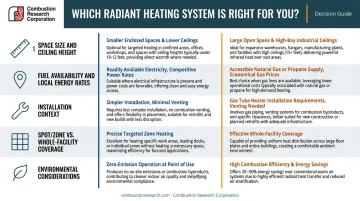
5. Environmental Considerations
Electric heat produces zero on-site emissions — relevant for facilities with sustainability targets or regulated indoor air quality requirements. Modern gas infrared systems produce significantly lower emissions than older combustion technologies, and dual-modulating designs like the Omega II reduce fuel consumption per BTU delivered.
The more useful comparison isn't on-site emissions alone. Total environmental impact depends on your upstream energy source: grid electricity in coal-heavy regions carries a higher carbon footprint than it appears, while natural gas in a high-efficiency infrared system often outperforms expectations.
Gas Radiant Heating in Action: Industrial Case Studies
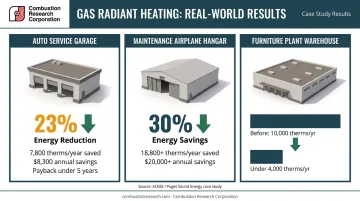
Real performance data from an ACEEE case study by Puget Sound Energy documents three distinct facility outcomes after switching to gas infrared tube heating:
Auto Service Garage (Seattle area)
- Saved 7,800 therms/year and more than $8,300 annually
- 23% energy reduction with payback under 5 years
- Facility staff reported significantly improved worker comfort
Maintenance Airplane Hangar
- Achieved 30% energy savings — more than 18,800 therms/year
- Saved over $20,000 annually while improving comfort during a colder heating season than the prior year
Furniture Plant Warehouse
- Reduced gas consumption from over 10,000 therms/year to under 4,000 therms/year
- Maintained comfort at a lower temperature setpoint
The same study also documented a cautionary outcome: a paper-machine parts manufacturer where poor heater selection and an underestimated heat load increased gas consumption and required supplemental forced-air equipment. The takeaway is straightforward — infrared systems need proper sizing and layout to deliver their efficiency potential.
If your facility has high ceilings, large open floor plans, or frequent bay door openings, gas infrared radiant heating has a proven track record of delivering consistent warmth and measurable energy savings. Combustion Research Corporation's engineering team provides sizing and layout support to ensure systems perform as specified — reach them at 888-852-3611 or info@combustionresearch.com.
Conclusion
The right system depends on where you're heating and what you're heating for.
Electric radiant heating is practical, low-maintenance, and well-suited for small zones, residential applications, bathroom floors, and facilities without gas access. Gas infrared tube heating is the stronger choice for large commercial and industrial spaces — where fuel economics, consistent warmth across high-bay environments, and long-term cost control carry real weight.
The technology label matters less than the specifics of your facility. The real deciding factors are:
- Ceiling height — high-bay spaces favor gas tube systems
- Square footage — larger footprints shift the fuel economics toward gas
- Local energy rates — where electricity is cheap, electric systems close the gap
- Daily operating demands — a system running 10+ hours a day warrants a longer-term cost view
Combustion Research Corporation manufactures both gas-fired and electric infrared heating systems, so if you're still weighing the options for your facility, the answer is usually in those four variables.
Frequently Asked Questions
Is radiant heat safe in winter?
Radiant heating is safe and effective year-round. Because infrared systems warm objects and people directly rather than the air, occupants stay comfortable even in cold weather with frequent door openings — the thermal environment doesn't reset every time a bay door cycles.
Do you still need a furnace with radiant heat?
Not in most commercial or industrial applications. Gas infrared tube heaters serve as the primary heating system in warehouses, hangars, and service facilities with no furnace required. In very cold climates, residential radiant floor systems may use a secondary heat source as backup.
What is the main difference between electric and gas radiant heating?
Electric systems use resistance heating elements to produce infrared energy — suited to small, localized zones. Gas infrared tube heaters combust natural gas or propane to produce radiant energy across large ceiling-mounted systems engineered for commercial and industrial scale.
Which is cheaper to operate — electric or gas radiant heating?
In most U.S. markets, natural gas costs roughly 3.4 times less per MMBtu than commercial electricity, making gas radiant significantly cheaper to operate at scale. The savings are most pronounced in large facilities where heating runs continuously through cold months.
Can gas radiant heating be used in enclosed indoor industrial spaces?
Yes. Gas infrared tube heaters are designed and certified for enclosed industrial spaces — warehouses, garages, and hangars — in both vacuum-vented and power-vented configurations. Installation must follow applicable codes including NFPA 54, NFPA 88A/88B, and NFPA 409 for hangars.
How long does a gas infrared radiant heater last?
Gas infrared tube heaters are built for long-term industrial use, and systems over 20 years old are common in well-maintained facilities. Combustion Research Corporation backs its Omega II, Reflect-O-Ray, and Serengeti-IR radiant tubes with a 10-year limited warranty against internally created corrosion.