Introduction
It's 2 a.m., the forecast just dropped ten degrees below what the weather app promised, and you're checking your greenhouse thermometer by flashlight. Every grower who's overwintered tender crops knows this moment. One cold snap can wipe out months of work if your heating setup isn't ready for it.
Heating a greenhouse sounds simple: add a heater, keep plants warm. In practice, results vary enormously based on greenhouse size, glazing material, your climate zone, and which heating method you choose. A heater that works perfectly in Georgia can fail badly in Minnesota.
This guide walks through the full process step by step, from calculating your actual heat load to choosing between passive, conventional, and radiant systems. We'll also cover the mistakes that waste fuel and money, even when the heater itself is running fine.
TL;DR
- BTU load depends on cubic volume, glazing type, and your coldest expected outdoor temperature, not floor space alone.
- Passive methods (thermal mass, compost) are free but limited; active systems offer more control.
- Seal and insulate first — leaks waste energy no matter how big your heater is.
- Even heat distribution via fans or radiant systems matters as much as total output.
How to Heat a Greenhouse: Step-by-Step Guide
Step 1: Calculate Your Heating Requirements
Start with your crop's minimum nighttime temperature. Cool-house crops like lettuce and pansies hold steady around 50°F, while warm-house crops such as tomatoes and roses need closer to 65°F. Tropical crops often require 70°F with added humidity.
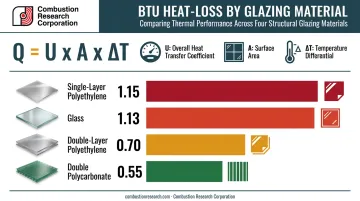
From there, size your heater using a real BTU calculation, not a square-footage guess. The standard conductive formula is Q = U x A x ΔT.
Here, U is your glazing's heat-loss factor, A is exposed surface area, and ΔT is the difference between your target indoor and coldest outdoor design temperatures for your region. This data comes from Purdue University's greenhouse heating calculations.
Glazing choice changes that number dramatically:
| Glazing type | U-factor (Btu/hr-ft²-°F) |
|---|---|
| Single-layer polyethylene | 1.15 |
| Glass | 1.13 |
| Double-layer polyethylene | 0.70 |
| Double polycarbonate | 0.55 |
A double-polycarbonate structure loses roughly half the heat of a single-poly house of the same size. Skip this step and you'll either undersize your heater or pay for far more capacity than you need.
Step 2: Insulate and Seal the Structure Before Adding Heat
Before you shop for heaters, walk your greenhouse and hunt for drafts. Check door seals, vent gaskets, and where the glazing meets the foundation. Every gap is a spot where warm air escapes and cold air pours in, undermining any heater you eventually install.
Practical fixes include:
- Weatherstripping doors and roof vents
- Sealing foundation and glazing seams with appropriate caulk
- Adding thermal mass, such as water barrels, pavers, or a concrete floor, to soak up daytime heat and release it overnight
- Installing insulating curtains or bubble-wrap glazing layers for the coldest months
The payoff is real. Michigan State University reports that well-installed retractable thermal curtains can cut seasonal greenhouse heating energy by up to 30%. That's a meaningful reduction before you've even touched the heat source.
Step 3: Select and Install the Right Heating System
Now match a heater to your structure. Electric units suit small hobby greenhouses. Gas and propane heaters scale further but bring combustion byproducts into the conversation. Geothermal works well for new builds with the budget for ground-loop installation.
For larger or commercial operations, low-intensity infrared changes the equation. Instead of heating air that then drifts and stratifies near the roof, ceiling-mounted radiant tube systems warm the plant canopy, benches, and floor directly.
Combustion Research Corporation's Reflect-O-Ray line, for example, is custom-engineered across a 40,000 to 250,000 BTU/hr range, scaling from a 500-square-foot hoop house to structures well over a million square feet. The Omega II 9K Series (30,000 to 220,000 BTU/hr) offers a pre-engineered, power-vented alternative for facilities that don't need a fully custom layout.
One non-negotiable rule: any combustion heater must be vented to the outside. Unvented units release ethylene, carbon monoxide, and sulfur dioxide directly into the growing space.
UMass Extension documents that ethylene injury in greenhouse crops can occur at concentrations as low as 0.01 ppm, causing malformed leaves, stunted growth, and early flower drop. That's an easy, invisible way to lose a crop without ever seeing frost damage.
Step 4: Add Air Circulation and Temperature Monitoring
Even the best heater fails if heat doesn't move evenly through the space. Cold pockets near doors and glazing edges create uneven growth and, worse, condensation that fuels fungal disease.
Round out your system with:
- Install circulating fans to eliminate stagnant air pockets and reduce humidity buildup on leaf surfaces
- Add a thermostat or greenhouse controller to automate heater cycling instead of running it manually
- Run daily temperature checks, adjusted ahead of forecasted cold snaps rather than after plants show stress
Growers who wait until they see wilting or blackened leaves are already too late. Check your forecast every afternoon during shoulder-season months, not just when a hard freeze is announced.
Is Heating a Greenhouse Worth It?
Not every greenhouse needs supplemental heat. It depends on your climate, your crops, and whether you're chasing year-round production or just extending a couple of extra months.
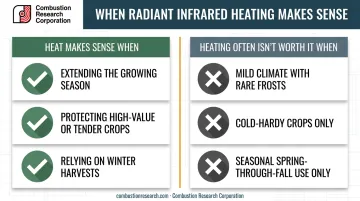
Heating makes sense when:
- You're extending the growing season into fall or early spring
- You're protecting high-value or tender crops that can't tolerate near-freezing temperatures
- You rely on winter harvests as part of your business model
Heating often isn't worth it when:
- You're in a mild climate zone with rare hard frosts
- You've selected cold-hardy crops exclusively
- You only run the greenhouse spring through fall anyway
There's no universal break-even formula here, since the math depends on your crop value, local fuel prices, and how likely a given freeze event actually is. But the logic is straightforward: even a modest frost-protection heater that costs a few hundred dollars to run over a season is cheap insurance against losing an entire planting overnight.
One bad frost can erase far more value than months of heating bills combined. High-efficiency radiant heaters cut fuel costs by 30-50% versus conventional systems, making that insurance cheaper still.
Choosing the Best Heating Method for Your Greenhouse
"Cheapest" and "best" aren't the same question. Cheapest usually points to passive, no-fuel methods. Best means the most efficient, consistent option for your specific structure and climate.
Passive & Low-Cost Methods
Thermal mass, compost heaters, and hotbeds cost little to nothing and work well in small greenhouses or mild climates. Their ceiling is real, though.
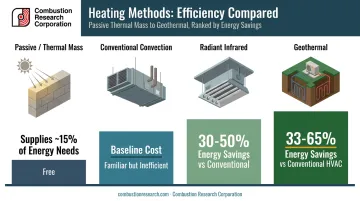
ATTRA estimates that compost sized primarily for CO2 production may supply only about 15% of a greenhouse's total energy needs in cold conditions. These methods work best as a supplement, not a primary heat source, once temperatures drop hard.
Conventional Convection Heaters
Electric and gas/propane convection heaters remain popular because they're familiar and cheap to buy upfront. Electric heaters scale poorly on operating cost as greenhouse size grows, and gas units carry the combustion byproduct risks covered in Step 3. They're a reasonable starting point for small hobby setups, less so for commercial production.
Radiant & Infrared Heating Systems
Infrared heaters skip the middleman. Rather than warming air that then has to reach your plants, they radiate energy directly onto crops, benches, and floors, similar to how sunlight warms a surface. That means less energy wasted heating the air near the roof where it does nothing for the canopy below.
CRC's product data illustrates the range here. The Omega II DI PEP (Stainless Steel), a dual two-stage unit, is documented to save up to 75% in energy costs, thanks to precise air-to-gas ratio control at both high and low fire. Across the broader Reflect-O-Ray, Omega II, and Serengeti-IR lines, documented savings run 30-50% versus conventional forced-air heating.
These systems also mount overhead, freeing up bench and floor space that a floor-standing convection unit would otherwise occupy. They don't stir up dust or pathogens the way forced-air blowers can.
Renewable & Geothermal Systems
Geothermal heat pumps carry a higher upfront investment but pay off over time, especially for new construction where the ground loop can be installed during initial excavation.
The U.S. Department of Energy reports geothermal heat pumps deliver 33-65% energy savings against conventional HVAC baselines in general building applications. A Michigan propagation greenhouse using in-floor geothermal heat reported winter electricity costs around $350 per month for a 5,000-square-foot space. Results vary by site, ground conditions, and existing insulation.
Bottom line: start with passive and thermal mass methods if budget is tight and your climate is forgiving. For consistent, cost-effective performance at commercial scale, radiant infrared or geothermal systems are worth the investment.
Key Factors That Affect Greenhouse Heating Performance
Your heater's rated output is only part of the story. A handful of controllable variables determine whether that heat actually keeps your crops safe.
Climate zone & outdoor temperature swings Colder regions demand considerably higher BTU capacity, plus a backup heat source for sudden cold snaps. Undersized systems fail exactly when you need them most, during an unexpected overnight plunge.
Greenhouse size & glazing type Larger surface area and single-layer glazing lose heat far faster than double-wall or insulated structures. Two greenhouses of identical size can have wildly different heating costs based on glazing alone.
Insulation & air sealing Gaps and uninsulated foundations cause continuous heat loss regardless of heater power. A sealed, well-insulated structure needs a smaller, less expensive heating system to hit the same target temperature.
Heater placement & heat distribution A single, poorly placed floor unit creates cold pockets near edges and doors. Ceiling-mounted radiant systems paired with circulating fans produce far more uniform temperatures than one centralized floor heater trying to cover the whole structure.
Common Mistakes to Avoid When Heating a Greenhouse
Even experienced growers fall into these traps:
- Undersizing the heater by estimating from square footage alone, ignoring glazing type and regional design temperatures
- Poor insulation and sealing before installing a heat source, which sends your heat straight outdoors through every gap and crack
- Using unvented gas or propane heaters indoors, releasing ethylene and carbon monoxide that damage or kill plants long before you notice frost stress
- Ignoring air circulation, which leads to cold pockets, condensation buildup, and higher fungal disease pressure across your crop
Each of these is fixable before you spend a dollar on equipment. Fix the envelope, calculate the real load, vent properly, and circulate the air. Power-vented radiant heaters, such as Combustion Research Corporation's Omega II line, exhaust automatically and eliminate that risk.
Frequently Asked Questions
What is the cheapest way to heat a greenhouse?
Passive methods like thermal mass (water barrels, pavers) and compost heaters cost the least, but they offer limited capacity in genuinely cold climates. Pair them with good insulation for the best results.
What is the best way to heat a greenhouse?
It depends on size and climate, but radiant infrared and geothermal systems typically deliver the most consistent, energy-efficient performance for serious or commercial growing operations.
Is it worth heating a greenhouse?
It's worth it if you're extending your season, protecting high-value crops, or growing year-round. In mild climates with cold-hardy crops only, supplemental heat may not be necessary.
How warm should a greenhouse be kept in winter?
Most tender plants need a minimum of 45-50°F, while hardier crops can tolerate temperatures closer to freezing without lasting damage.
Can you heat a greenhouse without electricity?
Yes. Thermal mass, compost heaters, hotbeds, and passive solar design all work without electricity, though they demand more manual monitoring and generally provide less capacity than powered systems.
What size heater do I need for my greenhouse?
Heater size comes from a BTU calculation based on square footage, glazing type, and your coldest expected outdoor temperature. For larger or commercial structures, consult a heating specialist to get the load calculation right.