The confusion is understandable. Every infrared heater is technically a radiant heater. But not every radiant heater is an infrared heater. That distinction sounds academic until you're specifying heating for a 50,000-square-foot distribution center with 30-foot ceilings and bay doors that open dozens of times a day — and suddenly the wrong choice costs you tens of thousands in annual energy waste.
This article breaks down exactly what separates these two categories, how each performs in real industrial environments, and how to choose the right system for your facility.
Key Takeaways
- Radiant heat is the broad category — any heat transfer through electromagnetic waves rather than circulating air.
- Infrared heat is a specific subset of radiant heat — it warms objects and people directly, bypassing the air entirely.
- In industrial settings, "radiant heater" typically means high-intensity spot heaters, while "infrared heater" usually refers to low-intensity tube heaters for zone or whole-facility heating.
- Low-intensity infrared tube heaters generally deliver 30–50% energy cost savings over conventional forced-air systems in high-ceiling industrial facilities.
- Matching the right system to your facility — ceiling height, size, ventilation needs, and door frequency — determines which option performs best.
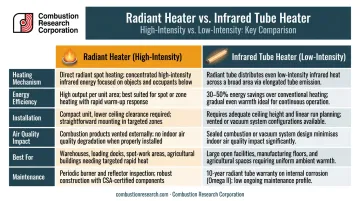
Infrared vs Radiant Heater: Quick Comparison
| Factor | Radiant Heater (High-Intensity) | Infrared Tube Heater (Low-Intensity) |
|---|---|---|
| Heating Mechanism | Short-wave infrared; concentrated, high-intensity spot output | Long-wave infrared; radiant heat distributed across objects and occupants |
| Energy Efficiency | Efficient for targeted spot zones | 30–50% savings vs. forced-air in large facilities |
| Installation | Portable, wall-mounted, or ceiling spot-mount | Ceiling-mounted; preserves all floor space |
| Air Quality Impact | No fan; can create localized hot spots | No fan, no air circulation, no dust redistribution |
| Best For | Small enclosed spaces, task heating | Warehouses, hangars, service bays, large facilities |
| Maintenance | Varies; element replacement may be frequent | No filters, no moving parts, minimal service calls |
What Is a Radiant Heater?
Any system that transfers thermal energy through electromagnetic waves qualifies as radiant — heated concrete floors, baseboard units, and ceiling-mounted industrial heaters all fall under the same category. The DOE's thermodynamics handbook defines radiant heat as one of three fundamental transfer modes, alongside conduction and convection.
Traditional radiant heaters emit thermal energy that surfaces absorb and re-radiate back into the space. This works well in well-insulated, enclosed environments.
The physics become less favorable when ceiling heights climb above 14 feet, when doors open frequently, or when the heated air volume is simply too large to stay consistent at floor level — where workers actually are.
Where Radiant Heaters Work Well
Conventional radiant heaters suit a narrower set of applications than the broad category name implies:
- Supplemental heating in small, enclosed workshops
- Spot heating at individual workstations or loading dock positions
- Short-duration zone heating in commercial spaces
- Residential baseboard or in-floor systems
Where They Struggle
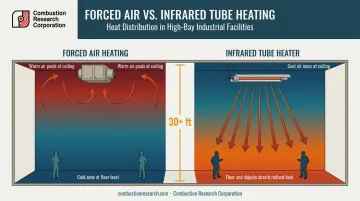
In large industrial environments — warehouses, aircraft hangars, vehicle service bays — broad radiant systems without directional precision face a real limitation. ASHRAE's analysis of thermal stratification in high-bay spaces confirms what facility managers already know: lower-density warm air rises and pools at the ceiling, never reaching floor level. Workers stay cold. Energy bills stay high.
What Is an Infrared Heater?
Infrared heaters are a specific subcategory of radiant heaters. They emit infrared radiation — an invisible band of the electromagnetic spectrum — that travels through air and directly heats solid objects, surfaces, and people on contact, without warming the air in between.
The AHRI Infrared Heater Safety Council describes this as working similarly to the way the sun warms the earth: people and objects become heat sinks, absorbing warmth regardless of ambient air temperature. This is why an infrared system can keep workers comfortable in a space that would require thousands more BTUs to heat conventionally.
High-Intensity vs. Low-Intensity: The Key Distinction
| Type | Element | Surface Temp | Best For |
|---|---|---|---|
| High-Intensity | Quartz or ceramic tile | ~1,800°F | Spot/task heating, high-air-change environments |
| Low-Intensity Tube | Gas-fired tube (no visible glow) | ~1,100°F | Zone or whole-facility heating from ceiling mount |
Combustion Research Corporation's product lines reflect this split directly. The Synergy line covers high-intensity applications with single and dual-stage configurations from 30K to 200K BTUs. The Omega II (power-vented) and Reflect-O-Ray (vacuum-vented) lines are low-intensity infrared tube heaters — purpose-built for demanding industrial environments where zone heating, air quality, and long-term operating cost matter most.
Why Ceiling Height Changes Everything
Because infrared heaters warm objects rather than air, heat doesn't stratify at the ceiling. In facilities above 14 feet — which covers most warehouses, hangars, and service bays — this difference is significant. The floor itself acts as a thermal reservoir, retaining absorbed heat even when bay doors open and close repeatedly. Forced-air systems lose that stored warmth immediately; infrared systems don't.
Air Quality and Safety
Infrared tube heaters contain no fans and move no air. According to the AHRI IRSC, gas-fired infrared heaters warm people and objects directly without the blower-driven air circulation that redistributes dust, allergens, and airborne contaminants. This matters in:
- Food processing and agricultural facilities
- Auto body and paint shops
- Animal confinement buildings
- Any facility handling sensitive inventory or fine particulates
These low-intensity systems support this further: no combustion air filters to replace, no moving parts to service. Vacuum-vented configurations (Reflect-O-Ray) pull combustion gases under negative pressure, so any tube breach draws ambient air inward rather than pushing exhaust into the occupied space.
Which Is Better for Industrial Applications?
There's no universal answer, but the decision framework is straightforward once you know your facility's parameters.
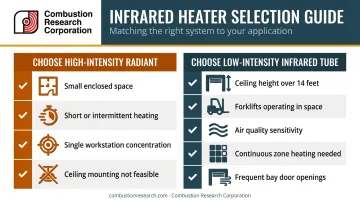
Choose a High-Intensity Radiant Heater When:
- The space is small and well-enclosed
- Heating duration is short or intermittent
- You need concentrated warmth at a single workstation
- Ceiling mounting of tube systems isn't structurally feasible
Choose Low-Intensity Infrared Tube Heaters When:
- Ceiling height exceeds 14 feet — stratification makes forced-air inefficient
- Bay doors open frequently — shipping docks, hangars, service bays lose heat constantly
- Air quality is a concern — food, animals, paint, or sensitive manufacturing
- Continuous zone heating is required — thermostatically controlled comfort across large areas
- Forklifts or material-handling equipment operate in the space — ceiling-mounted systems eliminate ground-level collision hazards entirely
The Cost Equation
Upfront cost comparisons between infrared tube systems and forced-air unit heaters often favor unit heaters on paper. Operational costs flip that equation. Combustion Research Corporation's low-intensity systems deliver 30–50% energy savings over conventional heating systems — consistent with published industry data comparing gas-fired infrared to forced-air in high-ceiling industrial buildings.
Over a 10-year service life — backed by a 10-year warranty on radiant tubes for internally created corrosion on Omega II models — infrared tube systems become the clear financial choice for any facility continuously heating more than a few thousand square feet.
Real-World Performance in Industrial Settings
The strongest independent data available comes from ACEEE case studies of infrared heating in industrial applications, which documented several facility conversions from forced-air to low-intensity infrared tube systems:
- An auto service garage with 18–20 ft ceilings replaced forced-air gas unit heaters with low-intensity infrared, saving 7,800 therms and over $8,300 annually against a $40,000 implementation cost — payback under 5 years.
- A maintenance airplane hangar that upgraded from a single-pass infrared system to double-run emitters saved approximately 18,800 therms, a 30% reduction.
- A furniture plant warehouse combined low-intensity infrared with controls and night setback, achieving 60%+ savings — including a 5°F setpoint reduction and after-hours energy reduction.
The results above reflect the same facility types Combustion Research Corporation's systems are built for. The Omega II and Reflect-O-Ray lines serve warehouses, aircraft hangars, auto dealerships, service bays, natatoriums, and shipping docks — with engineering support available for both new construction and retrofit projects.
Combustion Research Corporation provides heat loss calculations, layout review, and system specification support before construction begins. Contact our team at 888-852-3611 or info@combustionresearch.com to discuss your facility's requirements.
Conclusion
For supplemental or spot heating in small enclosed spaces, a general radiant heater may be perfectly adequate. For large industrial facilities with high ceilings, active machinery, and ongoing energy costs, low-intensity infrared tube heating is the clear choice.
The numbers back that up:
- 30–50% reduction in heating costs compared to conventional systems
- No heat stratification in high-ceiling spaces
- Zero air circulation to spread dust or contaminants
- Floor space fully preserved for operations
These gains affect energy budgets, worker comfort, and facility safety — all at once.
Frequently Asked Questions
Which is better, radiant heat or infrared heat?
Infrared heat is a more targeted, efficient form of radiant heat. For most industrial and commercial applications, infrared outperforms general radiant heating because it warms objects and occupants directly rather than the air — delivering faster comfort, lower energy waste, and consistent results even in high-ceiling or drafty facilities.
What is the healthiest type of heater?
Infrared heaters are the healthiest option for occupied industrial spaces. They produce no combustion byproducts at the point of use, contain no fans that circulate dust or pathogens, and deliver radiant warmth without drying out the air — a real advantage in food processing, animal care, and similar environments.
What is the difference between high-intensity and low-intensity infrared heaters?
High-intensity infrared heaters use a glowing element at approximately 1,800°F for concentrated spot heating. Low-intensity tube heaters run a gas-fired burner through a long heat exchanger at roughly 1,100°F, delivering even zone or whole-facility warmth from the ceiling — making them the better fit for most large industrial spaces.
Are infrared tube heaters energy-efficient for warehouses and large facilities?
Yes — low-intensity infrared tube heaters are among the most energy-efficient options for large industrial spaces. By heating occupied zones directly from ceiling height, they eliminate the heat stratification and air-volume waste that make forced-air and convection systems so costly in high-ceiling buildings.
Do infrared heaters circulate dust or allergens in industrial facilities?
No. Infrared heaters contain no fans and do not move air, making them the preferred choice in environments sensitive to airborne particulates — including animal confinement facilities, food processing areas, auto body shops, and any space where dust redistribution is a compliance or quality concern.
How long do industrial infrared tube heaters typically last?
Quality low-intensity infrared tube heaters deliver long service life with minimal maintenance — no filters, no moving parts, no condensation-prone components. Combustion Research Corporation backs its Omega II systems with a 10-year limited warranty on radiant tubes for internally created corrosion.