Many garage owners struggle with the same problems: heaters that take forever to warm up, units that trip a breaker, or systems that need a natural gas line they don't have. Propane solves all three by delivering high-Btu heat on demand, straight from a portable cylinder or a permanently piped tank.
This guide covers both worlds. You'll find portable propane heaters built for weekend projects, plus permanent infrared systems designed for service bays and commercial-grade garages that run heat all day, every day.
Key Takeaways
- Propane garage heaters deliver fast, high-BTU heat without needing 240V wiring or a gas line hookup
- Portable heaters suit occasional use; permanent infrared units suit daily or commercial use
- Safety features like oxygen depletion sensors and tip-over shutoff are essential for any indoor unit
- Sizing depends on garage square footage, insulation, and ceiling height, not BTU alone
- High-use service garages save more with a permanently mounted infrared system than with portable units
Overview of Propane Garage Heaters in 2026
Propane garage heaters generate heat by burning liquid propane, either through open-flame radiant and convection designs found in portable units, or through sealed combustion tube systems used in permanent infrared heaters. Both approaches work well in garages without a natural gas hookup, since propane arrives in a cylinder or tank rather than through a utility line.
That flexibility matters more than ever, since garage-based workspaces are booming. The U.S. garage organization and storage market is projected to reach $6.71 billion by 2033, growing at a 7.7% CAGR from 2025 to 2033, according to Grand View Research. Homeowners and shop owners are clearly investing in making garages functional year-round, and heat sits at the center of that shift.
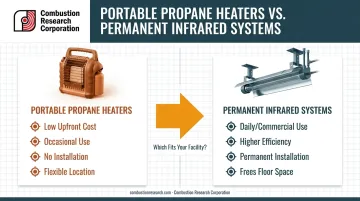
The list below splits into two categories:
- Portable propane heaters – best for occasional, personal-use warmth
- Permanent infrared systems – best for daily-use or commercial garages
Match your usage pattern to the right category before you shop on BTU alone.
Top 5 Best Propane Garage Heaters for 2026
We evaluated each pick on five factors: heat output (Btu), safety certifications, portability versus permanence, ease of setup, and whether it's built for residential or commercial-grade use. Here's how the field shakes out.
Mr. Heater Big Buddy Propane Heater
The Big Buddy is a portable radiant/convection heater that runs on swappable 1-lb propane cylinders, no outlet needed. It's a favorite for personal spot-heating in small to mid-size garages, and it crosses over easily to camping and job-site use.
What sets it apart is its safety package. An automatic oxygen depletion sensor and accidental tip-over shutoff come standard, and the unit runs noticeably quieter than most forced-air alternatives.
| Feature | Details |
|---|---|
| Heat Output | 4,000 / 9,000 / 18,000 Btu/hr, rated for up to 450 sq. ft. |
| Power Source | Two 1-lb propane cylinders (internal); no electrical hookup required |
| Best For | Personal spot-heating, small garages, occasional use, outdoor crossover |
Mr. Heater Portable Propane Forced-Air Heater (MH60QFAV)
This forced-air convection heater plugs into a standard 115V outlet to power its fan while burning propane for heat, producing a fast, whole-garage warmup that radiant models can't match.
Speed is what makes it stand out. A high Btu range and a simple hose-and-regulator setup make it a strong all-purpose pick for two-car garages where you need heat now, not in twenty minutes.
| Feature | Details |
|---|---|
| Heat Output | 30,000-60,000 Btu/hr, covers roughly 1,500 sq. ft. at max output |
| Ventilation Requirement | Cracked door or window for combustion air and exhaust |
| Best For | Whole-garage rapid heating during active project time |
DeWalt Cordless/Corded Forced-Air Propane Heater
DeWalt's forced-air propane lineup runs the blower on either a rechargeable 20V MAX/FLEXVOLT battery pack or a standard outlet, depending on the model, while propane handles the heat itself. That flexibility is useful for off-grid job sites and garages without a convenient outlet.
Differentiators include DeWalt's shared battery platform (handy if you already own their power tools), a lightweight build, and a thermocouple-operated gas valve with high-temperature overheat detection.
| Feature | Details |
|---|---|
| Heat Output | 27,000-68,000 Btu/hr across low and high settings |
| Power Flexibility | 20V MAX/FLEXVOLT battery pack (sold separately) or corded electric, depending on model |
| Best For | Garages, job sites, or off-grid spaces needing power flexibility |
Combustion Research Corporation Low-Intensity Infrared Propane Tube Heater
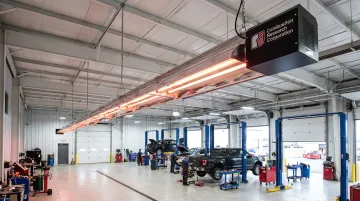
Combustion Research Corporation has built CSA-certified, low-intensity infrared heating systems for over 50 years. Its Serengeti-IR and Reflect-O-Ray tube heater lines are engineered for demanding garage and industrial applications, including service garages, auto dealerships, and oil and lube shops.
For garages used daily rather than occasionally, this category changes the math entirely. These are permanently installed, ceiling-mounted systems, so they free up floor space instead of eating it.
Radiant tube heaters also warm surfaces and occupants directly rather than heating the full volume of air. That means even warmth without stirring up dust or drafts, a real advantage in a shop full of sawdust or metal fines.
Every propane-compatible Reflect-O-Ray and Serengeti-IR model carries a 10-year limited warranty on the burner core and heat exchanger tubes. Engineering support for installation planning comes standard too, something you won't find with a portable unit off a shelf.
| Feature | Details |
|---|---|
| Efficiency | Manufacturer-stated energy savings of 30-50% versus conventional forced-air heating |
| Certifications | CSA International Design Certified to ANSI/CGA Standards; ANSI Z83.20 / CSA 2.34 |
| Best For | Service garages, oil & lube shops, large or multi-bay garages needing continuous, even heat |
Remington/Heat Hog Portable Propane Forced-Air Heater
If budget is the deciding factor, Remington's forced-air propane heaters deliver adequate heat for small to mid-size garages without the premium price tag. Setup is about as simple as it gets: connect the 20-lb tank, plug in the cord, and go.
It won't out-perform the pricier picks on this list, but for occasional supplemental heat, it gets the job done at a fraction of the cost.
| Feature | Details |
|---|---|
| Pricing | Entry-level/value pricing relative to other picks on this list |
| Heat Output | Up to 60,000 Btu/hr, covers up to 1,500 sq. ft. |
| Best For | Budget-conscious buyers who need occasional supplemental heat |
How to Choose the Right Propane Garage Heater for Your Space
The biggest mistake buyers make is picking Btu output based on garage size alone. Insulation quality, ceiling height, and ventilation all change how much heat you actually need.
Sizing Your Heater by Btu and Garage Size
As a rough benchmark, most manufacturer coverage ratings work out to roughly 40 Btu per square foot at maximum output. That translates to:
- One-car garage (~240 sq. ft.): around 9,600 Btu/hr
- Two-car garage (~360-480 sq. ft.): roughly 14,400-19,000 Btu/hr
- Three-car garage (~700 sq. ft.): around 28,000 Btu/hr
Poor insulation, high ceilings, and an uninsulated garage door can push those numbers up significantly. Undersizing means you'll never hit your target temperature; oversizing causes short-cycling and uneven heat.
Portable vs. Permanent Propane Heaters
Portable units win on flexibility and upfront cost. Grab a portable propane heater, use it for a weekend project, and put it away when you're done.
Permanently installed infrared tube systems cost more to install but deliver better efficiency and comfort over time. Light-commercial units — the type manufacturers like Combustion Research Corporation build for service bays and heated shops — make more sense once a garage moves beyond occasional use into daily work space territory.
Ventilation and Safety Requirements
Every propane heater needs fresh air, even models labeled "indoor-safe." Look for these features before buying:
- Oxygen depletion sensors (ODS) – automatically shut off gas flow if oxygen drops too low
- Tip-over shutoff – cuts fuel if the unit falls or tilts
- Thermo-electric safety valves – stop gas flow if the flame goes out
The Consumer Product Safety Commission advises never leaving a portable heater running unattended in a confined space and recommends working carbon monoxide alarms in any space where fuel-burning appliances operate.
Placement and Mounting Best Practices
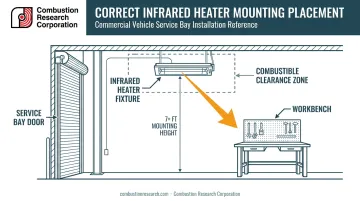
Permanent infrared heaters should be mounted per manufacturer clearance specs, commonly cited as at least 7 feet from the floor with adequate distance from combustibles. Position the unit to direct heat toward workbenches or high-traffic zones rather than the center of the room. Mounting opposite the garage door also helps, since it reduces heat loss every time the door opens.
How We Chose the Best Propane Garage Heaters
We compared each unit against manufacturer specifications, safety certifications like CSA and ANSI standards, and real-world use cases spanning small service garages to heavy-duty industrial bays. Our criteria included:
- Heat output and effective coverage area
- Safety certifications and built-in protection features
- Build quality and warranty terms
- Ease of installation, from simple setup to professional contractor installs
- Suitability across light-commercial and heavy industrial applications
Conclusion
There's no single "best" propane garage heater, only the best one for how you'll actually use your space. Occasional personal warmth calls for a portable radiant or forced-air unit. Daily-use or commercial garages get more value from a permanently installed, efficient infrared system.
Before you buy, weigh long-term operating costs, safety features, and warranty coverage, not just the price tag on the box. A cheaper heater that runs inefficiently for years can cost more than a premium system with a real warranty behind it.
For service garages, warehouses, or other heavy-use spaces, Combustion Research Corporation's engineering team can help specify a durable, energy-efficient gas-fired infrared heating system built for your exact layout. Contact CRC to talk through your project.
Frequently Asked Questions
Where should I hang my garage heater?
Infrared heaters should be mounted high, commonly 7+ feet from the floor per manufacturer specs, angled toward work areas rather than the room's center. Placing it opposite the garage door minimizes heat loss and improves even coverage.
What kind of heater is best for a garage?
It depends on use. Portable propane forced-air heaters suit occasional whole-garage warmup, while low-intensity infrared systems suit daily-use or commercial garages needing consistent, dust-free, energy-efficient heat.
Is it safe to use a propane heater in an enclosed garage?
Portable propane heaters require ventilation, a partially open door or window, even if labeled "indoor-safe." Permanently vented systems are the safer choice for fully enclosed, continuously used spaces.
How many Btu do I need to heat a two-car garage?
A two-car garage typically needs roughly 14,000-19,000 Btu/hr, using the 40 Btu-per-square-foot benchmark. Poor insulation or high ceilings can push that number well past that range.
Can I run a propane heater overnight in my garage?
Most portable propane heaters aren't designed for unattended overnight use and should be shut off when the garage is empty. Permanent vented systems, by contrast, are engineered for continuous, unattended operation.
What is the difference between propane and natural gas garage heaters?
Propane heaters offer installation flexibility since they don't require a gas line, just a cylinder or tank. Natural gas heaters are typically more economical to run long-term but need a professional gas line hookup first.