Introduction
Radiant heating is having a moment. The global market for hydronic underfloor heating alone is projected to grow from $3.0 billion in 2025 to $5.6 billion by 2035, with new residential construction driving nearly 87% of that revenue, according to a 2026 market analysis from Contractor Magazine.
Commercial and industrial facilities are shifting too, replacing noisy forced-air units with ceiling-mounted infrared tube heaters that skip the dust and reclaim floor space.
Cold floors, uneven heat, and winter utility spikes are common complaints in warehouses, hangars, and industrial facilities. Forced-air systems heat the air first. That warm air rises, stratifies near the ceiling, and escapes the moment a dock door or hangar bay opens.
Radiant heat sidesteps that problem entirely by warming people, floors, and equipment directly. This guide breaks down the radiant heating landscape for 2026 — the technology types, the top manufacturers for warehouses, hangars, and outdoor commercial spaces, and how to choose the right system for your project.
Key Takeaways
- Radiant heating splits into two families: floor systems for homes and infrared tube/panel systems for commercial, industrial, and outdoor use
- Documented energy savings of 30-50% over forced-air heating apply across both floor and infrared technologies
- Top picks include Warmboard, WarmlyYours, and Warmup for residential floors, plus Combustion Research Corporation and Infratech for commercial and outdoor spaces
- Match technology to space and application first: certification, warranty, and engineering support matter more than brand name
What Is Radiant Heating? Understanding the 2026 Market
Radiant heating transfers heat directly to people and objects instead of warming the air around them. That's the core distinction from forced-air convection systems, which heat air and rely on circulation to distribute warmth.
The Department of Energy defines radiant heating as delivery through floor, wall, or ceiling panels: either electric cables/mats or hydronic tubing carrying heated water.
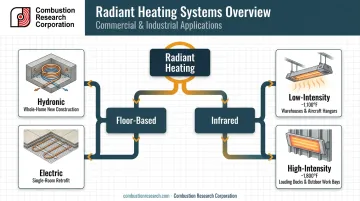
"Radiant heating systems" is really an umbrella term covering very different technologies:
- Hydronic and electric floor heating: built into residential subfloors for whole-home comfort or single-room retrofits
- Low-intensity infrared tube heaters: ceiling-mounted for large commercial and industrial spaces
- High-intensity infrared panels: rapid spot heating for docks, patios, and outdoor seating
The applications range widely: a heated bathroom floor, a 200,000-square-foot distribution center, an aircraft hangar with 20-foot ceilings, or a restaurant patio in January. Each of those spaces calls for a different radiant technology, which is exactly what the next section covers.
Types of Radiant Heating Systems for 2026
Floor-Based Radiant Heating (Residential)
Floor heating comes in two forms. Hydronic systems pump heated water through tubing beneath the floor, typically powered by a boiler running on gas, oil, or even solar. They suit whole-home new construction, where tubing gets embedded during the build.
Electric systems use cables or mats installed directly under tile, stone, or hardwood — a far simpler retrofit for a single bathroom or kitchen without touching the whole house's heating plant.
Infrared Radiant Heating (Commercial, Industrial & Outdoor)
Commercial and industrial buildings rely on infrared instead, which splits by intensity. Low-intensity tube heaters run hot exhaust through tubing at roughly 1,100°F and mount overhead in warehouses, hangars, and garages for total-building heat, a category that includes Combustion Research Corporation's Omega II and Reflect-O-Ray tube heaters.
High-intensity infrared burns at closer to 1,800°F on ceramic surfaces, delivering fast spot heat for high-bay zones, loading docks, or outdoor patios, a niche filled by ceramic units such as CRC's Synergy line.
The AHRI Infrared Heater Safety Council requires model-specific clearances to combustibles and minimum ventilation rates for unvented installations.
| Factor | Floor Heating | Infrared Heating |
|---|---|---|
| Best Use Case | Whole-room or whole-home comfort | Large-volume or spot heating |
| Installation Location | Beneath floor covering | Ceiling-mounted or wall-mounted |
| Typical Space Type | Bathrooms, kitchens, whole homes | Warehouses, hangars, garages, patios |
Best Radiant Heating Systems for 2026
Selection here comes down to four factors: energy efficiency, durability and warranty strength, third-party certifications, and fit across residential, commercial, or industrial use.
Combustion Research Corporation
Combustion Research Corporation (CRC) has manufactured low-intensity infrared tube heaters for over 50 years, purpose-built for demanding industrial and commercial environments. Its systems carry CSA International Design Certification to ANSI/CGA standards, and the product line spans the pre-engineered Omega II packages through the fully custom Reflect-O-Ray Engineered Design System (EDS).
What sets CRC apart:
- True Dual Modulating heaters that adjust both gas and air across high- and low-fire stages
- Stainless steel combustion chambers for corrosive environments like natatoriums and ice arenas
- Vacuum- and power-vented configurations with no filters or maintenance-prone components
- A 10-year limited warranty on the burner core and heat exchanger tubes
| Best For | Large industrial/commercial spaces (warehouses, hangars, garages, barns) needing ceiling-mounted heat that saves floor space |
| Key Features | Vacuum/power-vented configurations, no filters or maintenance-prone parts, 30-50% documented energy savings vs. conventional heating |
| Warranty/Certification | 10-year limited warranty on burner core and heat exchanger tubes; CSA certified to ANSI Z83.20/CSA 2.34 |
Warmboard
Warmboard is a hydronic radiant floor heating manufacturer built around aluminum-clad subfloor panels. The aluminum layer's thermal conductivity runs roughly 360 times that of gypsum-based thin-pour systems, letting the panels respond to temperature changes far faster than standard installations.
That conductivity advantage matters for two reasons: it allows much lower water temperatures, which cuts the boiler's workload, and it delivers even heat across the whole floor rather than warm spots near the tubing. Warmboard-S serves new construction with structural 7-ply plywood panels, while Warmboard-R is a thinner OSB panel built for remodels.
| Best For | Whole-home hydronic heating in new builds and major renovations |
| Key Features | Aluminum panel technology, room-by-room zoning, compatible with tile, hardwood, and most floor coverings |
| Pricing/Warranty | Sold by project quote based on home size and complexity; panels warranted for the life of the structure, tubing for 25 years |
WarmlyYours
WarmlyYours is an established electric radiant floor brand with a large installed base, built around its TempZone cable and mat systems. These deliver 15 watts per square foot and pair with smart WiFi thermostats that support scheduling and voice control through Alexa or Google Home.
The system fits best where a full hydronic retrofit doesn't make sense — a single bathroom, kitchen, or small addition. TempZone rolls run roughly $18-$20 per square foot for the heating element alone, before installation labor.
| Best For | Bathroom, kitchen, and single-room electric floor heating retrofits |
| Key Features | TempZone cables/mats, smart WiFi thermostat compatibility, wide flooring compatibility |
| Pricing/Warranty | Roughly $18-$20/sq ft for the heating element; backed by a 25-year "No Nonsense" warranty |
Warmup
Warmup, a UK-founded manufacturer with US operations, built its reputation on the DCM-PRO uncoupling membrane system, UL listed under file E303230 and rated for tile and stone floors. Standard cable spacing delivers about 13 watts per square foot, and a tighter 2-peg spacing pushes that to 16 watts.
Beyond indoor floors, Warmup also makes WSMM snow-melting mats rated at 50 watts per square foot for driveways and walkways, a category most floor-heating brands skip entirely.
| Best For | Tile and stone floor heating, plus outdoor snow-melting applications |
| Key Features | UL-listed DCM-PRO membrane, Smart WiFi thermostats, dedicated snow-melting product line |
| Pricing/Warranty | Cable warranty runs 30 years; membrane carries a limited lifetime warranty; snow-melting products carry a 10-year warranty |
Infratech
Infratech specializes in electric infrared panels designed for outdoor comfort — patios, covered dining, and semi-outdoor commercial seating. The W-Series spans 750 to 4,000 watts across low-profile fixtures that mount 6 to 10 feet overhead and reach full heat almost instantly.
Restaurants and hospitality venues favor Infratech because the panels mount flush to a ceiling or pergola, avoiding the bulky freestanding heaters common on patios, and controls range from a simple on/off switch to zoned dimming.
| Best For | Patios, outdoor dining, and semi-enclosed commercial comfort heating |
| Key Features | Instant-on electric infrared panels, weatherproof design, dimmable and zoned control options |
| Pricing/Warranty | Retail pricing runs roughly $700+ per unit depending on wattage; backed by a 3-year warranty with registration |
How to Choose the Right Radiant Heating System
The most common mistake buyers make is picking a system based on upfront price alone, without factoring in space size, insulation levels, or total operating cost over the system's life. A cheap unit that's undersized for a 40,000-square-foot warehouse will cost far more in wasted fuel than a properly specified system.
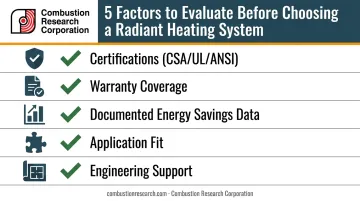
Evaluate these factors instead:
- Certifications (CSA/UL/ANSI): confirms independent testing, not just manufacturer claims
- Warranty coverage: a 10-year tube warranty signals more confidence than a 1-year warranty
- Documented energy savings data: look for figures tied to specific product lines, not vague industry averages
- Application fit: residential floor heat and industrial infrared solve different problems; don't force one into the other's job
- Engineering support: without it, a miscalculated layout in a large space turns into years of wasted fuel
For big facilities, that last point carries real weight. Undersizing a system in a 20-foot-ceiling hangar or a frequently door-cycled warehouse leads to chronic discomfort and higher fuel bills for the life of the building.
This is where manufacturers like Combustion Research Corporation provide heat-load calculations and layout engineering before a single unit ships, rather than leaving specification to guesswork.
Conclusion
Picking the right radiant heating system in 2026 means matching the technology to your space and application, not chasing a single "best" option. A hydronic floor from Warmboard makes sense for a new-construction home. That same system would be the wrong tool for a 100,000-square-foot warehouse, where a low-intensity infrared tube heater like CRC's Omega II does the job far more efficiently.
Before committing, weigh energy savings potential, warranty strength, and how well the system scales with your facility's needs. Brand recognition alone won't tell you any of that.
If you're managing an industrial or commercial facility and need help specifying the right infrared heating system, Combustion Research Corporation's engineering team can help. Their heat-load consultations make sure your system is sized right the first time.
Frequently Asked Questions
How many square feet will a commercial infrared heater cover?
Commercial infrared heaters are sized by BTU output rather than wattage, so coverage depends on ceiling height, insulation, and desired temperature rise. CRC's Reflect-O-Ray and Omega II lines range from 40,000 to 250,000 BTU, engineered per facility instead of a single square-footage rule.
Which is better, radiant heat or forced-air heat?
Radiant heat warms people and surfaces directly and evenly, while forced-air (convection) systems warm the air first and rely on circulation. For sustained space heating in commercial and industrial settings, radiant generally holds comfort better without constant air movement stirring dust or debris.
What is the difference between low-intensity and high-intensity infrared heating?
Low-intensity systems, like CRC's Omega II and Reflect-O-Ray tube heaters, circulate combustion gas through long steel tubes for gentle, even heat across large spaces. High-intensity systems, like CRC's Synergy ceramic infrared heaters, generate concentrated heat quickly for spot heating in doorways, docks, or work bays.
How much does it cost to install a radiant heating system in 2026?
Commercial and industrial infrared systems are priced per project based on facility size, BTU load, and venting requirements rather than a flat per-square-foot rate. Costs vary by heater type (gas-fired tube, high-intensity ceramic, or electric infrared), so most manufacturers provide project-specific quotes.
Is radiant heating cheaper to run than forced-air heating?
Commercial and industrial infrared systems from manufacturers like CRC document 30-50% energy savings over conventional forced-air heating. Actual savings depend on building insulation, ceiling height, and how often doors cycle.
Can radiant heating systems be used in large industrial buildings like warehouses?
Yes. Low-intensity infrared tube heaters are specifically engineered for large, high-ceiling industrial spaces. CRC's Reflect-O-Ray systems, for example, can heat facilities ranging from 500 square feet to over 1 million square feet.