Across a full heating season, that expense compounds. A facility spending $8,000 per month on heating during peak winter months can easily see $40,000–$50,000 or more absorbed by a system that's working harder than it should — money that could fund equipment upgrades, staffing, or facility improvements instead.
The important point: those costs aren't fixed. They're the product of three controllable variables — which heating system was selected, how it's operated day-to-day, and the physical condition of the building around it. This guide covers all three.
Key Takeaways
- Space heating accounts for roughly 39% of warehouse energy use, making it the single largest controllable utility cost
- Thermal stratification in high-ceiling facilities forces systems to run longer while delivering less comfort at floor level
- Infrared radiant tube heaters eliminate stratification losses by heating occupants and surfaces directly, bypassing wasted air volume
- Zone-based control and smart scheduling prevent heating unoccupied areas to full comfort temperatures
- Building envelope gaps at dock doors and uninsulated roofs often drive more energy cost than the heating system itself
How Warehouse Heating Costs Build Up
Warehouse heating costs don't arrive as a single line item. They accumulate gradually through a set of overlapping inefficiencies — each one adding runtime without adding comfort.
The compounding nature is what makes this problem expensive. A poorly insulated roof, an oversized forced-air system, dead zones with no zoning controls, and absent scheduling don't waste energy in separate, contained ways — they amplify each other.
Consider a typical scenario: the forced-air system heats air that immediately migrates toward an uninsulated ceiling. That ceiling leaks the heat outside. The thermostat never reaches setpoint, so runtime extends. Common contributors to this cycle include:
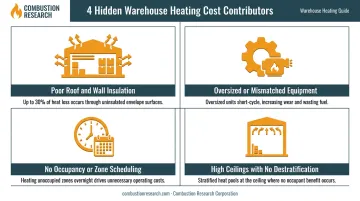
- Poor roof and wall insulation that bleeds conditioned air directly to the outside
- Oversized or mismatched heating equipment that short-cycles instead of running efficiently
- No occupancy or zone scheduling, so full output runs during unoccupied hours
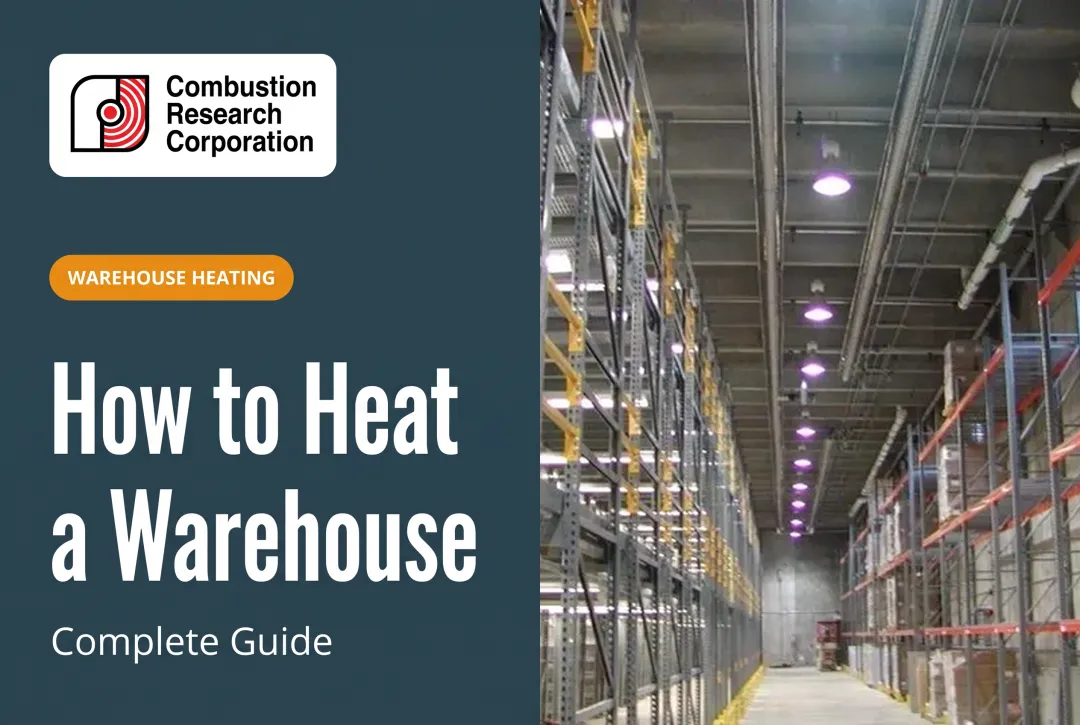
- High ceilings with no destratification, trapping heat 20–30 feet above the work floor
Across 100,000 square feet with 30-foot ceilings, those compounding losses translate to thousands of dollars in avoidable annual utility costs.
Most of these costs stay hidden. Utility bills arrive monthly, but the connection between a specific inefficiency and a specific dollar amount rarely gets made. Most warehouse operators don't trace high bills back to fixable causes until they've been overpaying for years — or until an equipment failure forces a full review.
Key Cost Drivers for Warehouse Heating
Understanding where money goes is the prerequisite for cutting it. Three drivers dominate most warehouse heating budgets.
Thermal Stratification
In facilities with ceilings between 20 and 40 feet, warm air rises and pools near the roof. Peer-reviewed measurements in large single-cell buildings have recorded floor-to-ceiling temperature differentials of 7.2–20°F. That gap means workers at floor level are cold while the heating system is technically "meeting setpoint" — at the ceiling, where no one works.
The result: systems run longer and harder to reach temperatures that still feel inadequate at occupant level. The system burns fuel heating air that does no useful work.
Building Envelope Leakage
Uninsulated or under-insulated roofs, walls, and dock doors create continuous heat-loss pathways that overwhelm even well-sized systems. The Carbon Trust estimates approximately 25% of a building's heat can escape through an uninsulated single-skin roof. In an older warehouse with minimal ceiling insulation, the heating system is in a race against the building itself.
Large dock doors compound this further. Every opening cycle displaces conditioned air and draws in cold outside air — and in a busy distribution facility, those cycles happen hundreds of times per day.
System-to-Application Mismatch
Forced-air unit heaters designed for lower-ceiling commercial spaces perform poorly in high-bay warehouses. They heat the air volume first, and in a 25-foot-tall building, the warmest air immediately migrates to where it does no work.
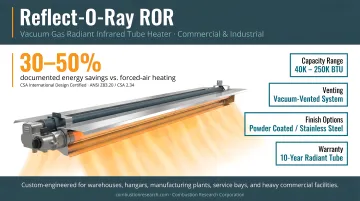
Low-intensity infrared radiant tube heaters solve this differently. Rather than heating the air volume, they deliver energy directly to floors, equipment, and occupants. Combustion Research Corporation's Reflect-O-Ray and Omega II systems are engineered specifically for this application:
- The radiant tube warms surfaces at occupied levels
- Those surfaces re-radiate heat back into the space
- Thermal recovery after a door opening takes seconds rather than minutes
Which driver dominates depends on the specific facility. A well-insulated new warehouse with the wrong heating technology has a very different cost profile than a drafty older structure with a correctly matched system. Identifying whether you're losing heat through the envelope, the air column, or mismatched equipment determines which fix actually moves the needle on fuel bills.
Cost-Reduction Strategies for Warehouse Heating
The strategies that move the needle most depend on which driver is actually causing excess cost. Start by identifying whether the problem lives in your system design, your operating practices, or the building envelope itself — then apply fixes in that order.
Strategies That Change Decisions (System Selection and Design)
These decisions set the efficiency ceiling for everything that follows.
Match heating technology to your facility's actual characteristics. For high-bay warehouses with ceilings above 16 feet, low-intensity infrared tube heaters are the most defensible choice. CRC's Reflect-O-Ray vacuum systems are engineered to scale across warehouses from 50,000 sq. ft. up to over 1 million sq. ft., with the Reflect-O-Ray 6.0 EDS specifically designed for facilities with 20-foot-plus ceilings. BTU inputs range from 40,000 to 250,000 BTU/hr per unit. Across commercial deployments, this approach documents 30–50% energy savings over conventional forced-air systems driven primarily by eliminating stratification losses and improving thermal recovery during dock door cycles.
Right-size using a proper heat load calculation. There's no universal BTU-per-square-foot rule that holds across insulation levels, ceiling heights, and climate zones. ACCA Manual N serves as the recognized commercial load-calculation standard. It accounts for envelope U-values, infiltration rates, occupancy patterns, and design outdoor temperatures. An oversized system short-cycles and creates uneven temperatures; an undersized one runs at full output continuously. Both outcomes raise operating cost.
Design for zones, not uniform conditioning. A warehouse contains spaces with fundamentally different heating requirements:
- Active picking and packing aisles (occupied, comfort-critical)
- Shipping and receiving docks (transitional, high infiltration)
- Bulk storage areas (rarely occupied, minimal heating needed)
- Offices and break rooms (continuous occupancy, standard comfort)
Specifying a single system to condition all of these uniformly means heating bulk storage to the same standard as picking aisles — one of the most persistent sources of wasted energy in warehouse operations. CRC's engineering support process includes zone design and heat load calculation assistance, accessible through their representative network.
Strategies That Change How Heating Is Managed
Once the right system is in place, operating discipline determines how much of that efficiency you actually capture. These strategies address the degradation that happens after installation.
Implement programmable thermostat scheduling tied to actual occupancy. Maintaining full comfort temperature in a 50,000 sq. ft. warehouse during overnight and weekend hours can consume as much energy as the entire occupied-hours demand. Setback temperatures during unoccupied shifts (typically 45–55°F to protect inventory and equipment) directly reduce runtime without affecting worker comfort during operations.
Add destratification fans where forced-air systems remain in place. In facilities with existing unit heaters and tall ceilings, ceiling fans running at low speed push the trapped warm air column back down to occupied levels. A 2017 study in Energy and Buildings examined destratification in large industrial warehouses using field measurements and CFD simulations, confirming measurable energy reduction.
The Carbon Trust notes manufacturing facilities can save up to 20% of heating costs through improved management and operation alone.
Maintain combustion efficiency proactively. A heating system operating with partially degraded combustion or blocked components uses more fuel to deliver the same output, often without any obvious malfunction. Key maintenance tasks include:
- Annual combustion efficiency testing
- Heat exchanger inspection for cracks or corrosion
- Burner cleaning and ignition system check
- Controls calibration verification
CRC's Omega II and Reflect-O-Ray systems don't require combustion air filters, which eliminates one of the most common maintenance failure points in high-particulate warehouse environments. That filter-free design also removes the recurring labor and material cost associated with filter replacement at ceiling height.
Strategies That Change the Building Context
In many warehouses, the building itself is the primary cost driver, not the equipment.
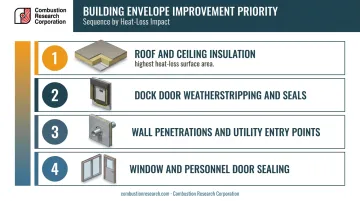
Prioritize envelope improvements at the highest-impact points. An uninsulated single-skin roof losing 25% of the building's heat is a more pressing problem than thermostat calibration. Sequence improvements by impact:
- Roof and ceiling insulation (highest heat-loss surface area)
- Dock door weatherstripping and seals
- Wall penetrations and utility entry points
- Window and personnel door sealing
Install high-speed doors or dock shelters at active loading bays. Every minute a conventional overhead door stays open displaces conditioned air and draws in outside air. High-speed roll-up doors close in seconds rather than minutes, cutting cold air infiltration during peak loading periods when occupancy is highest and comfort matters most.
Get an energy audit before committing capital to equipment. DOE Industrial Assessment Centers have documented a 44% recommendation implementation rate with mean implemented cost savings of approximately $49,980 per firm. In some facilities, a targeted insulation upgrade eliminates more heating cost than a full system replacement would. Utility providers frequently offer audit programs and may provide rebates for qualifying improvements. Investing in diagnosis before investment in equipment is consistently the better sequence.
Conclusion
Reducing warehouse heating costs isn't about applying generic tips across the board. It requires identifying whether the root cause is a system mismatch, a management gap, or a building envelope problem — and then targeting the right fix for that specific cause.
The most durable efficiency gains come from layering improvements: the right heating technology matched to the facility's ceiling height and thermal profile, paired with smart scheduling and a well-sealed building envelope. Each improvement reinforces the others. Done right, heating stops being a fixed cost you absorb every winter and starts being one you can actually control.
Frequently Asked Questions
What is the cheapest way to heat a large warehouse?
Low-intensity infrared tube heaters combined with zone-based design deliver the lowest long-term operating cost for most large warehouses. "Cheapest upfront" options like portable propane heaters or single unit heaters typically produce the highest operating costs — they're inefficient in high-bay spaces, provide inconsistent coverage, and don't address the stratification problem that inflates fuel consumption.
What is the rule of thumb for heating a warehouse?
BTU-per-square-foot rules of thumb break down quickly once ceiling height, insulation level, and climate zone vary — which they always do. ACCA Manual N is the recognized standard for commercial load calculations, accounting for all the variables that determine actual heating demand. A professional heat load calculation is worth more than any general rule.
What's the most energy-efficient heating system for a warehouse?
Low-intensity infrared radiant tube heaters are the most efficient option for high-bay warehouses, particularly those with ceilings above 16 feet. They heat occupants and surfaces directly rather than the full air volume, eliminating stratification losses — and that advantage over forced-air systems grows as ceiling height increases.
How do I know if my warehouse is losing heat through the building envelope?
Key indicators include utility bills that seem high relative to setpoint temperatures, cold drafts near dock doors or exterior walls, and frost or condensation patterns on interior surfaces in cold weather. A thermal imaging assessment or professional energy audit can pinpoint specific leak areas and quantify their impact.
Are infrared tube heaters safe in warehouses with forklifts and equipment?
Ceiling-mounted infrared systems eliminate ground-level contact hazards entirely — there's nothing at floor level to strike. CRC's systems are CSA International Design Certified to ANSI/CGA Standards (ANSI Z83.20 / CSA 2.34), include safety lockout ignition systems, and are 100% factory-tested before shipment.
How often should warehouse heating systems be serviced to maintain efficiency?
Annual pre-season inspections are the standard recommendation, covering combustion efficiency, heat exchanger condition, burner function, and controls calibration. Neglected maintenance is one of the most common causes of gradual efficiency loss — the system keeps running, but burns progressively more fuel for the same output.