The right system can change that math significantly. Combustion Research Corporation's engineering documentation — backed by over 50 years of industrial heating deployments — consistently shows 30–50% fuel savings when low-intensity radiant infrared tube heaters replace conventional forced-air systems in comparable commercial applications.
This guide breaks down the cost comparison across installation, operation, maintenance, and real-world performance so you can make the decision that fits your facility.
Key Takeaways
- Radiant heat warms objects and people directly; forced air warms air first — a costly disadvantage in tall or door-cycling facilities
- Radiant systems cost more upfront but deliver documented fuel savings of 30–50% over forced air in industrial settings, with typical payback in 2–5 years
- Every overhead door cycle bleeds forced-air heat; radiant-warmed surfaces re-radiate within seconds of the door closing
- High-ceiling facilities (above 12 feet) strongly favor radiant — forced air stratifies, leaving floor-level workers cold
- Low-intensity infrared tube heaters have no filters, no condensate components, and no standing pilots — fewer maintenance requirements than forced air
Radiant Heat vs. Forced Air: Quick Comparison
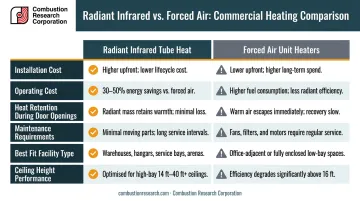
| Factor | Radiant Infrared Tube Heat | Forced Air Unit Heaters |
|---|---|---|
| Installation Cost | Higher upfront; custom-engineered or pre-packaged | Lower upfront; simpler to specify |
| Operating Cost | 30–50% lower in documented industrial deployments | Higher in high-ceiling, door-cycling buildings |
| Heat Retention (Door Openings) | Warmth stored in thermal mass; recovers in seconds | Heated air exits immediately; full reheat required |
| Maintenance | No filters, no condensate components, 10-year tube warranty | Filter replacements, blower service, duct inspection |
| Best Fit | Warehouses, hangars, auto bays, agricultural buildings | Small, well-sealed, low-ceiling spaces |
| Ceiling Height | Effective at any height; excels above 12 feet | Efficiency drops sharply above 12–15 feet |
What Is Radiant Heat?
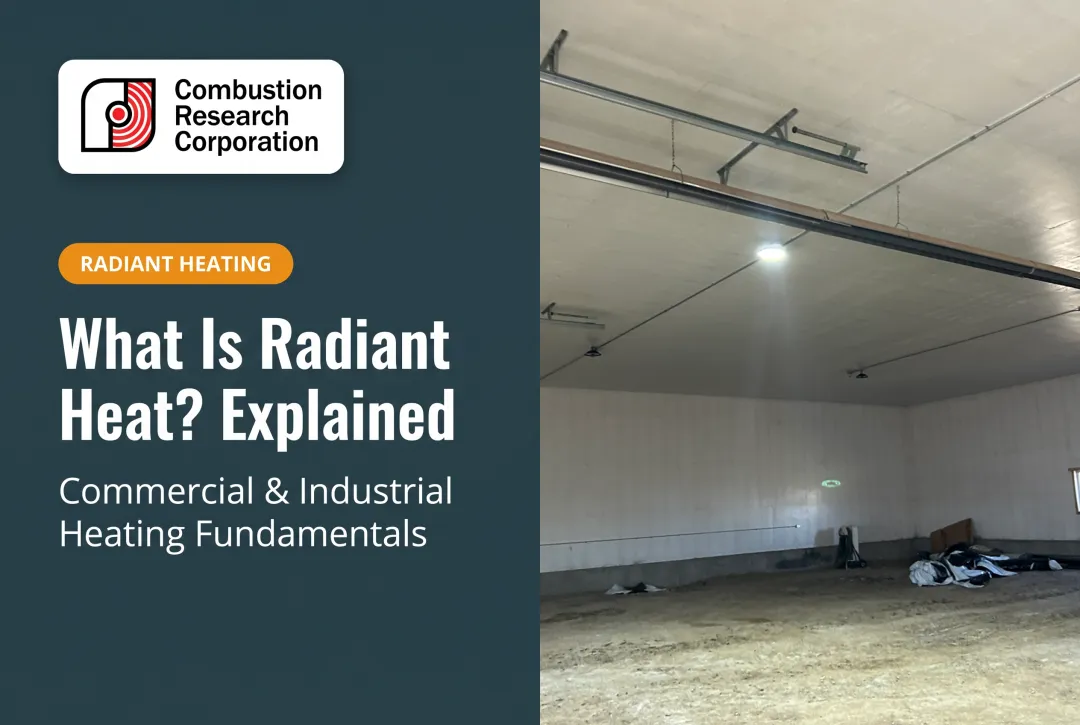
Radiant infrared heat transfers energy the same way the sun warms a concrete slab — the energy travels through air without warming it first, then deposits directly into surfaces, equipment, vehicles, and people. The air column is bypassed entirely.
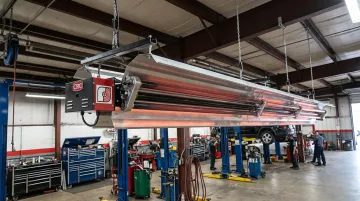
In commercial and industrial settings, this means ceiling-mounted gas-fired infrared tube heaters. Not floor heating systems. The burner fires into a sealed metal tube, heating it to approximately 1,100°F (the standard surface temperature for low-intensity tubes per AHRI product standards). That tube radiates infrared energy downward into the occupied zone.
How the Three-Stage Cycle Works
- Emission — The heated tube emits long-wave infrared radiation downward; the air column is not the target
- Absorption — Floors, concrete slabs, machinery, vehicles, and workers absorb the infrared energy directly
- Re-radiation — Warmed surfaces release heat back into the occupied zone, maintaining comfort even after the system cycles off or a door opens
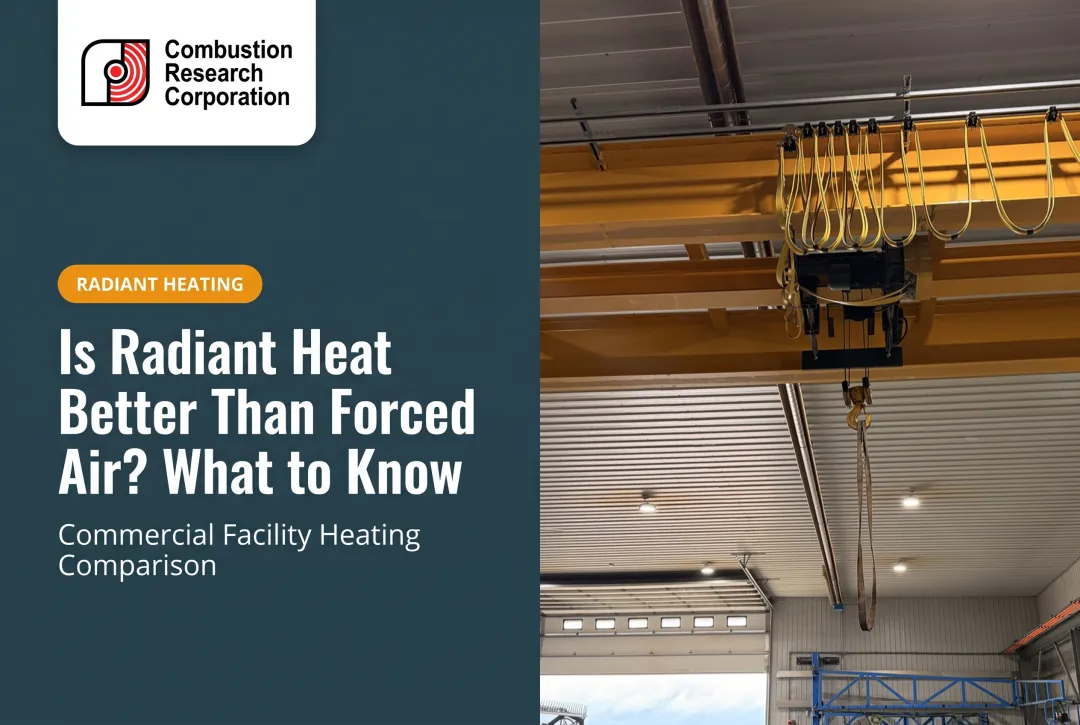
That third stage — re-radiation — is what makes radiant heat so effective in door-cycling facilities. When a loading dock door swings open, forced-air warmth exits the building and the system must reheat the entire air volume from scratch. In a radiant-heated building, the floor and thermal mass re-radiate stored heat within seconds of the door closing.
Two Categories Relevant to Industrial Settings
- Low-intensity infrared tube heaters (gas-fired): Surface temperatures around 1,100°F; suitable for enclosed occupied spaces including auto shops, warehouses, and hangars; combustion gases are vented externally
- High-intensity ceramic infrared (gas-fired): Surface temperatures around 1,800°F; better suited for spot/zone heating at specific workstations rather than whole-facility coverage
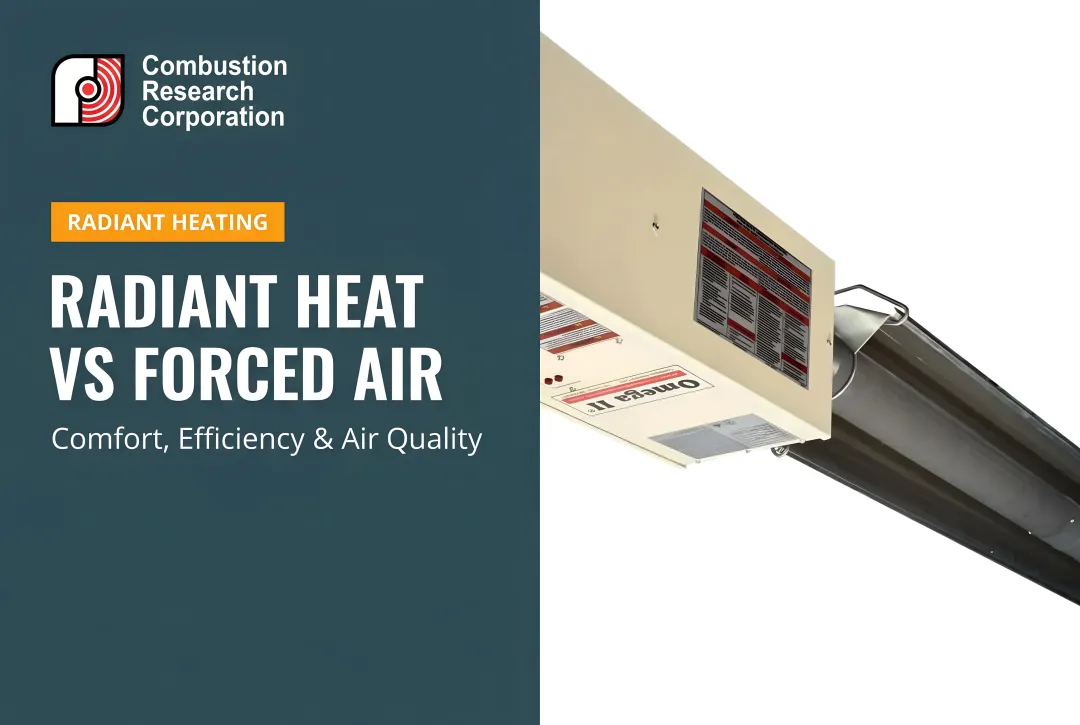
CRC's Omega II (power-vented) and Reflect-O-Ray (vacuum-vented) are low-intensity tube heaters, CSA International Design Certified to ANSI/CGA standards, with a 10-year limited warranty on the burner core and all combustion and heat exchanger tubes. They require no filters and have no condensate components.
Where Radiant Heat Performs Best
- Large warehouses and distribution centers with high ceilings and active loading docks
- Aircraft hangars where bay doors open routinely and floor space is occupied by aircraft
- Automotive service bays and body shops — door cycling is constant and airborne contaminants rule out forced air
- Agricultural buildings (barns, brooders, poultry houses, greenhouses) requiring floor-level warmth without stirring up bedding particulates
- Car wash bays, ice arenas, and natatoriums that need humidity tolerance and spot-specific heat coverage
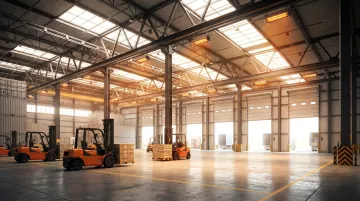
According to Natural Resources Canada's Major Energy Retrofit Guidelines, radiant heaters can work efficiently in environments where doors open and close frequently — specifically citing open loading docks as a major source of energy loss that radiant systems handle better than forced air.
What Is Forced Air Heating?
Forced air heating warms the air in a space, then distributes that warmth via fans or ductwork. In industrial and commercial settings, this typically means ceiling-mounted gas unit heaters with integral blowers, or centralized systems with duct networks.
Where Forced Air Works
- Fast heat-up: a cold space reaches set temperature quickly because the air is warmed directly
- Lower upfront equipment cost in most configurations
- Dual-purpose potential when ductwork supports integrated ventilation or cooling
Where Forced Air Struggles
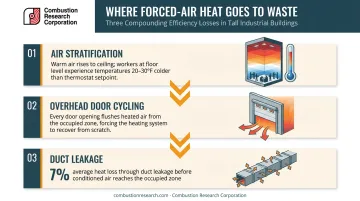
Stratification is the most significant efficiency limitation in tall buildings. Warm air is less dense than cool air, so it rises. In a 25-foot warehouse, the warmest air pools near the roof — where it does nothing useful for workers at floor level.
Workers stay cold while the thermostat keeps calling for heat. The system runs longer, burning more fuel to maintain a "comfortable" reading at sensor height while the occupied zone stays inadequately heated.
Overhead door cycles compound the problem. Every time a door opens, accumulated warm air escapes. A forced-air system must then rebuild the entire heated air volume — a process that can take several minutes per cycle. In a distribution center with high door activity, this happens dozens of times per day.
Duct networks introduce a third efficiency penalty. A Minnesota commercial and institutional study found measured duct systems averaged 7% leakage — energy lost before heat ever reaches the occupied space. This figure comes from measured commercial buildings, not modeled estimates.
When Forced Air Makes Sense
Forced air remains a viable option in specific scenarios:
- Spaces with ceilings under 10–12 feet where stratification is less pronounced
- Buildings with existing ductwork in good condition where full replacement isn't feasible
- Facilities where the lowest possible installation cost is the primary decision driver
- Spaces used intermittently that need rapid heat-up from cold
The caveat: as building size, ceiling height, and door-opening frequency increase, forced air's initial cost advantage erodes. Over a 5–10 year horizon in a facility above 5,000–10,000 sq ft with active door traffic, the operating cost difference often outweighs the installation savings.
Radiant Heat vs. Forced Air: Which Is Better for Industrial Spaces?
The answer depends on four factors: ceiling height, door-opening frequency, budget structure, and the nature of the work being done. Neither system is universally superior — but for most large industrial facilities, the numbers favor radiant when you look beyond installation cost.
The Total Cost of Ownership Case for Radiant
CRC's engineering reference documentation states a typical payback of 2–5 years on energy savings alone when radiant infrared replaces forced air in comparable commercial applications — driven by documented 30–50% fuel savings.
The payback calculation hinges on several variables:
- Ceiling height: Higher ceilings amplify stratification losses for forced air, strengthening radiant's advantage
- Door cycling frequency: More door cycles = more reheating cycles for forced air = faster payback for radiant
- Building envelope: Poorly insulated facilities lose heated air faster; radiant systems are less sensitive to this than forced air
- Fuel prices and usage hours: More hours per year in a cold climate = larger absolute dollar savings = shorter payback
- Utility rebates: CRC documentation notes that rebates are often available through local natural gas utility commercial programs, further compressing payback
Choose Radiant Heat When:
- Ceilings exceed 12 feet
- Overhead doors open frequently throughout the day
- Floor space must remain clear for forklifts, vehicles, or equipment
- The facility runs long hours in cold climates
- Workers are sensitive to drafts, dust, or fumes
- You're making a 10+ year investment and want to minimize cumulative energy spend
Choose Forced Air When:
- Ceiling height is under 10 feet and the space is well-sealed
- Existing ductwork is in good condition and replacement isn't feasible
- The project budget is strictly constrained on installation cost
- The space is used intermittently and needs rapid warm-up from a cold start
The Air Quality Factor
In automotive shops, body shops, agricultural facilities, and manufacturing environments with fine particulates, forced air systems distribute heat by moving large volumes of air — which also moves dust, chemical fumes, paint particles, and allergens through the space. Radiant systems deliver heat without relying on air movement, which reduces particulate circulation during heating cycles.
CRC designs the Omega II and Reflect-O-Ray without combustion air filters — eliminating a maintenance category that frequently causes problems in high-dust environments:
- Filter neglect on conventional unit heaters triggers pressure faults and nuisance shutdowns
- Degraded combustion quality from clogged filters raises fuel consumption and emission risk
- Filter-free radiant systems remove this failure point entirely, reducing unplanned downtime
Real-World Performance: What the Numbers Show
CRC's published performance position — 30–50% fuel savings over conventional forced-air heating — appears consistently across every product line and application category in their engineering documentation, including warehouses, aircraft hangars, auto dealership service bays, manufacturing facilities, military vehicle bays, and natatoriums.
The mechanism is consistent across all of them:
- Radiant energy deposits into floor mass and thermal surfaces, not the air column
- Thermal mass retains heat and re-radiates it even when doors open
- Eliminates stratification losses that penalize forced-air systems in tall, open spaces
- Requires no filter maintenance, standing pilots, or blower-driven airflow to distribute warmth
CRC's documentation acknowledges that savings vary by building, controls, and duty cycle — so the 30–50% range reflects comparable commercial applications rather than a guaranteed outcome for every installation. For facility-specific projections, CRC offers custom heat loss calculations and BTU sizing tools.
That variability doesn't diminish the long-term case. CRC has manufactured low-intensity infrared systems since 1965 and provides engineering support through its North American representative network throughout the specification process.
For warehouses, hangars, and high-activity service bays, the ROI case strengthens with every year of operation. Lower fuel costs, avoided filter replacements, and fewer service calls all accumulate — and a system with a 10-year tube warranty and no consumable maintenance components extends that savings gap across its full service life.
Facility managers evaluating heating options for warehouses, service bays, hangars, or agricultural buildings can request a cost comparison and system specification from CRC's engineering team at combustionresearch.com or by calling 888-852-3611.
Conclusion
Radiant heat and forced air solve the heating problem differently, and neither is the universal winner. Radiant infrared excels in large, high-ceiling, high-activity industrial environments where energy efficiency, floor space, and maintenance simplicity matter. Forced air remains viable for smaller, well-sealed spaces where rapid heat-up and lower upfront cost are the primary criteria.
For facility operators running warehouses, hangars, service bays, or agricultural buildings, that distinction matters most across a multi-year operating horizon. The system that wins on purchase price frequently loses on fuel bills, maintenance calls, and productivity costs by year three.
Before finalizing any specification, model these against your actual facility:
- Ceiling height and floor area — radiant efficiency gains grow with volume
- Occupancy patterns — intermittent use favors radiant's zone-control advantages
- Fuel access and rate — gas vs. electric cost per BTU varies by region and utility contract
- Maintenance budget — forced air filter and ductwork upkeep adds up year over year
- Upfront capital vs. operating cost tolerance — the right answer depends on your payback horizon
Total cost of ownership, not equipment price alone, is what the numbers consistently show separates a sound heating decision from a regrettable one.
Frequently Asked Questions
Is radiant heat cheaper to run than forced air in a warehouse or large commercial building?
In large industrial buildings, radiant heat typically delivers 30–50% lower fuel costs than forced air. It heats objects and people directly rather than warming the full air volume, so energy isn't lost to air stratification or wasted in unoccupied zones near the ceiling.
What is the installation cost difference between radiant and forced air heating for industrial buildings?
Radiant infrared tube heater systems generally have a higher upfront installation cost than forced-air unit heaters, with the gap varying by facility size, ceiling height, and system configuration. No public source provides a universal per-square-foot benchmark; CRC quotes projects per facility. Payback on the installation premium is typically 2–5 years based on energy savings, depending on fuel prices and operating hours.
How does radiant heat perform in buildings with frequently opening overhead doors?
Radiant heat is far more effective in these environments. Infrared energy is absorbed and stored in floors, equipment, and thermal mass, so warmth is retained even when doors open wide. Forced air exits the building immediately when a door opens, forcing the system to reheat the full air volume from scratch each time.
Does radiant heat or forced air work better in high-ceiling industrial spaces?
Radiant heat is strongly preferred for spaces with ceilings above 12 feet. Forced air warms air that naturally stratifies toward the ceiling, leaving floor-level workers cold while energy is wasted in the upper zone. Radiant systems deliver heat directly to the occupied level regardless of ceiling height.
How much maintenance does each heating system require in an industrial setting?
Forced air systems require regular filter replacements, blower motor servicing, duct inspections, and heat exchanger checks. CRC's Omega II and Reflect-O-Ray infrared tube heaters have no combustion air filters, no condensate-prone components, and carry a 10-year limited warranty on the radiant tubes — a significantly lighter maintenance burden.
Can radiant heat reduce dust and fume circulation in industrial workplaces?
Because radiant systems deliver heat without relying on high-volume air movement, they don't recirculate dust, chemical particulates, or allergens the way forced-air systems do during operation. This is a meaningful advantage in automotive shops, body shops, agricultural facilities, and any environment where air quality directly affects worker health or product quality.