OSHA data shows that slips, trips, and falls cause nearly 700 workplace fatalities per year — and car wash floors combine soap, water, hard concrete, and freezing temperatures into exactly the conditions that produce those incidents.
This guide covers how to select and install the right heating system for a car wash bay, what maintenance tasks matter and when to do them, warning signs that service is overdue, and a practical schedule you can implement immediately.
Key Takeaways
- Low-intensity infrared radiant tube heaters outperform forced-air systems in car wash bays by heating floors and surfaces directly, not air that escapes when doors open
- Outside combustion air intake is the single most important installation feature for protecting heater lifespan in chemical-heavy environments
- Preventive maintenance costs a fraction of emergency repairs; DOE/FEMP data shows preventive approaches save 12–18% over reactive ones
- Schedule annual inspections at minimum — truck and fleet wash bays with caustic chemicals need service twice a year
- Uneven heat, ignition lockouts, visible corrosion, or combustion odors require immediate action, not repeated manual resets
Why Proper Setup and Maintenance of Your Heated Car Wash Bay Matters
The Financial and Safety Stakes
The U.S. car wash industry generated $16.3 billion in revenue in 2022, spread across roughly 17,500 conveyor washes, 29,000 in-bay automatics, and 16,000+ self-service locations. Every unplanned shutdown during peak winter months is direct revenue lost — no production, no wash volume, no income while the repair clock runs.
The cost difference between reactive and preventive maintenance is measurable. DOE/FEMP data puts reactive maintenance at approximately $18 per horsepower per year versus $13 per horsepower per year for preventive approaches — and reactive maintenance can account for up to 50% of total maintenance costs in facilities that depend on it.
Those cost gaps come with a safety dimension attached. Inadequate heating leads to ice accumulation on bay floors and aprons — a direct slip-and-fall liability for customers and staff. Poorly maintained gas heaters also introduce combustion safety risks when flues, burners, or heat exchangers degrade without inspection.
The Lifespan Factor
Heaters in car wash bays face conditions that accelerate wear far beyond a dry warehouse. Alkaline detergents, high-pressure spray mist, temperature swings, and constant moisture are continuous stressors on tubes, reflectors, burner components, and electrical connections.
The gap between a heater lasting 5 years and one lasting 15+ years typically comes down to two decisions:
- Material selection at installation — components purpose-built for corrosive, high-moisture environments
- Consistent preventive maintenance — regular inspection and service before problems compound
Setting Up a Heated Car Wash Bay: System Selection and Installation
Forced-Air vs. Radiant Tube Heaters
This comparison isn't close for car wash applications.
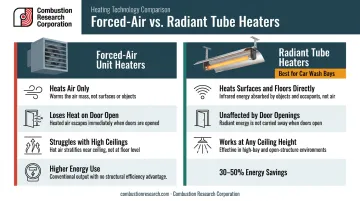
Forced-air unit heaters warm the air inside the bay. The moment a bay door opens (which happens constantly) that warm air escapes and must be replaced. In a high-ceiling bay with large doors, these systems fight a losing battle against infiltration.
Low-intensity infrared radiant tube heaters work differently. They emit infrared radiation that heats objects, floors, vehicles, and surfaces directly rather than the air. This mechanism works regardless of door openings, drafts, or ceiling height. Floors stay warm. Ice doesn't form. The heating effect persists even when the bay door is wide open.
Manufacturers including Schwank and Space-Ray report 30–50% energy savings versus conventional forced-air systems for radiant tube heaters. These are manufacturer-reported figures, not independently verified by ASHRAE. The underlying mechanism — less warm air lost through door cycles and air exchange — explains why the gap is real and consistent.
Corrosion Resistance: The Non-Negotiable Requirements
Any heating system specified for a car wash bay must address three corrosion risk factors:
- Stainless steel radiant tubes and combustion chambers — aluminized steel is the standard, but stainless is the right choice for truck washes and any bay with heavy chemical use
- Sealed and watertight electrical components — moisture intrusion into control boxes is a leading cause of premature failure in wash environments
- Outside combustion air intake — pulls combustion air from outside the bay rather than from the chemical-laden interior, protecting the burner and heat exchanger from caustic vapors
Outside combustion air intake is the single most protective feature you can specify. By drawing air from outside, it keeps caustic contaminants out of the combustion system entirely — the most direct way to prevent accelerated internal corrosion.
BTU Sizing and Placement
Ceiling-mounted tube heaters are the correct approach for car wash bays. They preserve floor space, eliminate the risk of accidental vehicle contact, and allow reflectors to be angled toward the floor where ice prevention matters most.
Key sizing inputs include:
- Bay dimensions and ceiling height
- Door size and estimated daily cycle frequency
- Local climate zone and design temperature
- Wash type (standard car wash vs. truck/fleet wash)
For automotive applications, most bays fall in the 75,000–150,000 BTU/hr range depending on mounting height. Systems are available from 30,000 BTU/hr up to 250,000 BTU/hr for larger truck wash facilities.
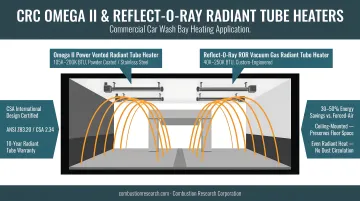
Combustion Research Corporation's Omega II and Reflect-O-Ray product lines cover this full range and are specifically designed for car and truck wash bay environments.
| Model | Construction | Best For |
|---|---|---|
| Omega II DI PEP | Stainless steel combustion chamber, 12-gauge 4" O.D. heat exchanger | Standard car wash bays with corrosive chemical exposure |
| Reflect-O-Ray 4C.SS-DI | Full stainless steel construction | High-demand truck wash and heavy wash-down conditions |
Both lines carry CSA International Design Certification (ANSI Z83.20 / CSA 2.34) and a 10-year limited warranty on radiant tubes for internally created corrosion. Neither requires combustion air filters, removing one of the most common maintenance failure points in high-particulate environments. CRC's engineering team provides sizing support through heat loss calculations and custom system design for new construction and retrofit projects.
Venting Configuration
Car wash bay venting must route exhaust completely outside the building. Combustion gases mixing with moisture-heavy interior air degrades air quality and accelerates corrosion on heating components.
CRC's two primary venting approaches differ in how they handle pressure:
- Omega II (power-vented/forced draft): Positive pressure pushes exhaust through the tube. Handles long exhaust runs and multiple bends well, making it practical for retrofit installations with complex routing
- Reflect-O-Ray (vacuum-fired): Negative pressure draws combustion gases through the tube. Any breach draws ambient air inward rather than pushing exhaust out , a built-in safety margin in occupied environments. Multiple units can share a common exhaust manifold and single roof penetration
Types of Maintenance for a Heated Car Wash Bay
Car wash bay heaters face more aggressive maintenance conditions than heaters in dry industrial spaces. The goal is to use preventive and predictive approaches so that reactive repairs — which are more disruptive and expensive — become the exception rather than the rule.
Routine / Preventive Maintenance
Preventive maintenance for car wash bay heaters covers:
- Visual inspection of tubes and reflectors for corrosion or discoloration
- Combustion air intake clearance check
- Thermostat calibration verification
- Ignition system test
- Venting inspection for blockages or moisture intrusion
- Reflector cleaning if chemical residue has accumulated
Standard car wash bays should have this performed annually, ideally before the first hard freeze. Truck washes and fleet facilities using caustic degreasers should increase to twice yearly given the accelerated corrosion environment.
Corrective / Reactive Maintenance
Corrective maintenance is triggered by failure: ignition lockout, significant heat output drop, or visible component damage. In a car wash setting, failures tend to hit during peak winter demand, when the system is under maximum load.
In a chemical-heavy environment, corrosion and tube degradation are gradual. By the time a visible failure surfaces, secondary components are often compromised too:
- Reflectors discolored or structurally weakened
- Hangers and mounting hardware corroded
- Electrical connections degraded from chemical exposure
Each of these adds to repair costs beyond the original failed component.
Predictive / Condition-Based Maintenance
Operational indicators that a service event is approaching before failure occurs:
- Heater cycling on/off more frequently than normal (short-cycling)
- Bay taking noticeably longer to reach set temperature after a cold night
- Uneven heat distribution across bay length
- Any error codes logged from the heater controller
- Gas consumption increasing without corresponding increase in wash volume
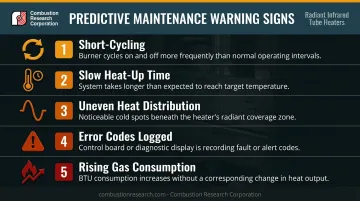
Tracking these indicators over time allows you to schedule service proactively rather than reactively.
Major Overhaul Maintenance
A major overhaul is typically required every 5–10 years depending on wash type and chemical exposure intensity. This covers:
- Heat exchanger tube integrity assessment and replacement if needed
- Burner assembly service or replacement
- Reflector cleaning or replacement
- Full gas pressure and combustion efficiency check
- Hanger and mounting hardware inspection
Facilities running caustic truck wash chemicals should expect to reach this threshold closer to the 5-year mark than the 10-year mark.
How to Tell If Your Car Wash Bay Heater Needs Maintenance
Performance-Based Warning Signs
- Bay consistently fails to reach the thermostat set point
- Heat-up time after a cold night has noticeably increased
- Heating is uneven — one end of the bay stays colder than the other
- Short-cycling: heater turns on and off in rapid succession rather than running full cycles
Visible and Physical Warning Signs
- Surface corrosion or rust-colored staining on tubes, reflectors, or hangers
- Pilot that keeps going out or an igniter requiring multiple attempts before the unit fires
- Sooting or discoloration around the burner area
- Flame color that is orange or yellow rather than a clean blue
Operational and Safety Warning Signs
- Combustion odors inside the bay — this suggests flue or heat exchanger integrity issues
- Increased gas consumption without a corresponding increase in wash volume
- Frequent manual resets of the heater controller
Per Re-Verber-Ray's troubleshooting documentation, if proof of flame is not established within 8.5 seconds, the unit locks out. Repeated lockouts that operators keep manually resetting — rather than calling for service — point to an ignition or combustion system problem that requires professional attention.
Any suspected combustion gas leak warrants immediate shutdown and professional inspection. Per NFPA guidance, do not attempt to locate a gas leak yourself — report it from a safe location away from the building and contact your gas provider or emergency services before re-entering.
Heated Car Wash Bay Maintenance Schedule
Maintenance frequency must match wash type and usage intensity. A seasonal self-serve bay has different requirements than a high-volume express tunnel or a truck wash running alkaline degreasers daily.
| Interval | Tasks |
|---|---|
| Daily / Per-Use | Confirm heater cycles on at startup; check for visible flame irregularities or unusual odors; verify bay floor drains are clear |
| Monthly / Seasonal | Verify combustion air intake is unobstructed; inspect venting termination for ice or debris; wipe down reflectors if chemical residue has built up; check thermostat settings; inspect visible tube sections for early corrosion |
| Annual | Full burner and ignition system inspection by qualified technician; heat exchanger tube integrity check; gas pressure and combustion efficiency test; hanger and mounting hardware inspection; reflector condition assessment; clean all combustion air intake surfaces |
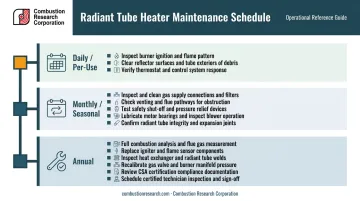
Frequency requirements vary by how hard the system works:
- Low-usage bays (seasonal self-serve locations): Annual servicing before season opening is the minimum. Get it done before the first freeze — waiting until the system is already under load costs more to fix.
- High-usage continuous-operation bays (express tunnels, truck washes): Schedule inspections twice a year. Add an extra check after any period of heavy chemical use or unusual operating conditions.
Northern climate operators should complete a pre-season startup inspection before the first hard freeze. Scheduling it for October and completing it in December — when the system is already running — is a pattern that leads to avoidable failures.
Conclusion
A heated car wash bay is operational infrastructure. The heating system protects pipes, floors, chemicals, and customers — and when it fails in January, it takes revenue with it.
The right system selection at installation — corrosion-resistant construction, outside combustion air intake, and correct BTU sizing — sets the foundation. Consistent preventive and condition-based maintenance protects that investment over the long term. The operators who treat their bay heaters as year-round assets are the ones whose systems reach 15 years of service instead of burning out at 5.
For car wash bays specifically, the maintenance math is straightforward: annual inspections plus corrosion-resistant hardware cost far less than emergency service calls, premature replacement, or a winter shutdown. Systems built for the environment — like stainless steel combustion chambers and tube heaters rated for high-moisture industrial use — simply hold up longer with less intervention.
Frequently Asked Questions
Are car wash bays heated in winter?
Yes, most professional car wash bays in northern climates are heated during winter months to prevent pipes and equipment from freezing, keep floors ice-free for customer safety, and maintain chemicals at effective working temperatures. For year-round operations, heating is considered essential infrastructure, not an optional upgrade.
What is the best type of heater for a car wash bay?
Low-intensity infrared radiant tube heaters are the preferred choice — they heat floors and surfaces directly rather than air, staying effective even with frequent door openings. Models with stainless steel components and outside combustion air intake, such as Combustion Research Corporation's Omega II and Reflect-O-Ray lines, are built for the moisture and chemical exposure common in wash bay environments.
How do you prevent pipes and equipment from freezing in a car wash bay?
The standard approach combines overhead radiant heaters to maintain bay temperature above freezing, heat tape on vulnerable plumbing runs, and thermostat-controlled systems that activate automatically when temperatures drop. Weep systems, which maintain a steady trickle of water flow through supply hoses, are a common supplemental strategy for self-serve bays.
How often should car wash bay heaters be serviced?
Standard car wash bays should receive a professional inspection at minimum once annually, ideally before winter season. Truck washes and facilities using caustic degreasers should schedule inspections every six months, as the more aggressive chemical environment accelerates corrosion on tubes, burners, and electrical components.
What are the signs that a car wash bay heater needs repair?
The most common indicators: bay not reaching set temperature, longer warm-up times after cold nights, visible corrosion or sooting on the heater, ignition failures or repeated lockouts, and combustion odors inside the bay. Combustion odors warrant immediate shutdown and professional inspection before the heater is restarted.
How much does it cost to heat a car wash bay?
Operating costs depend on bay size, climate, and heater type. Low-intensity infrared radiant tube heaters typically reduce heating energy costs by 30–50% compared to forced-air systems, with dual-modulating configurations like CRC's Omega II DI reaching up to 75% savings. For accurate projections, have a qualified engineer calculate site-specific heat loss before specifying equipment.