

The propane vs. natural gas decision looks simple on the surface. It's not. Commercial operators must weigh fuel price per BTU, pipeline access, storage logistics, seasonal demand, consumption volume, and heater technology compatibility. Getting any one of those wrong inflates heating costs unnecessarily.
This article breaks down the true cost difference between propane and natural gas for commercial heating, identifies which scenarios favor each fuel, and explains how heater technology interacts with both choices.
Key Takeaways
- Propane holds ~2.5× more energy per cubic foot than natural gas, but natural gas is typically cheaper per BTU where pipeline access exists
- For rural or remote facilities without gas main access, propane delivered by tank is often the only viable gas heating option
- Infrastructure costs like connection fees, trenching, and permitting can eliminate natural gas's per-BTU cost advantage entirely
- Switching from forced-air to infrared tube heating cuts fuel consumption by 30–50%, regardless of fuel type
- Fuel selection is a location-first decision; heater efficiency determines how far that fuel dollar actually goes
Propane vs. Natural Gas: Quick Comparison
Here's a side-by-side snapshot of the five factors that drive commercial heating fuel decisions.
| Factor | Propane | Natural Gas |
|---|---|---|
| BTU Density | ~2,500 BTU/cf (91,452 BTU/gal) | ~1,030 BTU/cf (100,000 BTU/therm) |
| Cost per MMBtu | Varies by region and contract; generally higher per BTU than pipeline NG | ~$11.90/MMBtu (U.S. commercial, March 2026, per EIA) |
| Availability | Deliverable anywhere by truck; no pipeline required | Requires connection to utility gas main |
| Infrastructure | On-site tank; delivery scheduling; no trench or utility fees | One-time main connection (costs vary with distance); metered billing after |
| Environmental | Not a greenhouse gas in unburned state; no soil/water contamination risk | Methane-based; upstream leakage is a documented emissions concern |
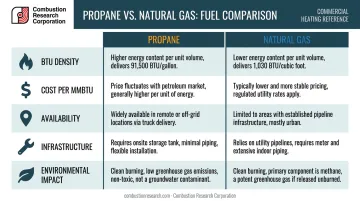
Which fuel makes sense depends heavily on facility location, consumption volume, and existing infrastructure — each factor covered in detail below.
Propane for Commercial Heating: What You Need to Know
What Propane Is and Why It Matters in Commercial Applications
Propane (C₃H₈) is a liquefied petroleum gas separated from raw natural gas or produced during crude oil refining. It's stored under pressure as a liquid and vaporizes for combustion — which means it can be transported by truck and stored on-site in tanks anywhere, with no pipeline infrastructure required.
For commercial heating, that energy density matters. Per EIA and NIST data, propane vapor delivers approximately 2,516 BTU per cubic foot versus natural gas at roughly 1,036 BTU per cubic foot — about 2.4× denser by volume. Commercial heating systems burn a lower volume of propane per hour to produce equivalent heat output, which affects equipment sizing and seasonal fuel budget estimates for large spaces.
Propane pricing fluctuates with crude oil markets, regional supply chains, and seasonal demand. According to EIA, U.S. propane inventories typically build April through September and draw down October through March, so facilities purchasing at peak winter demand typically pay more. High-volume commercial accounts often negotiate bulk purchasing or pre-season contracts to stabilize costs.
On-Site Storage and Supply Independence
Propane-powered facilities aren't exposed to pipeline outages or utility service interruptions. For manufacturing plants, cold-storage warehouses, and facilities in severe-winter regions, that's a meaningful operational advantage.
On-site tank storage puts fuel supply control in the facility operator's hands. The tradeoff is delivery scheduling discipline: running out mid-January is a far bigger problem than paying a slightly higher per-gallon price.
Where Propane Dominates
Propane is the default gas heating fuel in settings where natural gas mains simply don't exist:
- Rural warehouses and distribution centers
- Aircraft hangars at regional and private airfields
- Pole barns and agricultural confinement buildings
- Greenhouses and commercial growing operations
- Car and truck wash bays in suburban or rural locations
- Service garages without gas main access
For these applications, Combustion Research Corporation's gas-fired infrared tube heaters — including the Omega II and Reflect-O-Ray product lines — are available in propane configurations as standard catalog offerings, certified to ANSI Z83.20/CSA 2.34 standards for LP operation. For facilities without any gas infrastructure at all, CRC also offers the Reflect-O-Ray OIL EDS, an oil-fired variant specifically designed for off-grid commercial and remote military sites.

Natural Gas for Commercial Heating: What You Need to Know
Pipeline Supply and Cost Advantage
Natural gas is a methane-dominant mixture extracted from underground formations and delivered via pressurized pipeline to commercial customers. In markets where the pipeline is already in place, it's typically the cheaper fuel per BTU delivered.
The current EIA commercial natural gas benchmark is $12.34/Mcf (U.S. commercial, March 2026), which converts to approximately $11.90/MMBtu using EIA's standard 1 Mcf = 1.037 MMBtu conversion. That's the input cost before equipment efficiency is applied — a point we'll return to shortly.
Large commercial and industrial facilities with continuous high heating loads benefit from pipeline supply's effectively unlimited volume. There's no tank to size, no delivery window to schedule, and no run-out risk during a sustained cold snap.
The Infrastructure Commitment
Connecting to a natural gas main isn't free. It requires utility coordination, trenching and line installation, permits, and inspections. Costs scale directly with distance from the building to the nearest main — and in rural or exurban industrial zones, that distance can be substantial.
The American Gas Association's 2024 line-extension report documents that these costs are allocated through utility allowances, economic tests, and customer contributions that vary significantly by jurisdiction. There's no universal national benchmark per linear foot. Any facility evaluating natural gas for the first time needs a utility quote for their specific site before making assumptions about the economics.
Where Natural Gas Is the Standard Choice
Urban and suburban commercial facilities with existing gas main access represent the core natural gas market:
- Auto dealership service bays in developed commercial zones
- Manufacturing plants with established utility infrastructure
- Natatoriums and aquatic centers (where CRC's stainless steel Reflect-O-Ray variants handle chloramine-rich environments)
- Large warehouses in metro or suburban industrial parks
- Ice arenas and CNG repair facilities with code-compliant gas systems
Per EIA's Commercial Buildings Energy Consumption Survey, U.S. commercial buildings consumed 6.8 quadrillion BTU and spent $141 billion on energy in 2018. For facilities already connected to a main, that cost baseline is hard to beat — which is why the propane comparison only becomes relevant when pipeline access is limited, unreliable, or absent entirely.
Propane vs. Natural Gas for Commercial Heating: Which Wins?
The Cost-Comparison Framework
Comparing fuel costs requires converting both fuels to a common unit — cost per MMBtu — then adjusting for equipment efficiency. This second step is where most commercial operators underestimate the impact.
Consider two scenarios using natural gas at $11.90/MMBtu:
| Heating System | Efficiency | Cost per Usable MMBtu |
|---|---|---|
| Conventional forced-air | ~70% | ~$17.00 |
| Infrared tube heater | ~90%+ | ~$13.20 |
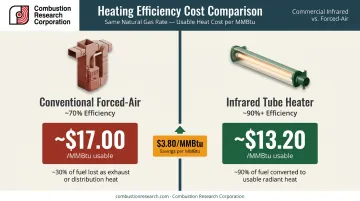
Same fuel, same utility rate — but a $3.80/MMBtu cost difference based entirely on heater efficiency. That logic applies to propane as well: higher energy density means less volume burned per hour, but a poorly matched heating system erodes that advantage just as quickly.
Infrastructure Costs Change the Calculation
For facilities not currently connected to a gas main, the connection cost must be factored into total cost of ownership. Depending on distance from the main, this can range from a few thousand dollars to well over $50,000. Amortized over 10–15 years of system life, that upfront cost reduces or eliminates the apparent per-BTU savings from natural gas — particularly for lower-consumption facilities or intermittent heating applications.
For facilities far from an existing main, propane's lower infrastructure cost (tank installation vs. utility trench) often makes it the more economical choice even before per-BTU pricing enters the equation.
Location Is the Primary Decision Driver
Infrastructure access largely determines which fuel wins on cost. The decision typically comes down to three scenarios:
- No gas main access → propane is the default viable option
- Existing gas main access → natural gas is typically more economical per BTU delivered
- Gas main access but substantial connection cost → run the infrastructure math before assuming natural gas wins
The Heater Technology Multiplier
Heater technology has more impact on operating cost than fuel type alone. Switching from conventional forced-air to a low-intensity infrared tube heater — which heats occupants and surfaces directly rather than cycling air — reduces fuel consumption by 30–50% regardless of which fuel is used.
ACEEE case study data confirms this across multiple facility types:
- A Seattle-area auto service garage cut annual gas use from 42,000 to 34,200 therms after an infrared retrofit
- An industrial maintenance hangar achieved 30% savings, over 18,800 therms/year, after upgrading to double-run infrared emitters
- Haldex Brake Systems documented a 42% natural gas reduction post-radiant retrofit
- A Whirlpool Corporation warehouse saw a 45% fuel-use decrease after replacing forced-air equipment with radiant tube heaters
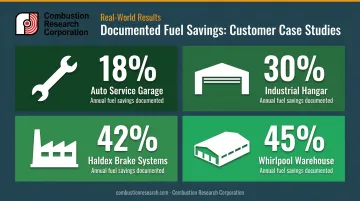
CRC's Omega II and Reflect-O-Ray infrared tube heaters are certified to ANSI Z83.20/CSA 2.34 standards for both propane and natural gas operation, with documented 30–50% energy savings over conventional forced-air systems across commercial and industrial deployments.
For large, open spaces — warehouses, hangars, agricultural facilities — that efficiency gap is where the majority of cost savings lives.
Situational Recommendations
Choose propane if:
- The facility is rural or remote without gas main access
- Energy independence and on-site storage reliability are operational priorities
- Seasonal or intermittent heating needs make pipeline connection economics unfavorable
Choose natural gas if:
- The facility is in an urban or suburban area with existing pipeline access
- The operation runs continuous, high-volume heating loads where lower per-BTU costs compound over time
- Pipeline connection costs have already been absorbed into the facility's infrastructure
In either case, engaging CRC's engineering team early in the specification process helps size the system correctly for the fuel type, facility dimensions, and usage pattern, avoiding costly oversizing or undersizing that erodes efficiency gains.
Conclusion
Neither propane nor natural gas is universally superior for commercial heating. The right fuel depends on four factors: pipeline access, facility location, consumption volume, and the efficiency of the heating system converting that fuel into usable heat.
For facilities already on the gas grid, natural gas wins on per-BTU cost. For rural, remote, or off-grid facilities, propane is often the only realistic gas option.
In both cases, heater efficiency — not fuel selection — is the largest lever on operating cost. Upgrading to an infrared tube heating system compatible with either fuel can deliver 30–50% operational cost reductions that dwarf the per-BTU pricing difference between propane and natural gas.
If you're evaluating commercial heating for a new build or retrofit, CRC's engineering team can spec the right system for both fuel types across all major commercial applications. Contact CRC at 888-852-3611, email info@combustionresearch.com, or find a local representative at combustionresearch.com/find-a-rep.
Frequently Asked Questions
Is it cheaper to heat with propane or natural gas?
On a per-BTU basis, natural gas is typically cheaper in pipeline-served areas, currently around $11.90/MMBtu at the commercial level. Propane costs more per BTU in most markets, though its higher energy density means less volume is consumed. The real cost difference depends on local pricing, equipment efficiency, and whether infrastructure connection costs are factored in.
Can commercial infrared tube heaters run on both propane and natural gas?
Yes. Quality low-intensity infrared tube heaters — including CRC's Omega II and Reflect-O-Ray lines — are certified to ANSI Z83.20/CSA 2.34 standards for both fuels, with appropriate orifice sizing and pressure settings for each. Switching fuels after installation typically requires a professional conversion to adjust gas train components and inlet pressures.
What is the BTU difference between propane and natural gas, and why does it matter?
Propane delivers approximately 91,452 BTU per gallon (about 2,516 BTU per cubic foot), while natural gas runs about 1,030 BTU per cubic foot, or 100,000 BTU per therm. Per cubic foot, propane holds roughly 2.4× more energy, so commercial systems burn less propane by volume to deliver equivalent heat output. This difference directly affects equipment sizing and per-hour fuel cost calculations.
Which fuel is better for heating large commercial spaces like warehouses or hangars?
In large, open commercial spaces, heater efficiency matters more than fuel type. Radiant infrared tube heaters are particularly effective here because they heat surfaces and occupants directly rather than cycling air. These systems work with both propane and natural gas, making heater selection often the more impactful decision than fuel choice.
How do infrastructure costs affect the propane vs. natural gas decision?
Connecting to a natural gas main involves utility fees, trenching, line installation, and permitting that vary significantly by site. For facilities located far from an existing main, those upfront costs can offset natural gas's per-BTU price advantage over the system's lifespan. In those cases, propane's lower infrastructure requirement typically makes it the more cost-effective choice.
Is propane or natural gas more reliable for commercial heating in rural areas?
Propane, stored on-site in tanks, provides full energy independence from utility pipelines, making it the more reliable option in rural areas or regions prone to utility disruptions. Reliability comes down to right-sizing your tank for seasonal demand and locking in delivery schedules before peak heating months.