Picking the wrong one means wasted energy, uneven heat, or a heater that simply can't keep up with the space. Space heating consumed 42% of residential energy use in 2020, according to the U.S. Energy Information Administration, making it the single largest household energy expense. For facility managers, the stakes multiply across thousands of square feet.
This guide breaks down how infrared and ceramic heaters actually work, where each one shines, and how to match the right technology to your space, whether that's a bedroom or a 50,000-square-foot distribution center.
TL;DR
- Infrared heaters radiate heat directly onto people and objects, ideal for drafty, large, or high-ceiling spaces
- Ceramic infrared heaters deliver high-intensity radiant heat, best for smaller spaces needing fast, targeted warmth
- Infrared often wins on efficiency for large or drafty spaces; ceramic wins on upfront cost for smaller rooms
- Industrial facilities favor ceiling-mounted infrared because it frees floor space and doesn't stir up dust
- The "better" heater depends on your space size, ceiling height, and whether you need instant or gradual warmth
Infrared vs Ceramic Heater: Quick Comparison
Before diving into the mechanics, here's how the two technologies stack up across the factors that matter most.
| Factor | Infrared | Ceramic |
|---|---|---|
| Heating Method | Radiant energy warms people/objects directly, similar to sunlight | High-intensity radiant panels deliver concentrated infrared heat for fast, targeted warmth |
| Best Use Case | Large, open, high-ceiling spaces: warehouses, aircraft hangars, manufacturing plants | Targeted zones needing fast warm-up: service bays, loading docks, break rooms |
| Energy Efficiency | More efficient for spot heating and large/drafty areas | More economical for targeted heating in defined zones rather than whole buildings |
| Noise & Air Quality | Fanless, quiet operation with minimal dust circulation | Fanless, silent operation with rapid warm-up in the targeted zone |
Neither column is universally "better." The right pick depends entirely on the space you're trying to heat.
What is an Infrared Heater?
Infrared heaters emit electromagnetic radiation that warms people and surfaces directly, the same way sunlight feels warm even on a cold day. Instead of heating the air first, infrared skips that step entirely. Heat comes from quartz tubes, metal coils, or gas-fired burner tubes, depending on the system.
This distinction matters most in large, drafty, or high-ceiling spaces. Heating the air in a warehouse with 20-foot ceilings is inefficient. Warm air rises, stratifies near the roof, and escapes every time a dock door opens. Infrared bypasses that problem by depositing energy straight into floors, equipment, and occupants.
Core operational benefits include:
- Near-instant warmth with no lag time for air to heat up
- No fan-driven circulation, which means less dust movement
- Quieter, fanless operation, useful for facilities with air-quality concerns
Two Very Different Scales of Infrared
Not all infrared heaters serve the same purpose. Quartz/electric infrared heaters are compact units built for spot heating in small residential rooms, while low-intensity gas-fired infrared tube heaters are industrial systems designed for whole-space comfort heating across large commercial floors.
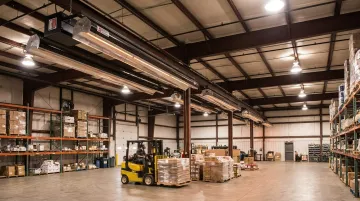
Combustion Research Corporation (CRC) manufactures the latter category. Its Reflect-O-Ray and Omega II radiant tube systems are engineered specifically for industrial and commercial spaces, with documented 30–50% energy savings over conventional forced-air heating. Because these systems mount to the ceiling, they preserve floor space entirely and reduce the risk of forklifts or material-handling equipment making contact with the heater itself.
Use Cases of Infrared Heaters
Infrared tube heating dominates in facilities where consistent, even heat matters more than instant ambient comfort, and where dust circulation is a genuine operational concern.
Industries where infrared leads:
- Auto dealership service bays and repair garages with frequently cycling overhead doors
- Aircraft hangars, where oversized doors open and close repeatedly
- Greenhouses and animal confinement buildings
- Warehouses and shipping/receiving docks needing zone heating
A widely referenced ACEEE study of industrial facility retrofits documented measurable outcomes after switching to infrared:
| Facility | Result |
|---|---|
| Auto-service garage | Annual gas use fell from 42,000 to 34,200 therms |
| Maintenance hangar | Usage dropped roughly 30% after layout optimization |
| Furniture-plant warehouse | Consumption fell from over 10,000 to under 4,000 therms |
Not every case succeeded. One machine shop actually saw gas consumption rise, traced back to a 60-foot mounting height and a poor radiant fraction for the heater chosen. The lesson: infrared performs best when the system is sized and mounted correctly for the space, not installed as an afterthought.
What is a Ceramic Heater?
Ceramic heaters work through convection. An electric current passes through ceramic plates, heating them up, and a fan blows air across those plates to circulate warmth through the room.
This approach makes sense in small, enclosed spaces where the goal is even, ambient room temperature rather than targeted warmth. A bedroom or home office benefits from air that's uniformly warm throughout, not just warm in one direction.
Why ceramic works well for personal spaces:
- Simple portability, most units are lightweight and easy to relocate
- Adjustable fan speed and thermostat settings for fine-tuned comfort
- Lower surface temperatures than some heater types, reducing burn risk
Compact vs Console Models
Ceramic heaters come in two general sizes:
- Compact desktop units: small footprint, ideal for under-desk or personal-zone heating
- Tower/console models — larger units with oscillation and multiple heat settings for whole-room coverage
One limitation worth flagging: ceramic heaters are built for personal or small-room use. They're not rated, sized, or designed for heating an industrial floor or open commercial bay.
Use Cases of Ceramic Heaters
Ceramic heaters fit naturally into residential and light-commercial settings where the space is already enclosed and relatively small.
Where ceramic heaters excel:
- Bedrooms and home offices needing supplemental warmth
- Small apartments during mild cold spells
- Under-desk heating for individual workstations
- Small retail spaces or single-room offices
Independent testing backs up the small-room fit. Wirecutter's testing found a ceramic model raised room temperature nearly 20°F in two hours, with a roughly 6°F difference between sensors placed 3 feet and 6 feet away.
That same test measured fan noise around 45 dBA at 3 feet on the highest setting, a trade-off worth noting if you're sensitive to sound. Consumer Reports runs its whole-room tests in a 204-square-foot room over just 15 minutes, further evidence that these units are built and validated for small, enclosed footprints, not open industrial floors.
Infrared vs Ceramic: Which Is Better?
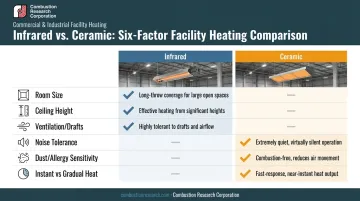
There's no single winner here. The right heater depends on a handful of practical factors:
- Room size: a bedroom and a warehouse have almost nothing in common thermally
- Ceiling height: infrared performs better the higher the ceiling goes
- Ventilation and drafts: frequent door cycling favors radiant heat
- Noise tolerance: fanless infrared is quieter than fan-driven convection
- Dust or allergy sensitivity: fans move air, and whatever is in it
- Instant vs gradual heat: infrared delivers warmth immediately; ceramic takes time to build ambient temperature
Choose ceramic if: you need affordable, even ambient heat in a small enclosed room like a bedroom, home office, or personal workstation.
Choose infrared if: you're heating a large, open, or drafty space, such as a garage, warehouse, or workshop, where direct, dust-free heating and long-term energy efficiency matter most.
Real-World Example: Industrial Facility Switching to Infrared
The ACEEE case data referenced earlier offers a useful window into what this switch looks like in practice. Take the auto-service garage example: before the retrofit, the facility relied on conventional heating that struggled to keep pace with a high-bay space and frequent door cycling.
Heat rose, stratified near the roof, and escaped every time a technician pulled a vehicle in or out.
After switching to a ceiling-mounted, low-intensity infrared system, annual gas use dropped from 42,000 to 34,200 therms, with the project reportedly paying for itself in under five years. It's a documented facility outcome tied directly to changing how heat gets delivered, not a marketing projection.
This is exactly the category CRC's Omega II and Reflect-O-Ray systems were engineered for. Beyond the 30–50% energy savings figure, CRC backs its radiant tube systems with a 10-year warranty on the tubes against internally created corrosion and a 3-year warranty on burner controls.
That kind of long-term cost certainty matters when a facility is planning a heating system replacement, not just a seasonal fix.
For large industrial or commercial spaces, infrared tube heating systems consistently outperform ceramic convection units on both cost and safety. If your facility is fighting the same uneven-heat, high-bill problem, it's worth exploring CRC's infrared heating solutions built specifically for industrial and commercial applications.
Conclusion
There's no universal answer to "infrared or ceramic." The right choice comes down to space size, ceiling height, and how directly you need heat delivered:
- Ceramic wins for small, enclosed personal spaces needing steady ambient warmth, such as offices or single-room commercial spaces.
- Infrared wins for larger, drafty, or high-ceiling commercial and industrial environments where targeted heat reaches people and equipment directly.
For facilities like warehouses, garages, and workshops, systems like CRC's radiant heaters deliver measurable savings, improved safety through ceiling-mounted design, and consistent comfort across the entire floor. That operational fit, not the sticker price alone, should be the deciding factor. Reach CRC's team at 888-852-3611 or info@combustionresearch.com to talk through what your specific space needs.
Frequently Asked Questions
Which is better: an infrared or ceramic heater?
It depends on the space. Ceramic works best in small, enclosed rooms needing even ambient heat. Infrared performs better in larger, drafty, or high-ceiling spaces that need direct, efficient warmth.
Do infrared heaters use more electricity than ceramic heaters?
Not typically. Infrared heaters often use energy more efficiently for large-space heating, with documented savings of 30-50% versus conventional heating, because they don't waste energy warming air that escapes through drafts or gaps.
Are infrared heaters safe for use in service garages and warehouses?
Yes. Low-intensity infrared tube heaters are designed for industrial use in warehouses, service bays, and aircraft hangars, with ceiling-mounted configurations that reduce contact hazards from forklifts and other equipment on the floor.
Can ceramic heaters effectively heat a large room or open space?
Not well. Ceramic heaters rely on circulating warm air, which dissipates quickly in bigger or drafty areas, making them unreliable for anything beyond a small room.
Which heater type is better for people with allergies or dust sensitivities?
Infrared generally has the edge here. It doesn't rely on fans to move air, unlike most ceramic convection heaters, which can stir up dust and allergens as they circulate warmth.
Is it cheaper to run an infrared heater or a ceramic heater long-term?
It depends on the space and usage pattern. Infrared tends to be cheaper for large or intermittent heating, while ceramic can be economical for small, continuously occupied rooms.