Gas-fired low-intensity infrared tube heaters solve this problem by bypassing the air entirely. They emit infrared radiation that heats floors, equipment, and people directly — the same way sunlight warms you on a cool day. A three-year commercial facility study documented 23% fuel savings when switching from forced-air to two-stage infrared heating, with improved comfort scores throughout.
But not all infrared tube heaters deliver the same results. Certification compliance, burner technology, and system design separate genuinely efficient systems from ones that simply look the part on a spec sheet.
Key Takeaways
- Radiant tube heaters heat objects and occupants directly via infrared radiation, not the air — making them far more efficient in high-ceiling or drafty industrial spaces
- Gas-fired low-intensity tube heaters are the efficiency standard for warehouses, hangars, and service facilities
- Three non-negotiable criteria: ANSI Z83.20 / CSA 2.34 certification, modulating or two-stage burner capability, and proper BTU-to-coverage sizing
- Top picks for 2026 come from Combustion Research Corporation, Roberts Gordon, Detroit Radiant Products, Schwank, and Superior Radiant Products
What Makes a Radiant Heater Energy Efficient?
The Core Mechanism
Infrared radiation travels in straight lines and transfers heat directly to solid surfaces — floors, machinery, structural steel, and people. Unlike forced-air heating, which must warm the entire air volume of a space before occupants feel any benefit, radiant heating delivers comfort to the occupied zone first.
This matters most in facilities where air-based heating fails hardest: buildings with ceilings over 16 feet, frequently opened bay doors, or poor envelope insulation. In a typical forced-air high-bay facility, ceiling temperatures can run 30–40°F warmer than floor level — meaning a large share of operating costs heat space nobody occupies.
Low-Intensity vs. High-Intensity Systems
Not all infrared heaters belong in occupied industrial spaces. The distinction matters:
| Feature | Low-Intensity Tube Heaters | High-Intensity Heaters |
|---|---|---|
| Surface temperature | Below 1,000°F / 538°C — no visible glow | Much higher, visible red glow |
| Occupied spaces | Safe for continuous occupancy | Restricted to unoccupied or tightly controlled environments |
| Heat distribution | Even, diffuse across long tube lengths | Concentrated, point-source |
| Typical application | Warehouses, hangars, service bays | Process heating, spot heating |
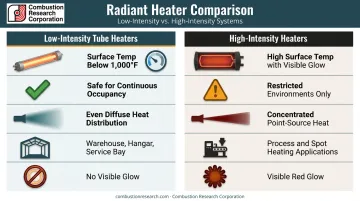
Low-intensity systems — gas-fired, ceiling-mounted radiant tubes — are the industry standard for occupied commercial and industrial facilities. Within that category, four design features determine how much fuel actually reaches the people and surfaces that need it.
Features That Actually Drive Savings
Two-stage or modulating burners adjust gas output to match real-time demand rather than cycling on and off at full input. That alone cuts fuel consumption noticeably and reduces the temperature swings that make occupants crank the thermostat higher.
Venting configuration matters too. Vacuum-vented and power-vented systems remove combustion exhaust reliably and maintain consistent burner performance across varied installation conditions — important in facilities where ceiling heights and draft conditions vary.
- Reflector geometry directs infrared radiation downward into the occupied zone; a poorly angled reflector wastes energy heating roof structure instead of the floor below
- Zone control and programmable thermostat compatibility lets facility managers heat only the areas in use, cutting the "always-on" waste typical of single-zone systems
Most Energy Efficient Radiant Heaters in 2026
All five systems below were selected based on verified certifications, documented energy performance, industrial-grade construction, and proven deployment in demanding commercial and industrial environments.
Combustion Research Corporation — Reflect-O-Ray & Omega II
Combustion Research Corporation (Rochester Hills, MI) has manufactured low-intensity infrared heating systems for over 50 years. Their two primary product lines — the Reflect-O-Ray vacuum-fired series and the Omega II power-vented series — serve warehouses, aircraft hangars, auto dealerships, animal confinement facilities, and agricultural operations across North America.
Key differentiators:
- True Dual Modulating Burner on the Omega II DI models: both gas and air are modulated at high and low heat stages, maintaining precise air-to-gas ratios for consistent combustion efficiency and preventing excessive overheating
- Vacuum-fired technology on the Reflect-O-Ray line creates negative-pressure combustion, a design CRC calls "The Original Dry Tube System"
- Corrosion-resistant aluminized steel radiant tubing standard across all Reflect-O-Ray models; stainless steel burner housing options available for wash bays, natatoriums, and other corrosive environments
- 24V thermostat hookup on the Omega II 9K Series enables integration with standard commercial programmable thermostat and zone control systems
- 100% factory tested before shipment
| Reflect-O-Ray (Vacuum) | Omega II (Power-Vented) | |
|---|---|---|
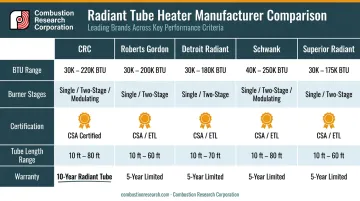
| BTU Range | 40,000–250,000 Btu/hr | 30,000–220,000 Btu/hr |
| Tube Diameters | 3.5", 4.0", 4C, 4DI, 6.0" | 3.5" (40K–100K), 4.0" (105K–200K) |
| Burner Stages | Single, dual-input (DI), modulating | Single, dual-stage, modulating (9K Series) |
| Fuel | Natural gas or propane | Natural gas or propane |
| Certification | CSA Certified (formerly AGA & CGA) | CSA Certified; ANSI Z83.20 / CSA 2.34 (9K Series) |
| Warranty | 10-year on radiant tubes (internal corrosion); 3-year on burner controls | 10-year on radiant tubes (internal corrosion) |
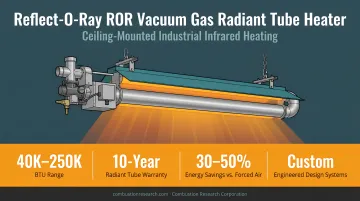
Engineering support is available throughout the specification process for both new construction and retrofit projects.
Roberts Gordon — Vantage Series
Roberts Gordon is a well-established manufacturer of gas-fired infrared tube heaters. Their Vantage series is widely deployed in manufacturing plants, distribution centers, and sports facilities where consistent overhead heating across large floor areas is required.
Key differentiators:
- Modulating burner technology on the Vantage line allows variable gas input across a range of outputs, providing more precise temperature control than single-stage or two-stage systems
- Industry-leading 3-year "tip-to-tip" warranty covers the full heater assembly, not just selected components
- Compatible with zone-based control configurations, supporting multi-zone setups in larger facilities
| Vantage Series | |
|---|---|
| Certification | Consult manufacturer for current NRTL listing |
| Burner Capability | Modulating |
| Warranty | 3-year, tip to tip |
| Support | Technical and specification support available |
Note: Roberts Gordon publishes multiple product families including Vantage, GordonRay, CARIBE, and Blackheat. Request current submittal documentation for the specific series being specified.
Detroit Radiant Products — HL3 & HLV Series
Detroit Radiant Products (also marketed as Re-Verber-Ray) has manufactured infrared heating equipment for commercial and industrial markets for decades. Their HL3 and HLV series are designed for high-clearance buildings where consistent floor-level heat distribution is critical.
Key differentiators:
- HL3 Series: two-stage low-intensity tube heater with 65,000–200,000 Btu/hr inputs and tube lengths from 20 to 70 feet — one of the broader length ranges in the category
- HLV Series: two-stage vacuum system with condensing technology, engineered to building-specific design parameters for maximum efficiency in demanding installations
- Both series reference compliance with ANSI Z83.20 and CSA 2.34 requirements in product documentation
| HL3 Series | HLV Series | |
|---|---|---|
| BTU Range | 65,000–200,000 Btu/hr | Varies by configuration |
| Tube Lengths | 20–70 ft | Engineered to spec |
| Burner Stages | Two-stage | Two-stage vacuum |
| Special Feature | — | Condensing technology |
| Certification | ANSI Z83.20 / CSA 2.34 referenced | ANSI Z83.20 / CSA 2.34 referenced |
Confirm current warranty terms and available tube length options directly with Detroit Radiant Products before final specification.
Schwank — duraSchwank & Tube Heater Series
Schwank manufactures gas-fired infrared heating systems for the North American industrial market, with select product lines produced in the USA.
Key differentiators:
- duraSchwank series is engineered specifically for moisture-heavy environments, including car washes, auto shops, and outdoor/covered applications. It features moisture-resistant burner enclosures, corrosion-resistant construction, and stainless steel cabinet options.
- Schwank's product catalog covers a full range from tube heaters to high-intensity systems with dedicated controls, supporting zone-based and building automation integration
- Technical documentation, installation manuals, and specification resources are publicly available through their technical documents summary page
| Schwank Tube Heater Series | |
|---|---|
| Applications | Car washes, auto shops, industrial, outdoor |
| Construction | Aluminized steel tube system; stainless steel cabinet options |
| Controls | Zone-compatible; see current catalog for control options |
| Warranty/Support | USA and Canada support available; confirm model-specific warranty with manufacturer |
Request current spec sheets and BTU range data from Schwank before publishing in specifications. Their technical documents page provides access to current installation and specification materials.
Superior Radiant Products — UA & TX Series
Superior Radiant Products manufactures a range of low-intensity infrared tube heaters for commercial and industrial facilities. Their UA and TX series are commonly specified for warehouses, manufacturing plants, and agricultural buildings requiring reliable overhead heat.
Key differentiators:
- UA Series (single-stage): 40,000–220,000 Btu/hr; available in U and L tube configurations with horizontal or 45-degree mounting; parabolic aluminum reflectors for directed heat distribution
- TX Series (two-stage): dual output with totally enclosed burner construction for added durability; natural gas or LPG fuel options
- Superior Radiant references ANSI/AHRI 1330-2024 for radiant efficiency ratings — a meaningful differentiator for buyers comparing delivered radiant output rather than just input BTU
| UA Series | TX Series | |
|---|---|---|
| BTU Range | 40,000–220,000 Btu/hr | 40,000–220,000 Btu/hr |
| Burner Stages | Single-stage | Two-stage |
| Fuel | Natural gas or LPG | Natural gas or LPG |
| Reflector | Parabolic aluminum | Available options |
| Performance Standard | ANSI/AHRI 1330-2024 referenced | ANSI/AHRI 1330-2024 referenced |
Verify current TSP series availability and certification status directly with Superior Radiant Products. Their engineering resources, SRP HeatCalc 2.0, and specification support are available through the SRP contact page.
How We Chose the Best Radiant Heaters
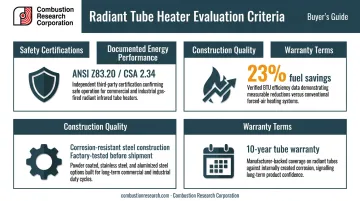
We evaluated all five manufacturers against four criteria — not just BTU output or price:
- Safety certifications — ANSI Z83.20 / CSA 2.34 or equivalent NRTL listing, the baseline standard for gas-fired tubular infrared heaters in commercial and industrial settings
- Documented energy performance — published fuel efficiency ratings, modulating or two-stage burner capability, or verified savings data. One independently referenced three-year study documented 23% fuel savings when switching from forced-air to two-stage infrared in a commercial facility
- Construction quality — heat exchanger material, gauge, corrosion resistance options, and factory testing protocols that signal long-term reliability
- Warranty terms — a 10-year warranty on combustion and heat exchanger tubes signals genuine manufacturer confidence in the product's durability
A Common Buying Mistake
These criteria exist partly because of a purchasing error that's surprisingly common: comparing heaters on input BTU alone. Input BTU tells you how much fuel a heater consumes — not how much usable radiant heat reaches the occupied zone. AHRI Standard 1330 establishes performance rating requirements for radiant output specifically, making it the accurate benchmark for side-by-side efficiency comparisons. Always request radiant efficiency data alongside input BTU specs.
Matching System to Environment
Even the best-rated heater underperforms in a mismatched installation. Key variables that must factor into selection:
- Ceiling height and building volume — determine minimum mounting height, tube length, and total BTU requirement
- Ventilation requirements — affect whether vacuum-vented or power-vented configurations are appropriate
- Zone control needs — facilities with partial occupancy schedules benefit significantly from multi-zone layouts
- Environmental conditions — corrosive environments (wash bays, natatoriums) require stainless steel burner housing or moisture-resistant construction
Conclusion
For industrial and commercial facilities in 2026, gas-fired low-intensity infrared tube heaters remain the highest-efficiency category of radiant heating available. The difference between a well-specified system and a poorly matched one can translate to tens of thousands of dollars in annual fuel costs annually, particularly in facilities over 10,000 square feet.
BTU rating and purchase price are starting points, not the full picture. Long-term efficiency depends on:
- Certification compliance (CSA/ANSI)
- Reflector design and heat distribution
- Burner modulation capabilities
- Venting configuration for the application
- Manufacturer engineering support throughout the project lifecycle
A system that checks all five delivers on its efficiency potential across 10, 20, or 30 years of operation.
For facilities seeking a CSA-certified, U.S.-manufactured low-intensity infrared solution backed by a 10-year warranty and 50 years of manufacturing experience, contact Combustion Research Corporation to discuss new construction or retrofit specifications:
- Phone: 888-852-3611
- Email: info@combustionresearch.com
Frequently Asked Questions
Are radiant heaters energy efficient?
Yes — radiant heaters are generally more efficient than forced-air systems in large, high-ceiling spaces because they deliver heat directly to objects and occupants rather than conditioning the full air volume. In warehouse applications specifically, reduced air stratification is the primary driver: radiant heat warms floors and occupants directly rather than the full air column.
What is the best heater for asthma patients?
Low-intensity infrared systems do not circulate air, which means they don't distribute dust or airborne particles the way forced-air systems do. Any heating decision involving respiratory conditions should involve a physician. That distinction is mechanical, not medical.
What is the difference between low-intensity and high-intensity infrared heaters?
Low-intensity infrared tube heaters operate below 1,000°F, produce no visible glow, and are safe for continuously occupied spaces. High-intensity heaters operate at much higher surface temperatures with a visible red glow and are generally restricted to unoccupied or carefully controlled environments.
How much can infrared tube heaters save versus forced-air in a warehouse?
A three-year commercial study documented 23% fuel savings with two-stage infrared versus forced air. The mechanism is reduced stratification — radiant heat warms floors and occupants directly rather than heating the air column, where ceiling temperatures in forced-air buildings can run 30–40°F warmer than floor level.
What certifications should I look for in an industrial radiant heater?
ANSI Z83.20 / CSA 2.34 is the primary safety standard for gas-fired tubular and low-intensity infrared heaters. CSA Group is OSHA-recognized as a Nationally Recognized Testing Laboratory (NRTL), so CSA certification provides independent verification that a product meets these safety and performance requirements.
What size radiant heater do I need for my facility?
Sizing depends on ceiling height, insulation levels, climate zone, and building volume. BTU input alone is not a reliable basis. Work with a manufacturer's engineering team to calculate actual heat loss and confirm heater placement. Combustion Research Corporation offers specification support for new construction and retrofit projects at 888-852-3611.