Barn heating is harder than heating a garage or workshop. High ceilings, uninsulated metal walls, large air volumes, and the welfare requirements of livestock demand systems built for continuous seasonal operation, not occasional use. An undersized or wrong-category heater doesn't just fail to keep things warm — it runs constantly, burns through propane, and still falls short.
This guide covers five of the best propane barn heaters available in 2026, evaluated for BTU output, installation type, certifications, and suitability for real agricultural environments. It also covers how to size a system correctly and what to look for before you buy.
Key Takeaways
- Propane beats electric on cost-per-BTU for most barn applications — commercial electric runs ~$40.80/MMBtu vs. propane at ~$29.24/MMBtu (EIA, March 2026)
- Size by barn volume (length × width × height), not floor area — high ceilings dramatically change your BTU requirement
- Permanent installations fall into two categories: ceiling-mounted infrared tube heaters and unit heaters — portable forced-air units suit supplemental or temporary use
- Key buying criteria: BTU output, venting type, certifications, efficiency rating, and livestock-safe design features
- The five heaters below cover every barn size and use case, from hobby farms to large commercial operations
Why Propane Is the Smart Choice for Barn Heating
Natural gas lines don't reach most rural barns. Electric resistance heat does, but the operating cost is hard to justify at scale. Propane fills the gap. At 91,452 BTU per gallon versus 3,412 BTU per kWh of electricity, propane delivers roughly 26.8 kWh-equivalent per gallon — a significant energy density advantage.
That energy density translates to real cost differences. Using EIA March 2026 benchmarks:
| Fuel Source | Cost per MMBtu |
|---|---|
| Propane (residential, March 2026) | ~$29.24 |
| Commercial electric resistance | ~$40.80 |
| Industrial electric resistance | ~$25.15 |
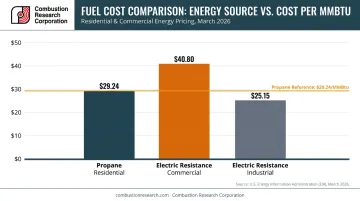
For commercial barn operators, propane sits below the commercial electric benchmark. Industrial electricity rates can undercut propane in some regions, but most farm accounts fall under commercial tariffs, not industrial.
Barn heaters also run for months at a stretch — not hours. A modest efficiency difference between heater types compounds into significant dollar amounts across a full heating season. That's why efficiency ratings and operating cost deserve more weight than upfront equipment price — a heater that costs $200 less but runs 15% less efficiently will erase that savings within a single winter.
Best Propane Barn Heaters for 2026
These heaters were evaluated for BTU output range, installation type, certifications, energy efficiency, and practical suitability for barn and agricultural environments.
Combustion Research Corporation — Reflect-O-Ray & Omega II Infrared Tube Heater Systems
Combustion Research Corporation has manufactured low-intensity infrared heating systems for over 50 years, with explicit design focus on barns, animal confinement facilities, and pole barns. Their two primary product lines for barn applications are the Reflect-O-Ray Engineered Design Systems (vacuum-vented) and Omega II Pre-Engineered Packages (power-vented) — both ceiling-mounted, permanently installed tube heater systems.
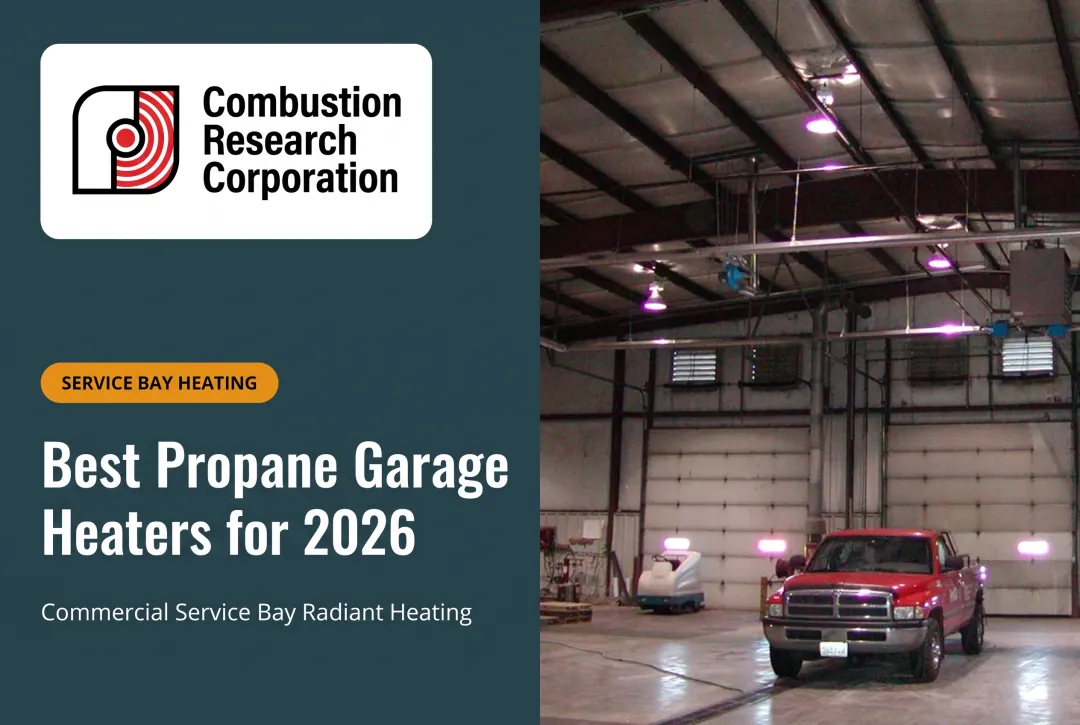
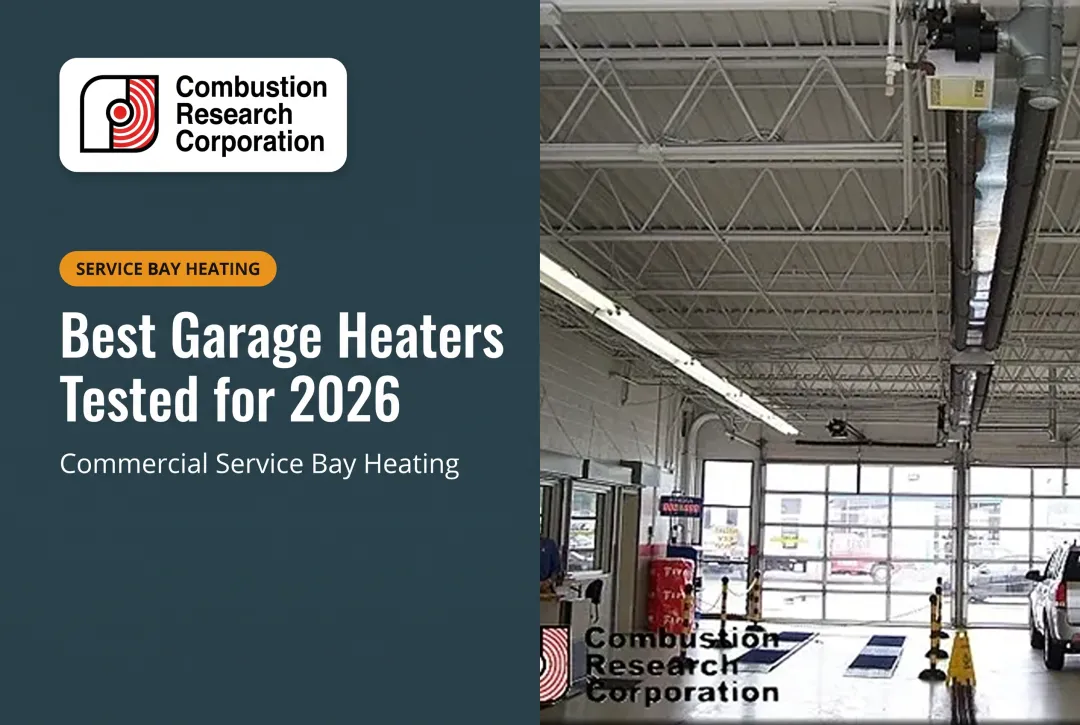
What separates CRC from unit heater alternatives is the heat delivery method. Infrared tube heaters radiate heat directly to animals, bedding, and surfaces rather than heating all the air in the space. In barns with 14- to 20-foot ceilings, that distinction matters: warm air stratifies at the ceiling with forced-air systems, while radiant heat reaches the occupant level regardless of ceiling height.
Additional CRC advantages:
- No combustion air filters required — eliminates a common maintenance dependency that causes system shutdowns in agricultural operations
- Vacuum-vented design (Reflect-O-Ray) draws ambient air inward on any breach rather than pushing combustion gases into the occupied space — a meaningful safety margin in livestock barns
- True Dual Modulating operation (Omega II DI PEP) modulates both gas and air simultaneously at high and low fire, delivering energy savings up to 75% compared to conventional systems
- CSA Certified (formerly AGA & CGA); Omega II 9K Series carries ANSI Z83.20/CSA 2.34 certification
| Spec | Reflect-O-Ray (Vacuum) | Omega II (Power-Vented) |
|---|---|---|
| BTU Range | 40,000–250,000 BTU/hr | 30,000–220,000 BTU/hr |
| Venting | Vacuum-vented only | Power-vented |
| Modulating Option | 4DI EDS (dual input, ~30% low fire reduction) | DI PEP (85K/65K up to 200K/145K BTU) |
| Warranty | CSA Certified; contact CRC for tube warranty details | 10-year on radiant tubes (internally created corrosion) |
| Best For | Sensitive livestock environments, occupied spaces | Large ag buildings, retrofit installs, complex exhaust routing |
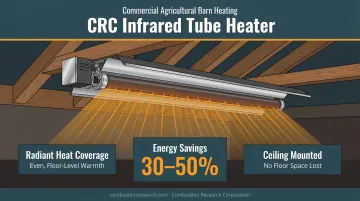
CRC offers engineering support throughout the specification process — heat loss calculations, zoning, and venting design — for both new construction and retrofit barn projects. Contact: 888-852-3611 or info@combustionresearch.com.
Modine Hot Dawg — LP Propane Unit Heater
The Modine Hot Dawg is one of the most widely installed ceiling-mounted unit heaters for garages, workshops, and barn spaces. LP propane versions are available across the full lineup, which spans 30,000 to 125,000 BTU/hr in single-stage and 75,000 to 125,000 BTU/hr in two-stage configurations.
Key installation details:
- Mounts overhead, freeing up all floor space
- Vents horizontally or vertically through 3-inch or 4-inch pipe
- Aluminized steel heat exchanger standard; 409 stainless steel optional
- Direct spark ignition
| Spec | Details |
|---|---|
| BTU Range (LP) | 30,000–125,000 BTU/hr (single-stage); 75,000–125,000 (two-stage) |
| Venting | Power-vented; 3–4 in. vent pipe; horizontal or vertical |
| Heat Exchanger | Aluminized steel standard; 409 stainless optional |
| Warranty | 10 years on heat exchanger; 2 years on other components |
| Best For | Mid-size barns, workshops, hobby farm spaces without livestock |
The Hot Dawg works well in enclosed, cleaner-air barn environments. In livestock barns with heavy dust or pathogen load, the forced-air design recirculates interior air — choose an infrared tube heater or a separated-combustion unit instead.
Mr. Heater Big Maxx — LP Propane Unit Heater
The Big Maxx is a ceiling-mounted forced-air unit heater sized for barns and large open spaces. Units ship in natural gas configuration with an LP conversion kit in the box; verify the kit is included before purchase.
Three BTU options cover a wide range of barn sizes:
| Model | BTU Input | Coverage Area |
|---|---|---|
| MHU50 | 50,000 BTU/hr | Up to 1,667 sq ft |
| MHU80 | 80,000 BTU/hr | Up to 2,667 sq ft |
| MHU125 | 125,000 BTU/hr | Up to 4,167 sq ft |
- Venting: Category 1 vertical or Category 3 horizontal; requires minimum 8-foot floor-to-heater clearance
- Warranty: 3 years on parts and burners; 10 years on heat exchanger
- Best For: Barns and workshops where budget matters and a permanent installation with straightforward venting is feasible
Wide availability at farm supply and home improvement retailers means replacement parts are accessible in rural areas — a practical advantage when a heater goes down mid-winter.
Reznor UDXC Series — Power-Vented Propane Unit Heater
The Reznor UDXC is the commercial-grade option in this lineup. Fourteen unit sizes span 30,000 to 400,000 BTU/hr input, and propane configuration is available via field-installed LP conversion kit (Option DL2). Thermal efficiency is 82–83%, which is above standard for unit heaters in this class.
The UDXC's standout feature for barn use is separated combustion capability. An optional SC1 kit converts the unit to pull combustion air directly from outside the building, completely isolating the combustion process from the interior air. In barns with high ammonia levels from livestock waste, stored chemicals, or significant airborne dust, that separation adds real safety and longevity value.
| Spec | Details |
|---|---|
| BTU Range (LP) | 30,000–400,000 BTU/hr (via LP conversion kit) |
| Efficiency | 82–83% thermal efficiency |
| Separated Combustion | Optional SC1 kit; pulls combustion air from outside |
| Heat Exchanger | TCORE² titanium-stabilized aluminized steel |
| Certifications | Intertek listed for industrial/commercial; residential utility certification for 30–125 sizes |
| Best For | Barns with livestock, chemicals, high humidity, or significant airborne dust |
The UDXC is priced above consumer-grade unit heaters and requires professional installation. That cost is justified specifically in barns where ammonia, chemical fumes, or heavy dust would degrade a standard unit heater's heat exchanger within a few seasons.
Mr. Heater Portable Propane Forced Air Heater — High-BTU Portable Option
For barn operators who need heat before a permanent system is installed — or supplemental heat during extreme cold snaps — Mr. Heater's portable forced-air propane lineup covers 38,000 to 170,000 BTU across six models. No permanent installation required.
| Model | BTU Range | Coverage | Notes |
|---|---|---|---|
| MH125QFAV | 75,000–125,000 BTU | ~3,125 sq ft | Requires 110v outlet; min. 40 lb propane cylinder |
| MH170QFAVT | 125,000–170,000 BTU | ~4,250 sq ft | Requires min. 100 lb cylinder |
Use limitation: Mr. Heater lists all forced-air propane units as outdoor or well-ventilated areas only — not indoor-safe. These are not a substitute for a vented permanent system in an enclosed barn. Use them as temporary heat during construction or as supplemental output on the coldest days, with barn doors cracked and adequate air exchange.
How to Size a Propane Heater for Your Barn
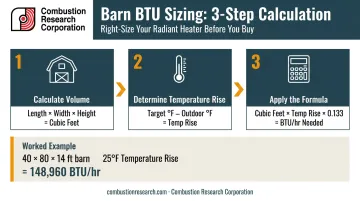
The single most common sizing mistake is calculating by square footage. Barn heating requires sizing by volume — length × width × height — because high ceilings dramatically increase the air mass that needs to be heated.
The Basic Calculation Approach
A commonly referenced vendor rule of thumb uses this formula:
(Cubic feet) × (desired temperature rise in °F) × 0.133 = BTU/hr needed
This is not ASHRAE-verified methodology, but it provides a useful starting estimate. For a precise load calculation — especially on new construction or large retrofit projects — ASHRAE's load calculation framework accounts for insulation values, infiltration rates, and ventilation requirements more accurately.
Example estimate: A 40 × 80 × 14-foot pole barn = 44,800 cubic feet. To raise temperature from 20°F outside to 45°F inside (25°F rise): 44,800 × 25 × 0.133 = 148,960 BTU/hr needed , so a 150,000 BTU system is the minimum starting point before adjusting for insulation.
Insulation Adjustments
Insulation quality changes BTU requirements significantly. Purdue Extension recommends R-13 walls and R-20 ceilings for livestock buildings in cold climates. An uninsulated metal pole barn can require 50% or more additional BTU capacity versus an insulated wood-frame structure of equivalent volume.
Additional Sizing Factors
- Large doors opened often lose significant heat through air infiltration every cycle
- Livestock load: Animals generate body heat that offsets heating demand. Fifty head of cattle can contribute roughly 50,000–75,000 BTU/hr of passive heat gain
- Climate zone: The Midwest averages ~4,776 heating degree days annually; the South averages ~2,019 , so the same barn needs significantly more capacity in Minnesota than in Tennessee
- Ceiling height: For barns above 10–12 feet, infrared tube heaters are generally more efficient than forced-air because they heat surfaces and occupants directly rather than the entire air column
For new construction or retrofit projects where sizing precision matters, Combustion Research Corporation's engineering team provides heat loss calculations as part of their specification support — at no charge for qualifying projects.
What to Look for When Buying a Propane Barn Heater
Heater Type and Heat Delivery
| Type | How It Works | Best Use Case |
|---|---|---|
| Infrared tube heater | Radiates heat to surfaces; no air movement | Livestock barns, high-ceiling spaces, dusty environments |
| Unit heater (forced-air) | Heats air, distributes via fan | Workshops, storage barns, spaces without animals |
| Portable forced-air | Heats air; requires ventilation | Temporary or supplemental use only |
Venting Configuration
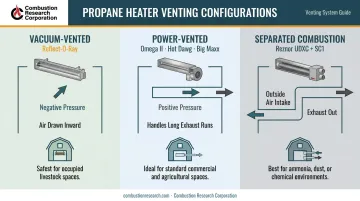
- Vacuum-vented (e.g., Reflect-O-Ray): Negative pressure draws air inward on any breach — safest for occupied livestock spaces
- Power-vented (e.g., Omega II, Hot Dawg, Big Maxx): Positive pressure handles back pressure in longer exhaust runs
- Separated combustion (e.g., Reznor UDXC with SC1 kit): Pulls combustion air from outside — best for barns with ammonia, dust, or stored chemicals
Safety Features for Barn Environments
- Overheat shutoff and flame failure protection — standard on quality unit heaters
- Oxygen depletion sensors (ODS) — relevant for portable unvented units; CPSC notes ODS shuts off gas when oxygen drops below 18%
- Ceiling-mounted installation — eliminates direct contact hazards with animals and equipment
- Carbon monoxide risk: CDC/NIOSH warns CO can rapidly accumulate in semi-enclosed spaces; NIOSH REL is 35 ppm TWA. Never run unvented portable heaters in closed barns with livestock
Certifications and Warranty
CSA marks indicate a product was tested against applicable North American standards. CSA is recognized by OSHA as a Nationally Recognized Testing Laboratory, and its marks are accepted by most Authorities Having Jurisdiction (AHJs). For barn installations, this matters for permitting, insurance claims, and code compliance.
Warranty length on heat exchangers is a useful quality signal. Key things to check:
- Most products in this guide carry 10-year heat exchanger warranties
- Coverage scope varies — confirm whether corrosion is included
- CRC's Omega II warranty explicitly covers internally created corrosion on radiant tubes, the primary long-term failure point in agricultural environments
Conclusion
Choosing the right propane barn heater comes down to four variables:
Choosing the right propane barn heater comes down to four variables:
- Barn size and ceiling height — determines BTU requirement and heat distribution method
- Use case — livestock barns, workshops, and seasonal storage each have different demands
- Installation feasibility — permanent ceiling-mounted systems versus portable units
- Ventilation availability — critical for any forced-air or open-flame option
A livestock barn with 16-foot ceilings and year-round animal presence is best served by a ceiling-mounted infrared tube heater. A seasonal storage barn or workshop may work fine with a unit heater. Temporary heat during construction calls for a portable forced-air unit, provided you have adequate ventilation.
Calculate your BTU requirement from barn volume before shortlisting products. From there, factor in operating costs across a full season, not just purchase price. A more efficient system often pays back the price difference within one or two winters.
For barn operators planning new construction or a retrofit project, Combustion Research Corporation's engineering team can help specify the right infrared tube heating system for your barn, covering heat loss calculations, system layout, and product specification. Reach CRC at 888-852-3611 or info@combustionresearch.com.
Frequently Asked Questions
What is the best propane barn heater?
The right choice depends on barn size, ceiling height, and use case. For large agricultural barns with livestock, ceiling-mounted infrared tube heaters are the preferred option — they heat without circulating dust, pathogens, or ammonia-laden air. Forced-air unit heaters work well for workshops or storage barns where air quality is less critical.
How many BTUs do you need to heat a 24×24 garage?
A 24×24 space with an 8-foot ceiling = 4,608 cubic feet. Using the rule-of-thumb estimate and a 50°F temperature rise: 4,608 × 50 × 0.133 ≈ 30,600 BTU/hr. A 30,000–45,000 BTU heater covers this range, assuming average insulation. An uninsulated metal structure would push that figure higher.
How long will a 30,000 BTU heater run on a 40 lb propane tank?
A 40 lb tank holds approximately 9.4 gallons. At 91,452 BTU per gallon, that's roughly 859,600 total BTUs. At full 30,000 BTU/hr output: approximately 28.6 hours of runtime. Actual runtime varies based on duty cycle, ambient temperature, and regulator performance.
Are propane barn heaters safe to use around livestock?
Ceiling-mounted infrared tube heaters and properly vented unit heaters are safe around livestock when installed at code-required clearances. Portable unvented heaters pose a CO risk in enclosed spaces and are not appropriate as primary heat sources in occupied livestock barns — use them only where ventilation is adequate.
Do I need to vent a propane barn heater?
Most permanently installed propane barn heaters require venting to exhaust combustion gases. Separated combustion and power-vented models are the safest options for enclosed or dusty environments. Some ventless models are permitted in well-ventilated spaces, but local codes vary. Always verify with your local code authority before installation.
What is the difference between a forced-air and an infrared tube barn heater?
Forced-air heaters heat air and distribute it via a fan, which delivers faster warm-up but stirs dust, pathogens, and ammonia throughout the space. Infrared tube heaters radiate heat directly to surfaces and occupants without air movement: more efficient in high-ceiling barns and significantly better for livestock environments where air quality matters.