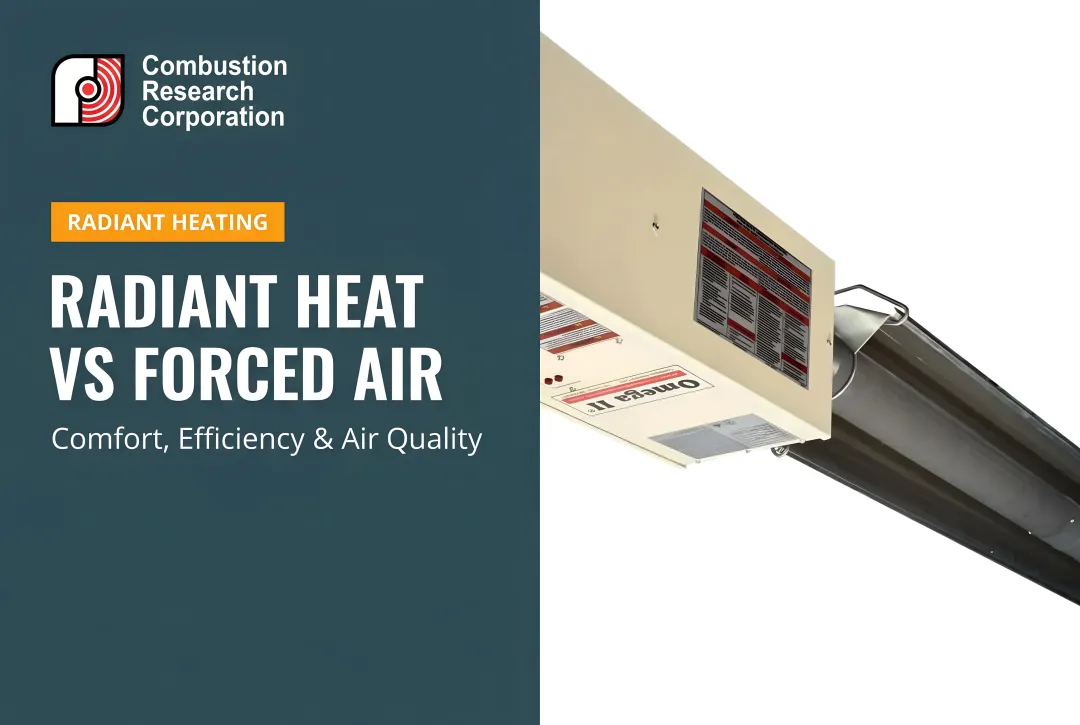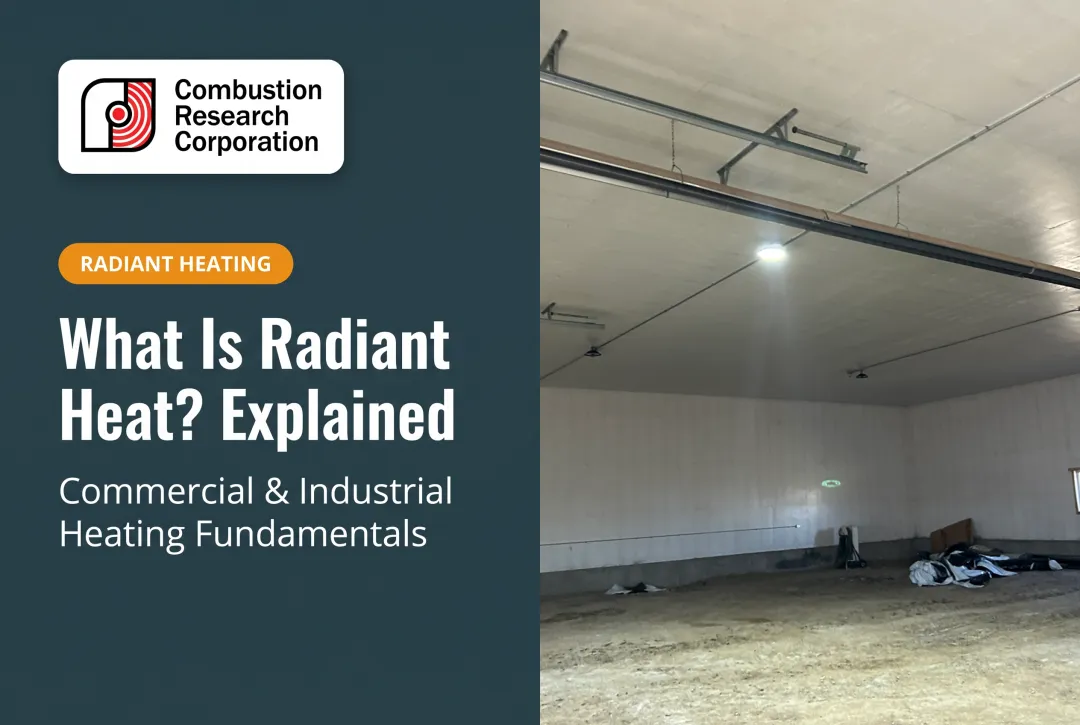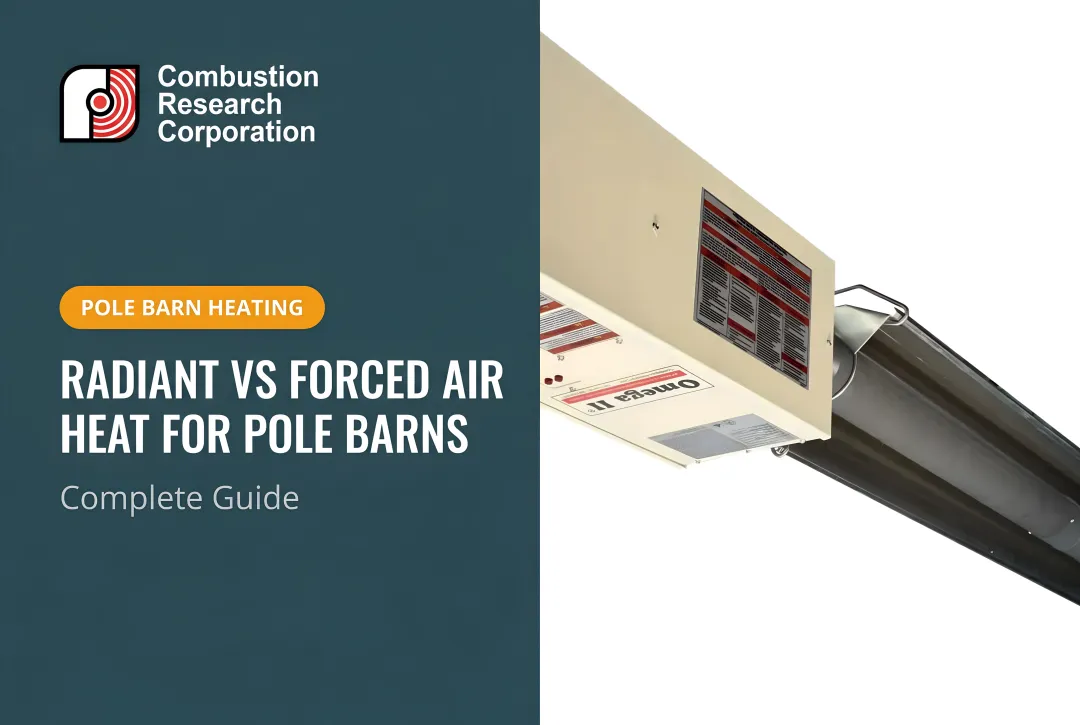
Radiant gas heat takes a fundamentally different approach. Instead of heating the air, it heats people, floors, equipment, and surfaces directly—the same way sunlight warms you on a cold morning even when the air temperature is barely above freezing.
This guide covers exactly what radiant gas heat is, how it works, the two main types available, and which environments it suits best. By the end, you'll understand how it compares to forced air, which type of gas radiant heater fits your application, and what efficiency gains you can realistically expect.
Key Takeaways
- Radiant gas heat burns natural gas or propane to produce infrared radiation that warms objects and people directly—not the surrounding air
- Two types exist: high-intensity heaters for outdoor or semi-open areas, and low-intensity tube heaters for fully occupied indoor spaces
- Radiant systems deliver 20–50% fuel savings compared to forced-air in commercial and industrial buildings
- Warehouses, hangars, auto shops, loading docks, and agricultural facilities get the most out of these systems
- Ceiling-mounted systems free up floor space and eliminate duct heat losses entirely
What Is Radiant Gas Heat?
Radiant gas heat is a heating method that burns natural gas or propane to produce infrared radiation. That radiation travels in straight lines from the heat source and is absorbed directly by solid objects—floors, walls, equipment, vehicles, and people—without first heating the air in the room.
The Physics, in Plain Terms
Think about standing in sunlight on a cold day. The air around you might be 40°F, but direct sun still feels warm on your skin. That's infrared radiation at work—thermal energy transferred through electromagnetic waves from a hot surface to a cooler one, with the air in between playing almost no role.
Radiant gas heat works the same way. The heater surface gets hot. That heat radiates outward, passes through the air without being significantly absorbed, and is converted back into warmth the moment it hits a solid surface.
How It Differs from Other Heating Types
Unlike forced-air or hydronic systems, gas radiant heaters deliver heat without moving parts, ductwork, or in-floor plumbing—which shapes both where they're used and how they're installed.
| System Type | Heat Delivery Method | Typical Application |
|---|---|---|
| Gas radiant (tube heaters) | Infrared radiation from ceiling-mounted tubes | Warehouses, hangars, garages |
| Forced air | Heated air circulated via ductwork | Residential, light commercial |
| Hydronic radiant floor | Heated water pumped through in-floor tubing | Residential, some commercial |
| Electric radiant | Infrared radiation from electric elements | Supplemental or residential |
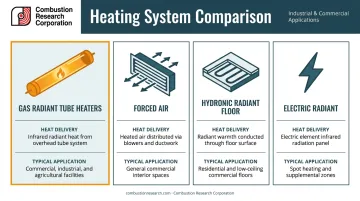
Gas radiant heaters are typically ceiling-mounted, which makes them practical for large-volume buildings where floor-based systems are either impractical or would interfere with operations. No water, boilers, in-floor tubing, or ductwork means installation is simpler than hydronic alternatives—and there's nothing at floor level to get in the way of forklifts or machinery.
How Does Radiant Gas Heat Work?
The process starts at the burner and ends at the floor—bypassing the air entirely.
Combustion and Heat Emission
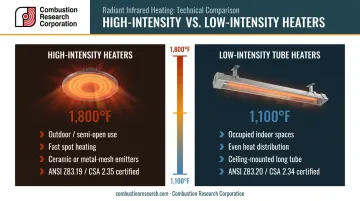
A gas burner ignites a fuel-air mixture inside the heater. In low-intensity tube heaters, the hot combustion exhaust gases travel through a steel tube, raising the tube's surface temperature to approximately 1,100°F. That hot tube surface then radiates infrared energy outward into the space below.
The reflectors mounted above the tube—typically polished aluminum—direct that infrared energy downward toward the occupancy zone rather than allowing it to escape toward the ceiling. Reflector design matters: a well-engineered reflector distributes heat evenly across the floor area below, while a poor one creates hot spots and cold zones.
What Happens at Floor Level
Once infrared radiation hits the floor, equipment, or a person, it's absorbed and converted to heat at that surface. Those warmed surfaces then gently heat the surrounding air through convection—a secondary effect, not the primary mechanism.
The result is a natural temperature profile where the occupancy zone stays warmer than the air near the ceiling. This is the opposite of what happens with forced air, where heat rises and pools above the work area.
Controls and Zoning
Most installations support several levels of control:
- Standard thermostats regulate burner on/off cycles to maintain set temperatures
- Modulating controls adjust both gas and air input continuously, matching output to actual heat demand
- Zoning allows only occupied areas to run at full output, so an idle section of a warehouse isn't heated alongside an active one
This flexibility is where radiant systems recover significant energy compared to whole-facility forced-air setups.
Types of Radiant Gas Heaters: High-Intensity vs. Low-Intensity
The distinction between these two categories affects installation requirements, safety considerations, and which applications each type suits.
High-Intensity Gas Radiant Heaters
High-intensity heaters operate at surface temperatures around 1,800°F, typically using ceramic or metal-mesh emitters that glow visibly red-orange during operation. They emit at a shorter infrared wavelength and deliver heat quickly over a focused area.
Best uses:
- Loading docks and open-air industrial areas
- Outdoor patios and semi-enclosed spaces
- Spot heating in drafty environments
- Applications where rapid heat delivery matters more than continuous comfort
Because of their high surface temperatures, high-intensity heaters require careful placement and clearance management in occupied indoor spaces. They're certified to ANSI Z83.19/CSA 2.35 standards.
Low-Intensity Gas Radiant Heaters (Tube Heaters)
Low-intensity tube heaters run a burner at one end of a long steel tube, with a reflector running the full length above it. The tube surface operates at roughly 1,100°F—lower than high-intensity heaters—which makes them better suited to occupied indoor spaces.
Why they're the standard choice for fully occupied facilities:
- Lower surface temperature reduces burn and fire hazard risks
- Long tube length distributes heat evenly across wide floor areas
- Ceiling mounting preserves all floor and wall space for operations
- No blowers or fans means no dust recirculation, no drafts, and no noise
Low-intensity tube heaters are certified to ANSI Z83.20/CSA 2.34—the standard specifically written for gas-fired tubular and low-intensity infrared heaters.
Combustion Research Corporation has built low-intensity tube heaters certified to that standard for over 50 years. Their two main product lines cover most facility types: the Reflect-O-Ray series (vacuum-vented, engineered to each facility's layout) and the Omega II series (power-vented, pre-engineered for standardized applications). Both include a 10-year limited warranty on radiant tubes for internally created corrosion — the most common long-term failure point in tube heating systems.
Key Benefits of Radiant Gas Heat
Energy Efficiency
Because radiant gas heat warms occupants and surfaces directly rather than heating an entire building's air volume, it outperforms forced-air systems on fuel consumption. According to AHRI/IRSC and supported by independent reports cited in Consulting-Specifying Engineer, users can expect 20–50% fuel-consumption savings over forced-air heating.
Real-world case data backs this up:
- A Seattle-area auto service garage saved 7,800 therms/year after switching to infrared, with a payback period under five years
- A maintenance hangar reduced gas use by 30%, saving over 18,800 therms annually
- A furniture-plant warehouse cut annual gas use from over 10,000 therms to under 4,000 therms after an IR retrofit
Indoor Air Quality
Gas radiant heaters have no blowers, fans, or ductwork—so they don't recirculate dust, debris, or airborne contaminants. AHRI/IRSC specifically notes that infrared heaters do not blow dirt and dust, a real concern in:
- Auto shops and body shops with paint overspray and sanding dust
- Agricultural facilities with feed dust and animal dander
- Food-adjacent operations where airborne contamination is a compliance issue
Space and Safety
Floor space and safety: Ceiling-mounted tube heaters occupy zero floor space. In facilities where forklifts, pallet jacks, and material-handling equipment move constantly, eliminating floor-level heating equipment removes one category of collision and trip hazard entirely.
Thermal retention at large openings: That same ceiling-mounted configuration pays off in buildings with bay doors or loading dock openings. Because radiant heat warms surfaces and objects rather than air, a heated floor slab acts as a thermal reservoir when doors open—it loses heat slowly and recovers quickly once doors close.
Best Applications for Radiant Gas Heat
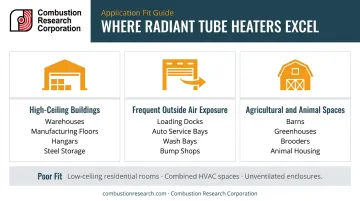
Radiant gas heat performs best in three broad categories of commercial and industrial space:
High-ceiling, large-volume buildings:
- Warehouses and distribution centers
- Manufacturing floors
- Aircraft hangars
- Steel storage facilities
Spaces with frequent outside air exposure:
- Loading docks and shipping/receiving areas
- Auto service bays, car and truck wash bays, and oil and lube facilities
- Bump shops and paint booths
Agricultural and animal confinement:
- Barns, brooders, and pole barns
- Greenhouses
- Animal housing where floor-level warmth and air quality are priorities
Intermittent-occupancy spaces are a particularly strong fit. Infrared heat warms people and surfaces almost immediately on startup, so facilities where doors open and close frequently can stay comfortable without running the system continuously.
Not every space is the right fit, however.
Spaces where radiant gas heat is a poor fit:
- Very low-ceiling residential rooms where mounting height and clearances are inadequate
- Spaces requiring both heating and cooling through a single system
- Fully enclosed environments where combustion venting cannot be properly accommodated
Radiant Gas Heat vs. Forced Air Heating
Heat Delivery and Stratification
Forced-air systems heat the air and circulate it via ductwork. In large spaces, three problems stack up fast: heat rises and pools at the ceiling, duct leakage wastes energy before it reaches the occupied zone, and the entire air volume must reach temperature before anyone at floor level feels warm.
The U.S. Department of Energy estimates that 20–30% of air moving through typical duct systems is lost through leaks and poorly connected ducts. In industrial buildings, the stratification problem adds another layer: ACEEE research found that forced-air industrial systems commonly show a temperature increase of about 5°F for every 10 feet of height. In a 30-foot building, that means the thermostat reading at ceiling level might be accurate while floor-level workers are significantly colder.
Radiant gas heat nearly eliminates this gradient. The same ACEEE study found that an IR-heated hangar maintained nearly identical temperatures at 5 feet and 24 feet above floor level.
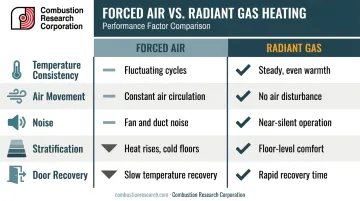
That floor-to-ceiling consistency is one piece of a broader comfort picture — the table below breaks down how the two systems compare across the factors that matter most in daily operation.
Comfort Quality
| Factor | Forced Air | Radiant Gas |
|---|---|---|
| Temperature consistency | Cycles hot/cold with furnace | Steady, even warmth |
| Air movement | Creates drafts | No air movement |
| Noise | Blower and duct noise | Silent operation |
| Stratification | Heat pools at ceiling | Uniform floor-to-ceiling |
| Door recovery | Must reheat full air volume | Slab retains heat, recovers quickly |
Do You Still Need a Furnace?
In most commercial and industrial applications, properly sized radiant gas heaters serve as the sole heating system—no furnace required. The determining factors are:
- Building insulation level
- Climate zone
- Ceiling height
- Large openings such as hangar doors or loading dock bays
For very cold climates or poorly insulated structures, a heat loss calculation determines whether radiant alone is sufficient. Combustion Research Corporation provides engineering support through the specification process, including heat loss calculations, to ensure systems are sized correctly for the specific facility before installation begins.
Frequently Asked Questions
How does gas radiant heat work?
A gas burner heats a steel tube or ceramic emitter surface, which radiates infrared energy downward through the space. That energy is absorbed directly by objects, floors, and people below—warming them without needing to heat the full air volume of the building first.
What is the difference between radiant heat and regular heat?
Forced-air heat warms a space by circulating heated air through ductwork, which loses energy to stratification and duct leakage. Radiant heat transfers energy directly from a hot surface to solid objects via infrared radiation, bypassing the air and eliminating those losses entirely.
Do you still need a furnace with radiant heat?
In most commercial and industrial applications, correctly sized radiant gas heaters can serve as the primary and sole heat source. Whether supplemental heating is needed depends on building insulation, climate, ceiling height, and a heat loss calculation for the specific space.
Is radiant gas heat energy-efficient?
Yes. In large commercial and industrial spaces, radiant gas heat typically delivers 20–50% fuel savings over forced-air systems by eliminating duct losses and heating occupants directly rather than the full air volume. Savings vary by building type, insulation, and ceiling height.
What is the difference between high-intensity and low-intensity gas radiant heaters?
High-intensity heaters operate at roughly 1,800°F and suit outdoor or semi-open applications requiring fast spot heating. Low-intensity tube heaters run cooler at around 1,100°F with longer infrared wavelengths, making them safer and more comfortable for fully occupied indoor spaces like warehouses, hangars, and garages.
Is radiant gas heat safe for occupied indoor spaces?
Low-intensity tube heaters are designed and certified (ANSI Z83.20/CSA 2.34) for occupied indoor use. Safe operation requires proper clearances from combustibles, appropriate venting configuration (vacuum or power-vented), and installation per manufacturer specifications.