Picking wrong isn't cheap. Space heating already eats up roughly 25% of annual energy consumption in U.S. commercial buildings, and buildings over 10,000 square feet account for more than 80% of that usage, according to the Department of Energy's 2024 building electrification guidance. For facility operators, the wrong system means inflated utility bills, cold spots near loading bays, or floor-mounted equipment that forklift operators have to navigate around all day.
This article breaks down how each heater type works, where each one belongs, and how to make the call for your specific building.
TL;DR
- Electric heaters warm room air; infrared heaters radiate heat directly onto people, floors, and equipment.
- Gas-fired infrared systems outperform electric heating in large, drafty, high-ceiling spaces like warehouses and hangars.
- Small, enclosed, well-insulated rooms often do best with simpler, lower-cost electric heaters.
- Square footage, ceiling height, door-cycle frequency, and floor clearance needs determine the right choice.
Electric vs Infrared: Quick Comparison
Before digging into definitions, here's how the two stack up on the factors facility managers actually care about.
| Factor | Electric Heaters | Infrared Heaters |
|---|---|---|
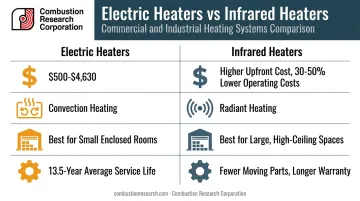
| Cost | Equipment runs roughly $500 to $4,630 depending on capacity, with installed costs between $660 and $5,470 (2022 EIA modeling data) | Higher upfront investment, but gas-fired systems typically deliver 30-50% lower operating costs than conventional heating, with payback in 2-5 years |
| Heating method | Convection/resistance: heats the surrounding air | Radiant energy: heats floors, objects, and occupants directly |
| Best suited space | Small, enclosed, well-insulated rooms | Large-volume, high-ceiling, or frequently-open-door spaces |
| Maintenance & durability | Fans and moving parts wear down; field data shows an average service life around 13.5 years | Fewer moving parts, no filters; radiant tubes often carry extended warranty coverage |
A quick note on that cost data: the EIA figures reflect equipment pricing by capacity, not a dollar-per-square-foot benchmark. No credible national source ties a fixed per-square-foot number to either heater type, so treat any such figure you see elsewhere with skepticism.
What Is an Electric Heater?
Electric heaters convert incoming electricity into heat, then either push that heat into the room with a fan (forced-air/convection) or radiate it from a heated element or panel. Commercial electric resistance units convert power to heat at 100% site efficiency, which is why they're so easy to size and install.
Common variations include:
- Portable forced-air unit heaters: quick deployment, no ductwork required
- Fixed electric resistance heaters: mounted units for continuous zone heating
- Electric radiant panels: ceiling or wall-mounted panels that emit heat without a fan
The appeal is speed and simplicity. There's no gas line to run, no venting to design, and installation is often a matter of hours, not weeks.
Where Electric Heaters Make Sense
Electric heaters fit best where the space is small, the envelope is tight, and the heating need is either temporary or intermittent:
- Temporary job sites and construction trailers
- Small offices, break rooms, and reception areas
- Occasional-use rooms like storage closets or small retail units
- Light commercial spaces under a few thousand square feet
The catch shows up at scale. In large or drafty industrial buildings, forced-air systems heat air that stratifies toward the ceiling, doing no useful work near the floor. That warm air also gets flushed out every time a bay door opens.
Facilities relying on electric convection heating in these conditions often see rising electric costs without a corresponding gain in comfort. The heater keeps fighting air changes it can't win.
What Is an Infrared Heater?
Infrared heaters skip the air entirely. Instead, they emit radiant energy that travels in a straight line and warms whatever it hits: floors, equipment, vehicles, and people. Those surfaces then reradiate warmth into the space.
NIST describes radiant heat as electromagnetic transmission that raises the sensible temperature of any material that absorbs it, particularly solid, opaque objects. That's exactly why radiant systems perform so well in industrial settings full of concrete floors and steel equipment.
This matters most in buildings with high ceilings or large open volumes, where convection heating struggles. Industry guidance identifies 16 feet and above as the ceiling height where infrared starts to outperform forced air, according to an ASHRAE Journal technical review of infrared heating equipment.
Low-Intensity vs High-Intensity, Gas vs Electric
Not all infrared heaters are built the same:
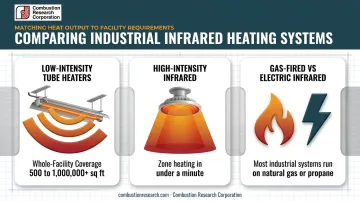
- Low-intensity tube heaters: spread heat across large floor areas for whole-facility comfort, as in CRC's Omega II and Reflect-O-Ray systems (500 to 1,000,000+ square feet).
- High-intensity infrared: delivers instant, targeted heat for spot or zone applications like loading docks or work cells (CRC's Synergy line heats up in under a minute).
- Gas-fired vs electric infrared: most industrial-grade systems, including Omega II and Reflect-O-Ray, run on natural gas or propane, though oil-fired and electric options exist for gas-free sites.
This fuel choice affects both heating and electric costs. Because radiant heat doesn't overheat the air column, it reduces the load on ancillary electrical systems like dehumidifiers and refrigeration compressors, a real advantage in natatoriums and ice arenas.
Where Infrared Heaters Make Sense
Infrared earns its keep in large, industrial environments where floor space and safety clearance matter:
- Warehouses, distribution centers, and steel warehousing
- Aircraft hangars and military maintenance facilities
- Auto dealership service bays, oil and lube shops, and bump shops
- Animal confinement barns, natatoriums, and ice arenas
Auto dealership service bays are frequently cited as radiant infrared's strongest commercial application, since overhead doors can open every few minutes, constantly displacing heated air that a forced-air system would otherwise rely on.
Because these systems mount overhead, floors stay clear for forklifts and vehicles. Documented results from utility-monitored conversions show 30-50% reductions in operational heating costs compared to conventional heating, with some optimized configurations reaching as high as 75% in engineered designs, based on CRC's field data across commercial deployments.
Electric vs Infrared: Which Is Better for Your Facility?
There's no universal winner here: the right system depends on how your building behaves. Weigh these factors before deciding:
- Square footage: Small rooms favor electric; large open floors favor infrared.
- Ceiling height: Above roughly 16-20 feet, radiant heat consistently outperforms convection.
- Air infiltration: Frequent door cycling (loading docks, hangars) punishes forced-air systems far more than radiant ones, since radiant energy is already stored in floors and objects rather than air.
- Equipment traffic: Forklifts and material handling equipment benefit from ceiling-mounted infrared, which removes floor- or wall-mounted obstructions.
- Occupancy pattern: Stationary work zones can use spot infrared; large transient spaces need broader radiant coverage or a hybrid electric approach for smaller adjacent rooms.
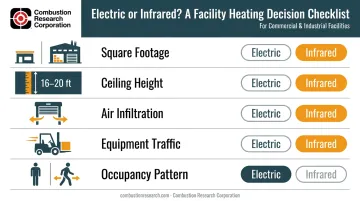
Rule of thumb: choose electric for small, sealed, temporary-use spaces. Choose infrared when you're dealing with high ceilings, big floor plans, or doors that open all day long.
Case Study: Infrared Heating in an Industrial Facility
A representative example comes from a Seattle-area auto service garage with an 18-20 foot ceiling. Forced-air gas unit heaters had struggled to keep the shop comfortable while bay doors cycled open throughout the day.
After switching to low-intensity gas infrared, results were clear:
- Annual gas consumption dropped from about 42,000 to 34,200 therms
- Savings reached roughly 7,800 therms and $8,300 per year
- The $40,000 project paid for itself in under five years
These figures come from utility-monitored data in a Puget Sound Energy study presented at the 2007 ACEEE Summer Study.
A separate industrial maintenance hangar saw an 18,800-therm annual reduction, roughly 30%, after upgrading to a properly designed double-run infrared layout.
Not every conversion goes this smoothly, though. A machine shop installed a single 60-foot emitter at a 30-45 foot mounting height and actually saw gas use increase, largely due to poor insulation and an emitter mismatched to the space. Sizing and layout matter as much as the technology itself.
Facilities with high ceilings and heavy equipment traffic tend to see the fastest payback from infrared conversion, but only when the system is engineered for the actual space. If you're evaluating a similar retrofit, Combustion Research Corporation's engineering support team can help size a system based on your ceiling height, square footage, and door-cycle frequency before you commit to equipment.
Conclusion
Neither electric nor infrared heating wins across the board. The right choice depends on your space size, ceiling height, safety requirements, and how people and equipment move through the building — not just the price tag on the unit itself.
Key factors that determine the right fit:
- Space size and ceiling height, since heat loss differs drastically between a small break room and a 50,000-square-foot warehouse
- Door traffic and equipment movement, which affects where radiant heat can be mounted safely
- Safety requirements around forklifts and material-handling machinery
- Long-term energy costs, not just the upfront price tag
For operators weighing this decision, the answer comes down to whether your ceiling height, door traffic, and equipment layout favor radiant coverage or make simple convection heating perfectly adequate. Getting that answer right protects your energy budget, keeps employees safer around forklifts and machinery, and determines how long your system lasts before you're replacing it.
Frequently Asked Questions
Do infrared heaters raise your electric bill?
Most industrial-grade infrared heaters, including gas-fired tube systems, run on natural gas or propane rather than electricity. Electric infrared panels do use electricity but tend to run more efficiently than standard electric convection heaters.
Are infrared heaters cheaper to run than electric heaters?
Gas-fired infrared systems typically deliver 30-50% lower operating costs than conventional heating, with savings scaling up as ceiling height and square footage increase. Smaller, well-insulated spaces see less dramatic savings than large industrial buildings.
Can infrared heaters effectively heat large warehouses or high-ceiling spaces?
Yes. Radiant heat warms floors and objects directly instead of relying on stored warm air, so it outperforms convection heating in high-ceiling buildings. Zone heating also lets you target occupied areas without heating the entire air volume.
Is infrared heat safe around forklifts, machinery, and employees?
Ceiling-mounted infrared systems keep heating equipment out of forklift paths and material-handling zones, reducing accidental-contact hazards common with floor- or wall-mounted electric heaters. Installation still needs to follow manufacturer clearance and mounting-height guidelines.
How long do industrial infrared heaters last compared to electric heaters?
Infrared tube heaters have minimal moving parts and no filters, which supports longer service life than electric units with fans and motors. CRC backs its radiant tubes with a 10-year limited warranty on internally created corrosion.
Do infrared heaters require special installation in industrial buildings?
Yes. Gas-fired infrared systems come in vacuum-vented and power-vented configurations, and the right choice depends on your building's exhaust routing and layout. Engineering support during specification helps match the system to new construction or retrofit conditions.