Introduction
Once temperatures drop, an unheated garage stops being a workspace and starts being storage. DIY projects stall, oil changes turn into finger-numbing chores, and that home gym you set up in October gets abandoned by December.
The fix isn't complicated: the right heater turns a cold garage into a functional, year-round space. It also protects tools, batteries, and vehicle fluids from cold-related damage that shortens their lifespan.
Picking that right heater means matching output, fuel type, and space size to your garage. This guide breaks down top-rated garage heaters across portable, electric, gas, and industrial-grade categories, plus exactly how to size and choose one for your space.
TL;DR
- Electric, propane, natural gas, and infrared heaters each suit different space sizes and budgets.
- Size electric units at 10 watts per sq ft; start gas units at 40 BTU per sq ft, then adjust for insulation.
- Portable heaters suit small garages or spot heating; ceiling-mounted units fit larger, multi-car spaces.
- Tip-over shutoff and oxygen depletion sensors are must-have safety features.
- Your best choice hinges on square footage, insulation, ventilation, and portable vs. permanent needs.
Overview of Garage Heaters in the Home Improvement Market
A garage heater is exactly what it sounds like: a dedicated heat source sized and built for garage conditions. Standard central HVAC rarely reaches a garage efficiently, and when it does, it struggles because of:
- Minimal or no insulation in walls and ceilings
- Large door openings that leak heat every time they cycle
- Concrete floors that absorb and hold cold
That gap has pushed more homeowners to buy dedicated units. About 61% of homeowners planned at least one home improvement project in early 2024, according to a Home Improvement Research Institute report. Remote work, home gyms, and DIY culture have all made garages double as year-round living space rather than just parking.
The result is a crowded product category spanning $80 portable propane units to multi-thousand-dollar ceiling-mounted systems. Below, we've rounded up top-tested options across portable, electric, gas, and industrial-grade categories to match nearly any garage.
Top Garage Heaters for Every Garage Size
Selection criteria for this list: heating performance, safety certifications, ease of installation, and value across a range of space sizes and budgets.
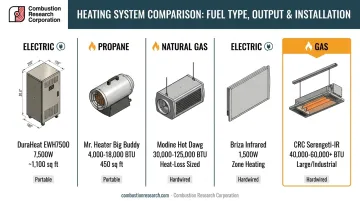
DuraHeat EWH7500 Hardwire Electric Ceiling Garage Heater
This hardwired electric ceiling unit is built for medium attached garages that need consistent, everyday warmth rather than occasional spot heat. It runs 7,500W on high and 6,250W on low, and the digital thermostat with remote and timer makes it easy to schedule heat before you walk out to the car in the morning.
One important detail buyers miss: the manual calls for a 50-amp or larger dedicated circuit and 8 AWG copper wiring, so professional installation isn't optional here.
| Specification | Details |
|---|---|
| Power Source | Hardwired electric, 7,500W (208–240V) |
| Room Coverage | Up to approximately 1,100 sq ft (manufacturer estimate) |
| Installation | Ceiling or wall mount, professional install required |
Mr. Heater Big Buddy Propane Heater
The Big Buddy is a portable radiant propane heater that runs 4,000, 9,000, or 18,000 BTU/h depending on the setting, with claimed coverage up to 450 sq ft. It connects directly to two 1-lb cylinders or, with an optional hose and filter, a 20-lb tank.
For occasional use with no electrical hookup nearby, it's hard to beat. It carries three separate safety systems: automatic low-oxygen shutoff, tip-over shutdown, and a high-limit switch that cuts power if internal temperatures climb too high.
| Specification | Details |
|---|---|
| Power Source | Propane (1-lb or 20-lb tanks) |
| Room Coverage | Up to 450 sq ft (manufacturer estimate) |
| Installation | Fully portable, no installation required |
Modine Hot Dawg Natural Gas Unit Heater
Modine's Hot Dawg line is a ceiling-mounted natural gas heater family built for larger garages and shops. Current models span a wide 30,000 to 125,000 BTU/h range, with efficiency ratings up to 83%, so you're not paying to heat air that escapes up the flue.
Because output scales across six size tiers, it fits everything from a well-insulated two-car garage to a full workshop. It does require a permanent gas line and code-compliant venting, so this is a professional-install product, not a weekend DIY job.
| Specification | Details |
|---|---|
| Power Source | Natural gas (propane conversion available) |
| Room Coverage | Sized by heat-loss calculation, not a flat sq ft rating |
| Installation | Ceiling/wall mount, requires venting and gas line |
Briza Infrared Electric Heater
The Briza is a corded electric infrared heater, commonly listed at 1,500W, that warms people and objects directly rather than heating the surrounding air. It's marketed for both indoor and outdoor use, which makes it a flexible pick for a workbench corner or an open garage bay door.
Because it runs silent with no fan, it's a good fit for anyone who finds forced-air units noisy during long garage sessions. It mounts to a wall, ceiling, or tripod, so placement is flexible.
| Specification | Details |
|---|---|
| Power Source | Corded electric, up to 1,500W |
| Room Coverage | Zone heating (spot warmth, not whole-room) |
| Installation | Wall, ceiling, or tripod mount |
Combustion Research Corporation Low-Intensity Infrared Heater
For garages that outgrow consumer-grade units entirely, Combustion Research Corporation (CRC) has manufactured low-intensity infrared tube heating systems for over 50 years. For large residential garages, CRC positions its Serengeti-IR™, running 40,000 to 60,000 BTU/h, as the right-sized entry point.
Step up to a full service bay or multi-bay shop, and CRC's Omega II (105,000–200,000 BTU, power-vented) or custom-engineered Reflect-O-Ray (40,000–250,000 BTU, vacuum-vented) systems take over.
Why it stands out for larger spaces:
- Ceiling-suspended design keeps floors clear of contact hazards near vehicles and lift equipment
- Radiant heat warms floors and objects directly, avoiding dust and airborne pathogens getting stirred up
- Documented 30-50% lower operating costs compared to conventional forced-air heating
- 10-year limited warranty on burner core and combustion/heat exchanger tubes, plus a 3-year burner control warranty
| Specification | Details |
|---|---|
| Power Source | Gas-fired, vacuum-vented (Reflect-O-Ray) or power-vented (Omega II, Serengeti-IR) |
| Room Coverage | Large residential garages through full commercial service bays and industrial spaces |
| Installation | Ceiling-suspended; engineering support available for new construction or retrofit |
How to Choose the Right Garage Heater
Sizing: Watts and BTUs
Two rules of thumb get you started:
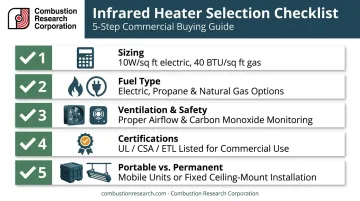
- Electric: roughly 10 watts per sq ft for primary heat.
- Gas: a common baseline is 40 BTU/h per sq ft, though this is a starting point, not a final answer.
A 2,500 sq ft service bay lands at about 25,000W electric or 100,000 BTU gas as a baseline. High ceilings, frequent bay-door traffic, or minimal insulation—common in auto service and repair facilities—often push the real number closer to 120,000-140,000 BTU. A heat-loss calculation, not a flat formula, gets you the accurate figure.
Fuel Type Trade-Offs
Once you know the BTU or wattage target, the next decision is fuel type.
- Electric: Easy install (for smaller units), no combustion venting, but generally higher operating cost per BTU.
- Propane: Fully portable, no power required, but needs ventilation and isn't recommended by the DOE for continuous unvented indoor use.
- Natural gas: Cost-efficient for large spaces long-term, but requires a gas line and proper venting.
Ventilation and Safety
Gas and propane heaters produce carbon monoxide as a byproduct. Any vent-free unit needs an oxygen depletion sensor (ODS) that shuts the unit down before oxygen levels drop to unsafe levels, plus occasional fresh-air exchange in the space.
Must-Have Safety Features
Look for these regardless of fuel type:
- Tip-over automatic shutoff
- Overheat protection
- Cool-touch exterior housing
These aren't optional extras. The CPSC estimates space heaters cause an annual average of 1,700 fires, 70 deaths, and 160 injuries in the US.
Certifications to Look For
At minimum, confirm UL, CSA, or ETL listing before buying. These marks confirm independent third-party testing against recognized safety standards, though they don't guarantee correct sizing for your space. CRC's industrial systems, for example, carry CSA International Design Certification to ANSI/CGA Standards, the commercial-grade equivalent of that same safety verification.
Portable vs. Permanent Installation
Portable units work for small garages or occasional use, but multi-bay service garages, dealership shops, and industrial spaces need consistent, all-day heat. Hardwired, ceiling-mounted radiant tube or infrared systems handle that load without taking up floor space forklifts and vehicles need.
How We Chose the Best Garage Heaters
We prioritized real-world performance over marketing copy:
- Heating performance — how quickly and evenly a unit warms a space at its rated output
- Safety certifications — CSA, UL, or ETL listing as a baseline requirement
- Ease of setup — plug-and-play portables versus professionally installed hardwired systems
- Noise levels — particularly relevant for units running during long workshop sessions
- Manufacturer-verified specs — cross-checked against actual product manuals rather than secondhand listings
The two most common buyer mistakes we see are undersizing a heater for the actual square footage, then blaming the heater when it can't keep up. The other is installing a gas unit without confirming proper venting or clearance requirements. Both hurt performance, and improper venting creates a genuine safety risk.
We compared products across price points and space sizes so recommendations work whether you're heating a single workbench or a full commercial service bay.
Conclusion
There's no single "best" garage heater. The right one matches BTU or wattage output, fuel type, and installation style to your specific garage size and how you actually use the space.
Weigh long-term energy costs and safety certifications against upfront price, not just the sticker number. A cheaper unit that's undersized or uncertified costs more in the long run.
For larger garages, service bays, or commercial workshops, a permanent, energy-efficient solution often makes more sense. Manufacturers like Combustion Research Corporation offer engineering support through their rep network to help size and specify the right infrared system for your facility.
Frequently Asked Questions
How many BTUs do I need to heat a 24x24 garage?
A 24x24 ft (576 sq ft) garage starts at roughly 23,000 BTU using a 40 BTU-per-sq-ft baseline. Poor insulation or high ceilings often push the real need to 25,000-30,000 BTU.
What type of gas heater is best for a garage?
Natural gas unit heaters suit larger, well-ventilated garages best due to lower long-term operating costs. Propane works better for portable use or garages without a gas line.
What is the safest heater to use in a garage?
Electric heaters are among the safest since they avoid combustion risks entirely. Any heater with tip-over shutoff, overheat protection, and UL/CSA certification performs safely when used and installed correctly.
What size heater do I need for a two-car garage?
A typical 500-700 sq ft two-car garage needs roughly 20,000-30,000 BTU as a starting estimate, or an equivalent electric wattage, adjusted upward for poor insulation.
Are ventless garage heaters safe to use indoors?
Yes, when equipped with an oxygen depletion sensor and used with occasional fresh air exchange. Most vent-free models are limited to around 30,000 BTU and 1,000 sq ft of coverage.
How much does it cost to run a garage heater?
Cost depends on fuel type, BTU output, and your local energy rates. Calculate hourly operating cost using your heater's rated wattage or BTU output against your utility's current rate per kWh or therm.