Introduction
Cold weather creates a real problem for paint booth operators. Below a certain temperature, coatings won't cure properly, adhesion fails, and finish quality drops—yet many shop owners aren't sure whether propane heat is even allowed in their booth, let alone which type of system is safe to run.
Propane is a widely accepted fuel for paint booth heating—but not every propane system qualifies. Code compliance depends on heater type, venting configuration, and how well the system handles the continuous air movement that makes paint booths uniquely demanding to heat. Portable propane heaters are prohibited entirely.
This guide covers the safety rules under NFPA 33 and OSHA, the three propane system types used in professional booths, a practical sizing walkthrough, and the compliance factors you need to confirm before commissioning anything.
TL;DR: Key Takeaways
- Propane is code-acceptable for paint booth heating—but only with the right heater type; open-flame portable units are strictly prohibited
- Direct-fired and indirect-fired make-up air (MUA) units are the two primary propane options for full-size booths
- Sealed-combustion infrared tube heaters are the right call for adjacent shop and prep areas—not inside the booth itself
- Size your system to the booth's CFM exhaust rate, not just floor area—make-up air demand is the dominant BTU driver
- Verify CSA certification, explosion-proof controls, and a purge cycle interlock before any unit goes near a paint booth
Why Temperature Control Matters in a Paint Booth
A paint booth has two distinct temperature requirements, and failing either one costs time and money.
During the spray phase, the substrate, product, and ambient air all need to be above 60°F. PPG's guidance for urethane clearcoats documents that every 10°F drop below 70°F can double clearcoat cure time—meaning a booth running at 50°F in January doesn't just slow production, it can make cure times commercially unworkable. Global Finishing Solutions recommends 70–75°F for waterborne coatings, or at least 5°F above ambient, whichever is greater.
During the bake/cure phase, temperatures climb significantly. These aren't suggestions—they're the conditions under which the coating chemistry actually completes. For reference:
- PPG VP2050 DTM primer: 40-minute bake at 140°F
- PPG D890 clearcoat: 30 minutes at 140°F (vs. an 8-hour air dry at ambient)
The Make-Up Air Complication
Paint booth heating differs from ordinary space heating in one critical way: the exhaust fans never stop. A spray booth runs continuous ventilation to maintain 100 feet per minute face velocity across the spray area, as required by OSHA and the IFC. That constant air movement pulls conditioned air out of the booth at high volume.
Every cubic foot of warm air exhausted gets replaced by cold outside air. In winter, incoming air could be at 10°F or 20°F, and the heating system must raise it to 65–140°F depending on the phase of operation. That make-up air heating load, not static heat loss through walls, is what determines the BTU requirement for any paint booth heater.
Can You Use a Propane Heater in a Paint Booth?
Yes—but with a critical distinction. Propane as a fuel source is acceptable. An open-flame or unvented propane heater inside the booth is not.
Why Portable Propane Heaters Are Prohibited
OSHA 1910.107 states plainly that heaters shall not be located in spray booths, and prohibits open flames or spark-producing equipment in any spraying area or within 20 feet unless separated by a partition. The IFC 2024 Section 2403.2.3 adds that heated surfaces sufficient to ignite vapors cannot be located in flammable vapor areas.
Three overlapping hazards explain the prohibition:
- The interior of a spray booth is a Class I, Division 1 hazardous location during spraying—flammable vapor concentrations can be significant
- Open-flame heaters introduce an ignition source directly into that environment
- Unvented heaters introduce combustion byproducts (moisture, CO, particulates) into the booth air, contaminating finishes
- Any portable propane unit placed inside a booth violates NFPA 33, OSHA requirements, and will typically void both booth warranties and insurance coverage
What "Sealed Combustion" Actually Means
So what does a compliant propane system look like? Compliant systems share one defining characteristic: they draw combustion air from outside the booth and vent exhaust gases externally. The flame never contacts the booth's interior air. That physical separation is what makes a propane-fueled system code-compliant.
One more consideration: some insurers require sealed or indirect-combustion systems regardless of what local code permits. Confirm requirements with both your local authority having jurisdiction (AHJ) and your insurer before purchasing any system.
Types of Propane Heating Systems for Paint Booths
Three propane system types are used in legitimate paint booth applications. Confusing these with prohibited portable heaters is a costly mistake — one that can invalidate insurance coverage and create serious ignition hazards.
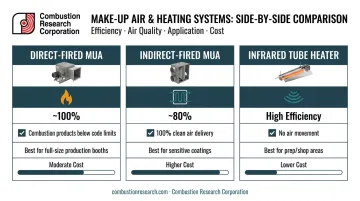
Comparison: Paint Booth Propane Heating Options
| System Type | Thermal Efficiency | Clean Air Delivery | Best Use Case | Relative Cost |
|---|---|---|---|---|
| Direct-Fired MUA | ~100% combustion efficiency | Combustion products enter air stream below code limits | Full-size production booths needing maximum heat output | Moderate |
| Indirect-Fired MUA | ~80% | 100% clean—no combustion byproducts in supply air | Sensitive coatings; facilities where contamination risk is unacceptable | Higher |
| Infrared Tube Heater | High (no duct losses) | No air movement at all | Surrounding shop space, prep areas, and adjacent work zones | Lower |
Direct-Fired Make-Up Air Units
Direct-fired MUA units burn propane in a combustion chamber and deliver heated air directly into the incoming air stream. According to Applied Air, products of combustion are introduced at concentrations well below code thresholds — and thermal efficiency reaches ~100%.
These units handle the full CFM volume the booth exhausts, replacing every cubic foot of exhausted air with tempered, heated supply air. For high-production automotive and industrial booths, this is the most common choice. Cambridge's M-Series, for example, handles up to 75,000 CFM and 6,500 MBH of heat input.
Indirect-Fired Make-Up Air Units
Indirect-fired units use a sealed heat exchanger to transfer heat from combustion gases to the supply air stream. The two never mix — combustion byproducts vent externally, and the air entering the booth is 100% clean.
Efficiency runs around 80% versus ~100% for direct-fired units, and capital cost is higher. But for facilities spraying highly sensitive waterborne coatings, or any operation where contamination risk can't be tolerated, indirect-fired is the right choice.
Low-Intensity Infrared Tube Heaters (Shop and Prep Area Heating)
Infrared tube heaters don't replace a make-up air system — they heat the surrounding environment. Ceiling-mounted and floor-space-preserving, they radiate heat downward to surfaces and occupants without moving air.
That "no air movement" characteristic matters in a finishing environment. Forced-air systems stir up dust and particulates; infrared tube heaters don't. For prep areas, detailing bays, service lanes adjacent to the booth, and general shop comfort heating, this is often the most practical and cost-effective approach.
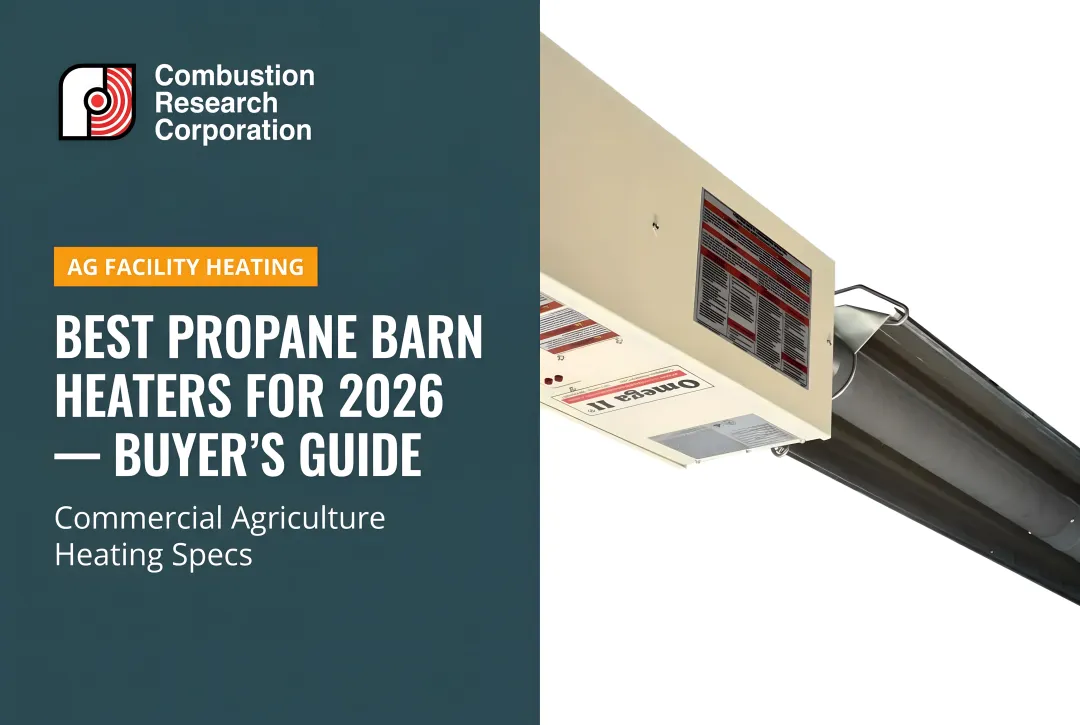
Combustion Research Corporation's Omega II and Reflect-O-Ray series are CSA-certified to ANSI Z83.20/CSA 2.34 standards and built specifically for bump shops and automotive service environments. The Reflect-O-Ray uses vacuum-vented operation, running under negative pressure so any potential leak draws ambient air in rather than pushing exhaust into the occupied space.
Both lines are available in stainless steel construction for environments with solvent or chemical exposure. The Omega II carries a 10-year warranty on radiant tubes.
What Not to Use
Torpedo heaters, portable propane space heaters, and unvented propane devices have no place in or near a spray booth — under any circumstances. This means:
- Not during spray cycles
- Not during bake cycles
- Not "just while warming the booth up"
These devices violate NFPA 33, create ignition hazards in classified locations, contaminate finishes, and will invalidate insurance coverage.
How to Size a Propane Heater for Your Paint Booth
Sizing a paint booth heater has two components. Most operators only calculate one of them.
Component 1: Static Heat Loss
This is the BTU load to offset heat escaping through walls, ceiling, and floor. It's a function of surface area, insulation R-value, and the temperature difference between inside and outside. For a well-insulated booth in a cold climate, this number is meaningful—but it's not the dominant load.
Component 2: Make-Up Air Heating Load
This is the BTU demand created by heating the continuous stream of cold outside air drawn in to replace what the exhaust fans remove. It's almost always the larger number, and it's what most undersized booth heaters fail to account for.
The verified engineering formula for sensible air heating is:
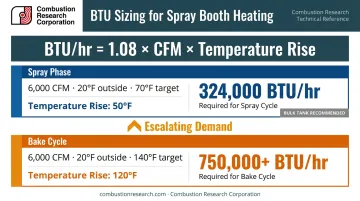
BTU/hr = 1.08 × CFM × Temperature Rise
Worked example:
- Booth exhaust rate: 6,000 CFM
- Outside temperature: 20°F
- Target booth temperature: 70°F
- Temperature rise: 50°F
BTU/hr = 1.08 × 6,000 × 50 = 324,000 BTU/hr
That's just to heat the incoming air to 70°F. To run a bake cycle at 140°F with the same airflow, the temperature rise climbs to 120°F, and the BTU requirement exceeds 750,000 BTU/hr. That figure is well beyond what any single-tank propane setup can sustain.
Propane Fuel Consumption
Those BTU demands translate directly into fuel draw. According to the U.S. Energy Information Administration, propane contains 91,452 BTU per gallon. A system running at 300,000 BTU/hr consumes roughly 3.3 gallons per hour under continuous operation. Any serious paint booth application requires a bulk propane tank with a permanent gas line—not 20 lb cylinders.
What Affects Your Final Number
- Climate zone matters: a shop in Michigan has far greater make-up air heating demands than one in Georgia
- Uninsulated walls multiply static heat loss and can push final BTU requirements significantly higher
- Bake cycles at 140°F require roughly 2.5× the BTU of 70°F spray-phase temperature maintenance
- Exhaust CFM is set by booth size and required face velocity—confirm this number with your booth manufacturer before sizing any heater
Get the CFM figure and your climate data before touching any BTU calculator. Combustion Research Corporation offers engineering support through the full specification process—both new construction and retrofits—so the system you order matches the load you actually have.
Safety and Compliance for Propane Paint Booth Heaters
Core Code Requirements
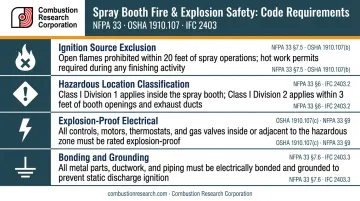
The governing standards are NFPA 33 (2024 edition), OSHA 1910.107, and IFC Chapter 24. Key requirements that directly affect propane heater selection and installation:
- Ignition source exclusion: OSHA prohibits open flames and spark-producing equipment in any spraying area or within 20 feet unless separated by a partition
- Hazardous location classification: The spray booth interior is Class I, Division 1; areas within 3 feet of booth openings are Class I, Division 2 (IFC 2403.2.1.3)
- Explosion-proof electrical: All wiring and equipment in flammable vapor areas must be explosionproof (IFC 2403.2.1.1); controls, motors, thermostats, and gas valves near the booth must be rated for their classified location
- Grounding: Metal parts of spray booths, exhaust ducts, and piping must be bonded and grounded (IFC 2403.2.5)
Purge Requirements Before Heating
Before any heat source can safely operate in a booth used for spraying, the booth must complete a purge cycle. IFC 2024 Section 2404.8.1.2 requires at least four air changes or 3 minutes, whichever is greater, before drying apparatus is energized. OSHA specifies a minimum 3-minute purge.
Automated interlock systems are typically required to enforce these conditions. The IFC mandates interlocks that:
- Prevent the heater from firing until purge is complete
- Block spraying while drying operations are running
- Shut off drying equipment if booth air temperature exceeds 200°F
Certifications to Verify
Before purchasing any propane heating system for a paint booth application:
- Check for CSA certification and ANSI/CGA compliance (for infrared tube heaters, look for ANSI Z83.20/CSA 2.34)
- Verify the system is listed for its intended use; heaters that run only during bake cycles (after purge) face fewer restrictions than those operating during active spray
- Have the completed installation inspected by your local AHJ (Authority Having Jurisdiction) before commissioning
- Review coverage with your insurer; some carriers require indirect-combustion systems regardless of local code adoption
Frequently Asked Questions
Can I use a propane heater in a paint booth?
Propane is an acceptable fuel for paint booth heating, but only with code-compliant system types—direct-fired or indirect-fired make-up air units, or sealed-combustion infrared tube heaters for surrounding areas. Portable or unvented propane heaters are prohibited by OSHA 1910.107 and NFPA 33 and create serious fire and health hazards in classified spray environments.
What is the best way to heat a paint booth?
A direct-fired or indirect-fired propane make-up air unit is the most effective solution for a full-size production booth—it heats incoming air while replacing exhausted volume, maintaining stable temperature and positive pressure. Ceiling-mounted infrared tube heaters work well for surrounding shop space, prep areas, and service lanes without disturbing dust or finishes.
How many BTUs do I need to heat a 20x20 garage?
There's no universal flat number—output depends on insulation, climate zone, and design temperature. With an active exhaust fan running, BTU demand can be two to four times a standard garage estimate due to continuous cold air infiltration. Use BTU/hr = 1.08 × CFM × Temperature Rise to account for the ventilation load.
How long will a 20 lb propane tank last on a 40,000 BTU heater?
At 40,000 BTU/hr, a 20 lb tank lasts roughly 2 hours based on propane's energy content of 91,452 BTU per gallon. Paint booth applications typically require 200,000–750,000+ BTU/hr, making a single 20 lb tank impractical—a bulk propane tank with a permanent gas line is the standard solution.
Do I need special electrical components with a propane paint booth heater?
Yes. All electrical components associated with the heating system—controls, motors, thermostats, gas valves—must be rated for the hazardous location classification where they're installed. Equipment within the spray area requires explosionproof ratings; equipment within 3 feet of booth openings must meet Class I, Division 2 requirements. Verify ratings before installation and have the AHJ inspect before commissioning.