Introduction
A drafty, uninsulated garage turns into a no-go zone the moment temperatures drop. Cold concrete, leaky overhead doors, and thin walls mean any warm air a standard heater produces disappears within minutes of the door going up.
Infrared heating has become the fix contractors and facility managers reach for first. It warms people, vehicles, and floors directly instead of chasing air that keeps escaping.
That direct-heating approach matters more than most buyers realize. A forced-air furnace has to reheat an entire room's worth of air every time someone rolls a truck in or out.
Infrared systems skip that step. They bank heat into surfaces and objects, so the space recovers fast and operating costs stay lower.
This guide breaks down the top infrared garage heaters for 2026, from heavy-duty gas-fired tube heaters built for multi-bay service garages, to compact electric infrared units suited to smaller commercial bays and workshops.
TL;DR
- Infrared heaters warm people and objects directly, not the air, so they perform better in drafty or frequently opened garages
- Top picks range from industrial low-intensity tube heaters for large workshops to compact electric panels for smaller spaces
- Choose based on garage size, fuel type, mounting needs, and safety certifications — not price alone
- Gas-fired units typically require venting; electric infrared units do not
Overview of Infrared Garage Heaters in the Home & Workshop Heating Market
Infrared, or radiant, heating transfers energy directly from a hot surface, such as a tube or ceramic emitter, to the people and objects in its path. Convection heaters, by contrast, warm the air itself and depend on that warm air circulating around the room.
In a garage where a car pulls in with the door open for two minutes, that difference decides whether you're comfortable or still shivering ten minutes later.
Radiant heating isn't a niche category anymore. Grand View Research pegs the global radiant heating systems market at $5.12 billion in 2024, with a projected 5.1% annual growth rate through 2033, as more residential, commercial, and industrial buildings move away from air-heating systems that lose efficiency to drafts.
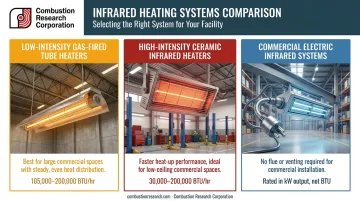
For garages specifically, three categories dominate:
- Low-intensity gas-fired tube heaters - ceiling-mounted, built for larger detached garages, workshops, and service bays where consistent heat output and floor space matter
- High-intensity ceramic infrared heaters - single or dual-stage units that deliver faster heat-up in bays with lower ceilings
- Commercial electric infrared systems - no gas venting required, suited to service bays and facilities without gas infrastructure
Which category fits depends on a few variables:
- Insulation - poorly insulated garages lose heat faster and need higher BTU density
- Ceiling height - taller bays need more mounting clearance and higher-output units
- Usage pattern - daily vehicle service work calls for a permanently installed system; occasional-use spaces can often get by with a smaller electric infrared unit
The list below ranks the top infrared garage heater manufacturers for 2026, based on efficiency, certifications, durability, and how well their product lines scale across garage sizes.
Top Infrared Garage Heaters for 2026
We evaluated each brand on energy efficiency, safety certifications, warranty coverage, and how well its product range spans single-bay garages through full workshop installations.
Combustion Research Corporation (CRC)
CRC has manufactured low-intensity infrared tube heaters for industrial and residential-scale garage applications for more than 50 years, and its systems carry CSA International Design Certification to ANSI/CGA standards.
Two product lines set the company apart:
- Reflect-O-Ray Engineered Design Systems: vacuum-vented, custom-engineered per facility, scaling from 40,000 to 250,000 BTU/h for larger workshops and multi-bay facilities
- Omega II Pre-Engineered Packages: power-vented, unitary systems rated 105,000-200,000 BTU/h, built for standard service-bay garages where a fully custom vacuum system isn't necessary
Both lines offer stainless steel combustion chamber options and corrosion-resistant aluminized steel tubing as standard, with stainless upgrades available for wash bays or salt-exposed environments. CRC backs the radiant tubes and heat exchanger with a 10-year limited warranty against internally created corrosion, plus a separate 3-year warranty on burner controls.
| Category | Details |
|---|---|
| Heating Type/Fuel | Low-intensity infrared gas-fired tube heater; vacuum-vented (Reflect-O-Ray) and power-vented (Omega II) configurations available |
| Best For | Multi-bay service garages, workshops, and larger residential garages needing consistent, ceiling-mounted heat without floor space loss |
| Key Advantage | Up to 75% energy savings and 30-50% lower operating costs versus conventional heating, with engineering support for retrofit or new builds |
Detroit Radiant Products (Re-Verber-Ray)
Detroit Radiant has supplied low-intensity infrared tube heaters to garages, warehouses, and commercial facilities for decades, with its LD3, HL3, and DX3L series covering everything from low-ceiling residential bays to full industrial buildings.
Single- and two-stage models run throughout the lineup, with rugged construction and optional stainless steel upgrades for corrosive environments. Select LD3 configurations carry certification for attached garage installation - worth checking closely, since the HL3 and DX3L series are positioned for commercial and industrial use rather than residential.
| Category | Details |
|---|---|
| Heating Type/Fuel | Gas-fired low-intensity infrared tube heater |
| BTU Range | LD3: 40,000-50,000 BTU/h; HL3: 65,000-200,000 BTU/h; DX3L: 50,000-200,000 BTU/h |
| Best For | Larger detached garages and workshops needing variable heat output |
Superior Radiant Products
Superior Radiant Products builds infrared tube heaters engineered specifically for cold-climate garages and industrial buildings, with strong distribution across North America.
Its two-stage GRT garage heater runs 30,000 BTU/h on low fire for steady-state winter conditions and steps up to 45,000 BTU/h on high fire to recover heat quickly after a door cycle or a cold snap.
The unit ships with a balanced-flue vent kit and ceiling mounting bracket, and corrosion-resistant components hold up well in low-clearance installations.
| Category | Details |
|---|---|
| Heating Type/Fuel | Gas-fired infrared tube heater (two-stage) |
| Mounting | Ceiling-suspended, ideal for preserving floor space in garages with vehicle lifts |
| Best For | Cold-climate residential and light-commercial garages |
Mr. Heater (Enerco Group)
Mr. Heater built its reputation on portable and wall-mounted infrared heaters aimed squarely at DIYers and residential garage owners who want something they can set up themselves.
The Big Buddy portable propane heater is the brand's best-known garage/workshop product, offering 4,000, 9,000, or 18,000 BTU/h settings. For a fixed installation, the MH25LP and MH40LP high-intensity radiant workshop heaters step up to 22,000 and 40,000 BTU/h. Setup is simple, and the products sell widely at hardware and big-box retailers.
| Category | Details |
|---|---|
| Heating Type/Fuel | Portable or fixed radiant propane infrared heater |
| Heat Output | 4,000-18,000 BTU/h (Big Buddy); 22,000-40,000 BTU/h (fixed workshop models) |
| Best For | Single-car residential garages and occasional-use spaces |
Dr. Infrared Heater / Heat Storm
For garages where running gas lines isn't practical, Heat Storm and Dr. Infrared focus on compact electric infrared heaters that mount to a wall and plug into a standard outlet.
Heat Storm's A-6000-GC garage heater is the clearer garage-specific benchmark, offering 3,000W or 6,000W settings with quiet operation and no venting to install. It fits attached garages, home gyms, or workshops with limited electrical capacity, where a permanent gas tube heater would be overkill.
| Category | Details |
|---|---|
| Heating Type/Fuel | Electric infrared panel heater, no venting required |
| Heat Output | 3,000-6,000W |
| Best For | Small attached garages, home gyms, or workshops with limited electrical/gas infrastructure |
How We Chose the Best Infrared Garage Heaters
We weighted manufacturer certifications, warranty length, and documented efficiency claims more heavily than marketing copy. A heater carrying CSA International Design Certification to ANSI/CGA standards, backed by a 10-year tube warranty, tells you more about long-term reliability than a headline BTU number alone.
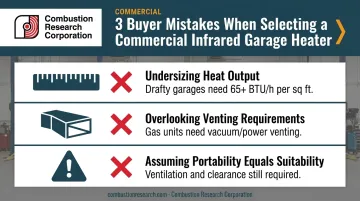
Common buyer mistakes we steered readers away from:
- Undersizing heat output for square footage - the standard 30-40 BTU/h per sq ft rule assumes good insulation; drafty garages often need 65+ BTU/h per sq ft
- Overlooking venting requirements - gas-fired tube heaters need vacuum or power venting per code, and skipping this step creates a safety hazard
- Assuming portability equals suitability - "indoor safe" propane heaters still require ventilation, clearance, and fuel-storage compliance inside a garage
We also weighted engineering and installation support, along with whether a manufacturer offers both ceiling-mounted and portable configurations. These factors affect long-term operating cost and safety more than the sticker price does.
Conclusion
The right infrared garage heater comes down to matching heater type and capacity to your garage's size, insulation, and how often you'll use it - not which brand has the most name recognition. A single-bay automotive service garage used a few times a week has very different needs than a four-bay dealership shop with doors cycling every few minutes.
Before you buy, verify these items, especially for larger or heavy-use garages where an uncertified unit gets expensive fast:
- Warranty coverage on the burner core and heat exchanger tubes
- Energy-savings data compared to forced-air heating
- Certification standards such as CSA International design certification
Combustion Research Corporation offers engineering support throughout the specification process, whether you're speccing a heater for new construction or retrofitting an existing service bay.
If you're weighing Omega II against Reflect-O-Ray, or sizing a system for a multi-bay garage, CRC's representative network can walk through the details. Call 888-852-3611 or email info@combustionresearch.com to get started.
Frequently Asked Questions
How much does it cost to run an infrared garage heater?
Operating cost depends on fuel type, heater wattage or BTU rating, and how many hours it runs. Infrared systems generally cost less to operate than forced-air alternatives, since they heat objects directly instead of losing energy to escaping air.
What kind of heater is best for a garage?
Low-intensity gas-fired infrared tube heaters suit larger or frequently used garages and service bays. Compact electric infrared heaters work better for smaller, occasional-use residential garages without gas lines.
Do infrared garage heaters need to be vented?
Gas-fired infrared heaters need vacuum or power venting to remove combustion byproducts, per the manufacturer's installation manual. Electric infrared heaters produce no combustion byproducts, so no venting is required.
What size infrared heater do I need for a two-car garage?
As a starting point, general industry sizing guidance puts 30-50 BTU/h per square foot, though poor insulation or frequent door cycling can push that higher. Manufacturer sizing charts or CRC's engineering support can nail down exact numbers for your space.
Can infrared heaters be installed in attached garages?
Select low-intensity infrared tube heater models are specifically certified for attached garage installation, but not every unit qualifies. Always confirm certification with the manufacturer before installing near living spaces.
Is infrared heat safe to use in a garage with a parked vehicle or fuel storage?
Certified infrared heaters are engineered with safety clearances and combustion controls for use around vehicles, per AHRI's gas-fired infrared safety guidance. Proper clearance distances and manufacturer guidelines for fuel storage still need to be followed exactly.