Introduction
Getting heat load wrong is an expensive mistake. Spec a system that's too small and your facility never reaches comfort temperature on the coldest days. Oversized? You're paying to run a system that short-cycles, wears out faster, and still doesn't heat evenly. According to research on commercial HVAC oversizing, small commercial systems in Northern California alone waste roughly $400 million per year in excess energy consumption — a direct consequence of systems that weren't sized correctly from the start.
Commercial heat load calculations are more complex than residential ones. High ceilings, variable occupancy, heavy infiltration from loading docks and vehicle bays, and wide climate swings all create conditions where residential rule-of-thumb estimates consistently produce the wrong answer — usually too low.
This article covers the exact formula and five-step calculation process for commercial heat load. It also breaks down the key variables and the sizing mistakes that lead to the most expensive failures in commercial and industrial buildings.
Key Takeaways
- Total heat load = transmission losses + infiltration losses – verified internal heat gains
- Use ACCA Manual N for commercial buildings; Manual J is for residential only
- Required inputs: building volume (not just floor area), ΔT, envelope U-values, ACH, and internal heat sources
- High-infiltration spaces — warehouses, hangars, vehicle bays — have infiltration as the dominant load component
- Radiant infrared systems can reduce required installed capacity in high-bay buildings by heating occupants directly, not the full air volume
How to Calculate Heat Load for a Commercial Building
Step 1: Collect Building Data and Establish Design Conditions
Start with building volume, not floor area. Measure length × width × ceiling height. A 20,000 sq ft warehouse with 24 ft ceilings contains three times the air volume of the same footprint at 8 ft and needs proportionally more heating capacity as a result.
Next, establish your temperature differential (ΔT):
- Indoor design temperature: typically 65°F for warehouses, 68–70°F for occupied commercial spaces (OSHA recommends 68–76°F for workplace comfort)
- Outdoor design temperature: pull the ASHRAE 99% winter heating dry-bulb value for your specific location from ASHRAE Standard 169 or the ASHRAE Handbook — Fundamentals, which covers over 12,400 weather stations
Using daily average temperatures instead of ASHRAE 99% design values is a frequent and costly error. ASHRAE design values represent the coldest conditions your system must handle, not typical winter averages.
Finally, collect construction details:
- Wall and roof assembly R-values (and their inverse, U-values)
- Window and door U-factors
- Floor type: slab-on-grade vs. raised
- Number, size, and type of all openings: overhead doors, dock doors, skylights
Step 2: Calculate Transmission Heat Loss
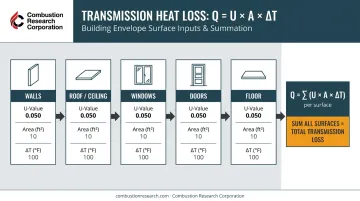
Apply the transmission formula to each envelope surface separately:
Q (BTU/hr) = U-value × Surface Area (sq ft) × ΔT (°F)
Run this calculation for walls, roof/ceiling, windows, doors, and floor — then sum all values. The U-value is the inverse of total R-value (U = 1/R), accounting for all layers: interior finish, insulation, sheathing, and exterior cladding.
Reference U-value benchmarks for common commercial construction:
| Assembly Type | Typical U-Value | Climate Zones |
|---|---|---|
| Metal building wall | U-0.079 | 1–3 |
| Metal building wall | U-0.052 | 4–8 |
| Metal building roof | U-0.035 | 1–5 |
| Metal building roof | U-0.029 | 7–8 |
| Insulated metal panel (3 in.) | U-0.066 | All |
| Insulated metal panel (4 in.) | U-0.043 | All |
| Commercial glazing | U-0.20 to U-1.20 | Varies |
Source: DOE/PNNL 2015 IECC compliance data; Metl-Span product data
A single uninsulated window or poorly detailed door can account for 20–30% of total envelope loss. Account for every opening accurately.
Step 3: Calculate Infiltration Heat Loss
Commercial buildings experience far more infiltration than residential ones. Loading dock doors, vehicle entry bays, and construction gaps all contribute. Use the Air Change Method:
Q_inf (BTU/hr) = 0.018 × Volume (cu ft) × ACH × ΔT
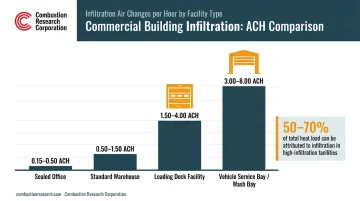
ACH (air changes per hour) varies widely by building type. A tightly sealed office building operates at a much lower effective ACH than a warehouse with multiple dock doors or a vehicle wash bay with doors cycling constantly. PNNL's commercial infiltration modeling guidelines and NREL's warehouse research both confirm that infiltration can be the primary heating energy driver in large-volume commercial buildings, not just a secondary line item.
Key infiltration realities for high-bay facilities:
- Dock doors, vehicle bays, and overhead doors raise effective ACH well above office defaults
- Facilities like car wash bays, service garages, and aircraft hangars experience frequent door cycles that spike infiltration beyond published generic values
- Field-verified ACH estimates are more reliable than table defaults for these building types
Applying office-grade ACH values to warehouses or vehicle service facilities is one of the most common sizing errors in commercial heat load calculations. Match your ACH inputs to the actual building type.
Step 4: Identify and Credit Internal Heat Gains
Occupants, lighting, motors, and process equipment all produce heat that offsets a portion of the heating load. Published ASHRAE sensible heat gain rates (from ASHRAE Handbook — Fundamentals, Chapter 28):
- Moderately active office work: 250 BTU/hr per person
- Light bench work: 275 BTU/hr per person
- Heavy work: 580 BTU/hr per person
- Lighting: Q = 3.41 × Watts × use factor × special allowance factor
Critical caution: ASHRAE's own guidance notes that for conventional heating-load purposes, internal gains from people, lights, and appliances are often excluded because they're intermittent and uncertain during all hours of heating need. A warehouse operating overnight with no occupants and minimal lighting provides zero internal heat gain offset. Size the system to handle the full load without internal gain offsets for unoccupied periods.
Step 5: Sum Components and Apply a Design Safety Factor
Total Heat Load (BTU/hr) = Transmission Losses + Infiltration Losses – Verified Internal Gains
With all components summed, add a design safety margin to account for calculation uncertainty, recovery loads, and abnormal infiltration events. No single standard sets a universal percentage. Apply margins where conditions justify them: high-infiltration facilities, extreme climate zones, or spaces with process heat sources that vary significantly.
Finally, convert the BTU/hr heat load to required equipment output:
Required Input BTU/hr = Calculated Heat Load ÷ System Efficiency Rating
This equipment input figure becomes the specification basis for selecting a correctly sized heater.
Key Factors That Affect Commercial Heat Load Calculations
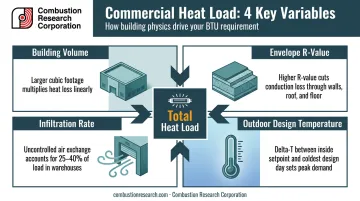
Four variables account for most of the difference between a low-load and high-load commercial space.
Ceiling Height and Building Volume
Heat load scales with volume, not floor area. A 10,000 sq ft warehouse with 24 ft ceilings contains roughly three times the air volume of an 8 ft ceiling office on the same footprint. Rule-of-thumb BTU-per-square-foot estimates consistently undersize heating systems in high-bay commercial and industrial buildings. Always calculate based on volume.
Building Envelope Insulation Quality
The R-value of walls, roof, and floor directly controls the U-factor in your transmission formula. Improving envelope insulation is often the most cost-effective way to reduce total heat load before specifying equipment — in some cases, an insulation upgrade reduces required heating capacity enough to justify the investment independently of energy savings.
Infiltration from Large Commercial Openings
Loading dock doors, vehicle entry bays, and frequently operated overhead doors are the largest source of infiltration variability. For facilities like car wash bays, service garages, and aircraft hangars, infiltration can represent 50–70% of total heat load — often the single largest calculation term. Verify ACH for these building types based on actual door count, dock configuration, and operational patterns rather than generic tables.
Climate Zone and Outdoor Design Temperature
The ASHRAE 99% winter design temperature sets the baseline ΔT for your entire calculation. To illustrate the impact: Detroit's ASHRAE 99% heating dry-bulb is approximately 8.9°F, compared to a normal January mean of about 25.8°F. That's a 17°F difference in ΔT — and since ΔT drives every term in the calculation, using weather averages instead of ASHRAE design conditions can meaningfully underestimate peak heating demand.
Always pull location-specific ASHRAE 99% data from the Handbook or ASHRAE's Climatic Design Conditions tool (ASHRAE Meteo).
These four factors — volume, envelope R-value, infiltration rate, and design temperature — interact with each other. Getting any one wrong compounds errors across the full calculation.
Common Mistakes When Calculating Commercial Heat Load
These four errors account for the majority of real-world sizing failures. Each one is common across warehouses, service garages, and high-bay industrial facilities — and each leads to equipment that's either too small to maintain setpoint or too large to run efficiently:
Ignoring building volume by sizing from floor area alone. BTU-per-square-foot shortcuts skip ceiling height entirely, which consistently undersizes high-bay warehouses and aircraft hangars where volume drives the calculation, not footprint.
Using generic infiltration rates instead of estimating ACH from actual door count, dock layout, and operational patterns. This is the single largest source of sizing error in warehouses and vehicle service buildings, where door activity can swing infiltration loads dramatically.
Sizing to weather averages instead of ASHRAE 99% design temperatures. Average temperatures run significantly warmer than design conditions, which leads to underestimated peak demand and undersized equipment when it matters most — the coldest days of the year.
Running a single blended calculation for multi-zone buildings. A conditioned office inside an unheated warehouse has a different ΔT, occupancy schedule, and infiltration exposure than the surrounding space. Treating both as one zone produces inaccurate totals for each — typically undersizing the office and oversizing the warehouse.
How Heating System Type Affects Your Required Output
Once you have a calculated BTU/hr load, system selection still matters — not all systems deliver equivalent usable warmth per BTU of output.
Radiant infrared systems heat surfaces, objects, and occupants directly rather than raising ambient air temperature. This distinction is especially important in high-bay, high-infiltration facilities: because infiltration removes warm air rather than warm surfaces, radiant heat is less easily lost through door cycles than the heated air volume a forced-air system depends on. In high-bay facilities with frequent door cycling, an infrared system can achieve equivalent occupant comfort at a lower total installed capacity than forced-air.
According to a 2007 ASHRAE Journal study on high-bay infrared applications, radiant infrared heaters can consume 33–50% less energy than traditional unit heaters in high-bay commercial settings, with conservative estimates around 20%. The mechanism: radiant systems reduce vertical temperature stratification, directing heat to the occupied zone rather than heating the roof deck air first.
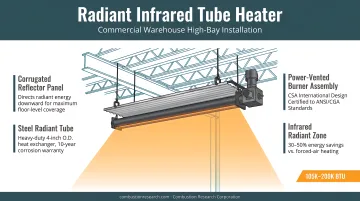
Combustion Research Corporation's Reflect-O-Ray and Omega II tube heaters (40,000–250,000 BTU/hr) are built for the highest-infiltration commercial environments:
- Aircraft hangars and large warehouses — high ceilings, frequent large-door cycles, significant air volume to heat
- Vehicle wash bays and service garages — continuous door activity and vehicle exhaust ventilation requirements
- Shipping and receiving docks — semi-conditioned spaces with near-constant infiltration exposure
The Reflect-O-Ray's vacuum exhaust design holds exhaust integrity even with frequent door cycles, making it well-suited to these applications. Both lines deliver 30–50% energy savings versus conventional forced-air systems.
One practical implication: after completing your heat load calculation, specifying an infrared system may allow you to meet comfort targets at a lower installed BTU/hr, reducing both equipment and operating costs relative to a forced-air system of equivalent capacity.
Conclusion
Accurate commercial heat load calculation depends on four required inputs: building volume, ASHRAE 99% outdoor design temperature, envelope U-values for every surface, and a realistic infiltration rate based on actual building conditions.
Two avoidable errors cause most sizing failures: using floor-area estimates that ignore ceiling height, and underestimating infiltration from large commercial openings. Both produce undersized systems that fall short on the coldest days of the year — when your facility needs full heating capacity and has none to spare.
For complex commercial and industrial projects, Combustion Research Corporation offers engineering support throughout the specification process — from validating heat load inputs to recommending correctly sized infrared heating systems for new construction and retrofit applications. Reach the team at combustionresearch.com or call 888-852-3611.
Frequently Asked Questions
What factors determine heat load calculation for commercial buildings?
The primary inputs are building volume, the indoor-to-outdoor temperature differential (ΔT), envelope U-values for walls, roof, windows, and doors, infiltration rate expressed as ACH, and internal heat gains from occupants and equipment. Of these, building volume and infiltration rate have the most variability in commercial applications.
What is the formula for calculating heat load for commercial buildings?
Total Heat Load (BTU/hr) = [U × A × ΔT for each envelope surface] + [0.018 × Volume × ACH × ΔT for infiltration] – Verified Internal Gains. ACCA Manual N governs commercial load calculations and provides the methodology framework for applying these formulas correctly.
How do you perform a heat load calculation for a commercial building?
Follow five steps: gather building dimensions and ASHRAE 99% design temperatures, calculate transmission losses through each envelope surface, calculate infiltration losses using the air change method, credit verified internal heat gains from occupants and equipment, and sum all components with an appropriate design safety margin.
What is the difference between heat load and cooling load?
Heating load quantifies the heat energy needed to warm a space during cold design conditions; cooling load quantifies the heat that must be removed during peak summer conditions. Both use similar envelope and infiltration inputs, but each is driven by opposite seasonal design temperatures: winter for heating, summer for cooling.
Can I calculate heat load without a professional engineer?
Basic calculations are manageable using published formulas and ASHRAE climate data for straightforward single-zone buildings. Facilities with multiple zones, large door openings, or significant process heat sources benefit from professional review. Sizing errors in those buildings are more costly to correct after installation.
How often should commercial heat load calculations be updated?
Recalculate after any significant building modification: adding or removing insulation, changing occupancy type or density, installing new equipment, modifying doors or loading docks, or expanding floor area.