The fuel choice matters more than most people realize. According to EIA 2025 pricing data, natural gas delivers heat at roughly $1.59–$1.85 per 100,000 BTU, compared to $5.07 per 100,000 BTU for electric resistance heating at average residential rates. That gap compounds quickly in a cold climate.
This guide covers 12 proven heating methods — from no-cost insulation fixes to high-output permanent systems — with a clear focus on natural gas as the primary fuel for large or frequently used garages.
Key Takeaways
- Natural gas infrared tube heaters deliver the best output-to-cost ratio for large, frequently used garages — including auto shops, service bays, and oversized residential spaces
- Insulation and draft sealing come first — skip them, and any heater works harder than it should
- BTU sizing depends on square footage, ceiling height, insulation quality, and climate; use a proper heat-loss calculation, not a rule of thumb
- The 12 methods range from portable space heaters to radiant floor systems; the right pick depends on garage size, usage frequency, and fuel access
- Long-term operating costs favor radiant infrared — typically 30–50% lower than conventional forced-air systems in comparable applications
How Much Heat Does Your Garage Actually Need?
Heating output is measured in BTU/hr. Size too small and the space never gets comfortable; size too large and the system short-cycles, wastes fuel, and wears out faster.
The Right Sizing Method
ACCA's Manual J 8th Edition is the ANSI-recognized standard for residential heating load calculations. It accounts for wall and ceiling insulation, garage door surface area, floor construction, infiltration rates, and local climate data. A qualified HVAC professional can run this calculation in under an hour — and it's worth doing before purchasing any system.
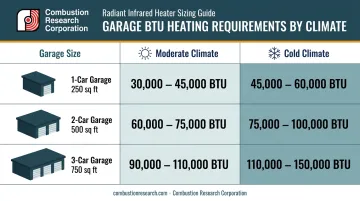
Rough BTU estimates from manufacturer sizing guides:
| Garage Size | Moderate Climate | Cold Climate |
|---|---|---|
| 1-car (~250 sq ft) | 12,000–16,000 BTU/hr | 20,000–24,000 BTU/hr |
| 2-car (~500 sq ft) | 20,000–28,000 BTU/hr | 30,000–40,000 BTU/hr |
| 3-car (~750 sq ft) | 28,000–36,000 BTU/hr | 40,000–60,000 BTU/hr |
Key Variables That Affect BTU Requirements
These figures assume average conditions. Several variables can push your actual requirement higher or lower:
- Insulation quality — a poorly insulated garage can require 30–50% more heating capacity than an insulated one
- Ceiling height — higher ceilings increase heated air volume and stratification losses
- Number of doors and windows — each opening is a heat loss point
- Attached vs. detached — attached garages benefit from shared wall heat with the house
- Local climate zone — the difference between Zone 3 and Zone 6 can double your BTU requirement
Infrastructure to Consider Before Choosing
Electric systems above roughly 10,000 BTU/hr typically require a dedicated 240V circuit. Natural gas systems connect to an existing gas line. Before committing to a heating method, confirm which infrastructure you already have — it often determines the most practical path forward.
12 Best Ways to Heat a Garage in 2026
These 12 methods cover fuel types, installation complexity, and budget levels — from foundational improvements to high-output permanent systems. Natural gas options are highlighted as the primary choice for large or commercial garage applications.
1. Insulate Your Garage First
Insulation isn't a heating method — it's a prerequisite. Without it, any heater runs harder and longer than necessary.
Three zones to address:
- Garage door — the largest single surface area in most garages; insulated replacement panels or door kits are the highest-impact upgrade
- Walls and ceiling — aim for R-13 minimum in walls, R-19 or better in the ceiling
- Windows and door frames — even small gaps here create consistent heat loss
Better insulation directly reduces the BTU capacity you need, which cuts both equipment cost and ongoing fuel bills. Treat this as investment in every heating method below.
2. Seal Drafts and Air Leaks
Air leaks undermine even a well-insulated garage. Find them with a simple daylight check on a bright day, or run your hand along door frames and wall penetrations on a cold day.
Two fixes:
- Weatherstripping — for the moving edges of garage doors, entry doors, and windows
- Caulk or expanding foam sealant — for static gaps around conduit penetrations, wall-ceiling joints, and window frames
Weatherstripping a standard two-car door costs under $30 and takes less than an hour. Draft-sealing is often the fastest comfort improvement in a garage that already has insulation but still feels cold.
3. Natural Gas Infrared Tube Heaters
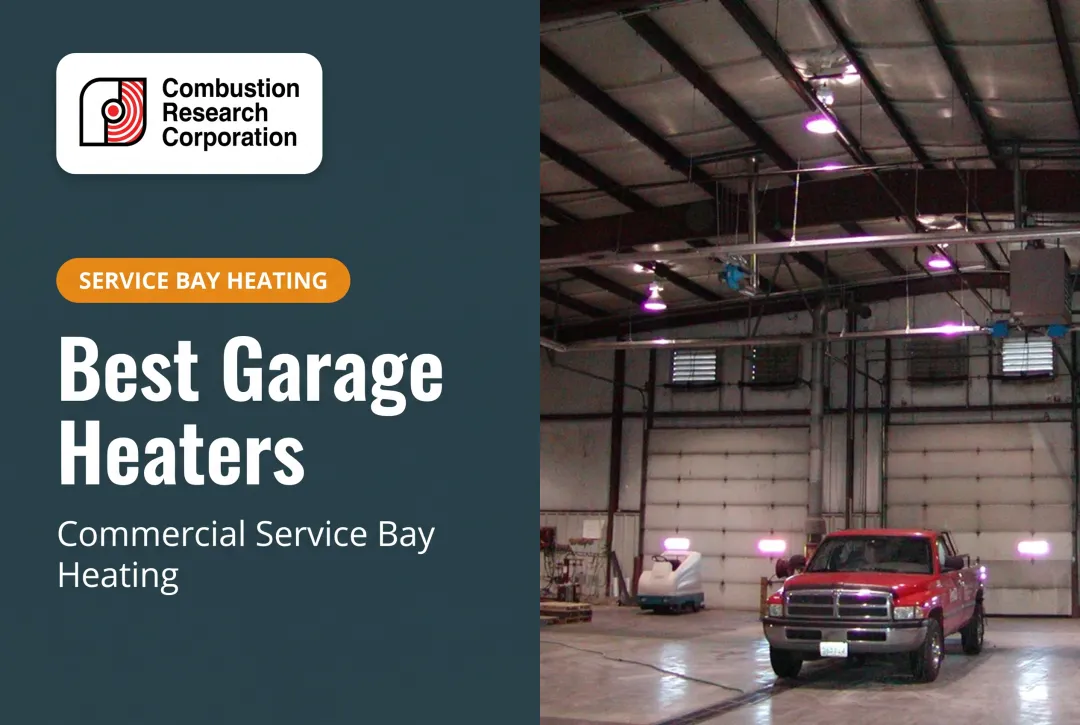
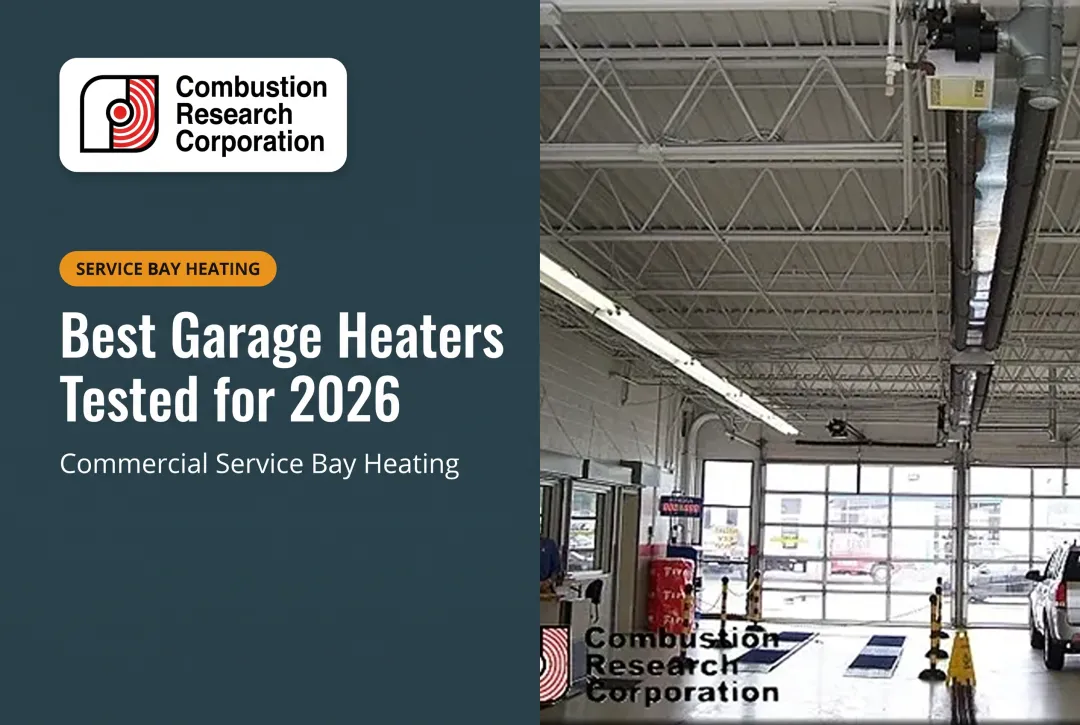
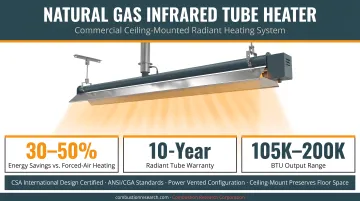
Low-intensity infrared tube heaters work differently than forced-air systems. A gas burner heats a metal tube suspended from the ceiling, which radiates infrared energy downward to warm floors, objects, and occupants directly, without heating and recirculating air.
Advantages over forced-air:
- No heat stratification — heat stays at floor level where people and vehicles are, not pooled at the ceiling
- No dust or pathogen movement — no blower means air quality stays undisturbed, a key advantage in auto shops and sensitive environments
- Floor space preserved — ceiling-mounted configuration keeps the work area clear
- Quiet operation — no fan noise during steady-state heating
Industry and manufacturer sources, including Space-Ray and Combustion Research Corporation, report 30–50% energy savings compared to conventional forced-air systems, with some engineered designs achieving even higher reductions. These figures reflect the efficiency advantage of heating surfaces rather than air volume, though savings vary by building and duty cycle.
Sizing for your application: Combustion Research Corporation's Serengeti-IR residential system (40K–60K BTU/hr) is specifically engineered for residential garages. For larger garages, service bays, and commercial spaces, the Omega II product line covers 40K–220K BTU/hr in straight or U-tube power-vented configurations. The Omega II 9K Series carries ANSI Z83.20 / CSA 2.34 certification and features dual modulating two-stage operation, adjusting both gas and air inputs to match actual heating demand — the basis for the higher end of their energy savings claims. All CRC radiant tube product lines carry a 10-year warranty on radiant tubes for internally created corrosion, reflecting confidence in tube durability under normal operating conditions.
4. Natural Gas Forced-Air Unit Heaters
Natural gas forced-air unit heaters use a burner and a blower to heat air and push it through the space quickly. They're wall- or ceiling-mounted, require proper venting (direct-vent or power-vent), and are a solid choice for garages that need fast heat recovery after frequent door openings.
Reznor's UDXC series spans 30,000–400,000 BTU/hr input at 82–83% thermal efficiency — well-documented capacity for any garage size. The trade-off versus infrared is heat stratification: warm air rises, so ceiling-mounted units in tall spaces can leave floor-level temperatures cooler than the thermostat reading suggests.
Best for: Garages where rapid warm-up after door openings matters more than steady-state efficiency.
5. Propane Heaters
Propane is the right choice when natural gas isn't available, particularly for detached garages far from the gas supply.
Key trade-offs:
- No permanent gas line required
- Works in both portable and permanently mounted configurations
- Requires combustion ventilation and CO detector installation
- Fuel must be refilled periodically — logistics matter in winter
- EIA data shows propane prices rose roughly 16% seasonally from fall to winter 2024–2025, and regional variation is significant
At approximately $3.34–$3.75 per 100,000 BTU delivered, propane costs roughly twice natural gas but half of electric resistance at current national averages.
6. Electric Infrared Heaters
Electric infrared heaters warm objects and occupants directly. Same physics as gas infrared, no combustion. No gas line, no venting, no byproducts. Installation is straightforward.
The limitation is operating cost. At $5.07 per 100,000 BTU for electric resistance at national average rates, running an electric infrared heater in a large garage through a cold winter adds up fast. Best suited for small, well-insulated garages or targeted spot-heating in a space that also has a primary heat source.
7. Electric Wall or Ceiling Heaters
Hardwired electric wall or ceiling heaters offer consistent warmth without taking up floor space. Models with built-in thermostats give you reasonable energy management.
Worth noting: units above roughly 10,000 BTU/hr (about 3 kW) typically require a 240V dedicated circuit. If your panel lacks spare capacity, factor in the electrical upgrade cost before comparing this option to gas alternatives.
8. Portable Space Heaters
The DOE notes that portable space heaters work best as supplemental heat sources, not primary systems. They need no installation, cost little upfront, and can be positioned exactly where needed.
For a small garage used occasionally, a quality 1,500W portable heater is a reasonable solution. For a 2-car garage in a cold climate, running one as a primary heat source is neither comfortable nor cost-effective.
Best for: Occasional-use small garages or supplemental spot-heating alongside a primary system.
9. Ductless Mini-Split Systems
Mini-splits provide heating and cooling from one system. Inverter-driven compressors modulate output to match demand, and ENERGY STAR confirms they use less energy than electric resistance heating through heat transfer rather than heat generation.
Higher upfront cost than most alternatives, but lower operating cost than resistance electric. Cold-weather performance varies by model, so check the rated heating capacity at your local design temperature before specifying.
Best for: Finished, well-insulated garages used as living or work spaces year-round.
10. Radiant Floor Heating
Hydronic or electric radiant floor systems embed tubing or heating elements beneath the concrete slab. Heat rises evenly from the ground up, with no stratification and no noise.
The catch is installation. Retrofitting radiant floor heating into an existing slab requires breaking concrete, which is expensive and disruptive. Best reserved for new construction or major renovations. Payback period depends heavily on how often and intensively the space is used.
Best for: New construction or full slab renovations where even, silent heat is a priority.
11. Extend Your Existing HVAC System
If you have an attached garage and a forced-air furnace with spare BTU capacity, extending ductwork into the garage is worth evaluating. It can be the lowest-cost solution if the furnace headroom is genuinely there.
The critical step: have a contractor run a load calculation before assuming the existing furnace can handle the extra zone. An undersized furnace will struggle to heat both spaces adequately; an already-maxed furnace will underperform in the whole house.
Best for: Attached garages where the existing furnace has confirmed spare capacity.
12. Smart Thermostat and Zoning Controls
Smart thermostats don't generate heat, but they meaningfully reduce how much fuel a heating system burns. Scheduling heat for only the hours the garage is in use, or enabling remote control via phone, prevents the common pattern of heating an empty space.
Compatibility matters: verify that any thermostat or controller is rated for unconditioned spaces, as some have minimum ambient temperature limits. The Omega II product line includes 24V thermostat hookup as standard, compatible with most programmable and digital thermostat systems.
Natural Gas vs. Electric vs. Propane: Which Is Best for Your Garage?
Choosing the right fuel type comes down to three factors: what's available at your location, how often you heat the space, and the long-term operating cost. Here's how the options stack up.
Fuel Cost Comparison at 2025 EIA Prices
| Factor | Natural Gas | Electric | Propane |
|---|---|---|---|
| Cost per 100,000 BTU delivered | $1.59–$1.85 | $5.07 | $3.34–$3.75 |
| Installation complexity | High (gas line + venting) | Low–Medium | Medium |
| Best garage size | Any, especially large | Small–medium | Any without gas access |
| Ventilation required | Yes (vented system) | No | Yes |
| Long-term cost rating | Lowest | Highest | Middle |
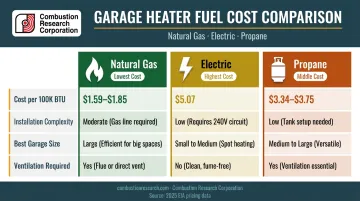
Costs based on EIA 2025 residential averages. Regional rates vary — New England electricity averages 27.68¢/kWh vs. the national 17.30¢/kWh average.
The cost gap widens considerably at scale — a garage used daily in a cold climate can easily run 1,000+ heating hours per year, where that $3–$4 gap per 100,000 BTU adds up fast. Use these breakdowns to match your situation.
When Natural Gas Wins
- Garages over 400 sq ft in cold climates
- Daily-use workshops, service bays, and auto shops
- Commercial and industrial applications where fuel cost compounds over years
- Any space where heat stratification or air quality matters
When Electric or Propane Makes More Sense
- Small garages used occasionally, locations without a gas line, or mild climates where a low-cost electric unit covers the load — electric is the practical choice.
- Detached garages far from the gas main, portable heating needs, or off-grid setups — propane bridges the gap where gas infrastructure isn't an option.
How to Choose the Right Garage Heating System
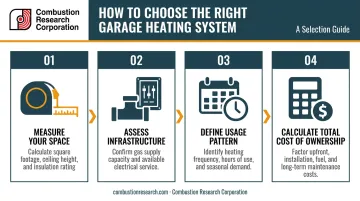
Four-Step Selection Framework
- Measure your space — calculate square footage and ceiling height, then run a Manual J heat-loss calculation or get a professional assessment
- Assess your infrastructure — gas line availability and electrical panel capacity determine which options are practical without expensive upgrades
- Define your usage pattern — daily workshop use justifies a higher-efficiency permanent system; occasional storage protection may not
- Calculate total cost of ownership — purchase price plus installation plus estimated annual fuel cost over 10 years often reveals that the cheapest upfront option isn't the best value
Certifications to Verify
For any natural gas or propane garage heater, look for:
- ANSI Z83.20 / CSA 2.34 certification for gas-fired infrared tube heaters (this is the governing standard for newly produced units)
- CSA International design certification as a baseline safety indicator
- Warranty terms on combustion components and heat exchanger tubes — these are the highest-wear parts; a 10-year tube warranty is a strong indicator of build quality
Installation: DIY vs. Professional
- DIY-appropriate: portable electric space heaters, some plug-in electric infrared units
- Professional installation required: natural gas tube heaters, forced-air unit heaters, any system requiring gas line connection or new venting
Gas connections and venting require licensed contractor work in most U.S. jurisdictions — Nashville's code, for example, requires a licensed master mechanical or HVAC&R contractor for all gas piping and appliance connections. Proper installation also typically validates the manufacturer's warranty; Combustion Research Corporation's warranty documentation, for instance, covers the radiant tubes for 10 years against internally caused corrosion — but only when the system is correctly installed.
ICC IMC 2024 Section 304.3 requires that ignition sources in private garages be located at least 18 inches above the floor — a code requirement that affects mounting height for all gas-fired heaters.
Conclusion
The best garage heating system isn't the cheapest upfront — it's the one matched to your space, fuel access, usage habits, and climate. For large garages, service bays, and commercial spaces used regularly, natural gas infrared tube heaters deliver the strongest combination of output, efficiency, and long-term value. Pair any system with proper insulation and draft sealing, and the performance gap between a good choice and a mediocre one widens further.
For residential garages, auto service bays, warehouses, or commercial facilities, Combustion Research Corporation offers engineering support throughout the specification process: from heat-loss calculations to full system design. With over 50 years of manufacturing experience and product lines spanning 30K to 220K BTU/hr, their team can identify the right low-intensity infrared tube heater configuration for your application.
Contact CRC at 888-852-3611 or info@combustionresearch.com to get started.
Frequently Asked Questions
Is it better to heat a garage with gas or electric?
For large garages or cold climates, natural gas is typically far more cost-effective — delivering heat at roughly one-third the per-BTU cost of electric resistance at 2025 national average rates. Electric heating makes more sense in small, occasionally used garages where a gas line isn't available and annual heating hours are low.
How many BTUs do you need to heat a 24x24 garage?
A 576 sq ft garage requires roughly 14,000–20,000 BTU/hr in a moderate climate and up to 30,000+ BTU/hr in colder regions. These figures shift based on insulation quality, ceiling height, and local design temperature — a Manual J heat-loss calculation is the reliable way to land on the right number.
What is the most energy-efficient way to heat a large garage?
Natural gas low-intensity infrared tube heaters are the most efficient option for large garages — they heat surfaces and occupants directly, eliminating the stratification losses that push warm air to the ceiling. Industry and manufacturer sources report 30–50% energy savings over conventional forced-air systems, with two-stage modulating units at the higher end of that range.
Do natural gas garage heaters require professional installation?
Yes. Gas line connections, venting, and ignition-source height requirements (18 inches above floor per ICC IMC 2024) all require licensed contractor work in most U.S. jurisdictions. Professional installation is also typically required to maintain manufacturer warranty coverage.
How do natural gas infrared tube heaters work?
A gas burner heats a metal tube suspended from the ceiling. The tube radiates infrared energy downward, warming floors, objects, and occupants directly without heating and recirculating air. This eliminates heat stratification and avoids the dust movement associated with forced-air systems.
What safety features should I look for in a natural gas garage heater?
Verify these before purchase or installation:
- ANSI Z83.20 / CSA 2.34 certification
- Automatic gas shutoff on flame failure (100% safety lockout)
- Proper power-vent or direct-vent exhaust routing
- Mounting height compliance with local code
Also install a CO detector in the garage regardless of heater type — NFPA recommends CO alarms on every level of the home and outside sleeping areas.