The heating method you choose affects energy costs, air quality, safety, and how effectively the space actually warms up. Get it wrong in a 30,000 sq ft warehouse with 25-foot ceilings and bay doors that open every few minutes, and you'll spend a lot of money heating air that escapes before anyone benefits from it.
Key Takeaways
- Radiant heaters warm people and objects directly via infrared waves; convection heaters warm the air, which then circulates
- In large, open, or drafty spaces, radiant heating is more efficient — warm air doesn't stratify near the ceiling or escape through gaps
- Convection heating works best in small, well-sealed rooms where warm air stays put
- For warehouses, hangars, and auto shops, ceiling-mounted radiant infrared tube heaters are almost always the better choice
- Choosing the wrong system for a large space means uneven heat, high energy bills, and potentially poor air quality
Radiant vs. Convection Heaters at a Glance
Here's how the two heating methods compare across the five dimensions that matter most in industrial and commercial settings:
| Dimension | Radiant | Convection |
|---|---|---|
| Heating mechanism | Heats objects and people directly via infrared radiation | Heats air, which then circulates to warm the space |
| Energy efficiency | Minimal loss to stratification or air infiltration | Continuous air reheating required as warm air escapes |
| Best space type | Large, open, high-ceiling, or drafty environments | Small, sealed, well-insulated rooms |
| Air quality impact | Doesn't circulate air or stir up dust and particles | Continuously moves air and anything suspended in it |
| Installation footprint | Ceiling-mounted; zero floor space consumed | Occupies wall, floor, or ceiling space with ductwork |
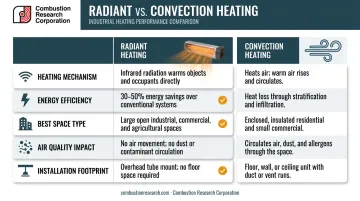
Convection works fine in small, sealed office spaces. The sections below explain why each factor in this table matters — and why the gap between the two systems widens significantly in large or open environments.
What Is Radiant Heating?
Radiant heating transfers energy directly from the source to objects and people via infrared radiation, not through the air between them. Picture standing near a campfire when it's 35°F outside. The surrounding air is frigid, but you feel warm because the fire radiates heat directly onto you. Infrared tube heaters work on the same principle.
The Physics Advantage
Because radiant heat doesn't depend on air as a medium, it's unaffected by drafts, open bay doors, or 30-foot ceilings. ASHRAE confirms that thermal radiation can pass through transparent gases without attenuation, so cold air between the heater and the floor doesn't reduce output.
Radiant output follows the Stefan-Boltzmann relationship: output scales with the fourth power of absolute temperature. A modest rise in heater surface temperature produces a disproportionately larger increase in radiant output. That's why infrared tube heaters deliver usable floor-level warmth without first heating an entire building's air volume.
Two Types Worth Knowing
- High-intensity radiant heaters — open flame or quartz elements, very high surface temperatures, suited for specific industrial processes or unoccupied spaces
- Low-intensity infrared tube heaters — sealed combustion chamber, lower surface temperatures, safe and consistent for occupied facilities
For most occupied industrial spaces (warehouses, hangars, service garages) low-intensity tube heaters are the standard choice. They deliver even warmth without the thermal extremes of high-intensity systems.
Combustion Research Corporation manufactures both types. Their Reflect-O-Ray® and Omega II® lines cover the low-intensity segment: ceiling-mounted systems CSA certified to ANSI Z83.20/CSA 2.34 standards. The Omega II® models include a 10-year warranty on radiant tubes for internally created corrosion.
Core Benefits for Industrial Facilities
- Immediate warmth at floor level (where workers actually are)
- No heat stratification — energy doesn't pool uselessly at the ceiling
- No air circulation to stir up dust, welding fumes, or contaminants
- Consistent comfort even when large bay doors are open
Where Radiant Heating Excels
Radiant heating is the right call for: large warehouses, aircraft hangars, loading docks, auto dealerships, car wash bays, greenhouses, animal confinement facilities, and any space where doors open frequently or ceilings exceed 14 feet.
In these environments, convective heat escapes through every opening. Radiant heat reaches occupants regardless of air temperature, which keeps workers comfortable without the energy waste of constantly reheating escaped air.
What Is Convection Heating?
Convection heating works by warming air through a heating element, then circulating that warm air throughout the space. In natural convection, warm air simply rises. In forced convection, a fan or blower moves it actively. Either way, the air is the delivery mechanism — and that creates a fundamental problem in large spaces.
The Stratification Problem
Warm air rises. In a building with 20-foot ceilings, that means heat accumulates where nobody works. Research published in the ASHRAE Journal modeled a 20-foot-high test building and found that vertical temperature gradients were more than twice as severe with forced-convection unit heaters as with infrared radiant heaters. The thermostat reads 65°F — but at floor level, workers are still cold.
It gets worse when doors open. Every time a bay door lifts, the warm air that was carefully heated escapes in seconds. The heating system fires up again. Fuel is consumed. The cycle repeats dozens of times per day.
Common Convection Heater Types
- Baseboard heaters
- Wall-mounted fan heaters
- Unit heaters with blowers
- Furnaces with ductwork
These work well in their intended context: small, well-insulated offices, enclosed server rooms, residential living spaces — anywhere the space can be fully sealed and temperature needs to be maintained over long periods.
Any facility with overhead doors, loading docks, high bays, or regular ventilation turnover will see significant heat loss with convection systems. The PNNL/DOE infiltration modeling guidelines list baseline commercial building envelope leakage at 1.8 cfm/sf — loading dock doors specifically at 0.40 cfm/sf.
In a facility with multiple dock doors cycling throughout the day, that leakage compounds fast. The heating system never fully catches up.
Radiant vs. Convection: Which Is the Better Choice?
No single heater type wins across every application. The right choice comes down to your building's dimensions, how the space is used, and what you're paying to heat it now. Four factors tend to decide it.
Energy Efficiency
In a 20-foot-high test building, infrared radiant heaters consumed roughly half the energy of traditional unit heaters to maintain equivalent temperatures — and an ASHRAE Journal modeling study projected 33% energy savings over unit heaters for typical commercial and industrial applications.
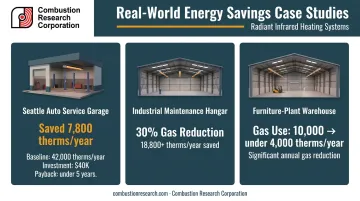
Real-world case data from ACEEE backs this up:
- A Seattle-area auto service garage replaced forced-air unit heaters with infrared systems, saving 7,800 therms/year from a 42,000 therm/year baseline — with a simple payback under 5 years on a $40,000 investment
- An industrial maintenance hangar reduced gas usage by 30% (more than 18,800 therms/year) after upgrading to double-run infrared heaters
- A furniture-plant warehouse saw annual gas consumption fall from 10,000 therms to under 4,000 therms after switching to infrared with lower temperature setpoints
Combustion Research Corporation's Reflect-O-Ray® and Omega II® systems are documented at 30–50% energy savings over conventional heating, with the dual-modulating Omega II DI delivering up to 75% savings in optimal conditions.
Air Quality and Dust Control
Energy savings are only part of the picture. In facilities where air quality matters, the heating method itself becomes a health and safety decision.
Convection systems continuously recirculate air — and everything suspended in it. In auto body shops, animal confinement facilities, food processing environments, or anywhere with airborne particulates, that recirculation spreads contaminants throughout the space.
Radiant heating delivers warmth without moving air. The environment stays cleaner, ventilation loads drop, and workers in sensitive environments aren't breathing recirculated dust, allergens, or fumes throughout the day.
Decision Framework
Choose convection if:
- Space is under ~2,000 sq ft
- The building is well-sealed and insulated
- Occupancy is continuous with no frequent door openings
- Ceilings are below 12 feet
Choose radiant if:
- Ceilings exceed 14 feet
- Bay doors or loading dock doors open regularly
- Dust, fumes, or air quality are a concern
- Floor space preservation matters
- You need consistent comfort at worker level regardless of air temperature
Safety and Maintenance
Wall- and floor-mounted convection heaters in industrial settings are vulnerable to forklifts, carts, and machinery. A ceiling-mounted infrared tube heater eliminates that hazard entirely. CRC's systems are designed without filters or condensation-prone components, which means fewer routine service interventions and no filter-neglect failures causing unplanned shutdowns.
Why Industrial and Commercial Facilities Choose Radiant Heating
Large industrial facilities present a heating challenge that residential comparisons don't capture. A warehouse with 25-foot ceilings, 50,000 sq ft of floor area, and bay doors that cycle 40 times a day isn't just a bigger house — it's a fundamentally different heating problem.
The ACEEE case data illustrates what that looks like in practice. The Seattle auto service garage was spending 42,000 therms per year on forced-air heating before the switch. At current natural gas prices, that's a substantial annual operating cost — and the workers were still dealing with cold floor-level temperatures and uneven comfort. The infrared retrofit cut consumption by nearly 19% while improving working conditions.
The industrial maintenance hangar case is even more striking: a 30% gas reduction translating to over 18,800 therms per year saved. For a high-volume facility, that kind of reduction reshapes the annual heating budget.
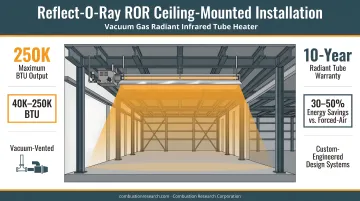
Combustion Research Corporation has been engineering solutions for exactly these environments for over 50 years. Their Reflect-O-Ray® vacuum systems are built specifically for high-loss spaces. The vacuum-fired design operates under negative pressure — any loosened connection draws ambient air inward rather than pushing exhaust gases into the occupied space.
Key design features suited to aircraft hangars and large warehouses:
- Negative-pressure operation keeps combustion gases out of occupied areas
- Multiple units share a single exhaust manifold
- One roof penetration serves the entire system, protecting roofing integrity
- Ceiling-mounted installation preserves floor space for forklifts and equipment
If your facility is dealing with high heating bills, cold floor temperatures, or air quality concerns from recirculated air, CRC's infrared tube heaters may be worth a closer look. Contact the engineering team at 888-852-3611 or info@combustionresearch.com for a system specification tailored to your space.
Conclusion
Radiant and convection heating each have clear applications. For a well-insulated office or small enclosed room, convection is practical and effective. But for industrial and commercial facilities with large floor areas, high ceilings, frequent door openings, or air quality concerns, radiant heating consistently delivers better comfort, lower energy costs, and fewer operational complications.
The right choice comes down to your space's actual dimensions and how it's used day-to-day. Evaluate ceiling height, door frequency, square footage, and air quality requirements before committing. Choose correctly and the results show up in measurable ways: lower fuel bills, fewer worker complaints about cold spots, and a heating system that holds up to the real demands of industrial operation.
Frequently Asked Questions
Is a radiant heater better than a convection heater?
For large, open, high-ceiling, or drafty industrial spaces, radiant is generally the better choice because it heats people and objects directly without relying on air circulation. Convection is more practical for small, well-sealed residential rooms where warm air stays put.
Which room heater is best for asthma patients?
Radiant heaters are typically recommended for people with respiratory sensitivities because they don't circulate air or stir up dust, allergens, or pollutants. Convection heaters continuously move airborne particles throughout the space, which can aggravate symptoms.
Can a gas heater make you feel dizzy?
Improperly vented gas heaters can produce carbon monoxide, which causes dizziness. Properly vented gas-fired radiant tube heaters with sealed combustion chambers exhaust combustion gases safely and are designed for occupied facilities. CRC's low-intensity infrared systems are certified to ANSI Z83.20/CSA 2.34 for exactly this reason.
Do radiant heaters work well in spaces with high ceilings or large doors?
Radiant heaters excel in exactly these conditions. Because they heat people and objects directly rather than warming air, heat isn't lost through stratification at the ceiling or through air escaping when large bay doors open.
How much energy can a radiant heating system save compared to convection heating?
Industrial radiant heating systems can reduce energy costs by 30–50% compared to conventional convection or forced-air systems in large commercial spaces. The exact savings depend on ceiling height, insulation, and how frequently the space opens to the outside.
What types of industrial or commercial spaces benefit most from radiant tube heaters?
Radiant tube heaters perform best in large spaces that can't be fully sealed. Top applications include:
- Warehouses and distribution centers
- Aircraft hangars and auto service garages
- Loading docks and car wash bays
- Greenhouses and animal confinement facilities