For facility managers, the exposure is not just equipment replacement. It's OSHA liability, production downtime, and potential facility shutdown — all stemming from decisions made long before a heater ever fires up.
Gas-fired infrared heaters are among the safer industrial heating options available. But safety outcomes depend almost entirely on correct product specification, professional installation, and consistent maintenance — not the technology itself.
Key Takeaways
- Gas-fired infrared heaters are safe for industrial use when installed per manufacturer specifications and applicable ANSI/CSA standards
- Proper venting — vacuum or power-vented — is non-negotiable in enclosed spaces to prevent carbon monoxide buildup
- Ceiling-mounted installation keeps heating elements away from workers and material-handling equipment
- Certification is application-specific — a warehouse-rated heater isn't automatically compliant in CNG shops, spray booths, or natatoriums
- Ongoing inspection is required to maintain safe operation, not just correct initial installation
Safety Guidelines for Infrared Heaters
How Infrared Heating Affects Risk
Gas-fired infrared heaters transfer radiant energy directly to objects, floors, and occupants — the surrounding air warms secondarily. There's no space-air blower circulating dust through the facility. That matters in dusty industrial environments, but it doesn't eliminate all risk. Natural convection, vehicle-induced air movement, and flammable vapor migration still occur regardless of heating method.
The practical risk profile for industrial gas-fired infrared heaters breaks down into four categories:
- Thermal burns from direct contact with hot emitter surfaces
- Fire from insufficient clearance to combustible materials
- Carbon monoxide accumulation from improper or failed venting
- Gas connection failures from unqualified installation or degraded fittings
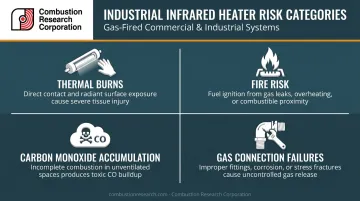
In industrial settings, safety depends most on system configuration — venting type, mounting height, and application-specific certification — rather than day-to-day user behavior. Specification and installation are where the most critical safety decisions get made.
General Safety Precautions
Clearance to combustibles is model-specific — there is no universal safe distance. Under IFGC Section 630.1, infrared heaters must be installed per manufacturer instructions and tested to ANSI Z83.19 or ANSI Z83.20. Published clearances vary by model, input rating, reflector configuration, and mounting angle. For Combustion Research Corporation's Reflect-O-Ray and Omega II lines, clearances range from 12 to 60 inches depending on mounting orientation. Always verify the clearance table in the specific model's installation manual — never apply a generic figure.
AHRI also requires heaters to post a sign indicating the maximum permissible stacking height needed to preserve the listed clearance. That sign is not decoration — reducing clearance to gain storage capacity is one of the most common and most serious mistakes in warehouse installations.
Beyond clearance, three precautions apply across all industrial infrared installations:
- Never block or obstruct the emitter tube or reflector; restricted airflow concentrates heat on the housing, raising surface temperatures and increasing burn and fire risk
- Confirm the heater carries the correct certification for the specific environment — application-specific ratings are required for CNG shops, spray booths, and high-humidity facilities
- Verify that built-in safety controls (flame safeguard, overheat shutoffs, modulating thermostats) have not been bypassed or disabled
Safety During Installation
Mounting Height and Gas Connections
Mounting height is determined by the heater model, input rating, and the application — not by ceiling availability. Too-low mounting in high-ceiling industrial spaces increases radiant intensity at floor level and can exceed safe exposure limits for workers. As a reference point, manufacturer documentation for some commercial tube heater models recommends minimum mounting heights of 18 to 20 feet for higher-BTU configurations — but these are model-specific figures, not universal minimums.
Gas supply connections must be made by a licensed gas professional. Requirements under the 2021 IFGC include:
- An individual appliance shutoff valve in the same room, within 6 feet of the heater
- Pressure testing at a minimum of 1.5x the proposed maximum working pressure, and not less than 3 psig
- A leakage check after gas is introduced
Licensing requirements vary by state and jurisdiction, but the underlying risk doesn't: unqualified gas connections are a leading cause of leak and ignition incidents, and no code-compliant workaround exists.
Venting Configuration
Pull-through (vacuum/negative-pressure) and push-through (power-vented) systems are not interchangeable field options — they're distinct system architectures with different vent categories, equivalent-length limits, and installation requirements.
Combustion Research Corporation's Reflect-O-Ray line uses negative-pressure vacuum venting: the exhauster draws combustion gases through the tube, so any breach in the connection draws ambient air inward rather than pushing exhaust into the occupied space. The Omega II line uses positive-pressure power venting, which handles back pressure better in installations with long exhaust runs.
Matching venting type to the application:
| Facility Type | Recommended Venting | CRC Product |
|---|---|---|
| Occupied manufacturing floors, CNG shops | Vacuum | Reflect-O-Ray EDS |
| Aircraft hangars (20+ ft ceilings) | Vacuum | Reflect-O-Ray 6.0 EDS |
| Natatoriums, wash bays (stainless) | Vacuum | Reflect-O-Ray SS variants |
| Agricultural buildings, pole barns | Power-vented | Omega II PEP |
| Single-bay shops, detail bays | Power-vented | Serengeti-IR |
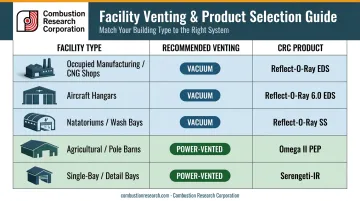
Mixing up venting approaches in retrofit projects is a documented safety error, particularly in enclosed industrial spaces where exhaust displacement has no easy recovery path. CRC's engineering support is structured specifically to catch these mismatches during specification — before they become a field problem.
Safety While Operating
Recognizing Combustion Problems Early
Normal combustion in a properly functioning gas-fired heater produces a predominantly blue flame. Warning signs that warrant immediate investigation:
- Yellow or orange flame color — indicates incomplete combustion
- Visible sooting on emitter tubes or reflectors — a sign of combustion deterioration
- Sulfur-like or unusual odors during or after startup
These aren't minor annoyances. They're early indicators of conditions that can progress to carbon monoxide production or component failure. CRC's heaters include a burner flame inspection window specifically so technicians can visually confirm flame characteristics without disassembly.
Carbon Monoxide in Enclosed Spaces
CO is colorless and odorless. Recognized exposure thresholds in commercial and industrial settings:
- Yellow or orange flame color — indicates incomplete combustion
- Visible sooting on emitter tubes or reflectors — a sign of combustion deterioration
- Sulfur-like or unusual odors during or after startup
CO is colorless and odorless. Recognized exposure thresholds in commercial and industrial settings:
- OSHA PEL: 50 ppm over an 8-hour workday
- NIOSH REL: 35 ppm over 10 hours, with a 200 ppm ceiling
- IDLH: 1,200 ppm — immediately dangerous to life and health
CO risk with gas-fired heaters comes from incomplete combustion or venting failure — not from normal operation of a properly installed unit. Complete combustion in a correctly installed, tuned, and vented heater produces minimal CO. That qualification matters: proper installation, burner calibration, and intact venting are what keep CO output in check. Install CO detectors at recommended heights in enclosed and semi-enclosed spaces, and test them regularly.
Environmental and Application-Specific Safety
Not every heater is appropriate for every facility — and using the wrong unit in the wrong environment isn't just a performance problem, it's a compliance violation.
Hazardous and Specialized Environments
CNG Repair and Storage Facilities
NFPA 30A Section 7.6.6 restricts heat-producing appliances in CNG vehicle repair and storage areas, limiting surface temperatures and prohibiting open flames in those zones. Standard warehouse-rated heaters do not satisfy this requirement.
Spray Finishing Areas
OSHA 1910.107 prohibits space-heating appliances in spraying areas where combustible residues can accumulate. This is a blanket prohibition, not a performance threshold.
High-Humidity Environments
Natatoriums, car wash bays, and similar wet facilities expose burner components and combustion chambers to chloramines and water vapor — conditions that degrade standard powder-coated heaters quickly. CRC's Stainless Steel variants, available across the Reflect-O-Ray and Omega II lines, use stainless burner housings and corrosion-resistant aluminized steel tubing built for these environments.
General positioning considerations:
- Avoid mounting directly above combustible storage racks
- Angle reflectors to direct radiant energy away from heat-sensitive machinery
- Account for forklift traffic patterns when selecting mounting zones — ceiling-mounted units keep heating elements out of the material-handling path, but layout planning still matters
Common Safety Mistakes to Avoid
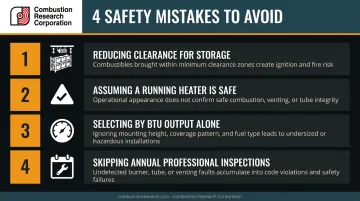
These four mistakes drive most preventable incidents and compliance failures in industrial infrared heating:
1. Reducing clearance to gain storage capacity. Radiant heat can raise the surface temperature of cardboard, wood pallets, or insulation materials past ignition threshold without direct flame contact. The required clearance exists for this reason — that clearance requirement is a minimum, not a margin.
2. Assuming a running heater is a safe heater. Sooting, pilot irregularities, and faint odors are early indicators of combustion deterioration, not minor annoyances. Ignoring them allows CO risk and component failure to develop undetected.
3. Selecting a heater based on BTU output alone. Output capacity and application-specific certification are separate questions. Installing a standard-rated heater in a CNG facility or spray environment voids safety compliance and creates direct liability exposure — regardless of how well the unit performs thermally.
4. Skipping annual professional inspections. Gas connections, burner components, and venting systems degrade in ways that aren't visible during normal operation. A heater that starts reliably and heats effectively can still have a deteriorating flue connection or corroding burner component that poses real risk.
Conclusion
Infrared heater safety in industrial settings comes down to three decisions made before a unit ever runs: selecting the correctly specified and certified heater for the application, ensuring professional installation with proper clearances and venting, and committing to scheduled maintenance inspections. Facilities that get all three right consistently see infrared operate without incident across decades of service.
With that framework in place, heater safety checks fit naturally into standard operational maintenance — no differently than annual fire suppression inspections or electrical panel reviews. For new installations or retrofits, working with an experienced infrared heating engineer from the beginning prevents the mismatches that create problems later. CRC's engineering team supports specification and system design from the earliest planning stage through installation, including submittal documentation for code compliance review. Reach them at 888-852-3611 or through combustionresearch.com.
Frequently Asked Questions
Are infrared heaters safe to leave on overnight?
Certified infrared heaters with functioning safety shutoffs and thermostats can operate unattended in industrial settings. Before doing so, confirm CO detectors are functional and that the unit shows no combustion irregularities: sooting, odors, or flame color changes.
Can gas-fired infrared heaters cause carbon monoxide poisoning?
CO risk exists with any gas combustion appliance but is managed through proper venting, correct installation, and functioning CO detectors. Risk increases when combustion is incomplete or venting fails; a properly installed, fully vented unit produces minimal CO.
What clearance is required between an infrared heater and combustible materials?
Required clearances vary by heater model, input rating, and mounting configuration with no universal distance. They are specified in the manufacturer's installation manual and must comply with ANSI/CSA standards. Never reduce clearance to accommodate storage needs.
Are infrared heaters safe in enclosed industrial spaces like warehouses?
Yes. Gas-fired infrared heaters are widely used in enclosed industrial facilities when venting correctly exhausts combustion byproducts outdoors and CO detection is in place. Venting configuration must match the specific heater model and space; approaches are not interchangeable.
Do infrared heaters pose a fire hazard?
Properly installed heaters with maintained clearances present very low fire risk. The primary fire-related danger comes from inadequate clearance to combustibles or deploying a non-rated unit in a hazardous environment — neither relates to the infrared technology itself.
What safety certifications should industrial infrared heaters have?
Gas-fired tubular and low-intensity heaters should carry CSA International design certification to ANSI Z83.20/CSA 2.34; high-intensity heaters fall under ANSI Z83.19/CSA 2.35. Applications in CNG facilities, spray areas, or other classified locations require additional occupancy-specific analysis beyond these base certifications.