Introduction
Heating a pole barn sounds straightforward until you actually try it. Large open volumes, ceilings that stretch 20 feet or higher, concrete floors, minimal insulation, and bay doors that open constantly — these aren't conditions where a standard heating approach just works.
Pick the wrong system and you're paying to heat the rafters while workers freeze at floor level. Every time a bay door swings open, that warm air escapes — and in a high-volume space, recovery takes a long time.
Radiant and forced air are the two dominant approaches for pole barn heating, and they perform very differently in this environment. According to ACEEE research on industrial infrared applications, a modeled service garage with a 17-foot ceiling used 23% fewer therms annually with infrared heating versus forced air — and real-world results showed even larger savings.
The right choice affects your monthly fuel bill, how comfortable the space feels, and how much time you spend on maintenance.
This guide covers both systems side by side — how they work, where each one wins, and what to look for before you decide.
Key Takeaways
- Radiant heat warms objects and people directly — effective even in uninsulated or drafty barns
- Forced air heats the air, which stratifies near high ceilings before reaching occupant level
- Infrared tube heaters typically deliver 30–50% energy savings over conventional heating in open structures
- Four factors drive the right choice: door frequency, ceiling height, insulation level, and how the barn is used
- For most pole barns, low-intensity infrared tube heaters deliver better efficiency and comfort with fewer maintenance demands than forced air systems
Radiant vs. Forced Air Heat: Quick Comparison
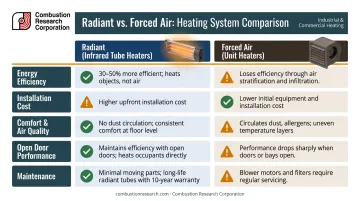
Here's how radiant and forced air systems compare across the factors that matter most to pole barn owners:
| Factor | Radiant (Infrared Tube Heaters) | Forced Air (Unit Heaters) |
|---|---|---|
| Energy Efficiency | Heats objects directly; no stratification loss; effective in uninsulated structures | Warm air rises to ceiling; significant stratification losses in high-ceiling barns |
| Installation Cost | Ceiling-mounted; no ductwork needed | Requires blower units, venting, sometimes ductwork; cost rises with ceiling height |
| Comfort & Air Quality | No air movement; no dust, dander, or fumes circulated | Fan-driven air stirs up dust, sawdust, and animal particulates |
| Open Door Performance | Heat stays in surfaces; minimal loss when doors open | Heated air escapes immediately; lengthy recovery time |
| Maintenance | No filters, no duct cleaning, minimal moving parts | Regular filter changes, blower service, duct inspection required |
The Stratification Problem in High-Ceiling Barns
This is the core issue with forced air in pole barns. Heated air rises, and in high-ceiling buildings, temperatures commonly increase by 5°F for every 10 feet of height, meaning a 20-foot barn ceiling can run 10°F warmer than the floor.
A peer-reviewed study of aircraft hangars found 4–11°C (7–20°F) floor-to-ceiling temperature differences. An 8°C (14°F) stratification differential alone increased heating energy requirements by up to 38%.
Radiant systems produce insignificant temperature stratification because they don't heat the air at all.
What Is Radiant Heat for Pole Barns?
Radiant heating transfers infrared energy directly to objects, surfaces, and people in its line of sight — the same mechanism that makes you feel the sun's warmth outdoors even on a cold day. The air temperature is irrelevant to how warm you feel.
This physics is particularly well-suited to pole barns. A gas-fired infrared tube heater uses a burner assembly to heat a long metal tube to 400–900°F. Reflectors above and beside the tube redirect radiated heat downward toward the floor and occupied zone. The heated concrete floor then acts as a secondary thermal mass, absorbing and slowly re-radiating warmth even after the burner cycles off.
Two heater types apply here. Low-intensity infrared tube heaters are gas-fired, ceiling-mounted, and vented — the standard choice for whole-barn comfort heating, available in straight and U-tube configurations from 40,000 to 250,000 BTU/hr. High-intensity ceramic or quartz heaters handle spot heating at shorter mounting heights but aren't suited for whole-barn coverage. For most pole barn applications, low-intensity tube heaters are the right tool.
Why Uninsulated Barns Aren't a Problem
That performance advantage becomes obvious in uninsulated buildings. Forced air has almost nowhere to start — you're heating an enormous volume of air that leaks through gaps constantly. Radiant works differently: occupants and surfaces receive heat directly, so the space feels comfortable within minutes of startup even if the air temperature is still climbing.
Air Quality Advantage
Because radiant systems don't move air, they don't circulate dust, animal pathogens, wood particles, or chemical fumes. This matters in:
- Agricultural barns where dust and ammonia damage respiratory tissue in livestock
- Automotive shops where fume and exhaust management is critical
- Woodworking and finishing spaces where airborne particulates create both health and fire hazards
Ceiling mounting also eliminates accidental contact with forklifts or vehicles — a real safety consideration in working facilities.
Best Use Cases for Radiant Heat
Radiant infrared tube heaters are the dominant or preferred choice in:
- Livestock and equestrian barns
- Automotive, oil-lube, and CNG repair shops
- Aircraft hangars
- Manufacturing, assembly, and car wash facilities
- Workshops with frequent large door openings
- Agricultural pole barns with high ceilings and minimal insulation
Combustion Research Corporation's Omega II and Reflect-O-Ray tube heater lines are built for these environments. Both are CSA certified to ANSI Z83.20/CSA 2.34 and carry a 10-year limited warranty on the burner core and heat exchanger tubes, with no combustion air filters required. Power-vented (Omega II) and vacuum-vented (Reflect-O-Ray) configurations are available depending on the application.
What Is Forced Air Heat for Pole Barns?
Forced air systems — whether a ceiling-hung unit heater, a furnace, or a heat pump — burn fuel or transfer thermal energy to heat air, then use a blower to push that air into the space. In pole barns, the most common installation is a ceiling-hung gas unit heater without ductwork, which reduces installation cost but retains all the stratification problems.
When Forced Air Makes Sense
Forced air remains practical in specific pole barn scenarios:
- Fully insulated barndominiums used as finished living or office space
- Small hobby workshops with good insulation, lower ceilings (under 10 feet), and infrequent door use
- Spaces that need cooling through the same system — when ductwork is justified for year-round HVAC
The Ceiling Height Problem
At 20–30 foot ceilings common in pole barns, forced air loses effectiveness fast. Warm air rises and pools near the ceiling before it ever reaches occupants below. Destratification fans are frequently required as a companion investment — adding both cost and complexity. Every time a large bay door opens, the heated air you paid for escapes in seconds.
High-efficiency condensing unit heaters (up to 97% thermal efficiency) can narrow the gap on fuel efficiency, but they can't solve the stratification problem without additional equipment.
Which Is Better for Your Pole Barn?
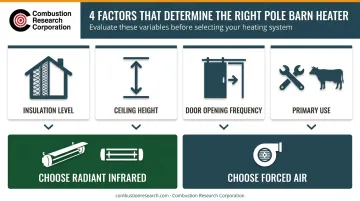
Four variables almost always determine the right answer:
- Insulation level — well-insulated vs. bare metal or minimal insulation
- Ceiling height — under 10 feet vs. 12–30+ feet
- Door opening frequency — occasional vs. multiple times per hour
- Primary use — living space vs. livestock, vehicles, or dusty work
Decision Guide
Choose radiant infrared tube heaters if:
- Ceiling height exceeds 12 feet
- The structure is uninsulated or minimally insulated
- Large doors open regularly during operation
- The barn is used for livestock, vehicles, or work that generates dust or fumes
- Long-term operating cost matters more than lowest upfront cost
Choose forced air if:
- The barn is fully insulated and finished
- Ceiling height is under 10–12 feet
- The space functions as an office or living area
- You need integrated cooling through the same system
BTU Sizing Basics
A common rule of thumb for rough sizing: multiply the space's cubic footage by the desired temperature rise (°F) by a heat loss factor. For a 40×60 barn with a 14-foot ceiling and a 50°F temperature rise, that's approximately 33,600 cubic feet — suggesting a rough starting point around 200,000+ BTUH before accounting for insulation, climate, and infiltration.
That number shifts for radiant systems. ASHRAE guidance suggests specifying rated output at roughly 80–85% of calculated building heat loss, since radiant heat warms the occupant zone directly rather than the full air volume — meaning equivalent comfort at lower BTUH ratings than forced air requires.
Actual sizing requires a proper heat loss calculation — ceiling height, insulation R-values, climate zone, and door cycling frequency all change the number significantly.
Real-World Operating Cost
ACEEE case studies from industrial and commercial facilities document what the efficiency gap looks like in practice:
- A Seattle-area auto service garage replaced forced-air unit heaters with infrared and saved 7,800 therms/year — project cost ran approximately $40,000, with a simple payback under five years. Workers had reported uneven warmth, cold floors, and high winter gas bills before the switch, all consistent with stratification and infiltration losses.
- An industrial maintenance hangar retrofit reduced gas use by 30%, saving over $20,000 annually
- A furniture warehouse saw gas use drop from over 10,000 therms/year to under 4,000 therms/year after switching to infrared
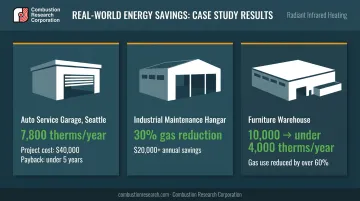
None of these are residential spaces. They're high-ceiling, high-use commercial buildings that share the same structural characteristics as larger pole barns. In every case, the higher upfront cost of infrared paid back within five years — and kept saving after that.
If you operate a commercial, agricultural, or industrial pole barn and want engineering support for specifying the right infrared system — sizing, layout, venting configuration — contact Combustion Research Corporation directly at 888-852-3611.
Conclusion
For the majority of real-world pole barns — high ceilings, minimal insulation, large doors, working use — radiant infrared tube heaters are the stronger fit. They heat occupants and surfaces directly, lose nothing to stratification, and perform reliably when doors open. Forced air isn't the wrong answer across the board; in a finished, insulated, low-ceiling space used as an office or living area, it's entirely appropriate.
Match the system to your barn's actual conditions. Each of these factors compounds over years of operation:
- Monthly fuel costs
- Worker and animal comfort
- Air quality inside the space
- Ongoing maintenance burden
Frequently Asked Questions
What is the most efficient way to heat a pole barn?
Low-intensity infrared radiant tube heaters are the most efficient option for most pole barn applications. They heat occupants and surfaces directly without losing energy to air stratification or ductwork, and they perform effectively even in uninsulated structures. Most installations deliver 30–50% fuel savings compared to conventional forced-air heating.
How many BTUs do I need to heat a 40×60 shop?
A 40×60 shop with a 14-foot ceiling typically requires 200,000+ BTUH as a starting estimate, but insulation level, climate zone, and door usage all shift the actual number. A proper heat loss calculation is worth doing before purchasing.
What is the cheapest heat for a pole barn?
Forced air unit heaters cost less upfront; radiant systems cost less to operate long-term in high-ceiling, drafty conditions. Either way, proper insulation is often the most cost-effective first investment before sizing any heating system.
Can you use forced air heat in an uninsulated pole barn?
You can, but it's highly inefficient. Heated air rises to the ceiling, stratifies, and escapes through gaps, so you're paying for warmth that never reaches occupant level. Radiant heat is far more practical and cost-effective in uninsulated structures.
Do radiant infrared tube heaters work well in pole barns with very high ceilings?
Ceiling height is actually an advantage for infrared tube heaters. They're designed to mount high and radiate heat downward to the occupied zone below, making them well-suited for the 14–30 foot ceilings common in pole barns. Forced air struggles at those heights— radiant heating performs better as ceiling height increases.
How long does it take for radiant heat to warm up a pole barn?
Infrared tube heaters warm occupants and surfaces directly, so comfort is near-immediate rather than dependent on heating the full air volume. Most spaces feel warm within minutes of startup, even while air temperature is still climbing.