That said, propane heating in a greenhouse is not a straightforward installation. Venting configuration, combustion byproducts, BTU sizing, and air supply all directly affect plant health and heater performance. Get any of these wrong, and you're not just losing efficiency — you're risking crop damage or equipment failure.
This guide covers how to correctly select, set up, operate, and maintain a propane heater in a real greenhouse environment — the decisions that actually determine whether your plants and equipment make it through winter intact.
Key Takeaways
- Only use vented heaters — unvented models release ethylene and sulfur dioxide at crop-damaging levels before you detect any odor
- Size by heat loss rate, factoring in glazing type, insulation, and your local design temperature — not square footage alone
- Install a CO detector and thermostat at canopy height before operating, plus adequate makeup air inlets
- Keep nighttime RH below 85–93% — propane combustion adds moisture, which accelerates Botrytis at those thresholds
- Follow a defined startup and shutdown sequence each season to reduce wear and prevent avoidable failures
When Should You Use a Propane Heater in Your Greenhouse?
Propane heating fits well in some greenhouses and poorly in others. The right answer depends on your fuel access, scale, and how you plan to use heat.
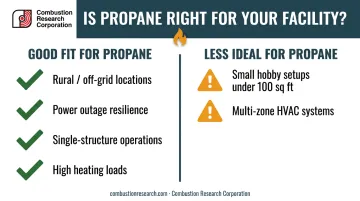
Good fit for propane:
- Rural or off-grid locations without natural gas access
- Operations that need heat during power outages (many propane heaters operate without electricity)
- Single-structure greenhouses where on-site fuel storage is practical
- Heating loads that exceed what electric systems can cost-effectively provide at scale
Less ideal for propane:
- Hobby setups under 100 sq ft with existing electric connections — electric is often simpler and cheaper at small scale
- Multi-zone interconnected HVAC systems not designed around propane distribution
Your use case also shapes your equipment requirements. A commercial cut-flower operation running propane year-round needs a permanently installed, properly vented unit with full combustion air provisions.
A home grower using propane as backup on hard-freeze nights may need a smaller unit — but venting and safety requirements apply regardless of how often you run the heater.
The EIA recommends comparing fuels by dollars per million BTU rather than by price per gallon or kWh. Factor in your heater's efficiency rating alongside the delivered fuel cost to get a true comparison.
What You Need Before Setting Up Your Propane Greenhouse Heater
Equipment Requirements
The heater itself: Use only a vented unit rated for greenhouse or agricultural use. Residential space heaters and "vent-free" models are not appropriate — venting is non-negotiable in a confined growing environment.
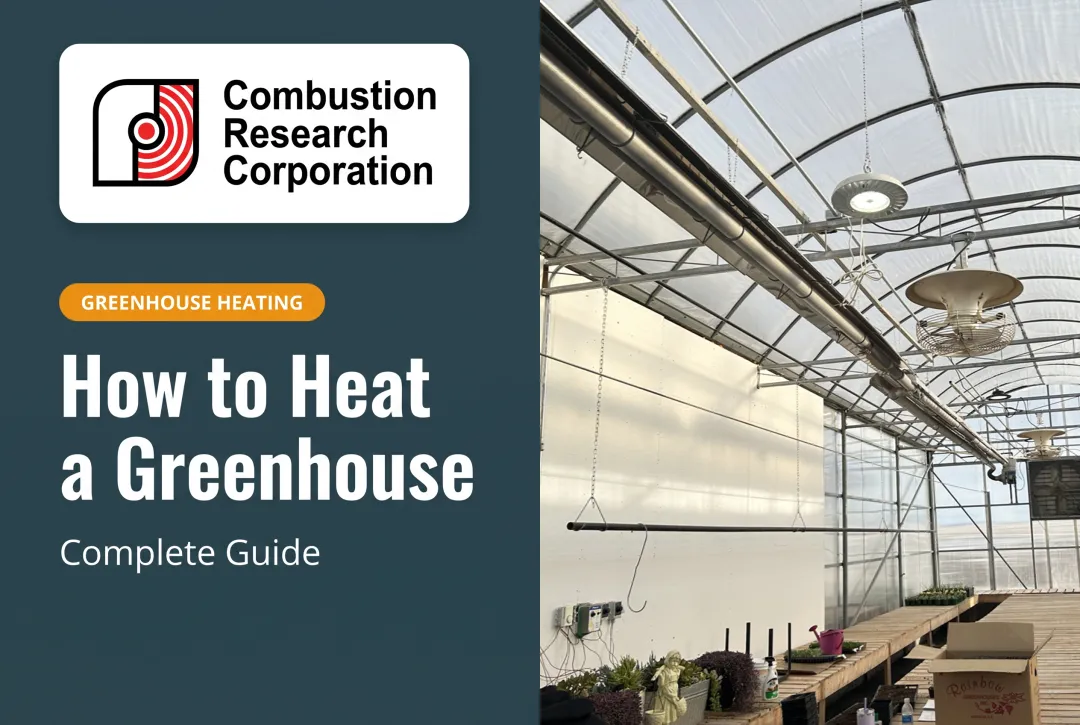
For commercial or larger greenhouse operations, low-intensity infrared tube heaters outperform conventional unit heaters in most scenarios. Combustion Research Corporation's Omega II and Reflect-O-Ray series (30K to 220K BTU, propane-compatible) heat plant surfaces and thermal mass directly rather than cycling heated air. That approach reduces temperature stratification, preserves floor space, and keeps combustion gases out of the crop zone entirely.
Fuel supply: Your tank or bulk delivery arrangement needs enough capacity to sustain operation through the longest expected cold spell. A 300 sq ft greenhouse held at 55°F can burn 30–40 pounds of propane per week during peak cold (mid-January through early March) — size your supply accordingly.
Safety and Control Equipment
| Item | Purpose |
|---|---|
| Calibrated thermostat (at canopy height) | Accurate crop-zone temperature control |
| Dedicated CO detector | Worker safety during daytime access |
| Adequate makeup air inlets | Prevent oxygen starvation during continuous operation |
Combustion air inlet sizing: Greenhouse extension guidance recommends 1 sq in of outside-air vent cross-section per 2,500 BTU of heater output. A 125,000 BTU heater, for example, needs at least 50 sq in of inlet area.
Code methods do vary by duct orientation. ICC specifies 1 sq in per 4,000 BTU/hr for direct/vertical openings and 1 sq in per 2,000 BTU/hr for horizontal ducts, so confirm the applicable method for your installation before finalizing inlet size.
How to Set Up and Operate Your Propane Greenhouse Heater
Get this sequence wrong and you're looking at combustion problems, cold spots, and a heater that dies before its time. Follow it correctly and the system runs predictably all season.
Setup and Preparation
Heater placement:
- Mount at ceiling height where possible — ceiling-mounted infrared tube heaters preserve floor space and deliver radiant energy to the crop zone without excessive air movement
- Maintain clearances from plants, flammable materials, and structural components per manufacturer specs
- Orient relative to circulation fans to support even temperature distribution
Venting verification before first use:
- Check flue pipe slope — condensate should drain toward the heater, not pool in the pipe
- Confirm all connections are secure with no gaps
- Verify exterior termination location can't re-entrain exhaust back into the greenhouse through nearby vents or doors
Initiating Use
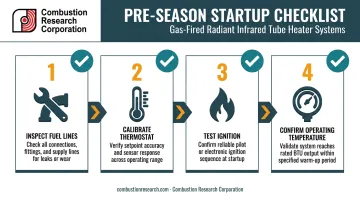
Pre-season startup checklist:
- Inspect fuel lines for leaks using soapy water — bubbles indicate a leak; don't proceed until it's resolved
- Calibrate the thermostat — verify it reads accurately at canopy height, not at wall or heater level
- Test ignition — pilot or electronic, confirm it lights on first or second attempt
- Confirm the unit reaches operating temperature without fault codes or flame irregularities
Once running, verify combustion quality: a correct flame is stable and blue. Yellow or flickering flame indicates incomplete combustion and requires immediate adjustment before continuing operation.
Operating Correctly
Set temperature targets based on crop requirements:
| Crop | Night minimum |
|---|---|
| Cool-season vegetables (lettuce, spinach) | 45–55°F |
| Greenhouse greens / microgreens | 50°F |
| Tomatoes | 62–65°F |
| Cucumbers | 60°F minimum |
Running warmer than your crop actually needs wastes fuel and can stress plants. Pair the heater with horizontal airflow (HAF) fans to prevent cold pockets. Temperature stratification is a common failure mode even when the heater itself is functioning correctly.
Monitoring During Operation
Check these regularly while the heater is running:
- CO detector readings — any rise above baseline warrants investigation
- Relative humidity — keep below 85% to control Botrytis; research identifies RH ≥93% combined with 8–12 hours of free moisture as the threshold for gray mold infection
- Thermostat cycling frequency — short-cycling or failure to reach setpoint on cold nights can indicate insufficient makeup air
- Glazing condensation dripping onto plants — signals excessive humidity loading, often from combustion moisture
In a tight greenhouse, a running heater consumes oxygen continuously. Insufficient makeup air shows up as three compounding problems: rising CO readings, a yellowing flame, and the heater cutting off on the coldest nights, exactly when you need it most.
Shutting Down at Season End
Skipping end-of-season maintenance shortens heater lifespan, mainly through internal corrosion. Follow this sequence:
- Close the fuel supply valve
- Run the unit until residual gas in the line clears
- Clean burner components — remove dust, debris, and any oxidation
- Inspect the heat exchanger and flue for corrosion or blockage
- Store with flue openings protected from moisture and pests
Moisture-laden flue gas residue sitting inside a cold heat exchanger all summer accelerates internal corrosion. End-of-season inspection matters even on units that ran without a single issue all winter.
Vented vs. Unvented Propane Heaters: What Greenhouse Operators Need to Know
The case against unvented heaters in greenhouses isn't just regulatory — the agronomic risks are just as serious.
The Combustion Byproduct Problem
Unvented propane combustion releases byproducts directly into the growing space:
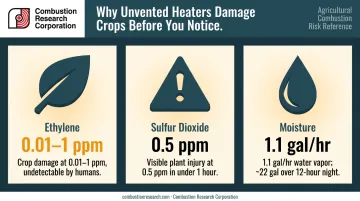
Ethylene: MSU Extension reports plants are susceptible to ethylene injury at 0.01 to 1 ppm or more. At those concentrations, tomato plants show leaf yellowing, stunted growth, and epinasty within 24 hours. Flower crops are even more sensitive — 0.01 ppm can cause flower drop and delayed blooming. Humans don't detect ethylene at these levels, so damage often goes unnoticed until it's widespread.
Sulfur dioxide: Alabama Extension reports visible plant damage at as little as 0.5 ppm SO₂, with injury possible in under an hour. Tomatoes and petunias are among the most sensitive species.
The Moisture Problem
A 100,000 BTU/hr unvented propane heater produces 1.1 gallons of water vapor per hour. In a 30 ft × 100 ft double-poly greenhouse held at 60°F on a 0°F night running for 12 hours, unvented heaters add approximately 22 gallons of moisture to the air. That's a direct path to fungal disease pressure that a vented heater avoids entirely.
The Efficiency Argument Doesn't Hold Up
Unvented heaters require permanent air openings to manage combustion air — those openings bleed heat continuously, all night, whether the heater is firing or not. A vented heater only loses heat through the flue when the burner is actually running. In a greenhouse context, the advertised efficiency advantage of unvented models largely disappears.
The Right Heater Type for Greenhouse Use
Two vented configurations are worth understanding before you specify a system:
Direct-vent (sealed combustion) draws combustion air from outside through a dedicated sealed intake and exhausts all products outside through a separate sealed path. Both air supply and exhaust are fully isolated from the greenhouse interior.
Power-vent / vacuum-vent uses a blower to move combustion air and exhaust gases out. Vacuum-vented systems, like the Reflect-O-Ray series, operate under negative pressure: if any breach occurs, ambient air draws inward rather than exhaust pushing into the growing space. That makes vacuum-vented systems the better choice for sensitive growing environments.
For larger commercial operations, low-intensity infrared tube heaters go one step further. By heating plant mass and surfaces via radiant energy rather than circulating warm air, they reduce stratification and eliminate forced-air movement of combustion gases through the crop zone entirely.
Best Practices for Safe and Efficient Propane Greenhouse Heating
Size Your Heater From a Heat Loss Calculation
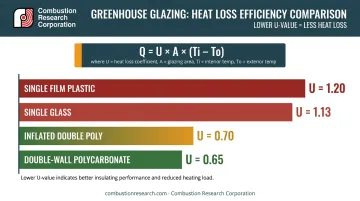
The National Greenhouse Manufacturers Association (NGMA) provides the standard formula:
Q = U × A × (Ti – To)
- Q = design heat loss (BTU/hr)
- U = glazing U-value (BTU/hr/sq ft/°F)
- A = total exposed surface area (sq ft)
- Ti – To = difference between target inside temperature and your local design low
Common U-values:
| Glazing type | U-value |
|---|---|
| Single glass | 1.13 |
| Single film plastic | 1.20 |
| Inflated double poly | 0.70 |
| Double-wall polycarbonate | 0.65 |
Use ASHRAE climatic data for your design outdoor low, not anecdotal lows from memory. Calculate before buying, not after — a heater that's undersized for your actual heat loss will run continuously and still fail to hold temperature on the coldest nights.
Establish a Maintenance Schedule
- Pre-season: Burner cleaning, ignition test, flue inspection
- Mid-season: Combustion check, confirm flame color and thermostat calibration
- Post-season: Full inspection per the shutdown sequence above
Servicing only at installation allows combustion efficiency to drift by late winter — precisely when demand on the system is highest.
Reduce Runtime With Passive Heat Retention
- Double-poly or polycarbonate glazing over single glass cuts heat loss by 30–40%
- Perimeter insulation (foam board at the foundation) reduces ground heat loss
- Thermal mass (water barrels, concrete paths) absorbs daytime heat and releases it overnight
A heater doing less work produces fewer combustion byproducts across the season — passive improvements pay off in both fuel costs and plant health.
Install Monitoring as Standard Equipment
- CO detector at worker breathing height — protects anyone accessing the greenhouse during operation
- Thermometer at canopy height — wall-mounted or heater-level sensors give inaccurate readings for crop management
- Humidity sensor — watch for nighttime RH climbing above 85%, particularly during weather systems that keep the heater running continuously
Getting engineering support during the design phase — before equipment is purchased — helps avoid undersizing, poor vent placement, and zoning mistakes that are costly to correct after installation. Combustion Research Corporation provides that specification support for greenhouse projects across North America.
Frequently Asked Questions
What is the cheapest way to heat a greenhouse in winter?
Propane is the most cost-effective fuel-based option in areas without natural gas access, especially combined with passive insulation improvements. Total cost depends on heater efficiency, greenhouse heat loss rate, and local propane prices . Compare fuels using cost per million BTU, not cost per gallon.
Are propane heaters safe for greenhouses?
Vented propane heaters are safe and widely used in commercial greenhouse operations. Unvented models pose real risks to plant health through ethylene and sulfur dioxide emissions — damage occurs at concentrations well below what humans can detect. Safety depends on proper heater selection, venting, CO monitoring, and adequate makeup air supply.
Do I need to vent a propane heater in a greenhouse?
Yes, venting is required. Unvented combustion releases ethylene (damaging at 0.01 ppm), sulfur dioxide (damaging at 0.5 ppm), and significant moisture into the growing space. These byproducts injure or kill sensitive crops before any human notices anything wrong.
What size propane heater do I need for my greenhouse?
Start with a heat loss calculation: Q = U × A × (Ti – To), where U is your glazing's heat transfer value, A is total surface area, Ti is your target indoor temperature, and To is your local design outdoor low. A BTU estimate based on floor area alone will be inaccurate for most greenhouse geometries.
How much propane does a greenhouse heater use?
Consumption varies by heater BTU rating, outdoor temperatures, insulation quality, and thermostat setpoint. As a real-world benchmark, a 300 sq ft greenhouse held at 55°F used 30–40 pounds of propane per week during peak cold (mid-January through early March), and about 40 pounds per month outside that window.
Can propane heaters damage plants?
Properly vented heaters maintained in good working order do not damage plants. Unvented or poorly maintained units can release ethylene and sulfur dioxide at crop-damaging concentrations. Tomatoes, orchids, and many flowering species are sensitive indicators. Epinasty, flower drop, or yellowing warrants a combustion check before ruling out other causes.