Key Takeaways
- Space heating accounts for 32% of U.S. commercial building energy use — the single largest end use
- Key efficiency metrics differ by system: thermal efficiency (TE) for commercial furnaces, COP/HSPF2 for heat pumps, and radiant output ratings for infrared systems
- Main system types — furnaces, heat pumps, VRF, and infrared radiant heaters — each suit different building configurations
- Infrared tube heaters typically deliver 30–50% lower operating costs vs. conventional forced-air in warehouses, hangars, and high-bay industrial spaces
- The right choice hinges on ceiling height, building envelope quality, occupancy patterns, and coverage needs
Facility managers routinely audit lighting and equipment for efficiency gains, but the heating system rarely gets the same scrutiny. That's a significant oversight. According to the EIA's 2018 Commercial Buildings Energy Consumption Survey, space heating consumed 32% of all U.S. commercial building energy — more than lighting, water heating, and cooling combined. For industrial facilities like warehouses, aircraft hangars, and automotive shops, that share translates directly into one of the largest controllable line items on the operating budget.
The deeper issue is fit. Traditional HVAC systems were engineered for enclosed, well-insulated spaces — not 30-foot ceilings, open bay doors, or facilities where forklifts move alongside employees. The wrong system inflates energy bills regardless of its nameplate efficiency rating.
What follows breaks down the metrics that matter, the four main system types, and how to match the right technology to your building.
Why Commercial Heating Efficiency Is a Bigger Cost Lever Than Most Realize
If space heating represents nearly a third of your building's energy consumption, a 20% improvement in heating efficiency is worth far more than a 20% improvement in lighting. Yet many facility managers pursue lighting retrofits while running outdated or mismatched heating systems.
The Hidden Problem in High-Bay Spaces
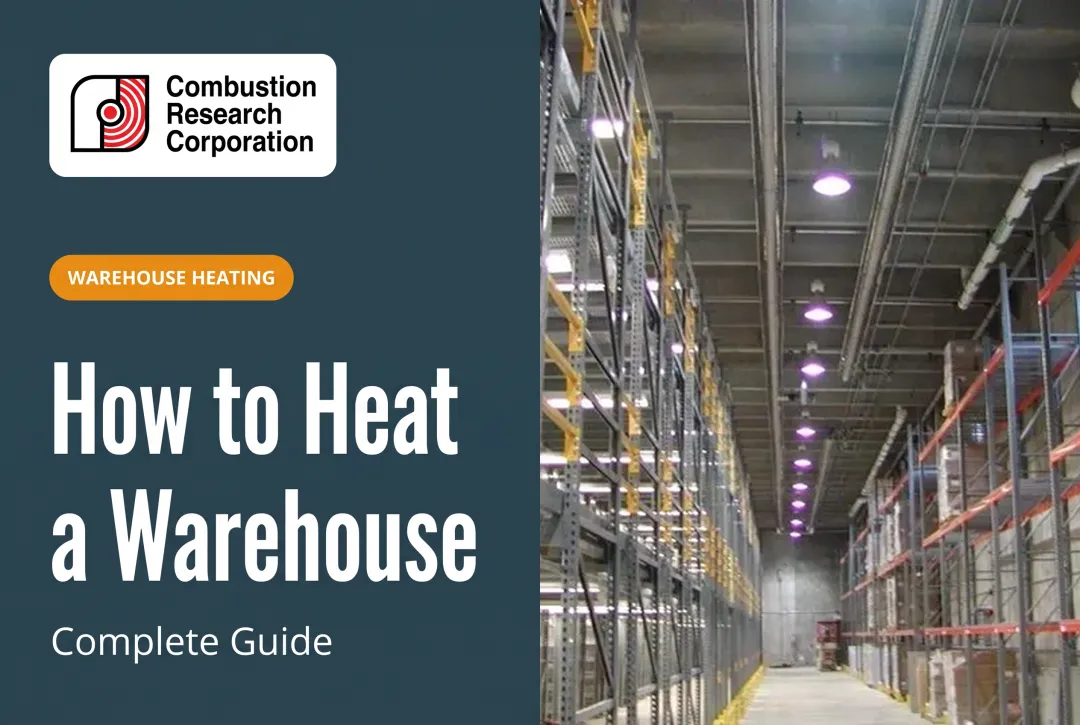
The core issue in industrial buildings is stratification. A peer-reviewed warehouse study found vertical temperature gradients of roughly 1°C per meter in heated warehouses. In practical terms, that means a facility with 25-foot ceilings can have temperatures 8°C higher at the roof deck than at floor level — where workers and equipment actually are.
Forced-air systems respond by running longer to maintain floor-level setpoints, paying to heat air that accumulates uselessly overhead. The same study documented 38% additional heating energy required in one hangar stratification scenario.
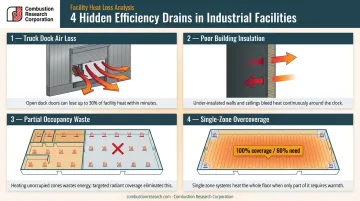
Other structural efficiency drains in industrial spaces include:
- Each truck dock opening flushes conditioned air from that zone, forcing the system to recover from scratch
- Older warehouses and agricultural buildings with minimal insulation bleed heat continuously
- Partially-staffed facilities pay to heat unoccupied floor area at full volume
- Single-zone systems heat 100,000 sq ft uniformly, even when only 20,000 sq ft is in use
These operational losses compound over time — and external pressure is now making them harder to absorb.
Regulatory and Financial Pressure Is Mounting
Building energy codes are tightening. The DOE determined that ASHRAE 90.1-2022 improves commercial building energy efficiency by 9.8% site energy relative to the prior standard, with states required to certify review and update by March 6, 2026.
That deadline isn't the only driver pushing heating performance onto the strategic agenda:
- Energy codes — stricter ASHRAE 90.1 requirements apply to new construction and major retrofits
- ESG reporting — investors and tenants increasingly require documented energy performance data
- Utility rate increases — rising gas and electricity costs amplify the cost of every inefficiency
Together, these pressures make heating system performance a strategic priority, not a maintenance afterthought.
Key Efficiency Metrics for Commercial Heating Systems
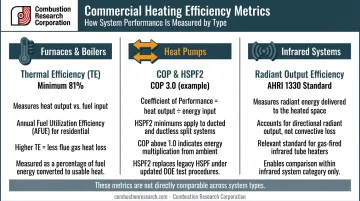
Comparing heating systems requires understanding that different equipment categories use entirely different rating frameworks. An AFUE number for a furnace and a COP for a heat pump measure fundamentally different things.
Thermal Efficiency for Commercial Furnaces and Boilers
The metric most buyers associate with furnace efficiency — AFUE — applies primarily to residential and small commercial equipment. For commercial warm-air furnaces, federal regulations use thermal efficiency (TE). Gas-fired commercial furnaces manufactured after January 1, 2023 must meet a minimum 81% TE; oil-fired units must meet 82% TE.
For commercial boilers, federal minimums vary by product class. Gas-fired hot-water commercial packaged boilers in the 300,000–2,500,000 Btu/h range require at least 80% Et. The FEMP high-efficiency purchasing benchmark for large commercial gas-fired hot-water boilers sits at 96% Ec — well above the minimum.
High nameplate efficiency doesn't eliminate stratification losses. A furnace rated at 90% TE still wastes energy if the heat it produces rises to a 30-foot ceiling before anyone benefits from it.
COP and HSPF2 for Heat Pumps
Heat pumps use two metrics:
- COP (Coefficient of Performance): Measures output heat energy divided by input electrical energy. A COP of 3.0 delivers 3 units of heat per unit of electricity consumed.
- HSPF2: A seasonal efficiency measure for heating mode. ENERGY STAR light-commercial criteria require 7.2 HSPF2 for single-package units and 7.8 HSPF2 for split systems under 65,000 Btu/h.
ENERGY STAR cold-climate ASHP criteria require a COP at 5°F ≥ 1.75. Heating capacity at 5°F must also be at least 70% of rated capacity at 47°F. For northern industrial facilities, this low-temperature performance floor is a critical spec to verify before selecting a heat pump.
Radiant Output Ratings for Infrared Systems
Infrared heaters are evaluated under AHRI 1330, which defines testing, rating, and conformance requirements for gas-fired infrared heaters up to 400,000 Btu/h per burner. The relevant metric is radiant output efficiency — how much of the fuel input is converted to useful radiant energy.
This rating isn't directly comparable to TE or COP. Infrared systems heat surfaces and occupants directly rather than heating the air, so air-based efficiency comparisons don't capture the full performance picture in high-bay environments like warehouses, automotive shops, or aircraft hangars.
Types of Energy-Efficient Commercial Heating Systems
Not every heating system suits every facility. The right choice depends on your building type, ceiling height, climate, and how the space is used. Here's how the major options compare.
Gas Furnaces and Boilers
High-efficiency commercial furnaces and boilers remain the dominant choice for enclosed, well-insulated buildings — office campuses, retail centers, schools, and similar occupied spaces. They distribute heat via forced air or hydronic loops, and modern units meet tight federal efficiency minimums.
Best fit: Enclosed commercial buildings with standard ceiling heights and consistent occupancy.
Key limitation: In high-bay industrial spaces, warm air stratifies at the ceiling, undermining the efficiency gains from high TE ratings. Destratification fans (ceiling fans that circulate air to mix warm and cool layers) can partially offset this, but they add complexity and don't eliminate the root problem.
Heat Pump Systems
Heat pumps transfer heat rather than generate it, which gives them a strong efficiency advantage in moderate climates. Industrial heat pumps operate across a typical COP range of 2–6, with many current systems achieving 40–50% of Carnot efficiency.
Best fit: Electrification projects in moderate climates, enclosed commercial buildings, facilities with dual heating and cooling needs.
Key limitation: Performance degrades at very low outdoor temperatures. For northern industrial facilities, a backup heating source may be required during design-temperature periods. COP at 5°F can fall to 1.75 or below for many cold-climate units — well below their rated performance at 47°F.
Variable Refrigerant Flow (VRF) Systems
VRF systems are ductless and zoned, allowing different areas of a building to heat and cool simultaneously. ENERGY STAR cold-climate small VRF units achieve COP of 3.4 at 47°F and 2.25 at 17°F. Independent studies comparing VRF to conventional VAV systems have documented 40–53% energy savings under favorable operating conditions.
Best fit: Multi-zone commercial buildings — hotels, mixed-use retail, office buildings — where different areas have different temperature demands simultaneously.
Key limitation: High upfront cost. Not practical for large open industrial spaces where zoning offers limited advantage over the physics of a single large air volume.
Infrared Radiant Heaters
Infrared heaters emit radiant energy that heats surfaces, floors, equipment, and people directly — not the air. Two main configurations exist:
- Low-intensity tube heaters: Ceiling-mounted, gas-fired, designed for whole-building coverage in high-bay spaces. The dominant choice for warehouses, distribution centers, aircraft hangars, and auto shops.
- High-intensity radiant heaters: Focused spot heating, faster heat-up times, suited for entry points, loading docks, and outdoor-protected areas.
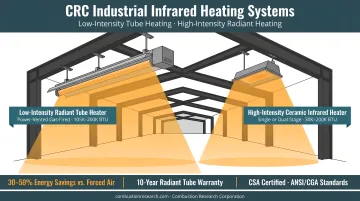
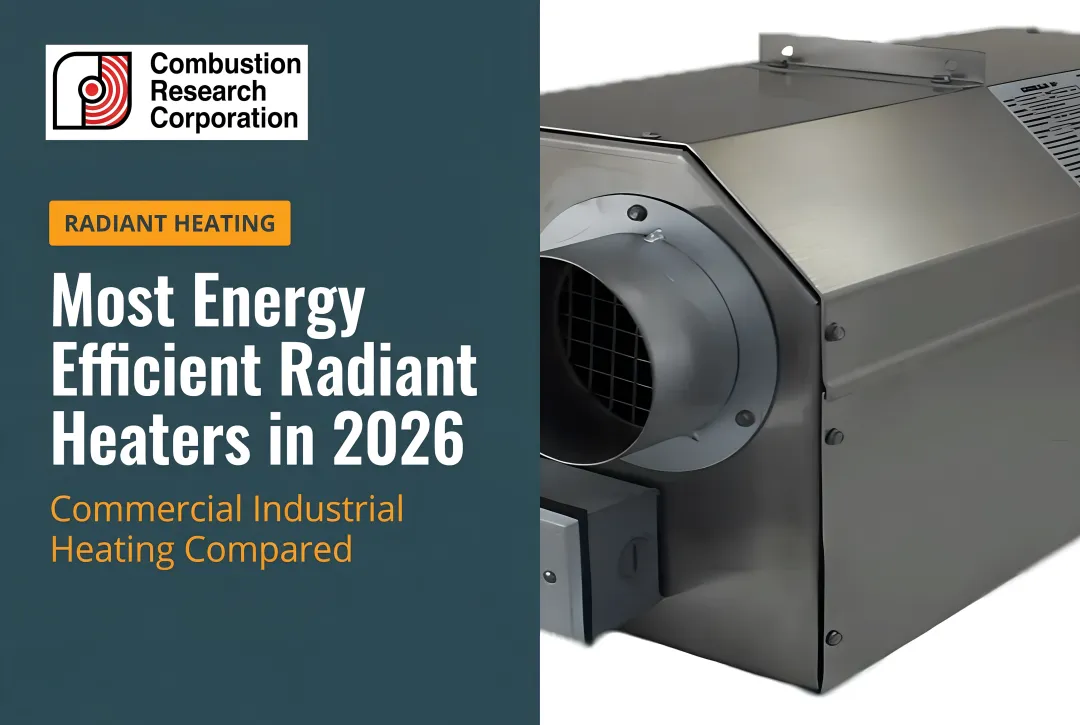
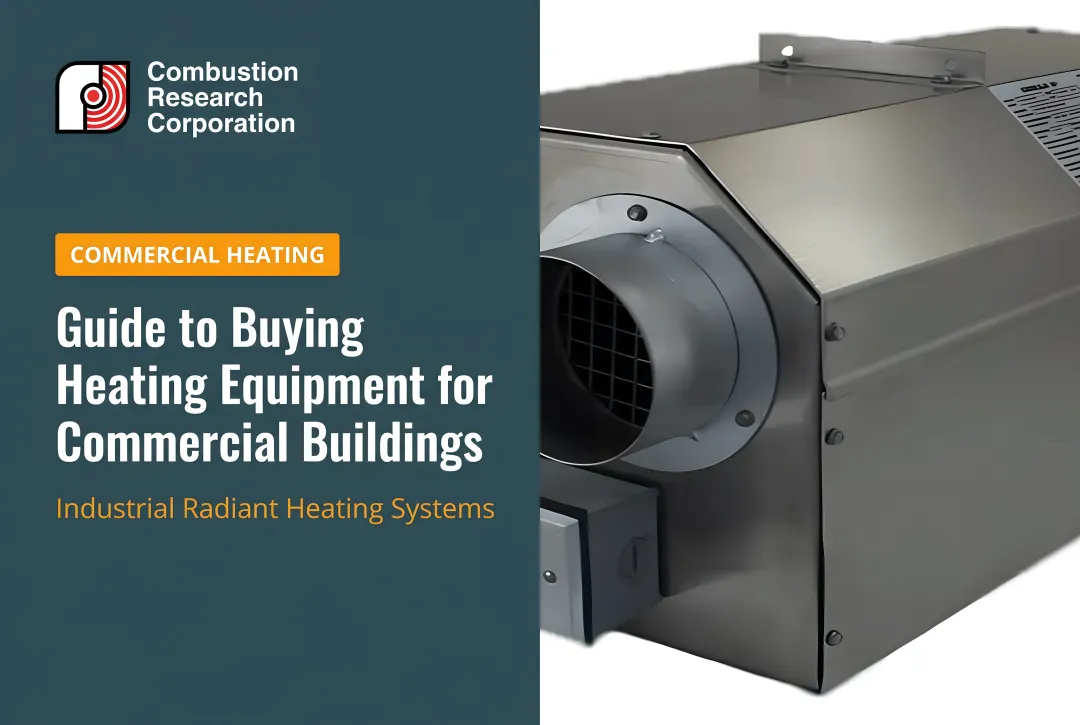
For example, Combustion Research Corporation's Omega II (power-vented) and Reflect-O-Ray (vacuum-vented) series are low-intensity tube heaters built for the high-bay applications above, while the Synergy line covers high-intensity spot heating needs.
Best fit: High-bay industrial spaces, facilities with frequent door openings, buildings with poor insulation, applications where air quality is a concern (auto shops, agricultural facilities).
Key advantage: Effectiveness doesn't depend on maintaining a heated air volume, so door cycling and air infiltration have minimal impact on occupant comfort.
Smart Controls and Zoning
Regardless of system type, integrating programmable thermostats, occupancy sensors, and zone controls cuts energy waste across the board. ENERGY STAR certified light-commercial HVAC equipment uses approximately 17% less energy than standard equipment — and controls are often what activates that gap in real operating conditions.
Best fit: Any commercial or industrial facility looking to reduce runtime waste without replacing existing equipment.
Key benefit: Pairs with any system type above; the efficiency gains compound when controls are matched to actual occupancy patterns rather than fixed schedules.
Why Infrared Heating Outperforms in Industrial and Large Commercial Spaces
The core reason is physics, not marketing. When a forced-air system heats a space with 25-foot ceilings, it must heat the entire air volume before floor-level temperatures reach setpoint. Warm air rises, concentrates at the roof deck, and escapes through the building envelope — exactly where heat loss rates are highest. The system then runs again to compensate.
Infrared bypasses this cycle entirely. Radiant energy travels in a straight line from the heater to the floor, workbenches, equipment, and people. The floor itself becomes a thermal mass that radiates warmth back into the occupied zone.
Operational Advantages in Industrial Settings
Ceiling-mounted tube heaters deliver several practical benefits beyond energy efficiency:
- No floor footprint — ceiling mounting keeps forklift paths and workspaces clear
- No filters or ductwork to maintain, which matters in dusty or high-particulate environments
- No air circulation, reducing the spread of dust, fumes, or pathogens in auto shops, agricultural facilities, and food-adjacent spaces
- Consistent output regardless of outdoor temperature — gas-fired systems maintain full capacity below 0°F, where heat pumps lose significant output
Performance When Building Conditions Aren't Ideal
Most industrial facilities aren't airtight. Loading docks open and close throughout the day. Wall panels have gaps. Older buildings were never designed to modern insulation standards. Forced-air heating systems lose a significant fraction of their useful output every time the building envelope is compromised.
Infrared tube heaters continue heating effectively in these conditions because they're not trying to maintain a heated air volume — they're maintaining the surface temperature of the floor and occupants. After a bay door cycles, comfort recovery is faster because the thermal mass in the floor hasn't changed significantly.
CRC's Low-Intensity Tube Heater Systems
Combustion Research Corporation has manufactured low-intensity infrared tube heaters for over 50 years, specifically for challenging industrial applications. Systems are available in vacuum-vented (Reflect-O-Ray) and power-vented (Omega II) configurations.
All systems are CSA International Design Certified to ANSI/CGA Standards (ANSI Z83.20 / CSA 2.34). Omega II models carry a 10-year limited warranty on the burner core and all combustion and heat exchanger tubes.
Two product lines address different project profiles:
| Product Line | Venting | BTU Range | Best For |
|---|---|---|---|
| Reflect-O-Ray EDS | Vacuum (negative pressure) | 40K–250K Btu/h | Custom-engineered projects, occupied spaces, hangars |
| Omega II PEP | Power-vented | 30K–220K Btu/h | Pre-engineered packages, retrofit installations, agricultural |
The vacuum-vented design of Reflect-O-Ray systems is particularly relevant for occupied facilities. Because the system operates under negative pressure, any tube breach draws ambient air inward rather than pushing combustion gases into the space — a meaningful safety margin in facilities with workers present.
CRC's engineering team engages during the specification phase for both new construction and retrofit projects, including heat loss calculations and system layout modeling before construction begins. For large facilities, this upfront work is what ensures system performance matches design intent through the installation process.
That engineering precision directly supports the 30–50% operational cost reductions CRC systems deliver. The savings come from eliminating duct losses, removing stratification waste, enabling zoned operation, and — in the Omega II DI PEP series — dual-input modulating burner technology that matches output to actual demand.
How to Choose the Right Energy-Efficient Heating System
Match System Type to Building Characteristics
Start with the physical reality of the space, not the efficiency spec sheet:
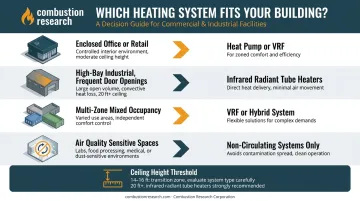
- Enclosed, well-insulated office or retail buildings → Heat pumps or VRF; zoned control adds significant value
- Large open industrial spaces, high ceilings, vehicle traffic, or frequent door openings → Infrared radiant tube heaters
- Multi-zone buildings with mixed occupancy → VRF or hybrid systems pairing infrared for high-bay zones with heat pumps for enclosed office areas
- Spaces where air quality is a concern (dust, fumes, pathogens) → Systems that don't circulate air; forced-air is disqualified
Ceiling height is often the single most decisive variable. Once you're above 14–16 feet, stratification losses from forced-air systems become significant. Above 20 feet, infrared radiant heating is almost always the more practical and cost-effective approach.
Evaluate Total Cost of Ownership
Purchase price is the least important number in the decision. What matters is the total cost across the system's operating life. Work through these components:
- Upfront equipment and installation cost
- Estimated annual energy savings — use realistic percentages based on your building type and current system baseline
- Maintenance costs — factor in filter replacement, duct cleaning, and service call frequency for your current system type vs. the replacement
- Expected service life — ASHRAE median service life data lists gas furnaces at 18 years, air-to-air heat pumps at 15 years, and steel water-tube boilers above 24 years
- Available incentives — IRS Section 179D applies to HVAC systems installed as part of commercial building improvements; 2025 deduction ranges run from $0.58–$1.16/ft² base, up to $5.81/ft² when prevailing wage requirements are met
A common repair decision threshold: replace rather than repair when repair cost exceeds $5,000, or when repair cost multiplied by system age in years exceeds that figure. Treat it as a starting point, not a final answer — actual energy savings projections from a replacement system should always factor into the call.
Factor in Climate and Incentives
Climate zone directly affects heat pump economics. In northern industrial facilities where design temperatures regularly fall below 0°F, a heat pump's efficiency drops enough that the installation cost may not pencil out without a backup heating system. Gas-fired infrared systems maintain rated output regardless of outdoor temperature, which simplifies design for cold-climate facilities.
Once you've accounted for climate constraints, check what incentives are available before finalizing any equipment decision. DSIRE is the most comprehensive national database for state and utility programs. Rebates and federal tax credits can shorten payback periods and make higher-efficiency equipment financially viable where it otherwise wouldn't be.
Frequently Asked Questions
What is the most energy-efficient commercial HVAC system?
The answer depends on building type. Heat pumps offer strong efficiency (COP above 3 in moderate climates) for enclosed commercial buildings. For large industrial spaces with high ceilings, infrared radiant tube heaters are typically the most cost-effective option because they eliminate the stratification and air infiltration losses that undermine forced-air systems regardless of their rated efficiency.
What is the $5,000 rule for HVAC?
The $5,000 rule suggests replacing a commercial HVAC system when the repair cost — or the repair cost multiplied by the system's age in years — exceeds $5,000. Treat it as a starting-point heuristic, and always weigh repair cost against projected energy savings from a newer system.
What is the cheapest way to heat a commercial building?
For large industrial and warehouse spaces, gas-fired infrared radiant heating is typically the lowest-cost option to operate. These systems heat occupants and surfaces directly rather than conditioning the full air volume, with operational cost reductions of 30–50% over conventional forced-air common in suitable applications.
How do I know when my commercial heating system needs replacing?
Key indicators include rising energy bills without changes in usage, increasing repair frequency, uneven heating across the facility, system age beyond 15–20 years, and reduced output during peak cold periods. Any combination of these signals warrants a replacement assessment — not just a service call.
Are infrared heating systems appropriate for all commercial buildings?
No. Infrared tube heaters are purpose-built for large open spaces with high ceilings, poor insulation, or frequent air infiltration — warehouses, hangars, auto shops, and agricultural buildings. For tightly partitioned office environments, a central forced-air or heat pump system with zoning controls is the more practical choice.
How much can upgrading to an energy-efficient commercial heating system save?
DOE research on advanced commercial HVAC technologies estimates 20–40% primary energy savings for qualifying upgrades in large commercial and industrial buildings. Industrial facilities switching to infrared radiant heating can reach the higher end of that range or beyond, depending on ceiling height and building envelope quality.