Introduction
A cold garage doesn't just sit there looking sad. It shuts down your winter woodworking, turns oil changes into an endurance sport, and leaves your treadmill collecting dust from October through March.
The right heater changes that math entirely, turning an unused bay into a workspace you actually want to be in.
For 2026, buyers face more choices than ever: hardwired electric units, portable propane heaters, radiant infrared panels, and hybrid forced-air models. That variety makes picking the right unit harder than it looks.
This guide breaks down the top-tested garage heaters by category and walks through sizing and fuel decisions. It also flags the point where a portable unit can't keep up with a larger, daily-use space.
Key Takeaways
- Electric heaters install easily; propane heats faster but requires real ventilation
- Size electric heaters at ~10 watts per square foot, gas units at ~40 BTU per square foot
- Infrared heaters warm people and objects directly, suiting dusty workshops better than forced air
- UL, CSA, or ETL certification plus tip-over shutoff aren't optional extras
- Multi-bay service garages and dealerships often outgrow portable heat, needing permanent infrared systems
Overview of Garage Heaters in 2026
A "garage heater" isn't just a space heater with a tougher-sounding name. Real units output far more wattage or BTUs than a bedroom heater and meet garage-specific safety standards.
Key differences include:
- Higher wattage or BTU output built for uninsulated, high-ceiling spaces
- Garage-specific safety ratings for dust, fumes, and moisture exposure
- Permanent ceiling or wall mounting instead of a floor cord
Home renovation spending remains a useful backdrop here. Harvard's Joint Center for Housing Studies projects $608 billion in 2025 spending on home improvements and repairs, with growth continuing into 2026.
Garages are capturing a growing share of that spending, as homeowners convert them into gyms, workshops, and hobby spaces that need real climate control.
That shift is exactly why the heater market for 2026 looks different than it did five years ago. Manufacturers now compete on smart controls, quieter operation, and safety features once reserved for commercial units.
Below is the breakdown of top-tested picks across every major fuel type and use case.
Best Garage Heaters Tested for 2026
Selection came down to four factors: heat-up speed, safety compliance, ease of installation, and real-world feedback pulled from major review outlets and manufacturer testing data. Each pick below represents a category, not necessarily one single SKU, since availability shifts year to year.
Best Overall: Hardwired Electric Ceiling-Mount Heater
This category consistently tops garage heater roundups for a reason. Mounted permanently to the ceiling, these units deliver quiet, even heat across mid-size garages without eating up wall or floor space. Models like the King KB2407 and Fahrenheat FUH75 anchor this category.
What sets them apart:
- Precise thermostat control with digital readouts instead of a single "hot/cold" dial
- Remote or app operation for adjusting temperature without climbing a ladder
- Quiet forced-air operation, a step up from older units that rattled the whole bay
| Feature | Details |
|---|---|
| Power Source & Output | Hardwired 240V electric, ~7,500 watts (25,600 BTU/h) |
| Installation | Ceiling or wall mount; typically requires an electrician |
| Best For | Attached garages and workshops wanting permanent, low-maintenance heat |
Manufacturer sizing guidance from King Electric puts a 7,500W unit at roughly 1,000 square feet in a well-insulated space, dropping to around 600 square feet if insulation is poor. That range matters more than the wattage number alone.
Best Propane: High-Output Portable Propane Heater
For garages without easy electrical access, or for anyone who wants heat without waiting on a circuit upgrade, propane still wins. The Mr. Heater Big Buddy MH18B is the benchmark unit in this category, and it's cordless, which means setup takes minutes.
Standout features:
- Three BTU settings (4,000 / 9,000 / 18,000) for fine-tuning output
- Up to 11 hours of runtime on two 1-pound cylinders at low settings
- Covers up to 450 square feet, per manufacturer specs
| Feature | Details |
|---|---|
| Power Source & Output | Propane, adjustable 4,000–18,000 BTU |
| Safety Features | Oxygen-depletion sensor, tip-over switch, thermal shutdown |
| Best For | Off-grid barns, unheated garages, or backup heat during outages |
The built-in oxygen-depletion sensor is the feature that separates indoor-rated propane heaters from the outdoor-only versions. Don't skip that spec when comparing models.
Best Infrared: Radiant Electric Heater
Infrared heaters like the Dr. Infrared DR-238 and Heat Storm Tradesman skip the "heat the air" approach entirely. Instead, they warm objects and people directly with radiant energy, similar to standing in direct sunlight on a cold day.
Why it stands out:
- Near-silent operation, since there's no fan pushing air around
- Flexible, weatherproof mounting on a tripod, wall, or ceiling, with housing rated for indoor-outdoor use on covered patios or open bays
| Feature | Details |
|---|---|
| Power Source & Output | Electric, up to 1,500 watts across multiple heat settings |
| Installation | Portable tripod, wall, or ceiling mount |
| Best For | Workshops with sawdust or debris where forced air isn't ideal |
If you're running a table saw or sander regularly, this category avoids the dust-circulation problem that forced-air units create.
Best for Small Garages/Budget: Compact Wi-Fi Infrared Heater
Single-bay garages and workbench zones don't need a 7,500-watt unit. Compact Wi-Fi infrared heaters like the Heat Storm Phoenix fill that gap with app-based scheduling and a smaller footprint.
Where this model earns its spot:
- Wi-Fi scheduling lets you preheat the garage before you walk out
- Lightweight wall mount installs without an electrician in most cases
- Adjustable heat range for dialing in comfort without overshooting
| Feature | Details |
|---|---|
| Power Source & Output | Electric, ~5,200 BTU (750–1,500W) |
| Controls | Wi-Fi app, remote, and onboard digital controls |
| Best For | Small garages or workbench areas on a budget |
One caveat worth flagging: the manufacturer rates this unit for 150 square feet of primary heat, with 750 square feet listed only as supplemental coverage. Don't size it as your main heat source in a two-car bay.
Best Heavy-Duty/Hybrid: Cordless Forced-Air Propane Heater
Large three-car garages and job-site-grade workshops need something with real muscle. The DeWalt DXH70CFAV, rated at 70,000 BTU, runs on 20V MAX or FLEXVOLT batteries for ignition while burning propane for heat output.
What makes it built for the job site:
- High BTU output for fast recovery after a garage door opens
- Stable, wide base built for job-site abuse
- Battery-powered ignition with CSA certification and high-limit safety switches
| Feature | Details |
|---|---|
| Power Source & Output | Battery-ignited propane, 70,000 BTU |
| Ventilation Needs | Requires open door or window for safe operation |
| Best For | Large three-car garages or workshops needing fast, high-volume heat |
Forced-air propane heaters in this class are built primarily for outdoor or well-ventilated use. Mr. Heater's own guidance calls for at least 1 square inch of ventilation per 1,000 BTU when running similar units indoors.
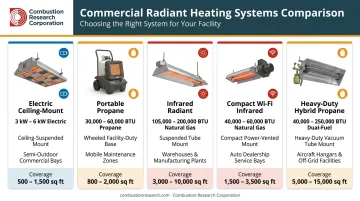
Sizing Your Heater: Watts, BTUs & Square Footage
Getting size wrong is the single most common garage heater mistake. Buy too small, and you'll fight cold spots all winter. Buy too big, and you'll waste energy heating a space that's already comfortable.
For electric heaters, King Electric's sizing guide recommends:
- 7.5 watts per square foot for well-insulated garages
- 10 watts per square foot for average insulation
- 12.5 watts per square foot for poorly insulated spaces
A 7,500-watt unit, then, covers anywhere from 600 to 1,000 square feet depending on how tight your garage envelope is.
For gas and propane heaters, Mr. Heater's general estimate lands closer to 40 BTU per square foot as a starting point, though it explicitly calls this a rough baseline, not a final answer. Ceiling height, layout, and local climate all shift the real number.
One adjustment matters more than most buyers realize: ceiling height. King's own guidance says to add 25% more capacity for every 2 feet of ceiling height above 8 feet. A garage with a 12-foot ceiling needs meaningfully more output than the same footprint under a standard 8-foot ceiling.
Oversizing isn't just wasteful. A heater that's too powerful for the space creates real problems:
- Cycles on and off constantly, adding wear to components
- Creates uncomfortable temperature swings across the garage
- Burns more fuel or electricity than a properly matched unit
Fuel Source, Heating Method & Safety
Choosing a fuel type comes down to three tradeoffs: upfront cost, running cost, and how complex installation gets.
- Electric heaters install with minimal hassle (some just need a dedicated outlet) but electricity is the priciest fuel per unit of heat delivered
- Propane heats faster and often costs less to run, but portable units need proper ventilation and indoor-rated safety features
- Natural gas units offer the cheapest running cost of the three but usually require professional gas-line installation
- Infrared/radiant heaters, whether electric or gas-fired, warm surfaces directly instead of the air, which matters in dusty workshop environments
Local utility rates ultimately decide which fuel costs least to run, so check your actual bill before assuming national averages apply to your area.
Why Safety Certifications Aren't Optional
Look for UL, CSA, or ETL certification on any heater before buying. These marks confirm the unit passed independent safety testing, not just a manufacturer's own claims.
Non-negotiable safety features:
- Tip-over automatic shutoff, which cuts power the instant a unit falls over
- Overheat protection, shutting the heater down before internal components overheat
- Cool-touch exteriors on portable units, especially in garages where kids or pets might wander near it
The stakes here are real. According to FEMA's fire administration data, portable heaters caused only 3% of residential heating fires between 2017 and 2019, but accounted for 41% of fatal residential heating fires in that same period.
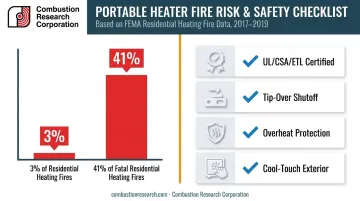
That gap between overall fire share and fatal fire share is exactly why certification and shutoff features matter more than price.
Keep at least 3 feet of clearance from anything combustible, plug electric units directly into wall outlets rather than power strips, and never leave a fuel-burning heater running unattended in an enclosed space.
When Portable Isn't Enough: Upgrading to Industrial-Grade Infrared Heating
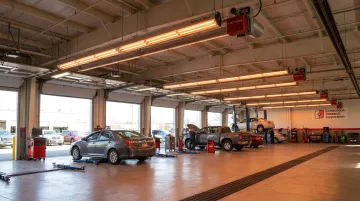
Portable and small electric heaters work fine for a single-bay garage used a few hours a week. Multi-bay service garages, auto dealerships, and larger detached workshops are a different story entirely.
The real problem is duty cycle, not square footage. A service bay door opens every time a vehicle rolls in or out, and forced-air heat gets displaced within seconds of that door lifting. Portable units simply can't recover fast enough to keep techs comfortable through a full shift.
This is where permanent, ceiling-mounted low-intensity infrared tube heating comes in, and it's the category Combustion Research Corporation has built its business around since 1965. CRC's Omega II and Reflect-O-Ray lines cover a wide range depending on facility size:
- Omega II power-vented systems: 105,000 to 200,000+ BTU/hr, pre-engineered for straightforward specification
- Reflect-O-Ray vacuum systems: 40,000 to 250,000 BTU/hr, custom-engineered for larger or high-bay facilities
- Serengeti-IR: 40,000 to 60,000 BTU/hr, sized for single-bay detail or quick-lube operations
Because these systems mount overhead, they free up floor space entirely. That matters in shops where forklifts, lifts, and vehicles move through the bay, since it also reduces the risk of accidental contact with heating equipment.
The efficiency case is well documented, too. CRC's systems deliver 30–50% energy savings compared to conventional forced-air heating in comparable commercial applications. Radiant heat warms floors, vehicles, and occupants directly, rather than heating an entire air volume that leaks out every time a door opens.
For facility owners planning a permanent, code-compliant heating upgrade rather than a seasonal fix, two differentiators stand out:
- CSA International Design Certification to ANSI/CGA standards
- 10-year limited warranty on radiant tubes against internally created corrosion
Conclusion
The right garage heater depends entirely on your garage, not on which unit topped a "best of" list. Size, fuel access, and how often you actually use the space should drive the decision. A weekend hobbyist needs something very different from a dealership running four service bays five days a week.
Before you buy, weigh long-term energy costs and safety certifications as heavily as the sticker price. A cheaper heater that runs inefficiently or lacks proper shutoffs isn't actually cheaper once you factor in a full winter of use.
If you're managing a service garage, dealership, or commercial workshop that's outgrown portable heating, Combustion Research Corporation's engineering team can help. They'll specify a durable, energy-efficient infrared system built for your facility's exact footprint and duty cycle. Reach out at 888-852-3611 or through combustionresearch.com/find-a-rep to start that conversation.
Frequently Asked Questions
What type of heater is best for a shop?
Electric or infrared heaters work well for smaller, enclosed shops, while propane or natural gas units suit larger, well-ventilated spaces. Daily-use commercial shops typically do best with permanent infrared tube systems for consistent, low-maintenance heat.
What size heater do I need for a two-car garage?
A typical two-car garage runs 500 to 700 square feet. Using the 10-watt-per-square-foot electric rule, that's a 5,000 to 7,000-watt heater, or roughly 20,000 to 28,000 BTU for a gas unit.
Is it safe to run a propane heater in an enclosed garage?
Only if the unit is specifically rated for indoor use and includes an oxygen-depletion sensor. Proper ventilation and an interconnected carbon monoxide alarm are both required safeguards.
What is the most energy-efficient type of garage heater?
Electric heaters convert 100% of energy to heat at the point of use but cost more per watt than gas. For larger spaces, gas-fired or infrared systems typically deliver lower running costs despite higher upfront installation complexity.
Can a garage heater be too big for the space?
Yes. An oversized heater cycles on and off constantly, creates uncomfortable heat swings, and wastes energy. Proper sizing based on square footage and insulation quality avoids this entirely.
How much does it cost to install a permanent garage heater?
Total installation typically runs $1,500 to $4,000, according to HomeAdvisor's cost data, depending on heater size, fuel type, and whether electrical or gas-line work is required.