Introduction
Walk into any heating supply store and you'll find two vent-free gas technologies competing for the same shelf space: blue flame and radiant (infrared) heaters. Many buyers assume they're interchangeable. They're not.
Picking the wrong one affects more than comfort. It changes your fuel bill, how evenly a room heats, and whether cold spots linger near doors and floors.
Manufacturer testing rates both blue flame and radiant vent-free units at 99.9% fuel efficiency, since no heat escapes through an outside vent, according to Empire's vent-free heater literature. But that number only tells part of the story.
This guide breaks down how each technology actually heats a space, where each performs best, and how to decide between them, whether you're warming a small workshop or a 50,000-square-foot warehouse.
Key Takeaways
- Blue flame heaters warm air through convection, ideal for enclosed, insulated rooms
- Radiant/infrared heaters warm people and objects directly, better for large or drafty spaces
- Both hit near 99.9% efficiency at the unit level and include Oxygen Depletion Sensors (ODS)
- Low-intensity infrared systems typically deliver 30-50% greater real-world energy savings in industrial settings
- Room size, ceiling height, and insulation quality should drive your final decision
Blue Flame vs Radiant Heaters: Quick Comparison
| Factor | Blue Flame | Radiant (Infrared) |
|---|---|---|
| Heating method | Convection : heats air, which circulates through the room | Infrared waves : heats objects and people directly |
| Best environment | Insulated, enclosed rooms (small offices, tight workshops) | Open, drafty, high-ceiling spaces (garages, barns, warehouses) |
| Speed of comfort | Gradual : whole room warms evenly over time | Near-instant : warmth felt immediately, like standing by a fire |
| Energy efficiency | Efficient in tight spaces; loses ground in large or leaky rooms | Avoids heating unused air; stronger savings in big or drafty spaces |
| Safety notes | Heat rises to ceiling first; furniture placement less critical | Direct heat output requires clearance from fabric and furniture |
A quick example: an insulated warehouse office behaves very differently than an uninsulated auto service bay with overhead doors cycling open every few minutes. The first favors blue flame. The second is exactly the scenario radiant tube heaters were engineered for.
What Is a Blue Flame Heater?
A blue flame heater is a vent-free gas appliance that heats its own metal housing first, then convects warm air upward and outward until it fills the room. The name comes from the visible blue combustion flame inside the unit, distinct from the glowing ceramic plaque you'd see on a radiant model.
Core benefit: consistent, whole-room warmth with minimal fuel waste, provided the space is reasonably sealed. Because the heater relies on natural air circulation, it performs best in rooms that hold heat rather than leak it.
Common variations include fuel type (natural gas or propane, depending on what's already piped or tanked at the property) and control style, ranging from manual dial units to thermostatic models that modulate burner output automatically.
Empire's BF30 model, for instance, uses a hydraulic thermostat that adjusts input from 8,500 to 30,000 BTU/h to hold a set room temperature rather than cycling on and off at full output. That kind of modulation matters more than people expect. A heater running at partial output all day typically uses less total fuel than one that repeatedly fires to full blast and shuts off.
Use Cases of Blue Flame Heaters
Blue flame units fit best where air can circulate naturally and stays contained:
- Residential living spaces: dens, finished basements, and family rooms with standard insulation
- Insulated home offices: small, enclosed rooms where consistent temperature matters more than instant heat
- Small enclosed workshops: hobby spaces or garages with sealed walls and limited air exchange
They're a poor match for large, drafty, or high-ceiling buildings. Heat convects upward, and in a space with a 20-foot ceiling or open bay doors, most of that warm air simply stratifies near the roofline long before it reaches anyone standing on the floor.
What Is a Radiant Heater?
Radiant, or infrared, heaters transfer thermal energy through electromagnetic waves rather than warming the surrounding air first. Think of sunlight on a cold day: the air temperature might read 40°F, but standing in direct sun still feels warm. That's the same principle at work indoors.
This direct-transfer approach means less energy gets wasted heating air near the ceiling that nobody occupies. It also reduces heat loss in drafty spaces, since infrared waves keep transferring energy to floors and equipment even when a door swings open.
High-Intensity vs. Low-Intensity Radiant
Industrial radiant heating splits into two main categories:
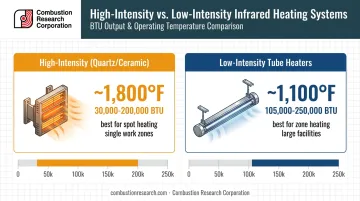
- High-intensity (quartz/ceramic) — combustion occurs at a ceramic surface running around 1,800°F, according to AHRI's infrared heating safety brochure. Best for spot heating specific work zones, like a single service bay.
- Low-intensity tube heaters — combustion gases pass through a heat-exchanger tube averaging closer to 1,100°F. These are ceiling-mounted and built for zone heating across larger footprints.
Combustion Research Corporation's product lineup maps directly onto this split. The Synergy line covers high-intensity ceramic infrared from 30,000 to 200,000 BTU, reaching full operating temperature in under a minute. The Omega II (power-vented, 105,000-200,000 BTU) and Reflect-O-Ray (vacuum-fired, 40,000-250,000 BTU) lines cover low-intensity tube heating, engineered for facilities ranging from 500 square feet up to a million-plus.
Use Cases of Radiant Heaters
Low-intensity tube systems solve problems that convection heaters simply can't in commercial and industrial settings:
- Warehouses and distribution centers — high ceilings mean convected heat stratifies out of reach
- Auto service bays and dealerships — frequent overhead door openings drain heated air fast
- Aircraft hangars, barns, and greenhouses — large open volumes with limited insulation
Ceiling mounting matters here for a reason beyond floor space. Reflect-O-Ray and Omega II systems don't rely on fans or filters to move heat, so there's no mechanism circulating dust, fibers, or airborne pathogens through the workspace. That's a real consideration in woodworking shops, packaging lines, and agricultural buildings, where forced-air systems tend to stir up particulates.
On energy performance, a Puget Sound Energy analysis of an auto-service garage found that replacing forced-air unit heaters with low-intensity infrared cut annual gas use from 42,000 to 34,200 therms. That's an 18.5% reduction, saving over $8,300 per year, according to ACEEE's published case study data.
Trade publications cite a broader 20-50% savings range for well-designed infrared retrofits in large, open spaces. That range aligns with the 30-50% figure Combustion Research Corporation cites across its own commercial deployments.
Blue Flame vs Radiant: Which Is Better for Your Space?
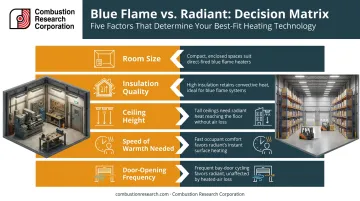
There's no universal winner. The right call depends on five factors:
- Room size — small and enclosed favors blue flame; large and open favors radiant
- Insulation quality — poorly insulated spaces lose convected heat fast
- Ceiling height — anything above 12-15 feet starts favoring radiant systems
- Speed of warmth needed — radiant wins for instant comfort near workstations
- Door-opening frequency — frequent overhead door cycles favor radiant's direct-transfer approach
For small, insulated, enclosed rooms needing even whole-room warmth, blue flame remains the simpler, lower-cost option. For large, open, drafty, or high-ceiling spaces, radiant/infrared systems, particularly low-intensity tube heaters, deliver better comfort and lower long-term fuel costs.
The Cost Trade-Off
Blue flame units typically carry a lower upfront price tag. Radiant tube systems cost more to install, largely due to engineering, mounting hardware, and gas piping runs, but that gap tends to close over time in larger facilities.
The Seattle auto-service garage mentioned earlier illustrates this well. The facility struggled with 18-20 foot ceilings, overhead doors cycling constantly, and forced-air heat that never reached comfortable levels at floor height.
After switching to low-intensity infrared through a utility-incentive program, the retrofit cost roughly $40,000. It paid for itself in under five years through $8,300 in annual savings.
For facilities managing large or industrial spaces, the math usually favors evaluating a properly engineered radiant system before defaulting to whatever heated the building last.
Combustion Research Corporation's engineering support team works through heat-loss calculations, mounting height, and zoning before a system ever gets installed. That step often separates a retrofit that saves 30% from one that increases gas use because the layout was wrong.
Conclusion
Neither blue flame nor radiant heating is objectively better; they solve different problems. Blue flame heaters suit small, insulated, enclosed spaces where even, whole-room warmth matters most. Radiant and infrared systems suit larger, open, or high-ceiling environments where targeted, efficient heat and floor-space preservation carry more weight.
The decision ultimately comes down to comfort, fuel costs, and, for commercial or industrial buyers, long-term energy savings.
If you're heating a warehouse, hangar, service bay, or similar facility, forced-air or convection heating often leaves cold floors and high utility bills. Before committing to another system with the same losses, have CRC's engineering team model heat distribution for your space.
Frequently Asked Questions
Is a blue flame heater better than a radiant heater?
Neither is universally better. Blue flame suits small, insulated, enclosed rooms, while radiant/infrared works better in larger, drafty, or high-ceiling spaces needing direct, targeted heat.
What are the pros and cons of using a blue flame heater?
Pros include even whole-room warmth, lower upfront cost, and strong performance in insulated spaces. Cons include slower initial warmth and reduced effectiveness in large or poorly insulated areas.
Which is more energy efficient, blue flame or radiant heaters?
Both rate near 99.9% efficiency at the unit level, but radiant/infrared systems typically deliver greater real-world savings in large or high-ceiling spaces by avoiding heat loss to stratification.
Can blue flame or radiant heaters be used in large spaces like garages or warehouses?
Blue flame heaters aren't built for large, open areas. Radiant/infrared systems, such as CRC's Omega II low-intensity tube heaters, are engineered specifically for large facilities like warehouses and aircraft hangars.
Do blue flame heaters use more gas than radiant heaters?
Both use comparable fuel for equivalent heat output. The space itself determines which technology wastes less energy in practice, not the heater alone.
Are blue flame and radiant heaters safe to use indoors?
Both are generally safe indoors, especially vent-free models with Oxygen Depletion Sensors. Radiant units do require maintaining safe clearance from combustible materials and equipment.