Introduction
Greenhouses are essentially heat sieves. Glass, polycarbonate, and polyethylene glazing transmit solar energy beautifully, but provide almost no insulating value — the moment the sun drops, heat bleeds out through every surface. For commercial operators, that translates directly into fuel bills.
According to Virginia Tech Extension, fuel costs typically account for 7–10% of greenhouse production costs, climbing to 20–25% during severe winters. Heating alone represents 70–80% of total greenhouse energy consumption, making it the single biggest energy lever available to growers.
This guide covers what commercial operators actually need: a clear comparison of heating system types, the BTU sizing math, envelope strategies that reduce heat load before you touch the thermostat, and how the choice of heating technology compounds into long-term profitability.
Key Takeaways
- Seal the envelope first — insulation and air sealing cut the energy load before you size a heater
- Infrared heats plants and surfaces directly — forced-air loses that energy to the ceiling through stratification
- Size heaters using the BTU formula (surface area × U-factor × temperature difference) and add infiltration losses on top
- Night setback controls reduce fuel consumption by roughly 2–3% per °F of setback with minimal investment
- Switching to infrared tube heaters can cut operational heating costs by up to 30% versus conventional forced-air
Why Greenhouse Heating Efficiency Matters
Farm Energy Extension puts energy as the third-highest cost for most greenhouse growers, after labor and plant materials — and notes it has grown to exceed 10% of total sales for many operations.
The structural reason is physics. Greenhouse glazing materials — glass, polycarbonate, polyethylene film — are selected for light transmission, not thermal resistance. A single layer of glass or polyethylene has a U-factor around 1.1–1.2 Btu/hr·ft²·°F, meaning heat escapes rapidly compared to standard wall insulation.
The result: up to 85% of total greenhouse heat loss occurs at night, when there's no solar gain to compensate.
The Compounding Effect of Efficiency Gains
Efficiency improvements don't just lower one line item. Consider what a 30–50% reduction in heating costs does across a full season:
- Lowers the break-even point on crops, improving margin per unit sold
- Extends the growing season into early spring and late fall, where heating cost is often the limiting factor
- Enables more competitive pricing against growers in warmer climates or those with cheaper energy sources
Virginia Tech data shows that switching from single-layer to double-layer polyethylene covering alone can reduce heating costs by 50%. That's before upgrading the heating system — which is where the next layer of savings comes from.
Comparing Greenhouse Heating Systems
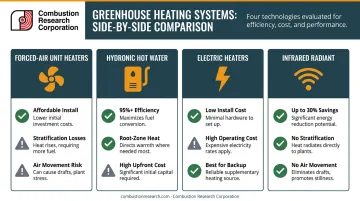
Commercial operators generally choose from four categories. Each involves distinct tradeoffs in installation cost, operating cost, heat distribution quality, and plant health outcomes.
Forced-Air Unit Heaters
Forced-air heaters combust natural gas or propane, then fan the heated air through the greenhouse — either directly or via perforated polyethylene distribution tubes. They're widely used and relatively inexpensive to purchase and install.
The core efficiency problem is stratification. Hot air rises and accumulates at ceiling height — the one place crops aren't growing. Growers end up paying to heat roof space while bench level stays cooler.
Horizontal airflow (HAF) fans are commonly added to push heat back down, adding equipment cost and complexity.
Air currents from forced-air systems also disseminate fungal spores and dust throughout the growing environment. Botrytis germination requires free moisture for 8–12 continuous hours at relative humidity above 85% — so disease management in forced-air greenhouses depends heavily on humidity control alongside air movement.
Hydronic (Hot Water) Heating
Hydronic systems circulate hot water from a boiler through pipes placed under benches, in root zones, or embedded in floors. Because heat is applied at plant level, stratification losses are dramatically reduced. Root-zone heating also allows greenhouse air temperatures to run 5–15°F cooler than standard systems while maintaining equivalent crop performance — a direct fuel saving.
A condensing boiler pushes combustion efficiency above 95% by recovering latent heat from flue gases that a standard boiler vents to atmosphere. Over a full heating season, that efficiency gap compounds into significant fuel cost reductions.
The drawback is upfront cost. Boiler, piping, zoning controls, and installation represent significant infrastructure investment — hydronic systems make the most sense for large, permanent commercial operations, not modular or smaller-footprint greenhouses.
Electric Heaters
Electric fan heaters and radiant electric heaters offer clear practical advantages:
- Low installation cost with no combustion byproducts
- Simple thermostat integration
- No fuel storage or gas line requirements
The limitation is operating cost. Per-BTU electricity costs typically exceed natural gas at commercial scale across most US markets, making electric heating well-suited as supplemental or emergency backup heat — but rarely the right primary source for a commercial operation running all winter.
Infrared Radiant Heaters
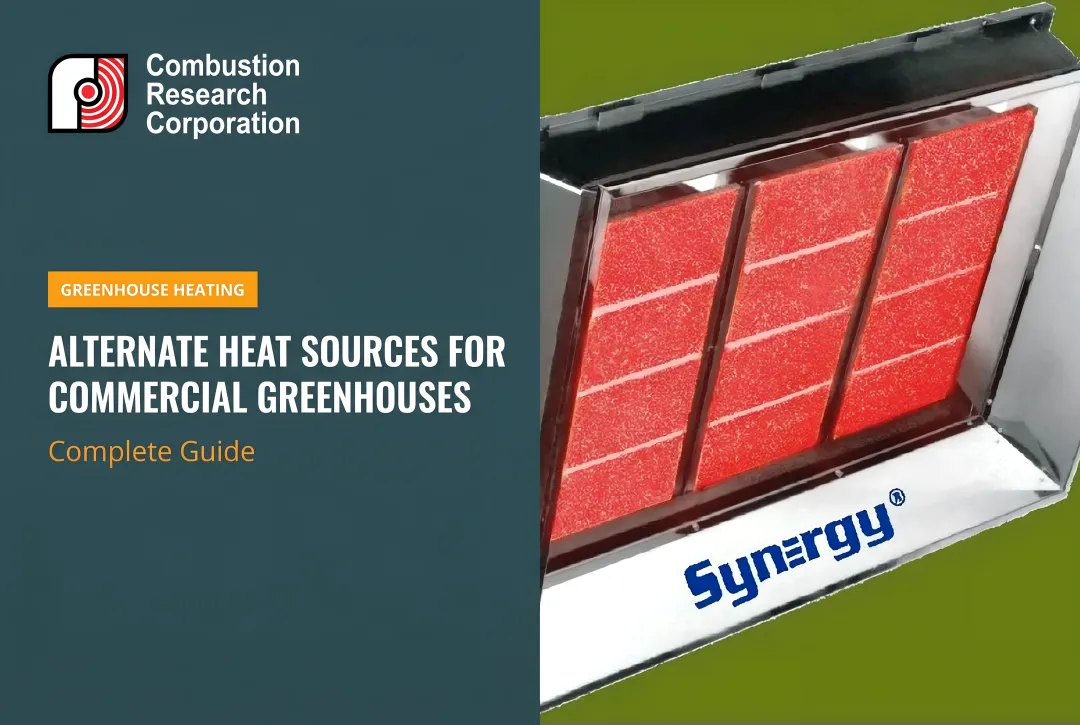
Infrared heaters operate on a fundamentally different principle. Rather than heating air, they emit radiant energy absorbed directly by solid objects — plants, soil, benches, floors — which then re-radiate warmth into the surrounding environment.
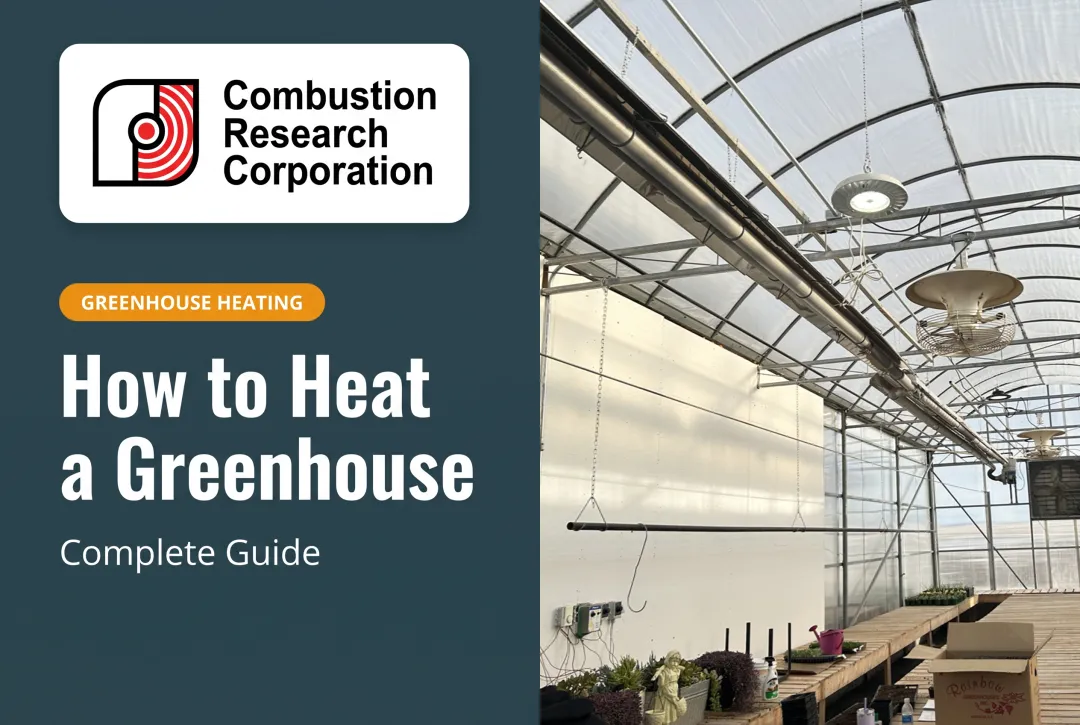
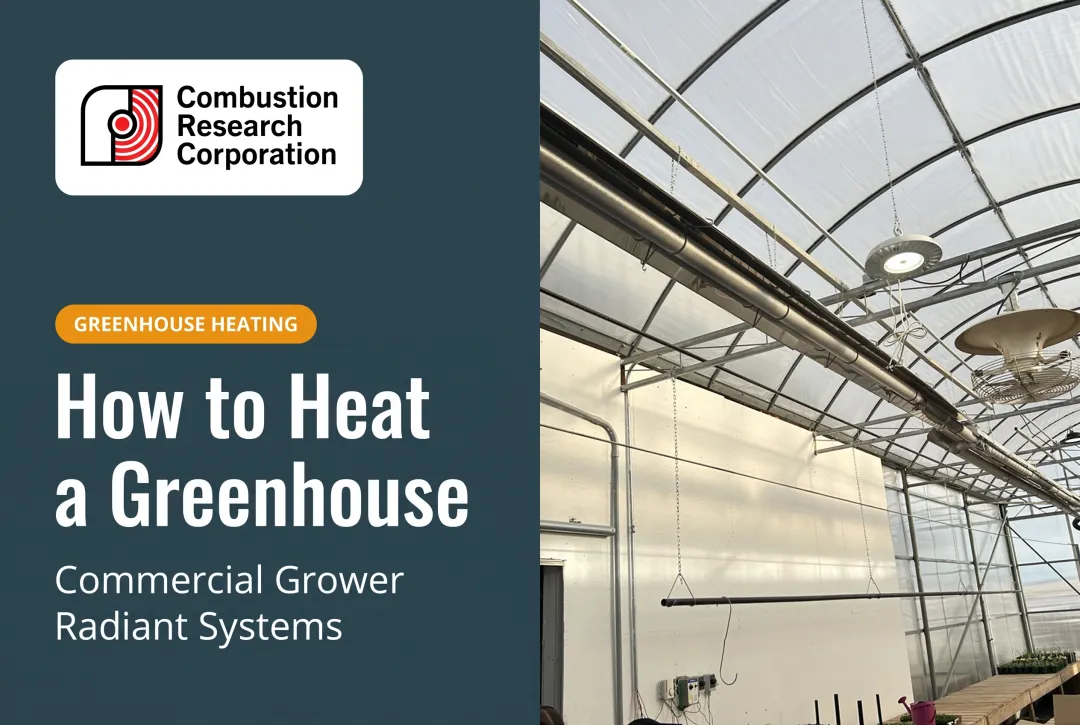
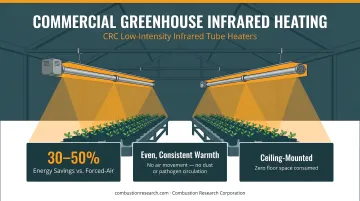
Because the air itself isn't the transfer medium, stratification losses disappear. Heat goes where the crops are. Low-intensity infrared tube heaters are ceiling-mounted, preserving all floor and bench space, and produce no air movement — meaning they don't disturb dust or circulate particles through the growing environment.
Virginia Tech Extension notes that infrared radiant systems may save up to 30% over traditional forced-air unit heaters in greenhouse applications — a meaningful operational advantage sustained across every heating season.
How to Calculate Your Greenhouse Heating Requirements
The BTU Sizing Formula
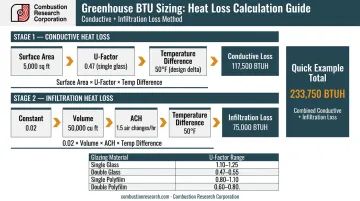
Conductive heat loss is calculated as:
Required BTUH = Surface Area (sq ft) × U-factor × Temperature Difference (°F)
Where Temperature Difference = desired interior temperature minus your design outdoor low temperature.
Use these U-factor values in the formula above:
| Covering Material | U-factor (Btu/hr·ft²·°F) |
|---|---|
| Single-layer polyethylene film | 1.1–1.2 |
| Double-layer air-inflated polyethylene | 0.7–1.0 |
| Single-pane glass | 1.1–1.4 |
| Twin-wall / double-wall polycarbonate | 0.5–0.7 |
For infiltration losses, Greenhouse Management recommends calculating separately using: 0.02 × Volume × Air Changes per Hour × Temperature Difference. Air change rates range from 0.5–1 ACH for a tight new greenhouse to 2–3 ACH for a poorly maintained structure. In windy locations, increase these values by 10–15%.
Quick example: A 5,000 sq ft greenhouse with double-layer poly (U-factor = 0.85) targeting 65°F indoors against a 10°F outdoor low needs roughly 233,750 BTUH for conductive loss alone — before adding infiltration. That's why accurate inputs matter before you size equipment.
Glazing Choice Has Long-Term Cost Implications
A greenhouse covered in double-layer air-inflated polyethylene has roughly half the heat loss rate of single-layer covering — directly reducing required heater capacity and ongoing fuel spend. The U-factor decision made at the design stage shapes every heating bill for the life of the structure.
Getting the math right before purchasing equipment is critical — an undersized system struggles to maintain temperature, while an oversized one cycles inefficiently and burns excess fuel. For commercial projects, Combustion Research Corporation's engineering team provides heat load calculation support and can validate sizing for both new construction and retrofits.
Reducing Heat Loss: Insulation and Envelope Strategies
The cheapest BTU is one you never have to generate. Reducing the heat load before optimizing the heating system is always the right sequence.
Practical envelope improvements:
- Seal air gaps and cracks around glazing, frames, and penetrations with silicone sealant
- Verify that all doors and vents close snugly — gaps around door frames are a common heat loss source
- Inspect deteriorated glazing seals and replace where needed
- Check that glazing panels haven't shifted or cracked, creating unintended ventilation
Thermal Curtains: The Biggest Single Upgrade
Interior thermal curtain systems — also called energy screens or thermal blankets — are drawn horizontally across the greenhouse at night, reducing the heated volume to the growing zone below the curtain. The impact is substantial.
According to Farm Energy Extension, energy curtains can save 30–50% on fuel bills because most greenhouse heating occurs at night. Separate data from Virginia Tech confirms thermal blankets can reduce energy use by up to 50%. Typical payback on curtain installation runs 1–2 years.
One management detail matters: thermal curtains can trap moisture above the growing canopy, creating conditions favorable to disease if not handled correctly. Most commercial installations include provision for curtain retraction during ventilation periods to keep humidity in check.
Insulation vs. Light Transmission
Unlike curtains, which target nighttime heat loss only, opaque insulating materials — bubble wrap on glazing panels, for instance — are in place whenever light is available. That tradeoff matters: in low-light winter months, crops with high light requirements may experience growth delays that offset any heating savings.
Leafy greens and herbs tolerant of lower light levels are better candidates for this approach than fruiting crops like tomatoes or cucumbers, which need consistent DLI (daily light integral) to produce.
Why Infrared Tube Heaters Excel in Commercial Greenhouses
The Stratification Advantage
In a forced-air greenhouse, temperature at ceiling height can be meaningfully warmer than at bench or floor level — growers are effectively paying to heat space above the crop canopy. Infrared heaters eliminate this by delivering radiant energy directly to plants and growing surfaces. The air temperature in the upper greenhouse can run lower while the plant environment remains at the target temperature.
In practice, this translates to the 30–50% fuel savings infrared systems consistently demonstrate over forced-air in commercial greenhouse applications.
Plant Health Considerations
Low-intensity infrared tube heaters produce no air movement. There's nothing to circulate dust or plant debris through the growing environment — a real advantage in densely planted operations where airborne disease pressure is a management concern. UF IFAS also notes that infrared heaters help maintain plant leaf surface temperatures above ambient air temperature, which can support disease management by reducing the duration of leaf wetness.
Floor Space and Layout Efficiency
Ceiling-mounted tube heaters occupy zero bench or floor space. In commercial greenhouses where every square foot of bench space has direct revenue implications, this matters. The heating system doesn't compete with the growing system for space.
Specifications to Evaluate When Selecting a System
Combustion Research Corporation's low-intensity infrared tube heaters are built specifically for demanding commercial applications. Key specifications relevant to greenhouse operators:
- Outputs from 40,000 to 250,000 Btu/hr cover facilities from 500 sq ft to over 1 million sq ft
- Product lines: Reflect-O-Ray® (vacuum-vented) and Omega II® (power-vented) — both listed for greenhouse applications
- Construction: Stainless steel and aluminized steel options; stainless steel burner housing on select Reflect-O-Ray models for high-humidity environments
- Reflectors: Bright aluminum, 98% reflectivity, independently rotatable at 0° or 30° to direct heat into specific growing zones
- Certifications: CSA International Design Certified to ANSI/CGA Standards, ANSI Z83.20 / CSA 2.34
- 10-year limited warranty on radiant tubes for internally created corrosion
- Maintenance design: Engineered without combustion air filters — a meaningful reliability advantage in greenhouse environments where dust and humidity stress conventional equipment
The choice between Reflect-O-Ray and Omega II depends on facility layout, exhaust path complexity, and occupancy sensitivity. CRC's engineering team supports both new construction and retrofit specifications.
Smart Controls and Operational Best Practices
Night Setback: High ROI, Low Cost
Virginia Tech Extension documents that lowering night temperature by 1°F saves 2–3% on the greenhouse heating bill. Farm Energy Extension's conservation checklist notes fuel consumption drops about 3% for each 1°F reduction in night setpoint.
A 10°F night setback — practical for many crops — can save 5% or more in heating energy. The upfront investment is a programmable controller or smart thermostat, and those savings compound across every heating season with zero additional spend.
Crop-specific setback limits to observe:
- Tomatoes and cucumbers: don't drop below 60°F at night
- Cool-season crops after germination: 55–60°F night minimum
- Hardy overwintering ornamentals: can tolerate 35°F once established
Zoning for Efficiency
Night setback addresses when you heat; zoning addresses where. Not every zone in a commercial greenhouse needs identical temperatures, and treating them as if they do wastes fuel.
A zoned system targets heat precisely, which cuts total fuel use while protecting temperature-sensitive crops. Key zoning considerations:
- Propagation areas with seedling trays need higher temps than staging zones for mature plants
- Separate zones for cold-hardy overwintering stock can run at significantly lower setpoints
- Independent controls per zone prevent over-heating low-priority areas during peak cold snaps
Maintenance Checklist
Annual maintenance before the heating season should include:
- Burner inspection — check fuel pressure, air-fuel mixture, nozzles, and ignitors
- Flue system check — inspect for blockages, corrosion, or deteriorated connections
- Thermostat calibration — verify accuracy within 2–3°F; a thermostat reading 2°F high can cost $100–$200 per season in unnecessary fuel use
- Reflector inspection — clean reflectors and confirm correct positioning to direct heat into the growing zone
- Heat exchanger visual inspection — check for signs of cracking or deterioration
Frequently Asked Questions
What is the most economical way to heat a greenhouse?
The most economical approach combines reducing heat loss through air sealing and thermal curtains with an efficient heating system. For commercial operations, infrared tube heaters or condensing hydronic systems offer the strongest long-term economics — infrared systems can deliver up to 30% savings over conventional forced-air heating.
Do greenhouse heaters use a lot of electricity?
Electric heaters consume significant electricity, and per-BTU operating costs typically exceed natural gas at commercial scale. Gas-fired infrared or hydronic systems are generally more economical as primary heat sources. Electric units are best reserved for supplemental zones or emergency backup heat.
What temperature should a greenhouse be kept at in winter?
Minimum temperatures depend on the crop: frost-free (35–40°F) for hardy overwintering plants, 45–50°F for tender perennials, and 60°F+ for warm-season crops like tomatoes and cucumbers. Size your heating system for the coldest expected outdoor temperatures in your location.
How do I calculate what size heater I need for my greenhouse?
Use the formula: surface area (sq ft) × U-factor of your glazing × temperature difference (desired interior minus outdoor design low). Add a separate infiltration calculation based on greenhouse volume and air change rate. For commercial applications, a heating specialist can verify your final sizing.
Is infrared heating good for greenhouses?
Infrared heats plants and growing surfaces directly, eliminating the stratification losses that waste fuel in forced-air systems. Ceiling-mounted installation preserves bench space, and no air movement means fewer airborne particles in the growing environment.
How can I reduce greenhouse heating costs without replacing the heater?
Start with air sealing around glazing and door frames, thermal curtains for overnight insulation, and a programmable thermostat with night setback. On existing infrared heaters, clean the reflectors and verify alignment — a dirty or misaligned reflector measurably reduces heat delivery to the growing zone.