The stakes are real: heating choice affects upfront capital, monthly energy spend, worker safety, code compliance, and whether the system survives the demands of your specific operation.
This guide covers the main types of commercial heating equipment, the critical buying factors that connect technical specs to business outcomes, and what to look for before committing to any system.
Key Takeaways
- Commercial buildings require purpose-built heating systems; residential equipment can't meet industrial load, safety, or durability demands.
- The five main system types each suit different building configurations, climates, and operational priorities.
- Ceiling height is one of the most overlooked variables — it eliminates several options outright in high-bay environments.
- Total cost of ownership — energy, maintenance, lifespan, and warranty — almost always matters more than purchase price.
- Low-intensity infrared tube heaters consistently deliver 30–50% energy savings versus forced-air systems in large open spaces.
Types of Commercial Building Heating Equipment
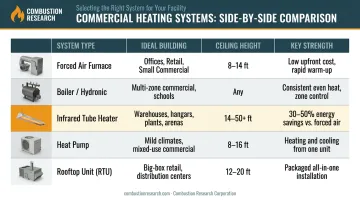
Commercial heating systems are engineered to handle large-scale spaces under continuous or heavy-use conditions — unlike residential units built for smaller, less demanding environments.
No single system is universally best. The right choice depends on building size, ceiling height, usage pattern, fuel access, and operational priorities. Here's what each system type delivers and where it falls short.
Forced Air Furnace Systems
Forced air systems heat air via a furnace and distribute it through ductwork and blowers. They're fast to heat a space, compatible with natural gas, propane, or heating oil, and widely used in offices, retail, and restaurants.
Limitations in industrial settings:
- Ductwork distributes heat unevenly in high-ceiling spaces — warm air stratifies near the roof
- An 8°C floor-to-ceiling temperature differential creates a heating energy penalty of up to 38% compared to a non-stratified environment
- Blower fans circulate dust, allergens, and airborne pathogens — a serious concern in manufacturing, food-adjacent, or automotive environments
Boilers and Hydronic Systems
Boiler systems heat water or generate steam, then circulate it through radiators, baseboard heaters, or radiant floor systems. They deliver even, consistent heat well-suited to large or older commercial buildings — schools, hospitals, and multi-zone facilities.
Cast iron boilers have median service lives of 30–35 years, making them a long-term asset when properly maintained. Key cost considerations:
- Higher upfront installation costs due to extensive pipework
- Regular maintenance required to prevent scale buildup and corrosion
- Scale exclusions appear in most commercial boiler warranties — water quality management is an ongoing budget line
Radiant Infrared Tube Heaters
Low-intensity infrared tube heaters radiate heat directly to people, floors, and equipment below — rather than heating the air. In high-ceiling spaces, that means usable heat stays at floor level instead of pooling near the roof where it does no work.
A utility-backed case study analysis found 30% energy savings in an aircraft maintenance hangar and more than 60% gas reduction in a furniture plant warehouse when replacing forced-air systems with infrared heating, with less than a five-year simple payback in an auto service garage application.
Why ceiling-mounted configurations matter operationally:
- Preserve floor space — no equipment footprint competing with forklifts or material handling
- Eliminate ground-level contact hazards from vehicle traffic
- Produce no air movement — dust, pathogens, and chemical fumes stay undisturbed
This makes infrared tube heaters the practical first choice for warehouses, aircraft hangars, auto dealership service bays, agricultural buildings, and any high-ceiling industrial space where heated air stratification would otherwise waste fuel.
Heat Pumps
For facilities where radiant heat isn't the fit — mixed-use office buildings, climate-controlled labs, or operations prioritizing dual heating and cooling from a single system — heat pumps are worth evaluating. They transfer heat rather than generate it, running on electricity and delivering high efficiency in moderate climates.
They're attractive for facilities reducing carbon footprint or seeking a dual-function system.
The primary limitation is cold-climate performance. DOE research shows standard heat pump performance can degrade by up to 50% in COP and 60% in capacity at -13°F. For facilities in Upper Midwest climates or anywhere with sustained sub-zero temperatures, heat pumps typically require a supplemental heat source to remain reliable.
Rooftop Units (RTUs)
RTUs are self-contained packaged systems installed on a building's roof, delivering centralized heating and cooling through ductwork. Popular in mid-sized retail, office buildings, and low-rise commercial facilities for their space-saving footprint and simplified maintenance access.
ASHRAE data puts median RTU service life at 15 years. Exposure to outdoor conditions — moisture, temperature cycling, debris — requires regular inspection of economizers, fans, and filters. Like forced-air systems, RTUs are a poor fit as the sole heating strategy in high-bay industrial environments where stratification wastes a significant portion of the fuel being burned.
Key Factors When Buying Commercial Heating Equipment
Matching BTU capacity to square footage is only the starting point. Each factor below directly affects energy spend, operational continuity, compliance, worker comfort, and total cost of ownership — get any one wrong and you'll pay for it over the system's 10–20 year life.
Building Type, Size, and Ceiling Height
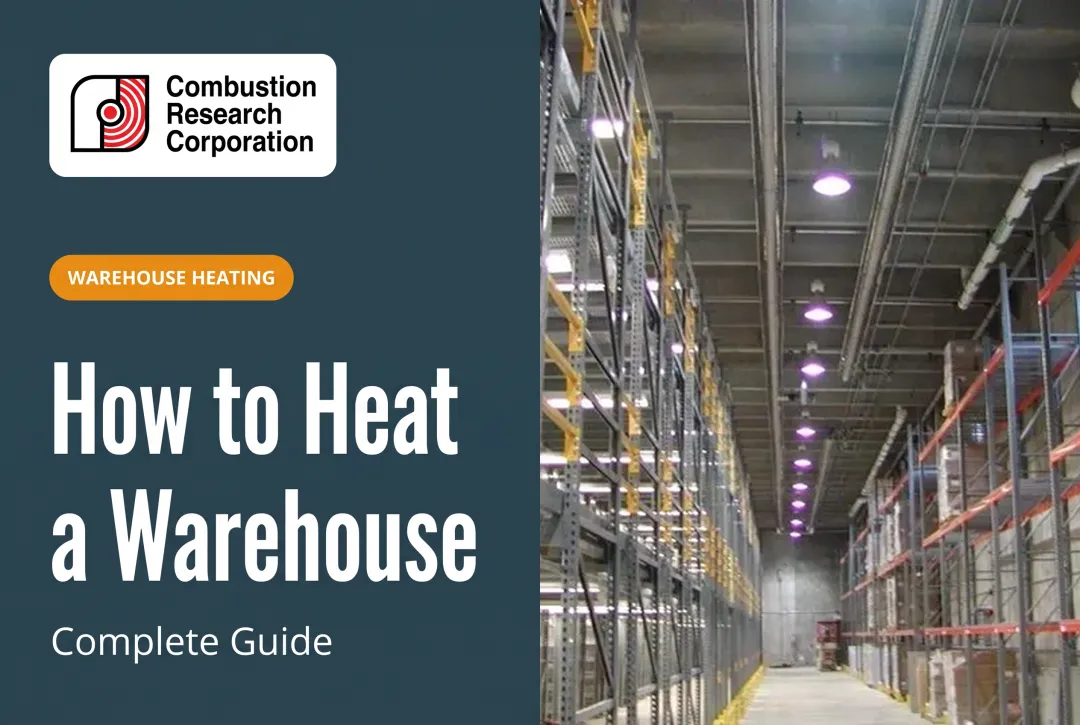
Ceiling height is one of the most consequential and most overlooked variables in commercial heating selection. Forced-air and convective systems lose efficiency dramatically as ceiling height increases — warm air rises and accumulates near the roof while workers at floor level stay cold.
Radiant systems deliver heat at floor level regardless of ceiling height, making them the practical choice for high-bay environments. For buildings with ceilings exceeding 14 to 15 feet, stratification losses from forced-air systems compound quickly.
Multi-zone buildings — office plus warehouse combinations, for example — may require hybrid or zoned systems.
Before specifying any system for a multi-zone or high-bay facility, confirm:
- Ceiling height and stratification risk at each zone
- Floor-level occupancy patterns (where workers actually spend time)
- Whether a single system type can serve all zones, or whether hybrid zoning is needed
Get a load calculation from a qualified mechanical engineer before finalizing any system selection.
Energy Efficiency and Fuel Type
Energy efficiency ratings directly impact monthly operating costs. Over a 10–20 year system life, fuel costs typically far exceed the initial purchase price — making efficiency the most financially consequential decision you'll make in this process.
Key ratings to understand:
- AFUE (Annual Fuel Utilization Efficiency): Used for furnaces. Federal minimum for commercial gas-fired warm-air furnaces is 81%.
- COP (Coefficient of Performance): Used for heat pumps. A COP of 3.0 means three units of heat output per unit of electricity consumed — the higher the COP, the lower the operating cost per BTU delivered.
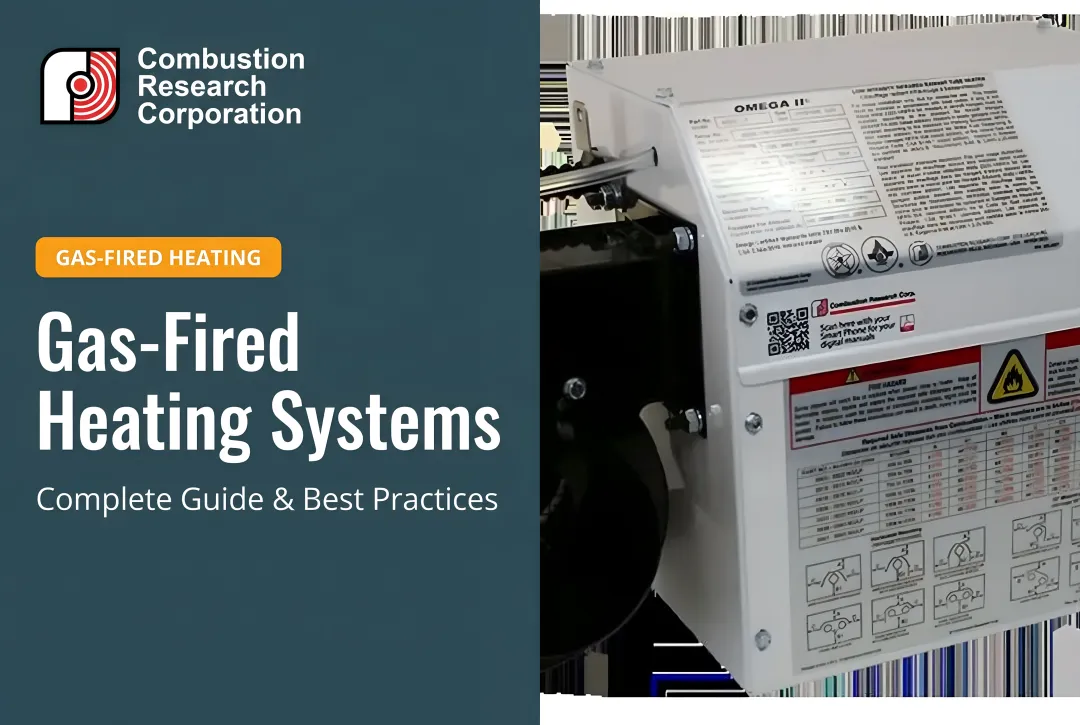
Factor in local fuel availability and pricing — natural gas, propane, and electricity vary significantly by region. Systems with modulating gas and air controls, like CRC's True Dual Modulating Heater on the Omega II DI series, adjust both fuel input and combustion air simultaneously for precise output at each stage — delivering efficiency gains over single-stage systems that can only cycle on or off at full capacity.
Installation Requirements and Building Compatibility
Installation complexity varies widely:
| System Type | Installation Complexity | Key Considerations |
|---|---|---|
| Boilers / Hydronic | High | Extensive pipework, water treatment |
| RTUs | Moderate | Structural roof capacity, ductwork |
| Forced Air Furnaces | Moderate | Ductwork routing, blower power |
| Infrared Tube Heaters | Lower | Ceiling mounting, gas line, single roof penetration (vacuum systems) |
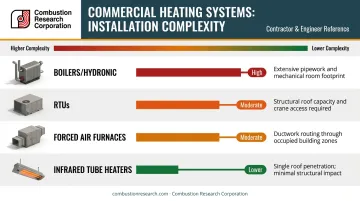
Ceiling-mounted infrared systems can often be retrofitted into existing buildings without major structural disruption. Vacuum-vented systems like CRC's Reflect-O-Ray can share a common exhaust manifold and single roof penetration, which cuts installation cost and preserves roofing integrity — a meaningful advantage in retrofit projects.
Confirm before purchasing: structural capacity for ceiling or rooftop loads, existing gas line infrastructure and pressure, and electrical panel capacity.
Indoor Air Quality and Worker Safety
Heating systems that circulate air — forced air, RTUs — distribute whatever is in that air throughout the facility. In automotive repair shops, agricultural buildings, animal confinement facilities, or any environment where chemical fumes or biological particulates are present, this creates real health and compliance exposure.
Radiant heating systems produce no air movement and require no ductwork, so they don't recirculate airborne contaminants. The ceiling-mounted configuration also eliminates the safety hazard of ground-level heating equipment in the path of forklift traffic — a real risk in active warehouse and manufacturing environments.
Warranty Terms and Long-Term Durability
Commercial heating equipment runs under demanding conditions: long hours, temperature extremes, industrial vibration. Warranty coverage on combustion components and heat exchanger tubes directly affects your risk exposure and maintenance budget.
Benchmarks to compare:
- Standard commercial RTU: 1 year parts from startup, 9–14 years on heat exchanger (varies by material)
- Commercial boilers: typically 10 years on heat exchanger, 1 year on parts — with scale exclusions
- Infrared tube heaters: varies widely; some manufacturers offer 3 years on components, 5–10 years on heat exchanger tubes
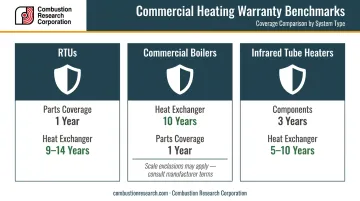
A 10-year warranty on combustion and heat exchanger components represents substantially lower risk than a 1–2 year standard parts warranty, particularly for high-utilization applications running two or three shifts.
Climate and Application-Specific Fit
Geographic climate and operational use case should drive system selection. Commercial buildings in cold and very cold climates consume an average of 36,100 Btu/sq ft for space heating — more than five times the intensity of hot climates. Facilities in those zones need systems proven to perform reliably in sub-zero conditions without efficiency degradation.
Specialty applications require additional scrutiny:
- Natatoriums: Chloramine exposure destroys standard aluminized components — stainless steel construction is required
- Greenhouses: High humidity and pesticide exposure shorten standard heat exchanger life
- Car wash bays: Corrosive environment demands stainless or specialized materials
- Ice arenas: Integrated heating/refrigeration design is essential to avoid fighting the ice plant's cooling load
Ask the manufacturer for documented installations in your specific application type — not just references, but evidence the system has performed in those conditions long-term.
How Combustion Research Corporation Can Help
Combustion Research Corporation (CRC) is a Michigan-based manufacturer with over 50 years of experience building low-intensity infrared tube heating systems for commercial and industrial applications — warehouses, aircraft hangars, automotive shops, natatoriums, ice arenas, and military maintenance facilities.
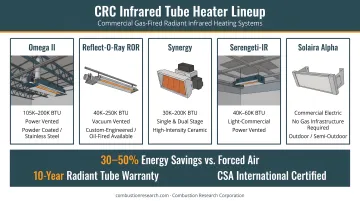
CRC's systems are CSA International Design Certified to ANSI/CGA Standards (ANSI Z83.20 / CSA 2.34) and carry a 10-year limited warranty on radiant tubes for internally created corrosion and a 3-year burner control warranty. Across documented commercial deployments, CRC systems deliver 30–50% energy savings versus conventional forced-air heating.
Key product differentiators:
- Reflect-O-Ray (Vacuum-Vented): Custom-engineered, 40K–250K BTU; 6.0 EDS configuration for high-bay facilities with 20+ foot ceilings; stainless steel variants for natatoriums and corrosive environments
- Omega II (Power-Vented): Pre-engineered unitary systems, 40K–200K BTU; True Dual Modulating option for precise efficiency; suited for retrofits with complex exhaust routing
- Synergy (High-Intensity Ceramic): No direct venting required; heat in under one minute; ideal for spot/zone heating at workstations and loading docks
- Serengeti-IR: Compact 40K–60K BTU power-vented radiant tube for single-bay service and light agricultural buildings
- Solaira Alpha (Electric Infrared): 1.5kW–18kW for facilities without gas infrastructure — covered terraces, dealership canopies, loading docks
Beyond the product lineup, two operational advantages stand out for busy facilities:
- No combustion air filters — eliminates a recurring maintenance category that causes nuisance shutdowns in dusty industrial environments
- Factory pre-wired, pre-piped, and 100% tested before shipment; MasterSpec listed for straightforward specification inclusion
CRC's engineering team supports both new construction and retrofit projects throughout the specification process — including heat loss calculations, layout review, and submittal documentation for code compliance.
Conclusion
Buying commercial heating equipment is a long-term capital decision. The right system must be matched to your building's specific dimensions, use case, climate, and operational demands — not selected on lowest upfront cost or brand familiarity.
Evaluate every system on total cost of ownership. The factors that matter most:
- Energy efficiency ratings and documented real-world savings
- Maintenance requirements and parts availability
- Warranty coverage on both the heat exchanger and burner controls
- Realistic service life given your facility's environment
- Code compliance for your specific application (CNG, natatorium, military, etc.)
Work with manufacturers or engineers who provide application-specific guidance during specification — someone who understands your facility type, not just the equipment specs. Combustion Research Corporation has supported commercial and industrial specification projects for over 50 years, offering engineering assistance for both new construction and retrofit applications across warehouses, hangars, automotive service bays, and other demanding facilities.
Frequently Asked Questions
Which HVAC system is best for a commercial building?
The best system depends on building size, ceiling height, use case, and climate. For large open industrial spaces, radiant infrared heating is typically more efficient than forced air. For moderate-climate offices, heat pumps or RTUs are common choices.
How much do commercial heat pumps cost?
Commercial heat pump installed costs vary based on tonnage, configuration, electrical service requirements, and climate specifications. Upfront costs typically exceed traditional furnaces, but lower operating costs in mild climates can offset the difference over a 5–10 year horizon.
What is the most energy-efficient heating system for a commercial warehouse?
Low-intensity infrared tube heaters are widely regarded as one of the most efficient options for high-ceiling warehouses. They heat occupants and floor-level surfaces directly rather than losing energy to stratified air near the ceiling, with documented savings of 30–50% versus conventional forced-air systems.
What is the difference between radiant heating and forced air heating in commercial spaces?
Forced air heats the air and distributes it via ducts — losing efficiency in high-ceiling spaces and circulating dust and pathogens. Radiant heating transfers heat directly to surfaces and occupants without air movement, making it quieter, cleaner, and more efficient in large open commercial and industrial environments.
How long do commercial heating systems last?
Lifespans vary by system type: RTUs average around 15 years, gas-fired furnaces approximately 18 years, and cast iron boilers 30–35 years per ASHRAE data. Quality infrared tube heaters carry heat exchanger tube warranties of up to 10 years — Combustion Research Corporation's Omega II and Reflect-O-Ray lines, for example, include a 10-year limited tube warranty — with actual service life commonly exceeding warranty terms under a regular maintenance schedule.
Are infrared tube heaters safe for industrial environments?
Low-intensity infrared tube heaters are specifically designed for industrial use. Ceiling-mounted installation keeps them out of forklift and machinery traffic paths, they produce no open flame at floor level, and models certified to ANSI/CSA standards meet rigorous safety and combustion requirements for commercial and industrial facilities.