The comparison is more complex than checking a price sheet. Propane and natural gas are priced in different units, deliver different amounts of energy per unit, and come with completely different infrastructure requirements. A gallon of propane costs more than a therm of natural gas in most markets — but that single observation tells you almost nothing about actual heating costs.
This guide walks through a proper cost comparison: normalized pricing, infrastructure costs, equipment efficiency, and the situational factors that determine which fuel actually makes sense for your facility.
Key Takeaways
- Propane holds roughly 2.5x more energy per cubic foot than natural gas, making raw price comparisons misleading without normalizing to a common unit.
- The correct comparison unit is cost per MMBtu, not $/gallon vs. $/therm.
- Pipeline access is often the deciding factor because natural gas isn't available at many rural commercial facilities.
- Infrastructure costs (connection fees, tank rental, delivery minimums) significantly affect total cost of ownership for both fuels.
- Heater efficiency matters more than fuel type alone — infrared tube heaters have cut gas consumption by 23–60% in commercial facilities.
Propane vs. Natural Gas: Quick Comparison
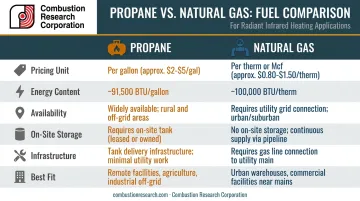
| Factor | Propane | Natural Gas |
|---|---|---|
| Pricing unit | $/gallon | $/therm or $/Mcf |
| Energy content | ~91,452 BTU/gallon | ~100,000 BTU/therm |
| Availability | Anywhere via truck delivery | Pipeline-connected locations only |
| On-site storage | Required (tank owned or rented) | Not required |
| Infrastructure | Tank installation; scheduled refills | Pipeline access + meter installation |
| Best fit | Rural facilities, off-grid locations, operations needing fuel independence | Urban/suburban buildings with existing pipeline access and high heating volume |
According to EIA data, commercial natural gas averaged $12.34/Mcf in March 2026 — approximately $1.19/therm using EIA's 1,036 BTU/cf heat content estimate. The most recent EIA commercial propane series shows prices around $1.977/gallon, though that data reflects 2022 figures; current prices vary by region and season.
Those price differences play out across a heavily skewed market. The 2018 Commercial Buildings Energy Consumption Survey found natural gas was the primary space-heating source for 40% of commercial buildings, while propane served just 4% — a gap driven by pipeline availability as much as cost.
Propane as a Commercial Heating Fuel
Propane is a liquefied petroleum gas (LPG) stored on-site under pressure in tanks ranging from 125 gallons to over 30,000 gallons for large commercial accounts. It's derived as a byproduct of natural gas processing and crude oil refining, which means its price is influenced by both crude oil markets and natural gas production levels.
For commercial operations far from utility infrastructure, propane's defining advantage is independence. No pipeline, no utility relationship, no risk of supply disruption from grid failures. The fuel arrives by truck and sits on-site until it's needed.
Where Propane Dominates
Propane is the practical default for facilities that pipeline networks don't reach:
- Rural warehouses and pole barns
- Aircraft hangars
- Agricultural facilities — brooders, livestock barns, greenhouses
- Car wash bays and service garages in semi-rural locations
- Any facility where a natural gas connection would require an expensive line extension
According to PERC's 2021 Economic Impact Report, commercial accounts consume roughly 2.37 billion gallons annually, representing 24.9% of total retail propane consumption. Agricultural use adds another 942 million gallons at 9.9% of the domestic retail market.
One notable regional pattern: 22% of commercial buildings in New England use propane for space heating, according to CBECS 2018 — a region where natural gas pipeline density drops significantly outside urban centers.
Propane and Infrared Tube Heaters
In facilities like the ones above, infrared tube heaters are a natural fit — and propane's high energy density supports them well in large open spaces. Combustion Research Corporation's Omega II and Reflect-O-Ray systems are available in both natural gas and propane configurations, covering BTU ranges from 30,000 to 220,000 BTU/hr, so fuel selection comes down to what's available at the site.
Propane prices fluctuate seasonally, typically peaking in winter heating months when demand is highest. For high-volume commercial users, that variability matters — budgeting for propane requires more cushion than a fixed-rate natural gas contract typically demands.
Natural Gas as a Commercial Heating Fuel
Natural gas is delivered continuously through utility pipelines, sold in therms or thousand cubic feet (Mcf), and is typically the lower per-unit cost option for facilities with existing pipeline access. For urban and suburban commercial buildings, it's the standard.
Core Advantages
- No on-site storage required
- Continuous supply — no scheduled deliveries to manage
- Generally stable per-unit pricing in competitive utility markets
- No tank rental, purchase, or installation costs
Where Natural Gas Is Dominant
Natural gas is the standard choice for:
- Urban manufacturing plants and distribution centers
- Auto dealerships and service facilities in metro areas
- Large office buildings and retail spaces
- Industrial facilities with well-developed pipeline infrastructure in their area
If there's no pipeline at or near your property, natural gas isn't an option without significant infrastructure investment. Many facilities Combustion Research Corporation serves — rural warehouses, hangars, agricultural buildings — fall outside serviceable pipeline zones entirely.
Pipeline access isn't the only cost variable to account for. Large commercial gas accounts often face demand charges on top of consumption charges. Under some utility rate structures (such as Peoples Gas Rate 4 for customers averaging over 41,000 therms/month), billing demand is set by peak winter usage. A few cold weeks can lock in elevated rates for the rest of the year.
The True Cost of Commercial Heating: Propane vs. Natural Gas
The Apples-to-Apples Problem
Comparing propane at $/gallon to natural gas at $/therm without normalizing for energy content produces a misleading result. The correct basis for comparison is cost per MMBtu (one million BTUs of delivered energy).
Here's the math:
- Propane: ~91,452 BTU/gallon → multiply $/gallon by 10.93 to get $/MMBtu
- Natural Gas: 100,000 BTU/therm → multiply $/therm by 10 to get $/MMBtu
Using the most recent available benchmarks as an illustration:
| Propane | Natural Gas | |
|---|---|---|
| Reference price | ~$1.98/gallon | ~$1.19/therm |
| Conversion factor | × 10.93 | × 10 |
| Cost per MMBtu | ~$21.64 | ~$11.90 |
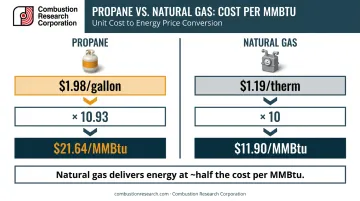
At these reference prices, natural gas delivers energy at roughly half the cost per MMBtu. That gap is real, but the per-unit price is only part of what drives your actual heating bill.
The Efficiency Multiplier
A heating system's efficiency rating changes the cost-per-delivered-BTU calculation significantly. A system operating at 70% efficiency wastes 30 cents of every fuel dollar. A 90%+ efficient system converts 90 cents of every fuel dollar into usable heat.
In high-ceiling commercial spaces, that efficiency gap becomes even more pronounced. Forced-air unit heaters supply hot air at 120°F–180°F, which drives stratification — warm air accumulates near the roof while the occupied zone stays cold. Infrared tube heaters sidestep this problem by radiating heat directly to floors, equipment, and occupants instead of heating the air column above them. ACEEE case studies documented real results from infrared heating retrofits:
- Auto service garage: 23% gas-use reduction, saving 7,800 therms/year
- Industrial maintenance hangar: 30% savings, over 18,800 therms/year
- Furniture plant warehouse: fuel consumption dropped from over 10,000 therms/year to under 4,000 therms/year
A 30% reduction in fuel consumption effectively cuts your cost per delivered BTU by 30% — which can narrow or close the cost gap between propane and natural gas.
Infrastructure and Hidden Costs
Neither fuel's true cost is captured in the per-unit price alone. Local infrastructure factors can shift the math considerably:
Natural Gas:
- Pipeline connection fees vary widely based on distance from the main line and local utility policy; the American Gas Association identifies distance, expected future revenues, and state policy as the key cost drivers — no universal dollar range applies
- Commercial demand charges can add material cost for high-volume accounts based on peak winter usage
Propane:
- Tank installation (rental or purchase for commercial ASME tanks ranging from 500 to 2,000+ gallons)
- Minimum delivery fees and will-call charges from propane distributors
- Seasonal price volatility — EIA commercial data shows meaningful price swings between summer and winter months
A facility 2 miles from the nearest natural gas main faces a very different infrastructure cost than one already on an existing service street. Always get local quotes before treating either fuel as automatically cheaper.
Which Fuel Is Right for Your Commercial Facility?
Decision Factors
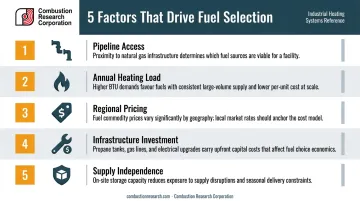
Five variables drive the fuel selection decision:
- Pipeline access — the single biggest constraint; if there's no gas main nearby, propane is often the only practical option
- Annual heating load — higher volume favors natural gas when pipeline access exists
- Regional pricing — fuel costs vary significantly by geography and season
- Infrastructure investment — connection fees, tank costs, and equipment conversion if switching
- Supply independence — propane's on-site storage provides continuity that pipelines cannot during utility outages
Situational Recommendations
Choose natural gas if:
- Your facility has existing pipeline access
- You operate in a competitive utility market with stable commercial rates
- Heating volume is high enough to amortize any connection costs quickly
Choose propane if:
- Your facility is in a rural or semi-rural area without pipeline access
- You need on-site fuel storage for supply continuity
- You're heating large open spaces (warehouses, hangars, barns) where delivery logistics are manageable
- A pipeline connection would require a costly line extension
The Efficiency Lever That Changes Both Equations
Regardless of which fuel you're on, the type of heating system matters as much as the fuel itself. In high-ceiling commercial and industrial spaces — warehouses, hangars, service bays — forced-air systems heat the wrong zone. Warm air rises and collects near the roof, while workers and equipment at floor level stay cold.
Infrared tube heaters work differently. They direct radiant energy downward, heating objects and occupants directly rather than warming air first. The result: the occupied zone reaches comfort at lower thermostat settings, and the building uses less fuel to maintain it.
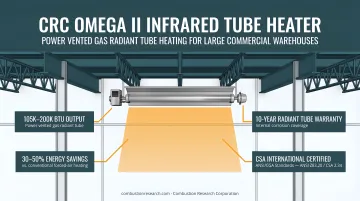
Combustion Research Corporation's Omega II and Reflect-O-Ray infrared tube heaters are designed for exactly these environments — available in both propane and natural gas configurations across a wide BTU range. ACEEE case studies document energy savings of 23% to over 60% in high-ceiling retrofits. That kind of efficiency gain can offset a higher per-unit fuel cost on propane.
Real-World Cost Scenario
Consider a rural warehouse operator heating a 15,000 sq ft facility with 24-foot ceilings. Natural gas is not available at the site — the nearest main runs 1.5 miles away. A utility quote for line extension comes back at a figure that would take years to recover through lower per-unit fuel costs.
The operator installs propane-fired infrared tube heaters. Using normalized pricing, propane at the reference rates above costs roughly $21/MMBtu versus natural gas at ~$12/MMBtu — a meaningful difference on paper. But the existing forced-air units were operating at roughly 70% efficiency with significant heat stratification losses.
The infrared system delivers heat directly to the floor zone, reduces stratification losses, and operates at higher effective efficiency. In a scenario like the ACEEE hangar case study, a 30% reduction in fuel consumption brings the effective cost per delivered BTU down substantially — enough that the propane infrared system competes on cost with what natural gas would have been, without the infrastructure investment.
The takeaway: when comparing fuels, compare delivered BTUs per dollar after accounting for system efficiency — not just price per unit.
Ready to run the numbers for your facility? Combustion Research Corporation's engineering team can help you assess the full cost picture — fuel type, system efficiency, and heat loss calculations — to find the most cost-effective heating solution. Contact the CRC team to start the conversation.
Conclusion
Natural gas offers a lower cost per MMBtu where pipeline access exists — that's a real advantage for connected facilities with high heating volumes. Propane costs more per MMBtu at current reference prices, but delivers supply independence, on-site storage, and availability in locations where natural gas simply doesn't reach.
Neither fuel wins universally — the right answer comes down to pipeline access, infrastructure costs, regional pricing, annual heating load, and the efficiency of the system burning the fuel.
System efficiency is as consequential as fuel selection. A high-efficiency infrared heating system in a high-ceiling facility reduces fuel consumption enough to shift the cost comparison meaningfully — sometimes enough to make propane competitive with natural gas, and always enough to reduce total annual heating costs regardless of fuel type. Combustion Research Corporation's gas-fired infrared tube heaters, for instance, cut heating costs 30–50% compared to conventional forced-air systems, which means the fuel cost gap between propane and natural gas often narrows significantly once the right equipment is in place.
Frequently Asked Questions
Which is cheaper for commercial heating: natural gas or propane?
Natural gas is typically cheaper per unit where pipeline access exists — recent EIA data puts commercial natural gas around $11.90/MMBtu versus roughly $21.64/MMBtu for propane. A complete comparison must also factor in equipment efficiency and infrastructure costs, which can shift the outcome significantly.
Does propane have a higher heating value than natural gas?
Yes. Propane vapor contains approximately 2,488 BTU per cubic foot versus about 1,036 BTU per cubic foot for natural gas — meaning propane delivers roughly 2.4x more energy per unit of volume. This is why raw $/gallon vs. $/therm comparisons are misleading without normalizing to cost per MMBtu.
What is the 80/20 rule for propane?
The 80/20 rule means propane tanks are filled to a maximum of 80% capacity, not 100%. The remaining 20% of tank volume is reserved for liquid propane to expand as temperatures rise — a standard safety practice that applies to all propane storage, including commercial tanks.
What hidden costs should commercial facilities consider when choosing between propane and natural gas?
Natural gas adds pipeline connection fees and demand charges for high-volume accounts. Propane adds tank rental or purchase costs, minimum delivery fees, and seasonal price volatility. Either way, factor in equipment conversion costs if you're switching fuels.
Is propane or natural gas better for rural commercial facilities?
Propane is the practical choice for rural commercial facilities. Natural gas pipelines rarely extend to remote or semi-rural locations, and line extension costs can be prohibitive. Propane can be delivered by truck and stored on-site, providing reliable supply without any dependence on utility infrastructure.
How does heating system efficiency affect the propane vs. natural gas cost comparison?
A more efficient heating system extracts more usable heat from every unit of fuel burned. In high-ceiling commercial spaces, documented infrared tube heater retrofits have reduced gas consumption by 23% to over 60% — enough to significantly close the cost gap between propane and natural gas.