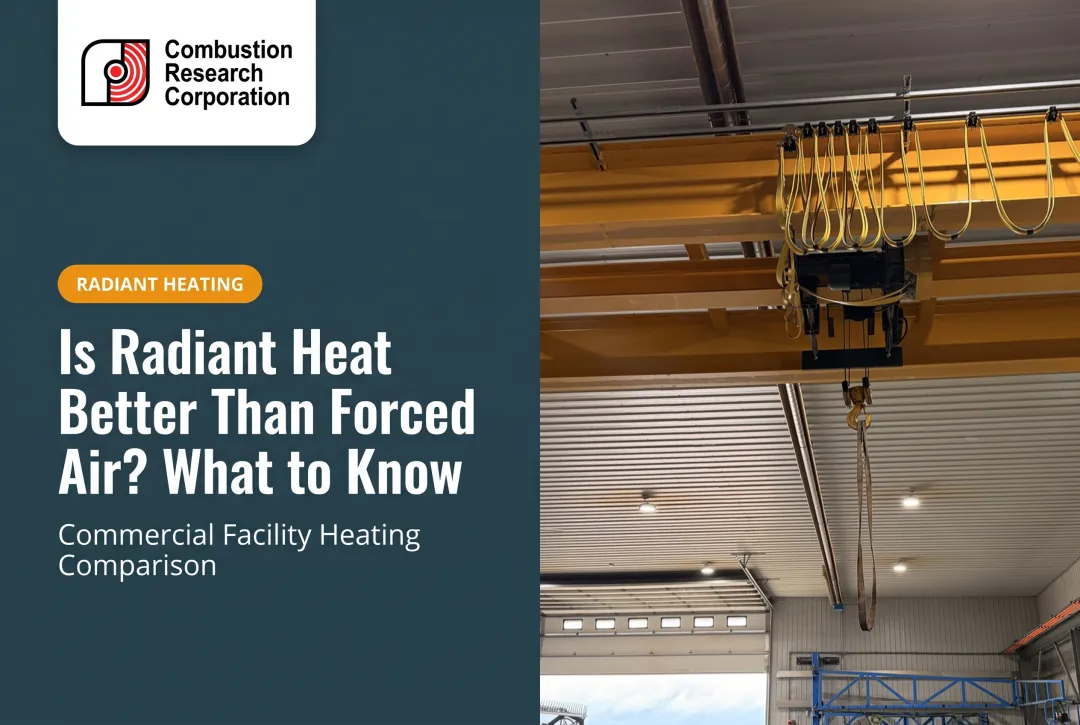
The radiant heat vs. forced air debate has a clear answer for most industrial operators, but the reasoning matters. This article breaks down the comparison across three dimensions: comfort and consistency, energy efficiency, and air quality — so facility managers and mechanical engineers can make an informed decision rather than defaulting to whatever was already there.
Key Takeaways
- Radiant heat warms objects and people directly via infrared waves — heat isn't lost when large bay doors open
- Forced air stratifies in high-ceiling spaces, leaving the occupied zone cold while warm air pools at the ceiling
- ACEEE case studies document 30%+ energy savings in aircraft hangars and 60%+ therm reductions in warehouses
- Radiant systems produce no airflow, so dust, fumes, and particulates stay settled
- Infrared tube heaters have no filters, no ductwork, and minimal moving parts — lowering both maintenance demands and failure points
Radiant Heat vs. Forced Air: Quick Comparison
The table below summarizes how radiant and forced-air heating compare across the factors that matter most in commercial and industrial facilities.
| Factor | Radiant Heat | Forced Air |
|---|---|---|
| Installation Cost | Higher upfront; no ductwork needed | Lower in spaces with existing ducts |
| Energy Efficiency | Heats objects directly; minimal stratification loss | Loses heat via duct leakage, stratification, door cycles |
| Air Quality | No airflow; dust and fumes stay settled | Actively circulates airborne particles |
| Heat Consistency | Even, steady warmth at floor level | Hot-cold cycles; heat rises in tall spaces |
| Maintenance | No filters, no ducts, fewer moving parts | Filter changes, duct cleaning, blower service required |
What Is Radiant Heat?
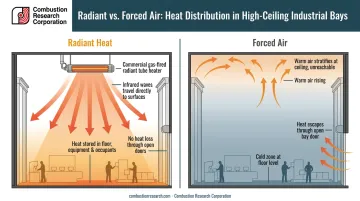
Radiant heat transfers thermal energy through infrared electromagnetic waves — the same mechanism as warmth felt from the sun. The critical distinction: it heats objects and people directly, not the air between them.
In industrial environments, this mechanism matters enormously. When a forklift bay door swings open, a forced air system loses its heated air volume immediately. A radiant system holds its heat. The energy is already stored in the floor, equipment surfaces, and the workers themselves.
Types of Radiant Systems for Commercial and Industrial Use
Two radiant subtypes dominate commercial applications:
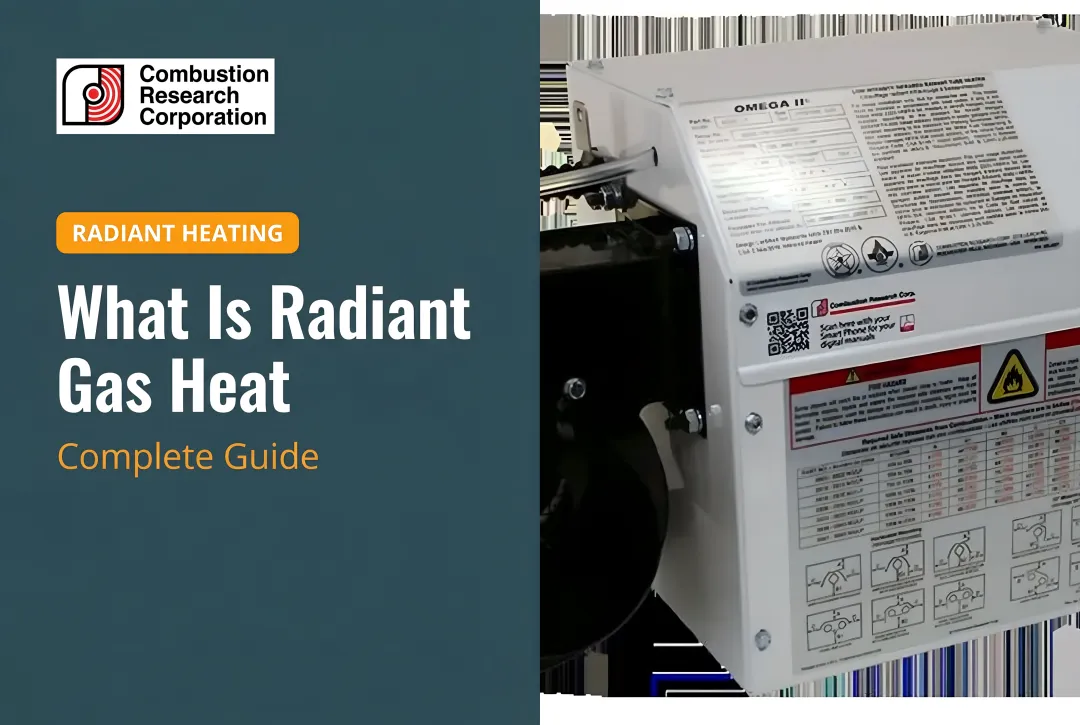
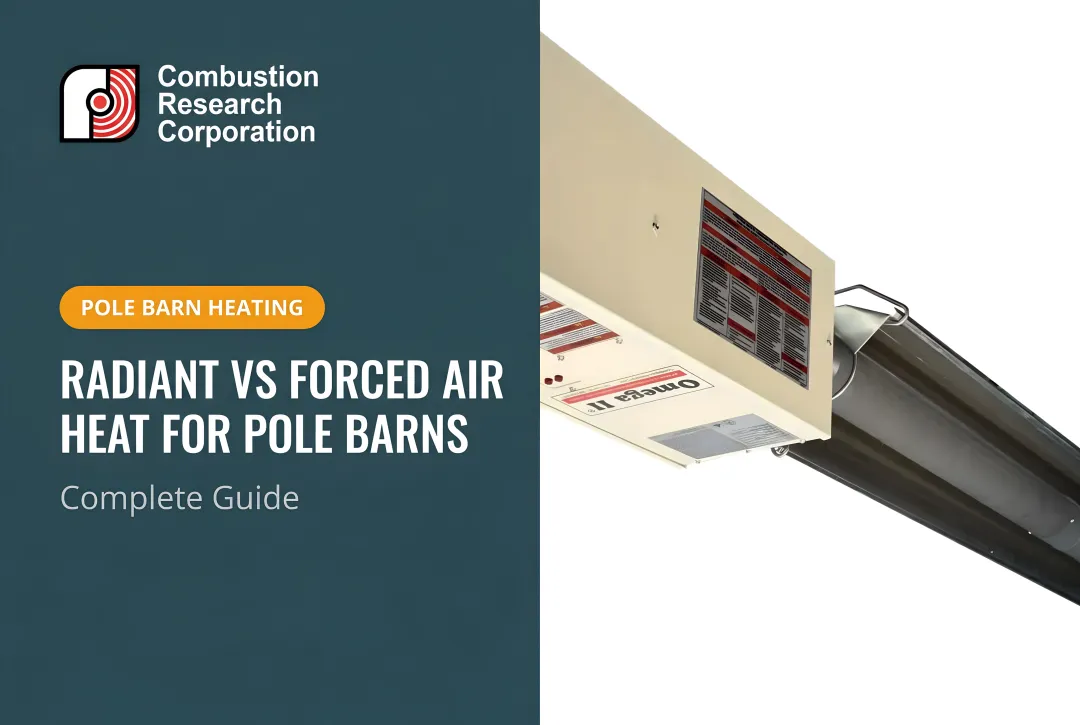
- Low-intensity infrared tube heaters — gas-fired, ceiling-mounted systems that deliver even infrared heat across large floor areas. Ideal for warehouses, hangars, and service bays. CRC's Omega II (power-vented) and Reflect-O-Ray (vacuum-vented) lines include the Reflect-O-Ray 6.0 EDS, custom-engineered for high-bay facilities up to one million square feet.
- High-intensity ceramic infrared heaters — purpose-built for spot and zone heating at work cells, loading dock entries, or picking stations. CRC's Synergy system reaches full operating temperature in under one minute.
Ceiling-mounted installation preserves every square foot of floor space for forklift paths and material handling. In facilities where floor layout is operationally critical, overhead placement also eliminates the risk of accidental contact between heating equipment and material-handling machinery.
From a maintenance standpoint, CRC's low-intensity tube heaters require no combustion air filters — a design feature that removes an entire category of recurring maintenance labor in dusty industrial environments.
Where Radiant Heat Works Best
Radiant infrared is the preferred solution wherever:
- Large doors open frequently — aircraft hangars, vehicle wash bays, shipping and receiving docks, auto dealership service bays
- Air quality is non-negotiable — auto body and bump shops where paint fume disturbance is a hazard, agricultural facilities where pathogen spread via airflow poses animal health risks, and greenhouses where humidity management depends on minimizing air turbulence
- Heat needs to reach floor-level occupants in high-ceiling spaces — infrared energy travels down to where people work, not up to unoccupied ceiling space
What Is Forced Air Heating?
Forced air heats air using a furnace, heat pump, or electric coils, then distributes it through ducts, vents, or fans. It's the most common heating method in U.S. commercial buildings — largely because initial installation costs are lower in spaces already equipped with ductwork.In high-ceiling industrial facilities, the physics work against it.
Why Forced Air Struggles in Large Facilities
Three mechanisms reduce its effectiveness in high-ceiling, high-infiltration spaces:
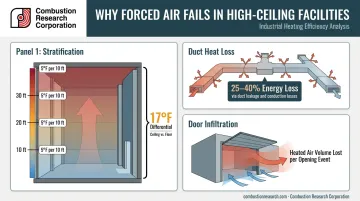
- Stratification: Warm air rises. In spaces with 20–30+ foot ceilings, forced air systems create a temperature gradient of roughly 5°F for every 10 feet of height, according to ACEEE research on industrial buildings. In a 35-foot hangar, air near the ceiling can run 17°F warmer than the setpoint at floor level — while workers at ground level stay cold.
- Duct heat loss: Lawrence Berkeley National Laboratory research indicates that typical ductwork systems lose 25–40% of heating energy through leakage and conduction before air reaches its destination.
- Door infiltration: Every time a bay door opens, the heated air volume flushes out. Forced air systems must reheat the entire air mass from scratch on each cycle.
When Forced Air Still Makes Sense
Forced air still has its place. It remains practical when:
- The space is small, well-sealed, and doors stay closed
- Existing ductwork makes a retrofit cost-prohibitive
- The facility needs combined heating and cooling from one HVAC system
Most industrial and commercial facilities — high ceilings, frequent door cycles, large open floor plans — don't fit that profile. That's where forced air's 25–40% duct losses and stratification penalties become operational liabilities rather than acceptable trade-offs.
Radiant vs. Forced Air: Which Is Better for Industrial and Commercial Spaces?
The decision depends on six factors: ceiling height, door-opening frequency, presence of dust or fumes, need for zoned heating, energy cost sensitivity, and whether the space is used intermittently or continuously.
Comfort
Radiant heat delivers consistent floor-level warmth without temperature cycling. The infrared energy absorbed by concrete floors, equipment, and structural elements re-radiates back into the space — so warmth persists even after the burner cycles off.
Forced air in high-ceiling environments does the opposite: heat accumulates above the occupied zone, and workers at floor level experience cold-hot cycles as the system turns on and off. The 5°F-per-10-ft stratification gradient means that in a 30-foot warehouse, ceiling temperatures can run 15°F above floor temperatures — a direct waste of purchased fuel.
Air Quality
Radiant tube heaters produce no airflow as part of the heat delivery mechanism — dust, chemical fumes, paint particles, animal dander, and airborne pathogens remain settled between cleaning cycles.
Forced air works by actively circulating the air volume, resuspending settled particulates on each heating cycle. In auto body shops conducting paint work, agricultural facilities managing disease transmission risk, or woodworking operations with fine dust, that distinction isn't just about comfort — it's a workplace safety and product quality concern. Radiant heating avoids adding fan-driven air movement to the problem, though it's not a substitute for proper ventilation, source capture, or filtration.
Energy Efficiency
The air quality and comfort advantages above translate directly into measurable cost savings. The ACEEE case studies provide the most useful third-party data:
- Aircraft hangar retrofit: switching from forced air to radiant infrared saved 30%, or 18,800 therms per year and approximately $20,000 annually
- Furniture warehouse: gas consumption dropped from 10,000 therms per year to under 4,000 therms — a reduction of more than 60%
- Auto dealership service garage: infrared heating saved 7,800 therms per year against a 42,000-therm forced-air baseline
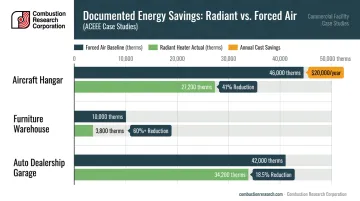
These savings don't come from infrared heaters having higher combustion efficiency — they come from delivering energy to where it's actually needed, rather than heating air that stratifies at the ceiling or escapes through doors and ducts.
Combustion Research Corporation documents 30–50% operational cost savings compared to conventional forced-air systems across its commercial product lines, consistent with the ACEEE findings for high-bay, high-infiltration facilities.
Decision Framework
| Choose Radiant Infrared When... | Choose Forced Air When... |
|---|---|
| Ceilings exceed 15–20 feet | Space is small and well-sealed |
| Large doors open frequently | Existing ductwork makes retrofit prohibitive |
| Dust, fumes, or pathogens are present | Combined heating and cooling from one system is required |
| Zone heating of specific work areas is needed | Operating schedule is intermittent and quick warm-up isn't critical |
| Energy cost reduction is a priority | Initial installation cost must be minimized |
Real-World Results: Why Commercial Facilities Switch to Radiant Heat
Consider a common scenario from CRC's core customer base: a large vehicle service garage running multiple bays, ceiling height around 18–22 feet, with overhead doors cycling dozens of times per day. The forced-air unit heaters run almost constantly in winter — yet technicians working at floor level on vehicles report cold conditions, particularly near the doors. Natural gas costs climb each heating season.
The operational trigger for switching is usually a combination of factors: technicians avoiding work near door zones, rising fuel costs with no measurable comfort improvement, and — in facilities with painting or body work — complaints about airborne particulates affecting finish quality.
After converting to ceiling-mounted infrared tube heaters, facilities in this situation typically report outcomes that align with ACEEE-documented efficiency gains for industrial infrared:
- Therm reductions of 30%+ in hangars and service garages, with some warehouse conversions exceeding 50%
- Warmer floor-level conditions even near bay doors — radiant energy stored in floors and vehicle surfaces isn't flushed out when doors open
- Fewer airborne contaminant complaints, since the heating system no longer actively circulates shop air
For auto shops specifically, CRC notes that radiant infrared heats the floor and vehicle surfaces directly, so bay thermal recovery after a door cycle is faster — the energy is already in the building materials, not in the air that just left. The same principle applies across facility types — warehouses, aircraft hangars, and agricultural buildings all benefit from heat that stays in the structure rather than escaping through the next open door.
Facility managers evaluating a switch can contact Combustion Research Corporation at 888-852-3611 or visit combustionresearch.com to discuss infrared tube heater specifications and engineering support for new construction or retrofit projects.
Conclusion
Forced air remains a practical choice in smaller, well-sealed spaces where existing ductwork makes a retrofit cost-prohibitive, or where a single system must handle both heating and cooling. Those constraints are real, and for some facilities forced air is simply the right call.
For large-footprint industrial facilities — warehouses, hangars, service bays, agricultural buildings — the evidence points consistently toward ceiling-mounted infrared tube systems. Direct occupant-level heating, resistance to door-cycle heat loss, no fan-driven air circulation, and documented 30%+ fuel savings collectively make radiant infrared the more comfortable and more cost-effective long-term investment. The higher upfront cost pays back through lower operating expenses, lower maintenance demands, and workers who are actually warm where they stand.
Frequently Asked Questions
What is the cheapest form of heat for a house?
The answer depends on local fuel costs, climate, and system efficiency. For commercial and industrial facilities, gas-fired infrared radiant systems typically deliver lower operating costs than forced air — they eliminate stratification losses and stop heating air that escapes through open doors and ductwork leaks. Documented fuel savings of 30–50% are common in warehouses, hangars, and service garages after switching.
What is the healthiest way to heat a house?
Radiant heat is the healthier option for most facilities because it produces no airflow that circulates dust, allergens, or airborne pathogens. For workers in auto shops, agricultural buildings, and industrial facilities, that means cleaner air and more consistent comfort without the dryness forced air creates.
Is radiant heat better than forced air for large commercial or industrial spaces?
Yes, in most cases. Ceiling-mounted infrared tube heaters heat occupants directly, resist heat loss when doors open, and avoid the stratification problem that leaves workers cold in high-ceiling forced-air spaces. ACEEE case studies document 30%+ fuel savings in hangars and service garages after switching.
Can radiant infrared heaters work effectively in buildings with very high ceilings?
Ceiling-mounted infrared tube heaters are specifically engineered for high-ceiling applications. They direct heat downward toward the occupied zone rather than heating a large air volume that rises away from workers — which is exactly why they outperform forced air in 20–40-foot ceiling environments.
Does radiant heat work well in spaces where large doors open frequently?
Radiant heat is the superior choice for these environments. Because it heats surfaces and people directly, opening a bay door doesn't flush the warmth from the space the way forced air does — the energy is already stored in the floor, equipment, and structural materials.
What maintenance does a radiant infrared tube heater require compared to a forced air system?
Infrared tube heaters require no filters, no ductwork, and have fewer moving parts than forced air systems — significantly lower maintenance demands overall. Periodic inspection of burner components and reflectors is still recommended, and CRC's systems are factory-tested before shipment to reduce field issues.