Introduction
If you've been researching "suspended tube radiant heat," you've likely landed on two completely different technologies: gas-fired infrared tube heaters hung from industrial ceilings, and hydronic radiant floor systems that embed tubing in concrete slabs. This guide covers ceiling-suspended, gas-fired infrared tube heaters used in warehouses, manufacturing plants, auto shops, and agricultural buildings.
The U.S. Department of Energy defines radiant floor heating as floor-located radiant heating. Suspended tube heaters hang overhead and emit infrared radiation downward — a fundamentally different approach suited to large, high-ceiling spaces.
What follows covers how these systems work, where they outperform forced-air alternatives, and what to evaluate when selecting a unit for your facility.
Key Takeaways
- Suspended tube radiant heaters are gas-fired, ceiling-mounted systems that warm floors, objects, and occupants through infrared radiation — not by heating air
- They cut fuel consumption by 20–50% by eliminating the stratification losses that plague high-bay forced-air systems
- No ductwork needed — only a gas line, electrical connection for controls, and a flue
- Best suited for warehouses, vehicle service bays, aircraft hangars, agricultural buildings, and natatoriums
- Look for ANSI Z83.20 / CSA 2.34 certification, heavy-gauge steel tubing, and a 10-year warranty on heat exchanger tubes
What Is Suspended Tube Radiant Heat?
Suspended tube radiant heat is a low-intensity infrared heating system where a gas-fired burner ignites inside a sealed metal tube hung from the ceiling. The tube heats until it emits infrared radiation downward toward floors, equipment, and people. No open flame is exposed to the building atmosphere.
Two Categories of Infrared Tube Heaters
The term "suspended tube" refers to the low-intensity category:
| Type | Surface Temp | Best Use |
|---|---|---|
| Low-intensity tube heaters | Up to ~1,100°F | Whole-building or zone heating indoors |
| High-intensity ceramic/quartz | Significantly higher | Spot heating, outdoor/semi-outdoor spaces |
Low-intensity systems use sealed combustion, distribute warmth across a broad floor area, and operate reliably in fully enclosed buildings. High-intensity systems heat up faster and harder — better suited for patios and loading docks than for sustained indoor climate control.
Physical Components
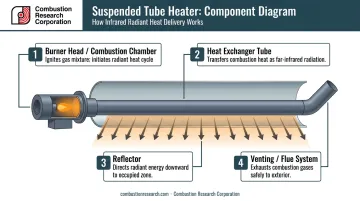
A typical suspended tube heater has four main parts:
- Burner head/combustion chamber: Gas ignites here. Stainless steel construction is available on premium models for corrosive environments.
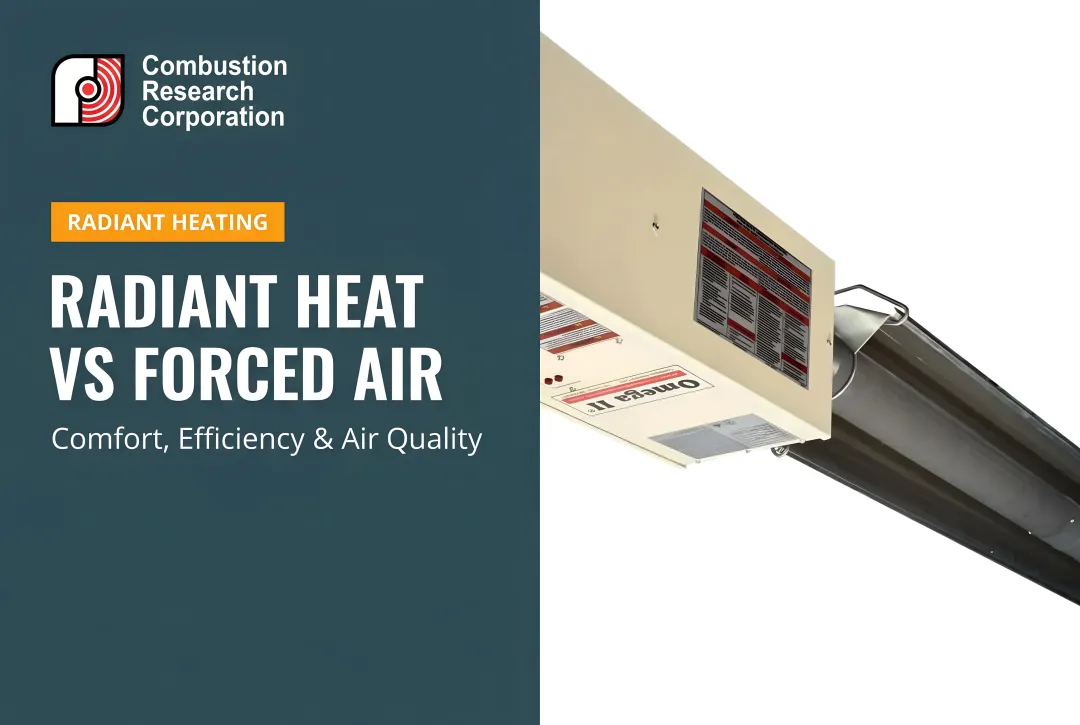
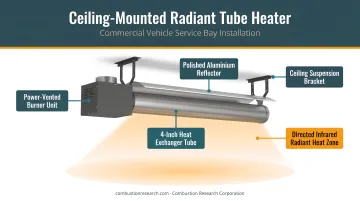
- Heat exchanger tube: The radiant emitter. Combustion Research Corporation (CRC) uses heavy-duty 12-gauge, 4-inch O.D. aluminized steel tubes across its Omega II and Reflect-O-Ray lines.
- Reflector: Mounted above the tube to direct infrared energy downward. CRC's bright aluminum reflectors achieve 98% reflectivity and rotate to 0° or 30° angles to optimize heat distribution.
- Venting/flue system: Exhausts combustion gases outside the building. Configuration choice directly affects both safety and installation logistics.
Venting Configurations
Two venting approaches are available, each suited to different facility types:
Vacuum-vented (pull-through): A draft inducer at the exhaust end draws combustion gases through the tube under negative pressure. Any breach in the system pulls ambient air inward rather than leaking exhaust into the space. CRC's Reflect-O-Ray line uses this configuration.
Power-vented (push-through): A blower at the burner end pushes exhaust through under positive pressure, handling long exhaust runs and complex routing effectively. CRC's Omega II line uses this approach.
For occupied or sensitive facilities, vacuum systems offer built-in exhaust integrity. Power-vented systems are the practical choice for agricultural buildings and large warehouses where exhaust routing involves significant back pressure.
How Suspended Tube Radiant Heaters Work
Combustion inside the tube heats its outer surface, which then emits infrared energy (long-wave electromagnetic radiation) that travels in straight lines downward through the air. Unlike a forced-air heater, infrared waves don't warm the air they pass through. Instead, they strike solid surfaces — floors, equipment, structural elements, people — and convert to thermal energy on contact.
The Heat Sink Effect
Floors and equipment absorb radiant energy and re-radiate warmth back into the occupied zone at ground level. This creates a stable, comfortable environment where heat concentrates where people work, not in the empty air volume near the ceiling.
In practice, that means workers at floor level stay warm even when the building itself is cold — and the system doesn't waste energy heating air volume that nobody occupies.
Why Stratification Kills Forced-Air Efficiency
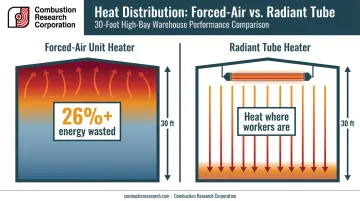
Hot air rises. In a 30-foot warehouse heated by unit heaters or ductwork, a significant portion of that energy pools near the ceiling where no one works. Research published in Energy and Buildings found that one warehouse achieved a 26.4% reduction in gas consumption through destratification alone — which illustrates how much energy conventional systems waste fighting physics.
Radiant tube heaters sidestep stratification entirely because infrared energy travels directly to the floor and occupants regardless of air temperature — the heating medium is radiation, not air.
How Reflectors Multiply Coverage
The parabolic or curved reflector above the tube redirects emitted radiation downward at a controlled angle. CRC's independently rotating reflectors — adjustable to 0° or 30° — allow heat distribution to be tuned for different coverage patterns. A reflector aimed straight down concentrates heat in a narrower band directly below; an angled position spreads coverage across a wider floor area. For large or irregular floor plans, reflector angle is just as consequential as BTU input — the right combination of both determines whether coverage gaps exist or heat is delivered where it's needed.
Key Benefits for Industrial and Commercial Spaces
Energy Cost Savings
According to trade sources including Consulting-Specifying Engineer, gas-fired infrared heating can save 20–50% in fuel consumption compared to forced-air heating in industrial buildings. Across its Omega II and Reflect-O-Ray product lines, Combustion Research Corporation documents 30–50% energy savings over conventional heating systems.
The modulating Omega II DI PEP goes further — adjusting both gas and air supply at high and low fire stages, it can save up to 75% in energy costs versus single-stage conventional systems.
No Ductwork
Ceiling-mounted tube heaters need only three connections: gas supply, electrical (for ignition and controls), and a flue. No duct network means:
- Eliminates duct heat losses (ENERGY STAR estimates leaky residential ducts waste 20%+ of conditioned air — industrial losses in large buildings run even higher)
- No duct cleaning or maintenance schedules
- Simpler installation in open-span structures
Air Quality and Comfort
In animal confinement, food processing, and natatoriums, air cleanliness is non-negotiable. Tube heaters produce no airflow, so they don't stir up dust, allergens, or animal bedding. The warmth feels more like sun exposure than the hot-and-cold cycling of forced air. For facilities where air cleanliness matters, that distinction directly affects product quality, animal health, and occupant comfort.
Floor Space and Safety
Ceiling-mounted systems leave the entire floor plan open for vehicles, forklifts, and material handling. There are no low-level heat sources to be struck by machinery — a concrete safety gain in busy industrial environments.
Fast Response and Zoning
Tube heaters heat up and cool down relatively quickly compared to systems with large thermal mass. Zoning — running heaters only in occupied areas — makes a practical difference in shipping docks, loading bays, or facilities with intermittent occupancy. An auto dealership service bay that's cold at 6 AM can reach working temperature by the time technicians arrive without heating the whole building all night.
Suspended Tube Radiant Heat vs. Other Heating Systems
vs. Forced-Air Unit Heaters
Unit heaters heat and circulate air. In high-bay buildings, that means stratification, noise from fans, drafts, and heat lost in ceiling air that nobody occupies. Tube heaters deliver more BTUs to the working zone per unit of fuel consumed in large spaces.
Unit heaters typically have lower upfront cost, which makes them attractive for smaller or lower-ceiling spaces. But in warehouses above 20 feet, the operating cost gap closes quickly.
vs. High-Intensity Ceramic/Quartz Heaters
High-intensity heaters operate at much higher surface temperatures and are built for spot heating or semi-outdoor use — patios, loading aprons, outdoor storage areas. The Synergy line serves this purpose, reaching maximum operating temperature in under a minute with no direct venting required.
For whole-building or zone heating in enclosed industrial spaces, low-intensity tube heaters are the stronger choice. Compared to high-intensity units, they offer:
- More even warmth distribution across large floor areas
- Safer surface temperatures for continuous indoor use
- Lower radiant intensity spread across a broader zone
vs. Hydronic Radiant Floor Heating
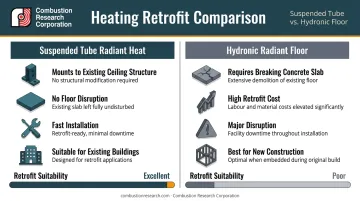
Hydronic systems embed tubing in floor slabs and heat slowly via conduction through concrete. They work well in residential construction and low-ceiling commercial builds where slab installation is part of original construction.
Retrofit applications in existing industrial buildings are a different story. Breaking up concrete floors to install hydronic tubing is expensive, disruptive, and often impractical. Suspended tube heaters mount to existing structure overhead — a retrofit can be completed without touching the floor.
Best Applications for Suspended Tube Radiant Heat
Suspended tube radiant heat works across a wide range of commercial, industrial, and agricultural environments. The common thread: spaces where forced air falls short — either because of ceiling height, air quality concerns, or the need for targeted, draft-free warmth.
High-Ceiling Industrial Spaces
Warehouses, manufacturing plants, aircraft hangars, and steel storage facilities benefit most. Forced air is inefficient at scale in these environments. Heat stratification losses increase with ceiling height, and unit heaters or baseboard systems simply can't deliver meaningful comfort at floor level in spaces like these.
Vehicle Service Environments
Auto repair shops, car and truck wash bays, oil and lube shops, and auto dealerships need reliable overhead heat that doesn't interfere with vehicle movement. CRC's Omega II and Reflect-O-Ray lines are both specified for CNG repair facility applications — a requirement that standard heaters cannot meet. Per DOE/AFDC guidance, heaters in CNG maintenance facilities must not exceed 750°F surface temperature and must be installed at least 18 inches below the ceiling.
Agricultural, Specialty, and Other Buildings
- Pole barns, animal confinement, and brooders: delivers draft-free warmth without stirring bedding or pathogens
- Greenhouses: even heat distribution eliminates cold spots that stress plants
- Natatoriums: CRC's stainless steel Reflect-O-Ray 4.0 EDS is rated for aquatic centers and corrosive chlorine environments
- Ice arenas: warms occupants overhead without affecting the ice surface
- Shipping and receiving docks: frequent door openings make forced air impractical — radiant heat restores comfort quickly without heating the full air volume
What to Look for When Choosing a Suspended Tube Heater
Certifications and Safety Standards
Look for heaters certified to ANSI Z83.20 / CSA 2.34 by a recognized testing body. This standard covers gas-fired low-intensity infrared heaters up to 400,000 BTU/hr per burner and governs combustion safety, venting requirements, and clearance to combustibles.
CRC's Omega II 9K Series carries this certification, and the broader product portfolio holds CSA certification (formerly AGA and CGA). With over 50 years of manufacturing experience, CRC builds certification compliance into the production process itself, not retrofitted after the fact.
BTU Output, Tube Length, and System Type
Matching heater output to a building requires a proper heat loss calculation accounting for square footage, ceiling height, insulation values, and occupancy patterns. Two approaches:
- Pre-engineered packages like the CRC Omega II (40K–220K BTU range) work well for straightforward layouts with standard BTU requirements
- Custom-engineered systems like the CRC Reflect-O-Ray EDS (40K–250K BTU, designed to specification) are the right choice for complex layouts, irregular geometries, or very large buildings
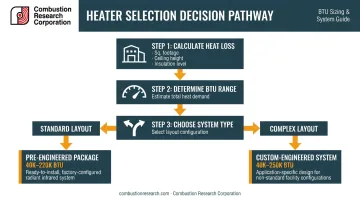
CRC provides engineering support for both new construction and retrofit projects, which is particularly useful for multi-zone layouts, long exhaust runs, or unusual ceiling geometry.
Warranty and Operational Features
Tube heaters face significant thermal cycling stress. A 10-year warranty on heat exchanger tubes signals genuine confidence in build quality. CRC offers a 10-year limited warranty on radiant tubes for internally created corrosion across both the Omega II and Reflect-O-Ray product lines, plus a 3-year warranty on ignition controls and electrical components.
Two-stage or modulating operation also matters for long-term efficiency. CRC's Omega II DI PEP modulates both gas and air supply at high and low fire stages, maintaining precise air-to-gas ratios at each level for stable combustion and lower operating costs than single-stage on/off cycling.
Frequently Asked Questions
What is a radiant tube heater?
A radiant tube heater is a ceiling-suspended, gas-fired infrared heating system. Gas combustion heats a sealed metal tube until it emits infrared radiation downward, warming floors, objects, and occupants directly without heating the surrounding air first.
What is the best tubing for radiant heat?
For industrial suspended tube heaters, heavy-gauge steel tubing — such as the 12-gauge, 4-inch O.D. corrosion-resistant aluminized steel tubes CRC uses — offers the best balance of thermal durability and consistent output. Stainless steel options are available for corrosive environments like natatoriums.
What is the difference between low-intensity and high-intensity radiant tube heaters?
Low-intensity tube heaters operate at moderate surface temperatures (up to ~1,100°F) using sealed combustion, making them suitable for whole-building heating indoors. High-intensity ceramic or quartz heaters run much hotter and are typically used for spot heating or outdoor/semi-outdoor applications.
How high should suspended tube radiant heaters be mounted?
Most low-intensity tube heaters are mounted between 10 and 28 feet, depending on BTU output and ceiling clearance requirements. Always confirm exact heights with the manufacturer's installation guide and local codes — improper mounting creates safety hazards and uneven heat distribution.
Are suspended tube radiant heaters safe for auto repair or CNG facilities?
Standard tube heaters are not rated for use near compressed natural gas equipment. CNG facilities require heaters that meet specific surface temperature and installation height requirements per DOE/AFDC guidelines. CRC's Omega II and Reflect-O-Ray systems meet the installation requirements for CNG repair facilities.
How much can suspended tube radiant heaters reduce heating costs?
Trade and engineering sources consistently cite 20–50% lower fuel consumption for gas-fired infrared tube heaters versus forced-air systems in industrial buildings. CRC's documented position for its product lines is 30–50% savings over conventional heating systems.