Many facility managers underestimate what neglected maintenance actually costs. A heater that's ignored through two or three heating seasons doesn't just run less efficiently — it accumulates small failures that compound into expensive corrective repairs, potential safety hazards from degraded combustion or faulty gas connections, and shortened system lifespan.
This guide covers why maintenance matters, what types of service are involved and what they cost, how to recognize early warning signs, and how to build a practical annual maintenance schedule.
Key Takeaways
- Annual preventive maintenance typically costs far less than a single emergency repair call
- Parts-only benchmarks: igniters run $52–$195, gas valves $167–$647, and boot replacement kits around $159 (labor additional)
- Dirty or degraded reflectors can reduce radiant output by up to 25%, directly increasing fuel consumption
- Annual pre-season professional service is the baseline — dusty or high-cycle environments warrant more frequent checks
- Flexible boot connectors should be replaced every 3–4 years on a scheduled basis
Why Proper Maintenance of Propane Radiant Tube Heaters Matters
Propane radiant tube heaters generate infrared energy through sustained combustion inside a sealed heat exchanger tube. That heat radiates from the tube surface and reflector assembly, warming floors, equipment, and occupants directly. Burner combustion quality, tube surface condition, and reflector cleanliness all determine how much of the fuel's energy actually reaches the heated space.
The Efficiency Case
Reflector condition is one of the most underappreciated maintenance variables. According to Roberts-Gordon, replacing old dirty reflectors with high-efficiency reflectors can increase radiant output by up to 25%. That's a significant performance gap — and it's recoverable with a cleaning or replacement that costs a fraction of the fuel wasted running a degraded system.
Soot buildup inside heat exchanger tubes, fouled burner faces, and clogged combustion chambers all compound the same problem: the heater burns more propane to deliver less usable heat. That same combustion degradation also changes the chemistry of what's burning — which creates a separate risk entirely.
The Safety Case
Propane combustion produces carbon monoxide when air-fuel ratios drift outside proper parameters. OSHA sets the workplace CO permissible exposure limit at 50 ppm over an 8-hour time-weighted average.
In commercial and industrial settings where heaters run continuously through long shifts, combustion drift from fouled igniters, degraded gas valves, or venting obstructions is a workplace safety issue — not just a performance concern.
Annual inspection of gas connections, combustion air systems, venting, and ignition components is the primary control against these risks.
The Financial Case
Preventive maintenance catches small, inexpensive problems — cracked burner ceramics, soot accumulation, early signs of tube discoloration — before they cascade into component failures requiring emergency service calls. Parts-only costs for common repairs give a clear picture of the financial exposure:
- Igniters/electrodes: $52–$195 in parts alone
- Gas valves: $167–$647 in parts alone
- Motor/blower assemblies: $153–$1,177 in parts alone
- Boot replacement kits: ~$159 in parts alone
Add labor and emergency call premiums to any of these, and a single unplanned repair can easily exceed the cost of two or three years of annual preventive service.
Types of Maintenance for Propane Radiant Tube Heaters and Their Costs
Not every heater has the same maintenance profile. Usage intensity, facility environment, and heater age all shape what a proper service program looks like.
Routine / Preventive Maintenance
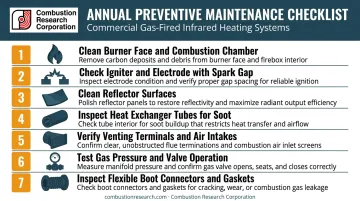
Annual preventive service is the baseline recommendation from virtually every major manufacturer. Both Schwank and SunStar specify annual inspection of the heater system, venting, and gas-supply connections before each heating season. The core tasks in a typical preventive visit include:
- Inspecting and cleaning the burner face and combustion chamber
- Checking the igniter and electrode, including spark gap adjustment
- Cleaning reflector surfaces (annually, per manufacturer guidance)
- Inspecting heat exchanger tubes for soot or carbon deposits
- Verifying venting terminals and fresh air intakes are clear
- Testing gas pressure and valve operation
- Inspecting flexible boot connectors and gaskets
One design factor worth noting: Combustion Research Corporation's Omega II and Reflect-O-Ray systems are engineered without combustion air filters, eliminating a common consumable that can cause shutdowns when maintenance slips. In dusty environments like agricultural barns or manufacturing plants, this filter-free design removes an entire category of recurring service touchpoints.
CRC systems are also designed around operating parameters that avoid internal condensation, a failure mode that shortens tube life in competing designs running in condensing mode.
Cost guidance: Pricing for single-heater annual preventive visits isn't standardized — rates vary by region, contractor, and facility access requirements. Get quotes from local commercial HVAC or radiant heating contractors before the heating season.
Corrective / Reactive Maintenance
Corrective maintenance is triggered by failure: a heater that won't ignite, produces a soft yellow flame, generates unusual odors, or trips its safety switch repeatedly. These aren't nuisance issues. They signal that something has failed and needs immediate attention.
Reactive repairs consistently cost more than preventive service because they involve emergency scheduling, unplanned parts procurement, and potential secondary damage from delayed intervention. Common parts benchmarks:
| Component | Parts-Only Cost Range |
|---|---|
| Igniter / electrode | $52 – $195 |
| Gas valve | $167 – $647 |
| Fan blower / vacuum motor | $153 – $1,177 |
| Flexible boot kit | ~$159 |
Labor is additional and varies by location and contractor.
Major / Overhaul Maintenance
After 10–15 years of operation, or following a major component failure, a full overhaul may be warranted. Tasks can include heat exchanger tube replacement, full burner assembly rebuilds, reflector replacement, and control system upgrades.
Parts-only benchmarks for major work:
| Component | Parts-Only Cost Range |
|---|---|
| Heat exchanger kits | $1,059 – $1,269 |
| Full burner assembly | $568 – $1,883 |
| Individual reflectors | from ~$129 per section |
When repair costs approach 50% of replacement cost, replacement is generally worth evaluating as the more economical long-term path. CRC's 10-year warranty on Burner Core and all Combustion and Heat Exchanger tubes provides meaningful cost protection during the first decade — reducing out-of-pocket exposure for the components most likely to need overhaul-level attention.
Signs Your Propane Radiant Tube Heater Needs Maintenance
Catching problems between scheduled service visits starts with knowing the specific signs — here's what facility managers and operators should watch for.
Performance and Efficiency Decline
- Uneven heat distribution — zones that feel colder than usual or take longer to reach temperature often signal burner fouling or soot accumulation inside the radiant tube
- Higher propane consumption without changes in usage patterns is one of the most reliable early indicators that combustion efficiency has dropped
- Longer cycle times to bring a space to setpoint, particularly in cold weather, can point to degraded reflector surfaces or tube deposits reducing radiant output
Visible and Operational Warning Signs
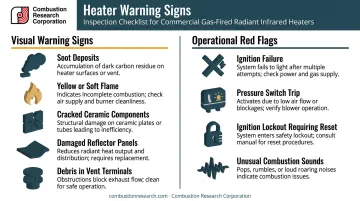
Physical signs to check during routine walkarounds:
- Soot deposits visible around the burner or on tube surfaces
- Yellow or "soft" flame rather than a stable blue
- Cracked or discolored ceramic burner components
- Damaged, warped, or heavily soiled reflector panels
- Debris or bird nesting in vent terminals or fresh air inlets
Operational red flags:
- Heater fails to ignite on the first or second attempt
- Pressure switch or vacuum switch trips (Schwank specifies a fault within 30 seconds of blower energizing as an air-flow fault indicator)
- Ignition lockout requiring manual reset
- Whistling, howling, or irregular combustion sounds during operation
Recurring Issues and Increased Downtime
If a technician is making more than one service call per season for the same heater, the pattern itself is the problem. At that point, a repair-vs-replace cost analysis is worth running before authorizing another service visit.
Flexible boot connectors and gaskets deserve close scrutiny during that review. Superior Radiant recommends replacing flexible connectors every 3–4 years and inspecting them for cracks, kinks, or leaks at each annual service. Ignored, deteriorating boots introduce air leaks that degrade system performance and eventually cause safety switch trips.
Propane Radiant Tube Heater Annual Maintenance Schedule
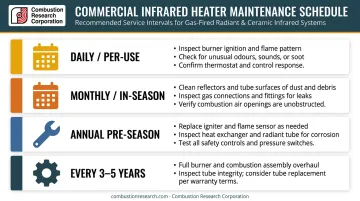
Maintenance frequency isn't one-size-fits-all. Industry guidance distinguishes between heavy-duty operation (annually or after 1,500 hours), medium-duty (every 2 years or 8,000 hours), and light-duty (every 3 years or 25,000 hours). A dusty agricultural barn runs a different profile than a clean automotive dealership — plan accordingly.
Maintenance Frequency Table
| Interval | Tasks |
|---|---|
| Daily / Per-Use | Verify ignition is responsive; note any unusual odors, sounds, or flame color changes before startup |
| Monthly / In-Season | Visually inspect vent terminals and fresh air inlets for obstructions; check reflector condition; note any ignition delays |
| Annual (Pre-Season) | Full professional service: clean burner and combustion chamber, inspect/replace igniter and electrodes, clean heat exchanger tubes, clean or replace reflectors, check gas pressure, inspect all venting, test safety controls |
| Every 3–5 Years | Replace flexible boot connectors; inspect all gaskets; evaluate heat exchanger tube condition; consider full system audit for heaters approaching 10+ years |
Planning Your Annual Service Budget
Before the heating season is the right time to schedule professional service — not after the first cold snap when contractors are already backed up. For facilities with multiple heaters, annual service contracts typically offer lower per-visit rates and priority scheduling compared to one-off calls. Warehouses, aircraft hangars, and car wash bays with continuous operation benefit most from this arrangement.
Budget planning should also account for what warranty coverage eliminates. CRC's 10-year limited warranty on Burner Core and all Combustion and Heat Exchanger tubes covers the components most likely to require costly attention during the first decade. During that window, qualifying failures on those components reduce out-of-pocket repair costs considerably. CRC's 3-year warranty on ignition controls and electrical components extends that protection to the control systems most likely to need corrective attention in the early years. For complete warranty terms and claim procedures, contact CRC at 888-852-3611 or through their representative network.
Conclusion
Annual maintenance for propane radiant tube heaters is straightforward: a pre-season professional service visit, operator-level monitoring through the heating season, and timely replacement of wear components on schedule. The cost of consistent preventive care is a fraction of what a single corrective repair call — let alone a premature system replacement — demands.
The right equipment foundation matters just as much. Systems engineered for durability, like CRC's Omega II and Reflect-O-Ray lines with their filter-free design and 10-year tube warranties, reduce baseline service demands and provide documented cost protection across the most critical years of operation. Pair well-engineered equipment with consistent preventive service, and 15–25+ year system lifespans become the expected outcome — not the exception.
Frequently Asked Questions
How much does it cost to run a propane radiant tube heater?
Operating cost depends on heater BTU output, current propane prices, and annual usage hours. Using EIA's figure of 91,452 BTU per gallon, a 100,000 BTU heater burns roughly 1.09 gallons per hour at full fire. Multiply your local propane rate by operating hours for a facility-specific estimate; well-maintained heaters with clean combustion consume less fuel than neglected systems.
How long will a 20 lb propane tank last on a 30,000 BTU heater?
A 20 lb tank holds approximately 4.7 gallons of propane (~430,000 BTU of usable energy). At 30,000 BTU/hr full-fire draw, that's roughly 14 hours of runtime. Real-world duration will be longer, since thermostat cycling means the heater won't run continuously.
What is the lifespan of propane radiant tube heaters?
Well-maintained commercial propane radiant tube heaters typically last 15–25+ years, with heat exchanger tube integrity being the primary longevity factor. CRC backs its Omega II and Reflect-O-Ray tubes with a 10-year warranty against internally created corrosion; consistent annual maintenance extends performance well beyond that window.
How often should a propane radiant tube heater be serviced?
Annual professional service before the heating season is the baseline recommendation from major manufacturers including Schwank and SunStar. Dusty environments (agricultural, manufacturing), humid applications (car wash bays), or heavy-use facilities operating near 1,500 hours per season warrant more frequent inspection.
Can I perform maintenance on my propane radiant tube heater myself?
Operators can handle basic visual checks — reflector condition, vent clearance, flame color observation, and noting ignition behavior. Combustion adjustment, electrode inspection, gas pressure testing, and any work involving gas connections must be handled by a qualified service technician.
What are the most common propane radiant tube heater repairs and their costs?
The most frequent repairs involve igniters/electrodes ($52–$195 parts), gas valves ($167–$647 parts), flexible boot connectors (~$159 parts), and reflector replacement (from ~$129 per section). Motor and blower assemblies range from $153–$1,177 in parts. Labor is additional and varies by region and contractor rates.