Introduction
Winter heating is one of the biggest operational challenges greenhouse growers face. Keeping crops warm enough to grow — without sending utility bills through the roof — requires the right system, not just more output. Forced-air systems heat air that stratifies near the ceiling, leaving root zones cold and plants stressed.
Radiant floor heating solves this by flipping the equation. Heat rises from the ground up, warming roots and soil first — exactly where plants need it most. According to NYSERDA's 2022 Greenhouse Energy Best Practices Guidebook, root-zone heating delivers 15% to 30% typical energy cost savings with payback periods of just 1 to 4 years.
This guide walks through how radiant floor heating works, its core benefits, system types (including overhead infrared as an alternative), and what to consider before choosing an approach for your operation.
Key Takeaways
- Radiant floor heating warms the root zone first, allowing greenhouse air temperatures to run 5–15°F cooler while plants stay productive
- NYSERDA documents 15–30% typical energy savings with 1–4 year payback for root-zone heating
- Hydronic systems suit large commercial operations; electric cables work better for smaller spaces or bench growing
- Insulation under tubing is critical — without it, heat sinks into the ground instead of rising to crops
- Overhead radiant tube heaters like CRC's Reflect-O-Ray and Omega II are a strong retrofit alternative for bench-growing setups
How Does Radiant Floor Heating Work in a Greenhouse?
Radiant floor heating uses pipes or electric cables installed beneath the greenhouse floor to emit heat upward through the ground. Unlike forced-air systems that warm the air and depend on circulation to distribute it, radiant systems heat solid surfaces directly (soil, concrete, plant stems, and benches), creating a stable thermal environment from the ground up.
Heat conducts through the floor medium (sand, concrete, or growing substrate) into the root zone, then rises naturally through the growing space. Because radiant energy warms objects rather than air, temperature stays consistent even when vents open or doors cycle.
System Components
Most in-floor systems fall into one of two categories:
- Hydronic systems — a boiler or water heater circulates warm water through PEX tubing embedded in the floor. Glycol is added to prevent freeze damage in cold climates.
- Electric systems — heating cables embedded in or under the floor surface, wired to an electrical source and controlled by a thermostat.
Both types pair with zone controls and thermostats, letting growers maintain different temperatures across propagation areas, grow-out zones, and staging areas within the same structure. For sizing, UMass Amherst's root-zone heating guidance recommends ½-inch tubing in loops up to 200 feet, or ¾-inch tubing up to 400 feet. Either configuration should be spaced 9–12 inches on center for even heat distribution.
Commercial greenhouse operators also use overhead radiant infrared heaters as an alternative — or alongside in-floor systems — to deliver the same surface-warming effect at the bench and canopy level without floor excavation.
Key Benefits of Radiant Floor Heating for Greenhouses
Energy Efficiency
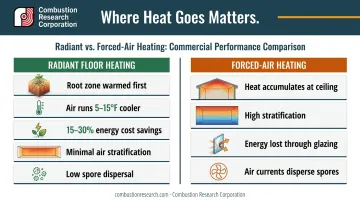
Forcing hot air to ceiling height wastes energy: heat accumulates where no crops are, then escapes through glazing. Radiant floor systems concentrate warmth at crop level, which means the thermostat setpoint for air can be lowered without sacrificing root-zone temperatures.
UMass reports that root-zone heating systems can allow greenhouse air to run 5 to 15°F cooler than traditional systems while maintaining the same crop conditions. Every 1°F reduction in thermostat setting saves approximately 3% in fuel costs. NYSERDA documents 15–30% typical energy cost savings for root-zone heating, with installed costs around $2–$3 per square foot.
Root Zone Warming and Plant Health
Plants respond to soil temperature as much as — often more than — ambient air temperature. Warm roots drive germination, cell division, and nutrient uptake.
According to Alabama Cooperative Extension's 2023 germination chart, optimum soil temperatures for common crops include:
- Tomatoes and peppers: 85°F optimal
- Lettuce: 75°F optimal
- Cucumber/watermelon: Up to 95°F depending on variety
A 2017 HortScience study on petunias found that bench-top root-zone heating at 27°C shortened time to flower for 'Potunia Plus Red' from 56 days (no root-zone heat) to 47 days — a 9-day production gain from soil temperature alone.
UMass recommends maintaining root-zone temperatures between 70–75°F, using water heater settings around 100–110°F.
Uniform Heat Distribution
Cold corners, drafty benches, and uneven temperature zones are a consistent problem with forced-air heating. Radiant floor systems embedded in concrete or sand distribute heat across the entire floor surface as the medium conducts warmth outward from each pipe or cable.
Rutgers' horticultural engineering research confirms that floor media help distribute heat evenly, and that hot-water systems provide more constant heat than air-based systems. The result: every square foot of growing space receives a consistent temperature rather than whatever warm air happens to circulate past.
Reduced Humidity and Disease Risk
Botrytis (gray mold) thrives when relative humidity exceeds 93% and free moisture sits on plant tissue for 8–12 continuous hours at temperatures of 55–65°F, according to Penn State Extension. Air currents from forced-air heating systems can disperse fungal spores throughout the greenhouse.
Radiant floor systems heat without moving air, cutting circulation-driven spore dispersal. UMass also notes that bottom heat keeps plant surfaces warmer, shortening the duration of leaf wetness and reducing condensation risk — a practical advantage for high-value ornamental and vegetable crops.
Extended-Season Growing
Consistent ground-level warmth lets growers start crops earlier in spring and carry production later into fall. A warm root zone during cold nights maintains soil temperature even when air temperatures dip, reducing the thermal stress that slows growth or sets back seedlings.
Types of Radiant Heating Systems for Greenhouses
Hydronic (Hot Water) Systems
A boiler heats water that circulates through PEX tubing embedded in the floor. The surrounding concrete or sand distributes heat evenly across the floor surface. Glycol is mixed into the fluid for freeze protection in cold climates.
Best suited for large commercial greenhouses with ground beds and new construction where the floor slab hasn't been poured yet.
Upfront installation runs $2–$3/sq ft for the radiant system alone, plus boiler costs — but operating costs stay low over time. Rutgers recommends these operating parameters:
- Loop water temperature: 90–110°F
- Flow rate: ~2.75 gpm per loop
- Maximum temperature drop per loop: ~5°F
One practical advantage: the thermal mass of a concrete slab stores heat and slowly re-radiates it overnight, providing a buffer during boiler shutdown or power interruptions.
Electric Radiant Systems
Heating cables embedded in or under the floor surface — simpler to install, lower upfront cost, but typically more expensive to operate due to electricity pricing.
Best suited for small hobby greenhouses, propagation benches, or supplemental under-bench heating where installation simplicity matters more than long-term energy economics.
GPN's underbench heating research notes electric units can support up to 2,000 sq ft of bench area and allow greenhouse air temperatures to run 5–10°F below soil temperature — reducing fuel use by 10% or more for supplemental applications.
Overhead Infrared Radiant Heaters
For retrofit situations, bench-growing operations, or greenhouses where excavating the floor isn't practical, overhead low-intensity infrared tube heaters are a strong alternative. They deliver radiant warmth from above — directly to crop canopies, benches, and floor surfaces — without requiring any concrete work.
Combustion Research Corporation (CRC) manufactures CSA-certified low-intensity infrared tube heaters specifically suited for agricultural and greenhouse applications:
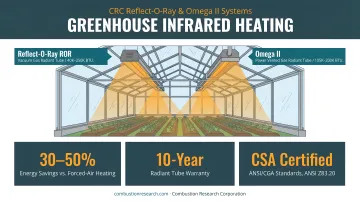
- Reflect-O-Ray (40,000–250,000 BTU/hr): Vacuum-fired, custom-engineered for large agricultural ranges. An oil-fired variant is available for remote or rural sites without natural gas.
- Omega II (105,000–200,000 BTU/hr): Power-vented, pre-engineered packages for high-production commercial bays.
- Serengeti-IR (40,000–60,000 BTU/hr): Compact and well-suited for smaller greenhouses.
CRC documents 30–50% energy savings over conventional forced-air heating across these product lines. All three carry 10-year radiant tube warranties, require no floor excavation, and are CSA International Design Certified to ANSI/CGA Standards.
Radiant Floor vs. Forced-Air Heating: What Greenhouse Operators Should Know
| Factor | Radiant Floor | Forced-Air |
|---|---|---|
| Heat placement | Root zone first, rises naturally | Ceiling first, depends on mixing |
| Air stratification | Minimal | Significant without HAF fans |
| Spore/pathogen dispersal | Low (no air circulation) | Higher (air currents move spores) |
| Retrofit difficulty | High (floor excavation) | Low |
| Best for | Ground beds, new construction | Bench growing, existing structures |
Two practical factors drive most grower decisions after reviewing that comparison:
- Energy efficiency: Root-zone heat keeps crops warm at lower air setpoints, so less energy goes into heating empty air volume near the roof — where it escapes through glass or poly glazing anyway. The efficiency gain comes from heat placement, not just insulation.
- Bench-growing limits: In-floor heat works best in ground bed systems. In elevated bench setups, floor-level warmth often dissipates before reaching the plant canopy. Growers in this configuration typically supplement with under-bench electric mats or overhead infrared heaters.
If your operation uses bench growing or occupies an existing structure, a hybrid approach — radiant floor where ground beds exist, overhead infrared for bench areas — often delivers better coverage than either system alone.
Installation: What Greenhouse Operators Need to Know
Planning and Timing
Radiant floor heating is far easier to install during new greenhouse construction before the slab is poured. Retrofitting an existing concrete floor requires breaking up the slab — adding significant cost and downtime during the off-season.
Key Components for a Hydronic System
A complete hydronic radiant installation requires:
- PEX tubing with oxygen diffusion barrier (½" or ¾" depending on loop length)
- Rigid foam insulation board beneath the tubing — Rutgers recommends 2-inch board (R-10) to prevent heat loss into subsoil
- Boiler or water heater — domestic hot-water heaters work for areas under 3,000 sq ft; commercial units handle larger operations
- Headers/manifolds for distributing flow across multiple loops
- Thermostat and zone controls — remote-bulb or soil-sensor thermostats that cycle the pump
- Glycol for freeze protection in cold climates
Insulation and Thermal Mass
Without rigid foam beneath the tubing, a significant portion of heat conducts downward into the subsoil rather than upward to crops. MSU recommends 2-inch polystyrene board extending 2 feet vertically along the greenhouse perimeter as a minimum in colder climates — skip this layer and you're heating dirt, not plants.
The concrete slab itself provides useful thermal mass — storing heat during peak boiler operation and slowly re-releasing it overnight.
Floor Construction and Drainage
Tubing is embedded in a concrete slab that should be sloped toward floor drains — a necessity in greenhouses where irrigation runoff is constant. Standard construction embeds pipes in the lower half of a 4-inch slab, balancing structural integrity with heat distribution.
Zoning
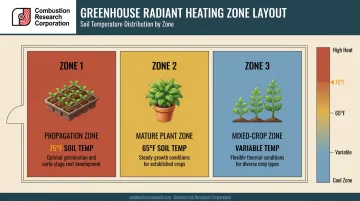
Larger greenhouses benefit from zoned systems that match soil temperature to crop stage:
- Propagation zone: 75°F soil temperature for germination and early root development
- Mature-plant zone: 65°F to support established crops without over-heating root zones
- Mixed-crop structures: Separate zones let different species share one greenhouse without compromise
Choosing the Right Heating System for Your Greenhouse
Match System to Growing Method and Size
| Operation Type | Recommended System |
|---|---|
| Large commercial, ground beds, new build | Hydronic in-floor |
| Small hobby or propagation bench | Electric under-bench cables |
| Retrofit or bench-growing operation | Overhead infrared (e.g., CRC Reflect-O-Ray, Omega II) |
| Remote/rural site without natural gas | Reflect-O-Ray Oil-Fired variant |
Calculate Your Heating Load First
Matching system type to your operation matters — but proper sizing determines whether any system performs. Purdue's greenhouse heating formula uses Q = U × A × ΔT, where:
- U = glazing heat-transfer coefficient (double polycarbonate: 0.55; double poly film: 0.70; single poly: ~1.2)
- A = exposed surface area
- ΔT = indoor minus outdoor design temperature
Your climate zone, glazing type, infiltration rate, and crop temperature targets all feed into BTU requirements. Radiant systems improve heat placement — but they don't replace the heat-load calculation.
CRC offers online BTU calculators at combustionresearch.com/resources/calculators and engineering support through their representative network (888-852-3611) for growers sizing a system.
ROI and Long-Term Cost
| System | Upfront Cost | Operating Cost | Typical Payback |
|---|---|---|---|
| Hydronic in-floor | High | Lowest long-term | 1–4 years (NYSERDA) |
| Electric radiant | Low | Higher — best as supplemental heat | Varies |
| Overhead infrared | Moderate (no excavation) | 30–50% savings vs. forced-air | 2–5 years |
Utility rebates through local gas programs can further reduce payback for overhead infrared installations.
Frequently Asked Questions
How does radiant floor heating compare to forced-air heating for greenhouses?
Radiant floor heating warms from the ground up, keeping root zones warm and allowing air setpoints to run 5–15°F cooler. Forced-air systems push heat from the ceiling down, where it stratifies away from the crop zone. Radiant is generally more energy-efficient and better for plant health in ground-bed operations.
Is radiant floor heating worth it for a small or hobby greenhouse?
For very small greenhouses, excavation and installation costs can outweigh the energy savings. Electric under-bench heat mats or overhead infrared tube heaters are more cost-effective at small scale. Larger hobby or commercial operations, particularly those heating year-round, tend to see stronger ROI from hydronic in-floor systems.
What temperature should radiant floor heating be set to in a greenhouse?
Water in hydronic loops typically runs at 90–110°F, producing root-zone temperatures of 70–75°F in the growing medium. Most vegetables germinate best at 75–85°F soil temperature; ornamentals propagate well at 72–76°F. Air temperature follows soil temperature, running several degrees cooler.
Can radiant floor heating be used with bench growing systems?
Floor-level heat often doesn't reach plants on elevated benches effectively. Growers using bench systems typically supplement with under-bench electric heat mats or overhead infrared tube heaters that deliver radiant warmth directly to the canopy regardless of floor temperature.
How long does installation take?
New-construction installation typically takes 2–4 days for tubing layout, followed by 21–28 days of concrete curing before the system can operate. Retrofitting an existing slab adds demolition and reconstruction time on top of that, so plan for significant downtime when scheduling a retrofit project.
What maintenance does a greenhouse radiant floor system require?
Hydronic systems need periodic checks of boiler function, glycol levels, and manifold valves. Electric systems have minimal maintenance requirements. The in-floor tubing itself once properly installed is largely maintenance-free and protected by the concrete slab above it.