Introduction
Heating a warehouse with 30-foot ceilings and loading docks that open a dozen times a day is a fundamentally different problem than heating an office. Facility managers running convection-based systems in those environments already know the symptoms: workers in jackets despite a running furnace, sky-high gas bills, and thermostats set ten degrees higher than anyone would need if the heat actually stayed at floor level.
The choice between infrared and convection heating shapes your energy costs, worker comfort, air quality, and how safely equipment moves through your space.
This article breaks down exactly how each method works, where each performs best, and why direct radiant heating holds a measurable advantage for large-format industrial and commercial spaces.
Key Takeaways
- Infrared heaters warm objects and people directly; convection heaters warm air that rises and pools at the ceiling, not at worker level.
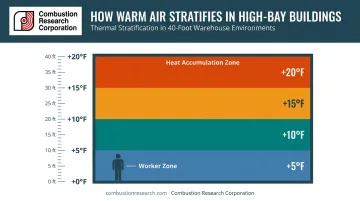
- Forced-air systems in tall buildings commonly produce a 5°F temperature increase for every 10 vertical feet, meaning heat pools at the ceiling, not at worker level.
- Independent trade sources and utility case studies report 20–50% fuel savings when switching from forced-air to infrared in applicable industrial facilities.
- Convection heating still makes sense for small, sealed, low-ceiling spaces where consistent ambient temperature is the priority.
- For most industrial facilities (warehouses, hangars, automotive shops, barns), infrared tube heating delivers better efficiency and worker-level comfort.
Infrared vs. Convection: Quick Comparison
| Factor | Infrared Tube Heater | Convection / Forced-Air |
|---|---|---|
| Heating Method | Warms objects and occupants directly via radiant energy | Warms air; relies on air movement to distribute heat |
| Efficiency in Large Spaces | High — bypasses thermal stratification entirely | Low — significant heat loss to ceiling in high-bay buildings |
| Startup Speed | Usable radiant output begins quickly from startup | Must heat full air volume before floor-level comfort is felt |
| Airborne Particulates | No air movement; airborne particles settle and stay settled | Continuous circulation redistributes dust, allergens, and particulates |
| Maintenance Requirements | No filters, no fans, no condensation-prone components | Regular filter changes, fan service, duct inspection required |
Note: This comparison covers industrial and commercial space heating — specifically gas-fired low-intensity ceiling-mounted infrared tube heaters — not residential panel heaters. Scale, ceiling height, and operational demands vary considerably between the two.
What Is Infrared Heating?
Infrared heating transfers energy via electromagnetic radiation. Rather than warming air as an intermediary, radiant energy travels directly from the heat source to solid surfaces and people, where it's absorbed and converted to warmth. Air molecules largely don't intercept it — which is exactly why it works so well when that air keeps escaping through a loading dock door.
How Gas-Fired Tube Heaters Work
In industrial settings, the standard is the low-intensity gas-fired infrared tube heater. A burner ignites at one end of a long metal tube suspended from the ceiling. The tube heats along its length and radiates warmth downward across a broad area. There's no open flame in the occupied space, and a vacuum or power-vented exhaust system removes combustion gases safely.
Combustion Research Corporation's Reflect-O-Ray and Omega II systems use this approach — CSA certified to ANSI Z83.20 / CSA 2.34 standards, with both vacuum-vented (Reflect-O-Ray) and power-vented (Omega II) configurations. The Reflect-O-Ray operates under negative pressure, meaning any tube breach draws ambient air inward rather than pushing exhaust into the occupied space, which matters in facilities where workers are present throughout the day.
Operational Advantages for Industrial Buyers
Ceiling-mounted infrared tube heaters deliver several practical benefits that convection systems simply can't match in large industrial spaces:
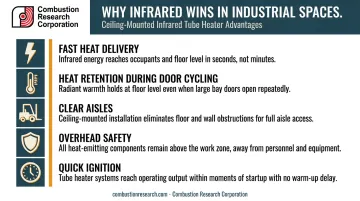
- Reaches floor level fast — radiant energy travels directly to occupants, bypassing 35 feet of air entirely
- Starts delivering heat within minutes of ignition, with no wait for air to circulate
- Holds warmth through door cycling — heat already absorbed by surfaces and equipment stays put when dock doors open
- Ceiling-mounted design keeps aisles clear for forklifts and material-handling equipment
- Located overhead and out of reach, eliminating contact risk from vehicles or machinery
Primary Applications
These operational advantages make low-intensity infrared tube heating the practical choice across a wide range of facility types:
- Large warehouses and distribution centers
- Aircraft hangars
- Automotive and CNG repair shops
- Car wash bays
- Pole barns and animal confinement facilities
- Shipping and receiving docks
- Natatoriums
What Is Convection Heating?
Convection heating works by warming the air. A heat source — gas burner, electric element, or heat exchanger — raises air temperature, the warm air rises, cooler air moves in to replace it, and the cycle repeats. In a well-sealed room with low ceilings, this works reasonably well. In a 35-foot warehouse, the physics work against you.
The Stratification Problem
Warm air is buoyant. Forced-air industrial systems typically supply air at 120–180°F, which rises aggressively toward the ceiling. Research from Puget Sound Energy and the ACEEE found that forced-air systems commonly produce a 5°F temperature increase for every 10 vertical feet in high-bay industrial buildings — meaning a 40-foot space may have a 20°F difference between the floor where workers stand and the ceiling where heat accumulates.
The result: the system runs harder and longer to push any usable warmth down to occupant level, burning energy to heat air that just floats away.
When Convection Heating Is the Right Fit
Convection isn't always the wrong answer. It remains appropriate when:
- The space is small and well-insulated with low ceilings
- Maintaining uniform ambient air temperature is the primary goal (paint mixing rooms, climate-controlled offices, server rooms)
- Occupancy is continuous and consistent
- There's little to no air infiltration from outside
Where those conditions don't apply — high ceilings, drafty doors, intermittent occupancy — the heat loss adds up fast. That's where infrared takes over.
Head-to-Head: Performance in Industrial Settings
Energy Efficiency and Heat Stratification
The stratification problem described above isn't just a comfort issue — it's a direct energy cost. A peer-reviewed study of large warehouses examining thermal destratification found gas-use reduction potential up to 26.4% simply from addressing the temperature gradient in forced-air-heated buildings. That's energy wasted on heating the ceiling.
Infrared tube systems don't have this problem. The same PSE/ACEEE study documented that in an infrared-heated aircraft hangar, temperatures at 5 feet and 24 feet above the floor were nearly identical to the setpoint — no stratification gradient, no wasted output at ceiling level.
Savings when switching from forced-air to infrared are site-specific. The PSE/ACEEE data shows:
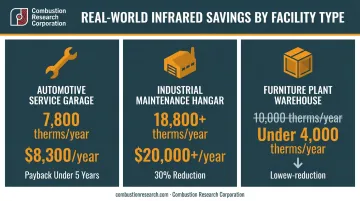
- An automotive service garage saved approximately 7,800 therms/year and over $8,300/year after retrofitting with infrared, with a payback period under five years
- An industrial maintenance hangar achieved 30% savings — over 18,800 therms/year and more than $20,000/year
- A furniture plant warehouse reduced gas use from over 10,000 therms/year to under 4,000 therms/year by switching to infrared with a lower setpoint and night setback
A 2007 trade analysis in Consulting-Specifying Engineer references independent reports suggesting 20–50% fuel savings over forced-air systems — consistent with the case study data above.
Zone Control and Partial Operations
Infrared tube heaters can be zoned to heat only occupied sections of a facility. If one wing of a warehouse is idle, those heaters stay off. Convection systems must heat the entire air volume to be effective — zone control is largely impractical when air from heated zones mixes freely with unheated ones.
Combustion Research Corporation's Omega II DI systems extend this further with dual modulating capability, precisely adjusting both gas and air ratios at high and low heat stages — letting facilities cut fuel use during partial operations without reheating the entire air volume.
Air Quality
Convection systems continuously circulate air. In facilities with fine particulate matter, animal dander, or food-adjacent operations, that means continuous redistribution of airborne contaminants. Infrared systems produce no air movement — dust and allergens settle and stay settled. This matters particularly in animal confinement facilities, auto body shops, and any operation where particulate exposure affects worker health.
One important caveat: in environments with heavy fumes, mists, or process gases, forced pressurization systems may actually be required to meet ventilation code. Infrared heating excels in cleaner industrial environments, while facilities with significant airborne hazards need to evaluate ventilation requirements independently.
Safety in Active Facilities
Ground-level and wall-mounted unit heaters present real contact risks in facilities where forklifts, pallet jacks, and other equipment move constantly. OSHA's powered industrial truck standard (29 CFR 1910.178) requires sufficient headroom under all overhead installations — ceiling-mounted infrared tube heaters comply cleanly with this requirement while eliminating floor-level obstacles entirely.
There are no heater bodies at vehicle height, no wall-mounted units that can be clipped by a turning forklift.
Which Heating System Is Right for Your Facility?
Choose Infrared When:
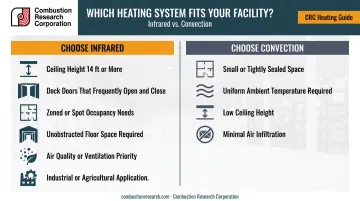
- Ceiling height is 14 feet or higher
- Loading dock doors or other large openings cycle regularly
- The facility operates in zones with variable occupancy
- Floor space must remain clear for equipment and vehicles
- Air quality and particulate management are priorities
- The application includes aircraft hangars, automotive shops, car wash bays, warehouses, or agricultural buildings
Choose Convection When:
- The space is small, sealed, and well-insulated
- Uniform ambient air temperature throughout the space is the core requirement
- Ceiling height is low and stratification isn't a significant factor
- The space has minimal air infiltration from outside
Real-World Example
The Seattle automotive service garage case from the PSE/ACEEE data illustrates the decision well. The facility had 18–20 foot ceilings and frequent overhead door openings, exactly the conditions where forced-air heating struggles most. After retrofitting with infrared heaters, the facility saved 7,800 therms/year and over $8,300 annually on a project that paid back in under five years.
Workers also reported improved comfort. Because radiant heat warms surfaces and occupants directly, an overhead door cycling open doesn't reset the equation the way it does with forced-air systems.
For facilities evaluating a similar transition, Combustion Research Corporation provides engineering support throughout the specification process for both new construction and retrofit projects — including heat loss calculations and heat distribution modeling before construction begins. Contact their team at 888-852-3611 or info@combustionresearch.com to get a custom heating specification for your facility.
Frequently Asked Questions
Which is better, an infrared or convection gas heater?
For large, high-ceiling, or drafty industrial spaces, infrared gas heaters are more efficient — they heat objects directly rather than warming air that stratifies or escapes. Convection suits smaller, sealed environments where consistent ambient air temperature is the primary goal.
Can infrared tube heaters effectively heat large warehouse or hangar spaces?
Ceiling-mounted infrared tube heaters are specifically engineered for large-span industrial spaces. They deliver consistent warmth at floor level regardless of ceiling height, bypassing the stratification losses that undermine forced-air systems in the same environments.
Do infrared heaters work in open or drafty industrial environments?
Infrared heating performs well in drafty conditions. It warms objects and people directly, so radiant energy absorbed by surfaces stays put when a loading dock door opens — convection heat, by contrast, exits with the air immediately.
How much energy can switching from convection to infrared heating save?
Documented industrial cases show 20–50% fuel reductions in high-bay applications. An industrial maintenance hangar in the PSE/ACEEE study saved over 30% — more than 18,800 therms annually. Buildings with significant door cycling and high ceilings typically see the largest gains.
What maintenance do low-intensity infrared tube heaters require?
Low-intensity infrared tube heaters have no built-in filters, no fans, and no condensation-prone components, so routine maintenance needs are minimal. CRC's systems carry a 10-year limited warranty on combustion and heat exchanger tubes — a direct reflection of their durability under normal operating conditions.
Are ceiling-mounted infrared heaters safe in facilities with forklifts and heavy machinery?
Ceiling mounting eliminates floor-level contact hazards entirely. There are no heater bodies at vehicle height and no wall obstructions for turning equipment to strike.