Introduction
Stand in a patch of sunlight on a crisp autumn day. The air around you stays cool, but your face and arms feel genuinely warm. That's radiant heat — one of the oldest heating principles in physics.
The same effect powers commercial and industrial heating systems that consistently outperform forced air in large, high-ceiling buildings. Understanding how it works helps facility managers, mechanical engineers, and contractors make smarter specification decisions — especially where conventional systems fall short.
What follows covers the science, the main system types, the performance advantages, and what to weigh when specifying radiant for a commercial or industrial facility.
Key Takeaways
- Radiant heat warms people and objects directly through infrared waves, bypassing the surrounding air entirely
- Three main system types exist: electric radiant, hydronic radiant, and gas-fired/electric infrared heaters
- Radiant systems eliminate hot/cold stratification common in forced-air buildings
- Industrial infrared tube heaters are the practical choice for warehouses, hangars, and auto shops with large, open air volumes
- Space heating consumes 39% of warehouse energy, making system efficiency one of the highest-impact cost levers for facility operators
What Is Radiant Heat? The Science Behind the Warmth
Radiant heat is the transfer of thermal energy through electromagnetic (infrared) waves, moving directly from a warm surface or source to people and objects in its path — without heating the surrounding air first.
To understand why that matters, it helps to place radiation alongside the other two heat transfer mechanisms:
- Conduction — molecule-to-molecule heat transfer through direct contact (touching a hot pan)
- Convection — heat transfer through a fluid such as air (a forced-air furnace heats air, which circulates through the room)
- Radiation — electromagnetic wave transfer through space, requiring no medium at all
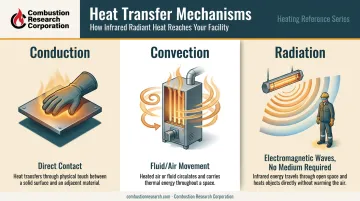
Infrared radiation travels at the speed of light in straight lines. When it strikes a solid surface (a floor, a person, a piece of equipment), that energy is absorbed and converted to heat. The air between the source and the surface is largely bypassed, which is why a radiant-heated room can feel comfortable even at a lower thermostat setting than a comparable forced-air space.
The Sun Analogy (And Why It Holds Up)
The sunlight-on-a-cool-day experience is the clearest real-world example: air temperature might be 45°F, but standing in direct sun feels noticeably warmer. Radiant heating systems replicate this indoors — the warmth is absorbed by occupants and surfaces rather than suspended in the air above them.
One nuance: infrared radiation isn't absorbed exclusively by solid surfaces. Atmospheric constituents like water vapor and CO₂ absorb some infrared as well. In practical heating applications, though, the dominant effect is surface and occupant warming — not air warming — which is what distinguishes radiant from convective heating in terms of comfort and efficiency.
Radiant Heat vs. Infrared Heat: Are They the Same Thing?
Yes — with one labeling distinction worth understanding.
All infrared heat is radiant heat. The terms describe the same physical mechanism. The difference is how manufacturers use the labels:
- "Infrared heater" typically refers to a device that emits infrared waves directly from a high-temperature surface or tube (gas-fired tube heaters, ceramic panel heaters, and similar devices)
- "Radiant floor heating" refers to systems that warm a large surface (the floor) at lower temperatures, which then radiates heat into the room
Both operate on identical physics — the distinction is application and intensity, not mechanism.
Types of Radiant Heating Systems
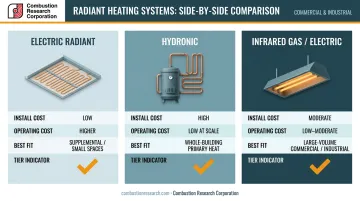
Radiant heating systems fall into three broad categories. They overlap in places, but the distinctions are useful starting points for facility managers and mechanical engineers comparing options.
| System Type | Typical Install Cost | Operating Cost | Best Fit |
|---|---|---|---|
| Electric Radiant | Low | Higher (depends on rates) | Supplemental, small spaces |
| Hydronic | High | Low at scale | Whole-building primary heat |
| Infrared (Gas/Electric) | Moderate | Low–Moderate | Large-volume commercial/industrial |
Electric Radiant Heating
Electric radiant systems use heating cables or mats installed beneath flooring, or within wall and ceiling panels, to convert electrical current into heat.
Common applications:
- Residential bathrooms and kitchens (supplemental heating)
- Smaller commercial spaces
- Spot heating in areas without gas access
Trade-offs: Lower upfront installation cost than hydronic systems, but operating costs depend heavily on local electricity rates. For large spaces, electric operating costs typically make gas-fired alternatives more economical.
Hydronic Radiant Heating
Hydronic systems circulate hot water — heated by a boiler — through tubing embedded in floors, walls, or ceilings. The warm surface then radiates heat into the occupied space.
Common applications:
- Whole-building primary heating in new residential or commercial construction
- Facilities where long-term operating costs outweigh higher upfront investment
Trade-offs: Higher installation complexity (boiler, pump, manifold, embedded tubing) and capital cost. Lower long-term operating costs at scale, especially in well-insulated buildings with stable heating loads.
Infrared Radiant Heaters (Gas and Electric)
Gas-fired and electric infrared heaters emit infrared radiation directly from a high-temperature surface or tube. These include:
- Low-intensity tube heaters — gas-fired, ceiling-mounted, with radiant tubes that reach moderate surface temperatures and distribute heat across a large floor area
- High-intensity ceramic heaters — higher surface temperatures, shorter mounting distances, suited for spot or zone heating
- Electric infrared heaters — for facilities without gas infrastructure
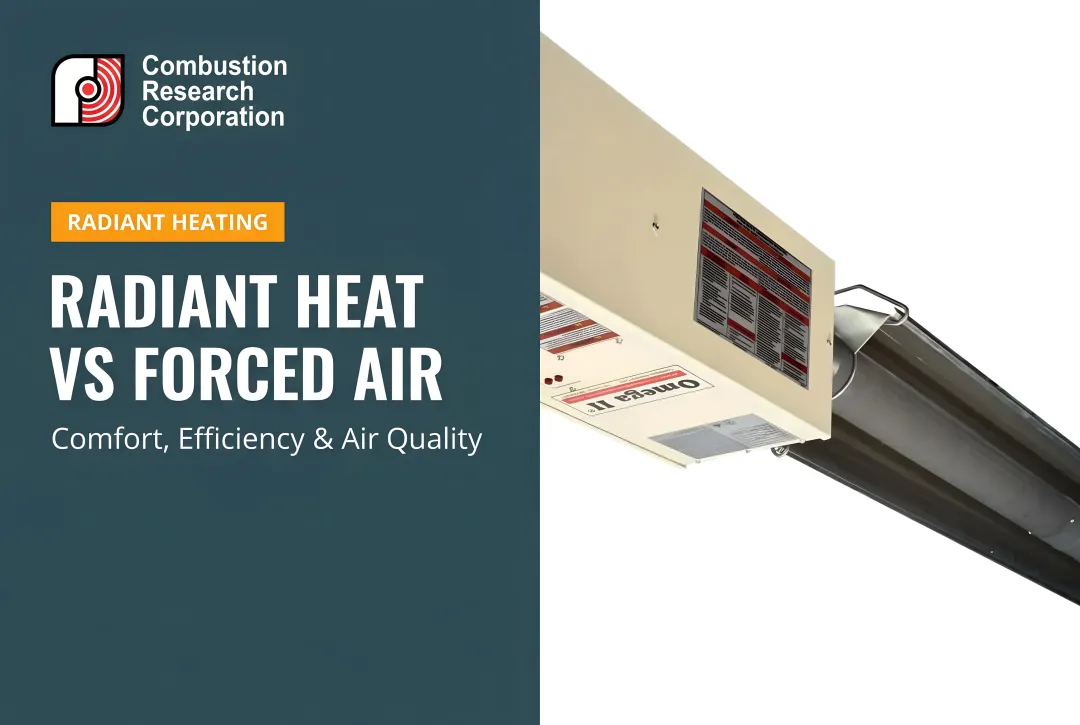
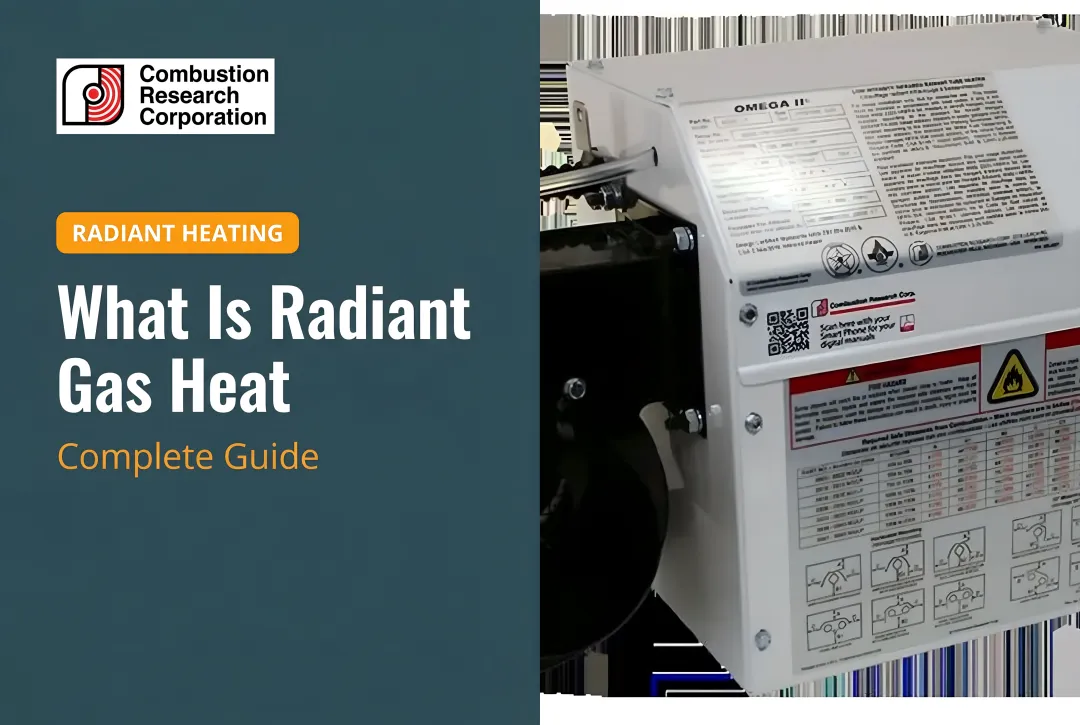
This category is the dominant choice for large-volume, high-ceiling, or semi-open commercial and industrial spaces. Combustion Research Corporation's low-intensity infrared tube heaters — the Omega II (power-vented) and Reflect-O-Ray (vacuum-vented) families — are CSA International certified to ANSI Z83.20/CSA 2.34 standards.
BTU inputs range from 40,000 to 250,000 BTU/hr, covering facilities from a single service bay to warehouses exceeding a million square feet.
Key Benefits of Radiant Heat
Even, Consistent Comfort
Forced-air systems create vertical temperature stratification: warm air pools at the ceiling while floor-level temperatures stay cool. Workers and occupants spend their time at floor level — where the heat isn't.
Radiant heat eliminates this problem. Because energy is deposited directly into surfaces and occupants rather than the air column, warmth is consistent from floor to work height. No hot pockets near the ceiling. No cold drafts at ankle level.
Energy Efficiency
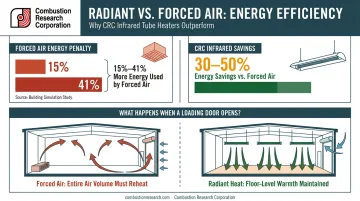
A 2018 peer-reviewed study published in Building Simulation found that air heating used 15% to 41% more primary energy than radiant-panel heating in industrial hall conditions — with modeled savings reaching 23% under lower ventilation loads. This study examined radiant panels rather than gas-fired infrared tube heaters specifically, but the underlying physics advantage holds: radiant systems heat people and objects, not air.
For large industrial facilities, Combustion Research Corporation documents 30–50% energy savings over conventional forced-air systems across commercial deployments. The mechanism is straightforward — radiant energy deposits into the floor, inventory, and workers, and those thermal masses re-radiate heat back into the space even when overhead doors cycle open. Forced-air systems must reheat the entire air volume each time a door closes.
Improved Indoor Air Quality
Radiant heating doesn't move air. No blower means no redistribution of dust, allergens, or airborne particulates — a direct advantage in:
- Animal confinement facilities and agricultural buildings
- Food processing and food-adjacent commercial spaces
- Allergy-sensitive environments
- Clean manufacturing areas
Quiet, Low-Maintenance Operation
CRC's low-intensity infrared tube heaters are engineered to minimize recurring maintenance. Compared to forced-air systems, they eliminate several common service categories:
- No blower motors or fans to service
- No combustion air filters to replace — a deliberate design choice for dusty industrial environments
- Dry-tube construction prevents internal condensate formation, the failure mode covered under the 10-year radiant tube warranty
Annual inspection by a qualified contractor is standard practice for any gas-fired commercial system. Beyond that, there's little routine maintenance to schedule.
Humidity Stability
Forced-air heating cycles air continuously through the building, accelerating moisture loss — particularly in cold-climate facilities where outdoor air is already dry. Radiant systems don't alter air movement or moisture distribution, so indoor humidity stays closer to its natural equilibrium. In environments like natatoriums, greenhouses, or animal confinement facilities, that stability reduces the need for supplemental humidification.
Radiant Heat vs. Forced Air: A Direct Comparison
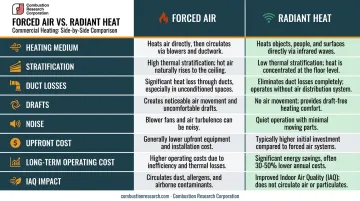
The core mechanical difference is simple: forced-air heats the air and moves it through ductwork with a blower. Radiant heat bypasses air as the medium entirely.
| Factor | Forced Air | Radiant Heat |
|---|---|---|
| Heating medium | Air | Infrared waves (surfaces/occupants) |
| Stratification | Warm air rises, floor stays cool | Even from floor to work height |
| Duct losses | Present (energy lost through leaks) | None (no ductwork) |
| Drafts | Common — blower cycles create airflow | None |
| Noise | Blower motor cycles on/off | Silent |
| Upfront cost | Lower (in most configurations) | Higher (especially hydronic) |
| Long-term operating cost | Higher in large, drafty, high-ceiling spaces | Lower — especially at industrial scale |
| IAQ impact | Circulates dust and allergens | No air circulation |
Where Each Approach Fits
Forced air works adequately in smaller, well-insulated residential spaces where ceiling heights are modest and the building envelope is tight. Response time to thermostat changes is fast, and upfront costs are lower.
Radiant heating — particularly overhead infrared — becomes increasingly advantageous as building size grows, ceiling heights increase, and occupancy patterns become intermittent. Heating the full air volume with forced air in these environments becomes both costly and ineffective:
- 25-foot-tall warehouses: warm air stratifies near the ceiling, never reaching workers or equipment at floor level
- Loading docks with frequent door cycling: conditioned air escapes every time a door opens
- Aircraft hangars: doors open for every arrival and departure, making air-based heating a losing battle
Industrial and Commercial Applications for Radiant Heat
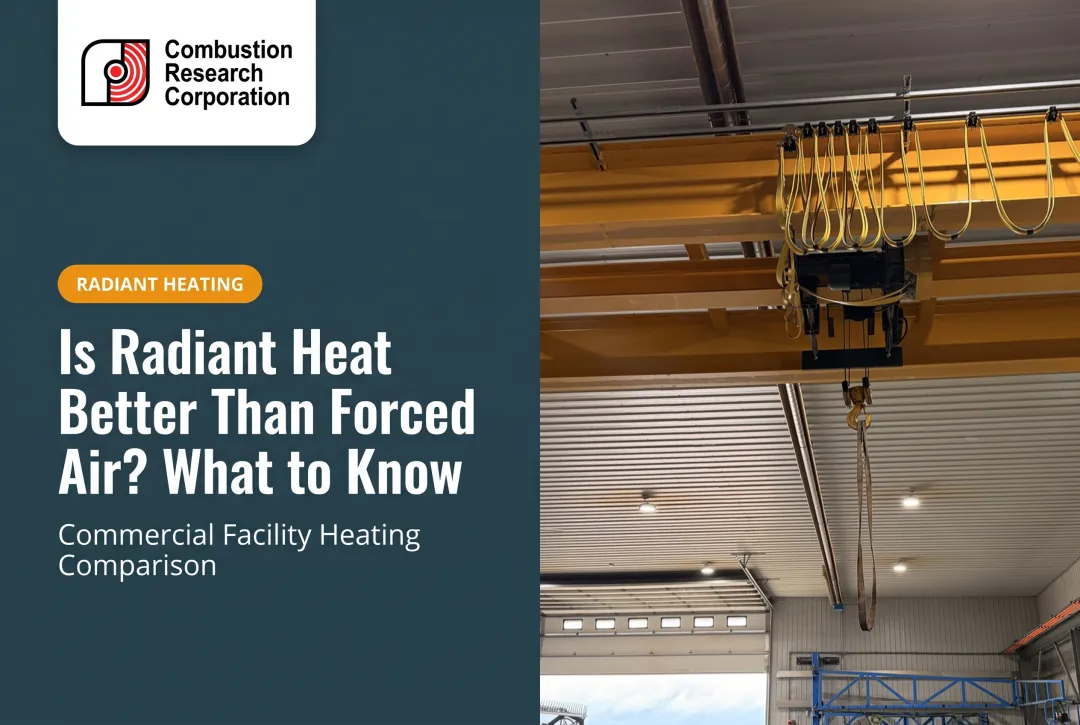
Large-volume, high-ceiling, and semi-open buildings are where overhead infrared radiant heating earns its strongest case. Heating the full air column of a 30-foot warehouse to comfort temperatures with forced air is energy-prohibitive — the heat stratifies, pools useless at the ceiling, and gets displaced every time a dock door opens. Infrared delivers warmth directly to workers and equipment at floor level, regardless of what happens to the air above them.
Typical industrial and commercial applications include:
- Warehouses and distribution centers
- Aircraft hangars (FBO, MRO, military)
- Auto dealership service bays and CNG repair shops
- Shipping and receiving docks
- Pole barns and agricultural buildings
- Ice arenas and natatoriums
- Greenhouses
- Car and truck wash bays
- Military vehicle bays and MRO facilities
Ceiling-mounted configurations serve all of these environments well. Combustion Research Corporation's infrared tube heater systems keep all heating equipment above forklift travel lanes and clear of material-handling machinery, preserving usable floor space. The Reflect-O-Ray vacuum-vented system can reduce the number of utility drops required by up to two-thirds compared to competing systems in high-bay facilities, lowering installation cost and minimizing roof penetrations.
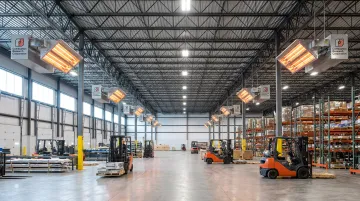
Both vacuum-vented (Reflect-O-Ray) and power-vented (Omega II) configurations are available to match different facility layouts, ceiling heights, and exhaust path constraints. Engineering support during the specification process covers heat loss calculations, zone layout, and coverage optimization to help ensure the system performs as designed from initial startup.
Frequently Asked Questions
What is meant by radiant heat?
Radiant heat refers to thermal energy transferred through infrared electromagnetic waves — directly from a warm surface or source to people and objects, without first heating the air between them. Think of the warmth you feel from sunlight or a fireplace even when the surrounding air is cool.
Does radiant heat use a lot of electricity?
Electric radiant systems consume electricity, with operating costs tied to local utility rates. Gas-fired infrared heaters — running on natural gas or propane — are generally more economical for large commercial spaces. Both types outperform forced-air systems on efficiency because they heat occupants directly, not the full air volume.
What is the difference between radiant heat and forced air?
Forced air heats and circulates air through ductwork, which leads to stratification, drafts, and energy lost through duct leakage. Radiant heat warms surfaces and occupants directly through infrared energy, producing quieter, more even, and typically more energy-efficient heating — with no blower noise and no air movement.
What are the main types of radiant heating systems?
Three main categories exist: electric radiant (cables or mats under floors or in panels), hydronic radiant (hot water through floor or wall tubing, common in residential), and infrared heaters (gas-fired or electric devices emitting infrared waves directly). For commercial and industrial facilities, overhead infrared heaters — gas-fired radiant tube and high-intensity ceramic — are the dominant choice.
Is radiant heat effective for large industrial or commercial spaces?
Infrared radiant heating is well-suited for large, high-ceiling, or semi-open spaces — warehouses, hangars, auto shops, loading docks. It warms workers and equipment at floor level without heating the full air volume. That makes it far more cost-effective than forced air in facilities where ceiling height and frequent door cycling cause constant heat loss.