Two systems dominate industrial and commercial applications: radiant tube heaters and unit heaters. Each has a legitimate place, but they operate on fundamentally different physics — and that difference matters enormously depending on your building's geometry, usage patterns, and budget priorities.
This guide breaks down exactly how each system works, where each performs best, and how to make the right call for your specific application.
Key Takeaways
- Radiant tube heaters warm objects and people directly via infrared radiation; unit heaters heat air using a fan and heat exchanger
- In high-bay, high-infiltration spaces, radiant tube heaters typically deliver 30–50% lower operating costs than forced-air alternatives
- Unit heaters cost less upfront and heat air quickly — practical for smaller, well-sealed spaces with minimal door traffic
- Warehouses, hangars, automotive shops, and loading dock areas favor radiant tube heaters for comfort and efficiency
- The right choice depends on ceiling height, infiltration frequency, budget structure, and how the space is used
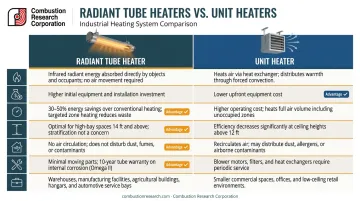
Radiant Tube Heater vs Unit Heater: Quick Comparison
Use this table to compare both heater types across the factors that matter most for your facility.
| Factor | Radiant Tube Heater | Unit Heater |
|---|---|---|
| Heating Mechanism | Infrared radiation warms objects, floors, and occupants directly | Fan forces air across a heat exchanger into the space |
| Upfront Cost | Higher equipment and installation cost | Lower equipment and installation cost |
| Operating Efficiency | Stronger in tall, drafty spaces; no stratification loss | Efficiency drops in tall spaces due to heat stratification |
| Ceiling Height | Performs best above 12–14 ft; model-specific minimums apply | Effective at lower ceiling heights (under 12–14 ft) |
| Indoor Air Quality | No fan-driven air movement; doesn't circulate dust or debris | Fan operation can redistribute airborne particles |
| Maintenance | No filters required; fewer wear components | Filters and fan motors require periodic maintenance |
| Best Applications | Warehouses, hangars, auto shops, car washes, ag facilities | Tight buildings, low ceilings, fast warm-up requirements |
What Is a Radiant Tube Heater?
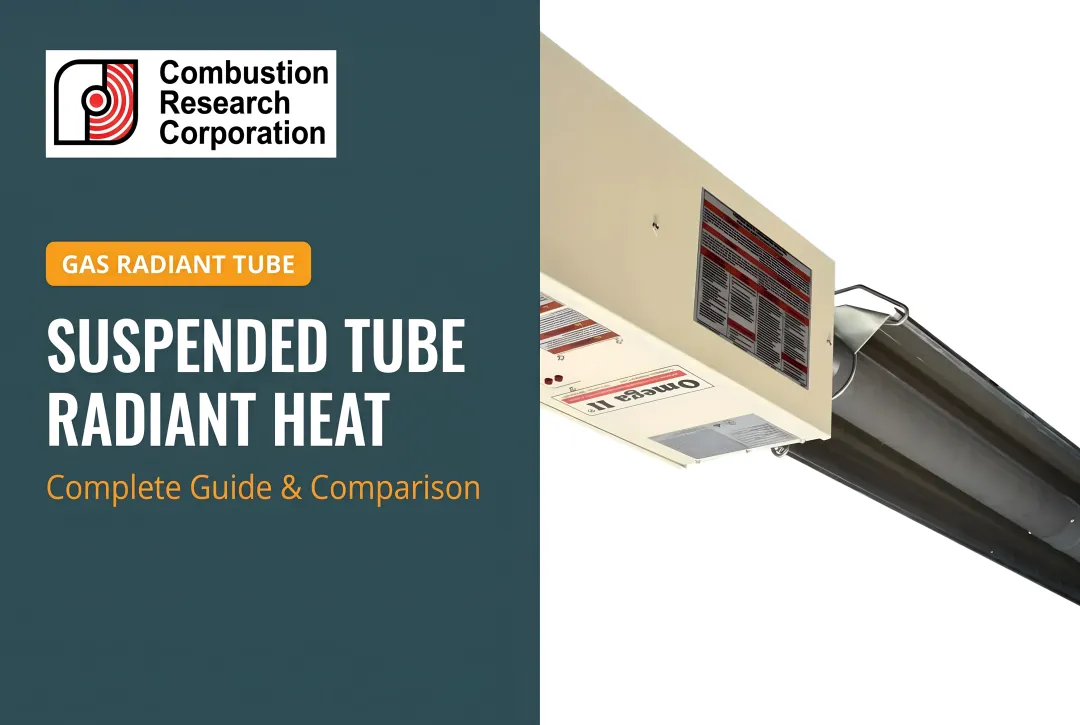
A radiant tube heater is a ceiling-mounted system that uses a gas burner to heat a long metal tube, which then emits infrared radiation downward — warming floors, equipment, and people directly rather than heating the surrounding air first. The same principle explains why a 45°F sunny day feels warmer than a 50°F overcast one. The radiant energy is absorbed by surfaces, which then re-radiate that warmth into the occupied zone.
In large, drafty buildings, this translates directly to comfort. Because floors and objects absorb and hold heat, the "feels like" temperature stays stable even when a dock door opens and cold air rushes in — the system isn't chasing a moving target every time.
Low-Intensity vs. High-Intensity Systems
Two broad categories exist, and the distinction matters for occupied spaces:
- Low-intensity infrared tube heaters — gas-fired, enclosed combustion, vented systems. This is the standard choice for occupied industrial and commercial spaces: warehouses, automotive shops, aircraft hangars, and similar environments
- High-intensity radiant heaters — open-flame, higher output, generally suited for unoccupied or extremely well-ventilated spaces
For most commercial and industrial applications with workers present, low-intensity tube heaters are the right choice.
Configuration Options That Affect Performance
Buyers evaluating radiant tube heaters will encounter a few key configuration choices:
- Straight-tube vs. U-tube layouts — U-tube designs recirculate heat more evenly along the full tube length, improving distribution in compact or single-zone spaces
- Vacuum-vented vs. power-vented — vacuum systems operate under negative pressure, which maintains exhaust integrity even if connections loosen over time; power-vented systems use forced exhaust
- Single-stage vs. dual modulating operation — modulating systems adjust both gas and airflow simultaneously for high- and low-heat output, preventing over-firing during mild weather
Combustion Research Corporation's low-intensity infrared tube heaters are built for these environments. The Omega II (power-vented) and Reflect-O-Ray (vacuum-vented) lines carry a 10-year limited warranty on the burner core and all combustion and heat exchanger tubes, require no combustion air filters, and are CSA International Design Certified to ANSI/CGA Standards.
Omega II dual modulating (DI) models adjust both gas and air at each stage, delivering up to 75% energy savings compared to single-stage operation. Engineering support is available through the specification process for both new construction and retrofit projects.
Where Radiant Tube Heaters Excel
These systems are the clear choice in:
- Warehouses and distribution centers with loading docks
- Aircraft hangars
- Automotive repair shops, bump shops, and dealership service bays
- Car and truck wash bays (stainless steel construction recommended)
- Greenhouses and agricultural facilities
- Animal confinement buildings
- Ice arenas and natatoriums
- Any facility where doors open frequently or air quality must be protected
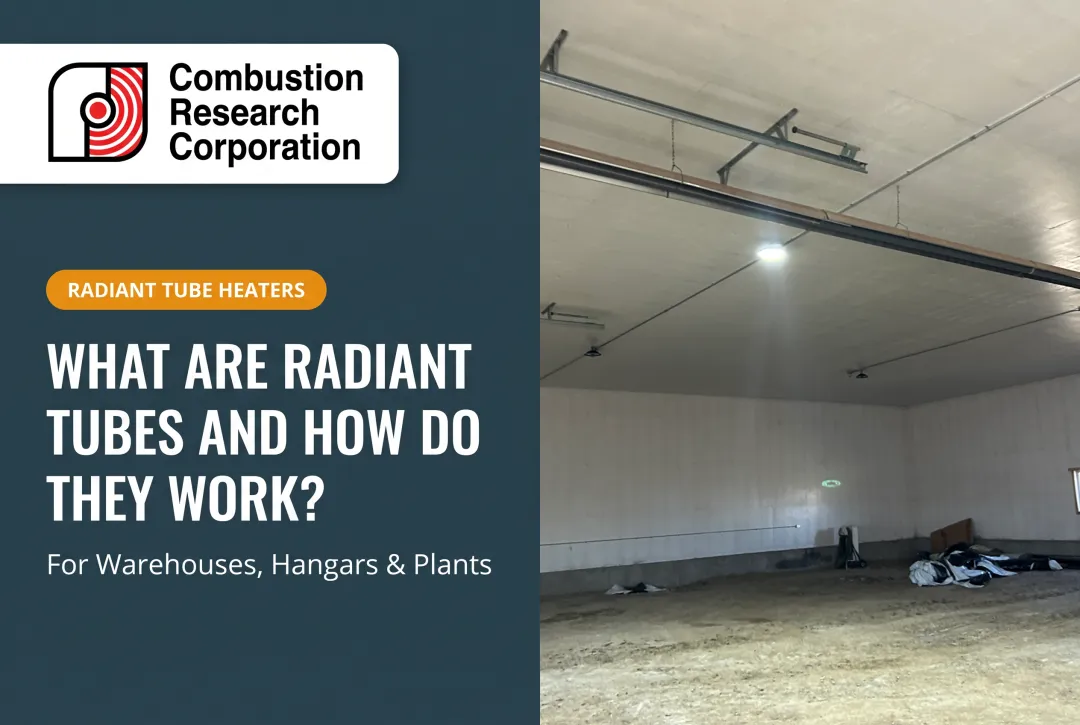
Automotive shops are a useful benchmark: bay doors open constantly, and forced-air systems simply can't recover fast enough to keep technicians comfortable. Radiant energy heats people and surfaces directly, so traffic flow becomes a non-issue.
What Is a Unit Heater?
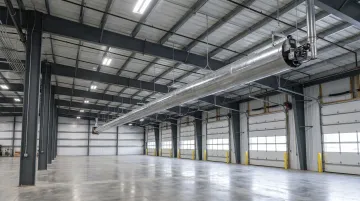
A unit heater is a compact, ceiling- or wall-mounted appliance that pulls room air across a gas-fired heat exchanger and uses a propeller fan to push warm air into the space. No ductwork required. According to ACEEE's research on commercial heating systems, approximately 80% of unit heaters burn gas, and the vast majority are unducted — making them self-contained space heaters rather than part of a broader HVAC distribution system.
They're widely available, easy to install, and familiar to virtually every mechanical contractor. For the right application, that simplicity is a genuine advantage. The challenge is that "the right application" is narrower than most buyers expect.
The Core Trade-Off in Tall Spaces
The fundamental limitation of unit heaters in large buildings is stratification. A peer-reviewed study in Energy and Buildings measured floor-to-ceiling temperature differentials of 7.2°F to 20°F in large single-cell buildings using forced-air heating. ACEEE's industrial heating research puts it more directly: forced-air industrial spaces can show vertical temperature variation of 5°F per every 10 feet of ceiling height.
In a 30-foot-tall warehouse, that means warm air accumulates near the roof while workers at floor level remain cold — and the heater runs continuously trying to compensate.
When a dock door opens, the problem gets worse. All that warm air near the ceiling escapes, and the unit heater must reheat the entire air volume from scratch.
Destratification fans (ceiling fans that push warm air back down) can partially offset this in taller buildings, but they add equipment cost, energy use, and another maintenance item.
Where Unit Heaters Remain Practical
Unit heaters work well in the right conditions. They make sense when:
- Ceiling heights are below 12–14 feet
- The building is well-sealed with minimal door traffic
- Fast warm-up from a cold start is a priority
- Upfront capital budget is constrained and the operator understands the operating cost trade-off
- Very high BTU loads require fewer installed units — unit heaters are available in larger single-unit capacities than most tube heaters
Radiant Tube Heater vs Unit Heater: Which Should You Choose?
Four variables drive this decision. Get these right and the answer becomes straightforward.
Factor 1: Ceiling Height and Building Volume
Ceiling height is the single most reliable predictor of which system performs better. Radiant tube heaters are designed for tall structures — the infrared energy travels downward to the occupied zone, and height doesn't create a thermal penalty. Unit heaters heat air, and tall buildings give that warm air plenty of room to stratify away from workers.
If your ceiling exceeds 12–14 feet, radiant tube heaters have a structural physics advantage that no amount of destratification equipment fully neutralizes.
Factor 2: Air Infiltration Frequency
How often do dock doors, vehicle entrances, or large openings cycle? ACEEE's case study research on industrial infrared heating documented a Seattle auto service garage where replacing forced-air heaters with low-intensity infrared systems saved 7,800 therms per year, with a simple payback under five years. A furniture plant warehouse in the same study saw annual gas use fall from over 10,000 therms to under 4,000 therms after switching to infrared.
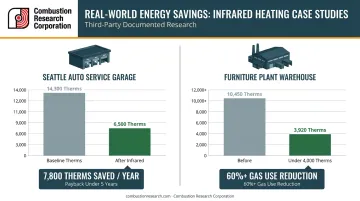
Both are documented third-party cases, not manufacturer claims. Results vary by facility, but the mechanism is consistent: radiant heat stored in floors and objects doesn't escape through an open door the way warm air does.
Factor 3: Budget Structure
Unit heaters cost less to purchase and install. Radiant tube heaters carry a higher upfront price — but operating costs change the math in the right building.
CRC positions their systems at 30–50% lower operating costs than conventional heating in appropriate applications — a range supported by the case study evidence above and consistent across their Omega II and Reflect-O-Ray product lines. For large facilities with significant heating loads, that operating advantage typically closes the upfront gap within a few years.
Factor 4: Indoor Air Quality and Occupant Sensitivity
Unit heaters use fans. Fans move air. In automotive shops, that means redistributing exhaust fumes, brake dust, and solvents. In animal confinement, it means circulating pathogens. In food-adjacent facilities, it creates compliance concerns.
Radiant tube heaters deliver heat without fan-driven air movement. The occupant benefit is measurable: no drafts, no dust circulation, no pathogen redistribution. CRC's systems specifically require no combustion air filters — eliminating a recurring maintenance item and reducing particulate disturbance in sensitive environments.
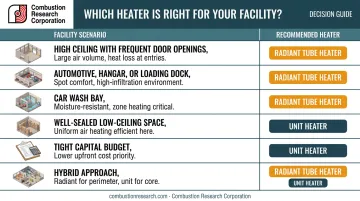
Situational Guide
| Scenario | Recommended System |
|---|---|
| Ceiling over 14 ft, frequent door openings | Radiant tube heater |
| Automotive shop, hangar, or loading dock area | Radiant tube heater |
| Car wash bay or natatorium | Radiant tube heater (stainless steel) |
| Well-sealed space, ceiling under 12 ft | Unit heater |
| Tight capital budget, low-traffic building | Unit heater |
| High door frequency + tight capital budget | Radiant tube over dock areas; unit heater elsewhere |
The Hybrid Approach
Many large facilities use both. Unit heaters handle interior zones with lower ceilings and minimal infiltration, while radiant tube heaters cover dock doors, loading bays, and high-traffic work areas. This approach captures the lower upfront cost of unit heaters where they perform well, while protecting infiltration-prone zones with radiant efficiency where it counts most.
For new installations or retrofits, Combustion Research Corporation provides engineering support through the full specification process, from heat loss calculations to zone layout and system sizing.
Conclusion
For large industrial and commercial facilities with high ceilings, frequent door openings, and a focus on long-term efficiency, radiant tube heaters consistently outperform unit heaters — both the physics and documented case evidence support that conclusion. For smaller, tighter spaces with lower ceilings and minimal air infiltration, unit heaters remain a cost-effective, straightforward option.
What matters most is matching the system to the building. The choice between these two technologies has measurable consequences across the life of the system:
- Energy spend — radiant systems typically cut heating costs 30–50% in high-bay applications
- Maintenance burden — tube heaters have fewer moving parts and no filters to service
- Floor safety — ceiling-mounted systems stay clear of forklifts and material handling equipment
- Indoor air quality — radiant heat doesn't recirculate dust, debris, or pathogens
Before deciding, evaluate your ceiling height, door traffic frequency, and 5-to-10-year cost horizon. If you're unsure which system fits your facility, the Combustion Research Corporation team can help you work through the application specifics — call 888-852-3611 or email info@combustionresearch.com.
Frequently Asked Questions
What is the main difference between a radiant tube heater and a unit heater?
Radiant tube heaters emit infrared energy that warms objects, floors, and people directly — without heating the surrounding air first. Unit heaters blow heated air into the space using a fan and heat exchanger. That difference in heat transfer method is what drives every practical trade-off between the two systems.
Which type of heating is healthier for indoor air quality?
Radiant tube heaters produce no fan-driven air movement, so they don't circulate dust, debris, or airborne particles. Unit heaters use propeller fans that redistribute whatever is in the air — a real concern for automotive shops, animal confinement facilities, and any space sensitive to airborne contaminants.
Do radiant tube heaters effectively heat a room?
Yes — not by raising air temperature, but by warming floors, walls, equipment, and occupants directly. The absorbed heat re-radiates from those surfaces, creating a comfortable "feels like" temperature that holds even when doors open or cold air enters.
Are radiant tube heaters more expensive than unit heaters?
Upfront, yes — radiant tube heaters carry higher equipment and installation costs. However, documented operating cost reductions of 30–50% in industrial and high-infiltration facilities typically produce faster payback and lower long-term total cost of ownership.
Can radiant tube heaters work in spaces with low ceilings?
Radiant tube heaters require adequate clearance to combustibles, and minimum mounting heights are model- and BTU-specific. For spaces with ceilings below roughly 12 feet, unit heaters or high-intensity radiant systems may be more practical. Consult the manufacturer's installation specifications or an engineering team before specifying a system for low-clearance environments.
Which heater is better for a warehouse with frequent dock door openings?
Radiant tube heaters are strongly preferred. Because they warm floors, racking, and workers directly, opening a dock door doesn't force the system to reheat the entire building's air volume. The stored radiant heat in surfaces continues warming occupants even as cold air enters — a resilience that forced-air systems simply can't match in high-infiltration environments.