Introduction
Heating a pole barn sounds straightforward until you're staring at a space with 14-foot ceilings, uninsulated steel walls, and a door that opens every 20 minutes. The physics work against you: warm air rises, infiltration bleeds heat through every gap, and a heater sized for a standard room will run continuously without ever reaching your target temperature.
The wrong choice shows up on your fuel bill every month. Oversize the unit and you cycle through fuel without achieving stable temperatures. Undersize it, and the space stays cold no matter how long it runs — just less efficiently.
This guide covers what you need to make an informed decision: how pole barn heaters work, how to calculate BTU requirements for your specific building, and which factors — fuel type, insulation, venting, and certification — determine whether a heater performs year after year or becomes an expensive disappointment.
Key Takeaways
- Infrared tube heaters outperform forced air in pole barns — they heat objects and occupants directly, not air that rises and escapes
- BTU sizing starts with barn volume (length × width × height), not square footage
- Fuel cost per MMBtu varies significantly: natural gas runs ~$9.90, propane ~$25–28, electricity ~$37
- Look for CSA certification to ANSI Z83.20 / CSA 2.34 on any gas-fired tube heater
- A 10-year warranty on combustion and heat exchanger tubes signals genuine product confidence
What Are Pole Barn Heaters?
Pole barn heaters are heating systems — either purpose-built or commercially rated — designed to overcome the thermal challenges of large, open, often uninsulated structures with high ceilings. The category covers agricultural buildings, workshops, vehicle storage, and commercial operations housed in post-frame construction.
Types of Pole Barn Heaters
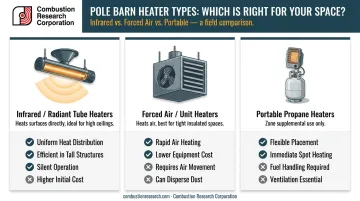
Infrared/radiant tube heaters are ceiling-mounted systems that emit radiant heat absorbed directly by surfaces, floors, equipment, animals, and occupants — not the air. This mechanism is particularly effective in tall or drafty buildings where heated air would otherwise stratify at the ceiling and escape through infiltration.
Forced air/unit heaters heat air directly and distribute it via fan. They work well in tight, well-insulated buildings. In open pole barns with high ceilings, warm air rises and pools near the roof — away from the people and livestock that actually need it.
Portable and temporary propane heaters can supplement heat in a specific zone but aren't practical as a primary solution for large pole barns. Output is limited, fuel monitoring is continuous, and they introduce safety limitations in agricultural or vehicle-storage environments.
Why Infrared Tube Heaters Outperform in Pole Barn Environments
Radiant heat transfers directly to occupants and surfaces without relying on air as the delivery medium. A USACE/WBDG technical study on overhead radiant heating found that replacing conventional convection heating with overhead radiant units cut natural gas consumption by 44% in a high-bay facility — a figure that translates directly to lower operating costs for pole barn owners.
Beyond energy efficiency, infrared tube heaters offer several practical advantages for pole barn environments:
- Preserve floor space by mounting at the ceiling, keeping aisles clear for machinery, vehicles, and livestock
- Reduce contact hazards from forklifts or material-handling equipment passing beneath heaters
- Don't circulate air, avoiding the dust redistribution and pathogen spread that forced-air systems cause in workshops and animal confinement facilities
How to Calculate the Right Heater Size for Your Pole Barn
Start With Volume, Not Square Footage
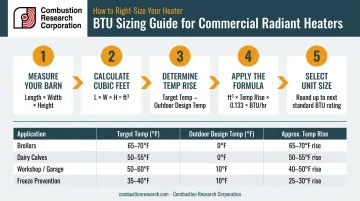
Pole barns require volume-based calculations because ceiling height dramatically affects how much space needs to be heated. Multiply length × width × height (in feet) to get total cubic feet.
A common rule-of-thumb sizing formula is:
Cubic feet × desired temperature rise (°F) × 0.133 = minimum BTUs per hour
This coefficient reflects the heat capacity of air and serves as a practical starting point, though a full engineering heat-loss calculation accounting for envelope, infiltration, and ventilation is more precise for final specification.
Worked Example
A 40×60×14 pole barn = 33,600 cubic feet
- Outside design temperature: 15°F
- Target interior temperature: 50°F
- Temperature rise needed: 35°F
33,600 × 35 × 0.133 ≈ 156,408 BTU/hr minimum
Size up to the next standard unit rating: for this barn, a system in the 175,000–200,000 BTU range.
For a smaller 30×40×12 barn (14,400 cubic feet) with the same 35°F rise:
14,400 × 35 × 0.133 ≈ 67,032 BTU/hr → size up to a 75,000–80,000 BTU unit
Adjust for Insulation and Intended Use
Uninsulated steel pole barns lose heat rapidly through walls and roof. The required buffer above the calculated minimum depends on wall area, roof pitch, and local wind exposure.
For uninsulated buildings, consult a heating engineer to determine the correct BTU buffer before finalizing your specification.
Use-specific temperature targets also matter:
| Application | Target Temperature |
|---|---|
| Broiler chick brooders | 88–93°F at floor (day 0) |
| Dairy calves | Thermoneutral zone ~50–78°F |
| Beef cattle (dry coat) | Above 32°F to avoid cold stress |
| Workshop/auto service | 50–60°F comfort range |
| Pipe freeze prevention | Maintain above 40°F |
Adding insulation before selecting a heater is worth evaluating — it can cut both the required BTU rating and long-term fuel costs.
Key Factors to Consider When Choosing a Pole Barn Heater
BTU output is the starting point. But the best heater for a pole barn must also match the building's fuel infrastructure, construction quality, venting options, and certification requirements.
Fuel Type and Availability
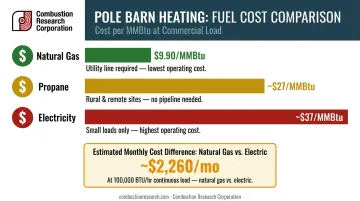
The operating cost difference across fuel types is substantial at pole barn scale. Based on 2024 EIA data and PERC propane energy values:
| Fuel | Approximate Cost per MMBtu | Notes |
|---|---|---|
| Natural gas (commercial delivered) | ~$9.90/MMBtu | Requires utility gas line |
| Propane | ~$25.90–$28.53/MMBtu | Rural/remote sites; comparable efficiency |
| Electricity | ~$37.37/MMBtu | Higher operating cost at large loads |
For a 100,000 BTU/hr heater running 8 hours/day, the gap between natural gas and electric adds up to roughly $220/month — significant over a heating season.
Natural gas costs less per BTU where a line exists. Propane is the practical choice for rural and remote pole barns without utility access. Electric infrared is viable for smaller loads or facilities without gas infrastructure, but the per-BTU premium becomes difficult to justify at 100,000+ BTU/hr loads.
For propane installations, tank sizing matters. A system that runs well in October can fall short in January if the tank volume can't sustain continuous delivery through cold snaps. Build an automatic delivery arrangement into your total cost plan before commissioning.
Barn Insulation and Building Envelope
Insulation level is the single largest variable affecting both heater sizing and operating costs. Uninsulated steel walls and roofs lose heat continuously; even basic reflective insulation on the roof deck measurably cuts that loss.
Infrared tube heaters tolerate poor insulation better than forced-air systems because they don't rely on air temperature to deliver comfort. Opening a large overhead door drops the air temperature, but surfaces and occupants retain their radiant warmth and recover within seconds of the door closing. A forced-air system has to reheat the entire air volume from scratch.
Insulation still reduces operating costs regardless of heater type. Get your envelope estimate before finalizing BTU calculations — it directly affects which unit size you need.
Venting Configuration and Installation Requirements
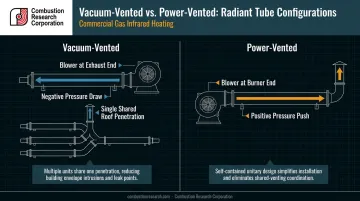
Venting connects directly to insulation strategy: how you exhaust combustion gases affects where heaters can be placed, how many roof penetrations you need, and what the installation costs. Gas-fired infrared tube heaters require venting to exhaust combustion byproducts safely. Two primary configurations:
- Vacuum-vented systems: A blower at the exhaust end draws combustion gases through the tube under negative pressure. Any joint leak draws ambient air inward rather than pushing exhaust out — a safety advantage in occupied spaces. Multiple units can share a common exhaust manifold, reducing roof penetrations in larger barns. The Reflect-O-Ray ROR line uses this configuration.
- Power-vented systems: A blower at the burner end pushes exhaust through the tube under positive pressure. These are unitary systems, faster to specify and install for straightforward building footprints. The Omega II line uses power-vented configuration in sizes from 105,000 to 200,000 BTU/hr.
Venting is both a safety requirement and a code compliance matter. Minimum clearances, vent termination location, and whether your jurisdiction requires a licensed contractor for installation all affect total installed cost. Budget these before purchasing a unit.
Safety Features and Certifications
CSA International's ANSI Z83.20 / CSA 2.34 standard covers gas-fired low-intensity infrared tube heaters and verifies independent testing for safe operation, performance consistency, and combustion quality. The 2018 International Mechanical Code requires appliances to be listed and labeled for their application — uncertified units can create permit and inspection problems and may not satisfy insurance requirements.
Beyond certification, review warranty terms as a proxy for product confidence. A 10-year warranty on combustion chambers and heat exchanger tubes — as Combustion Research Corporation offers on the Omega II, Reflect-O-Ray, and Serengeti-IR lines — signals a durability commitment that shorter warranties do not.
How Combustion Research Corporation Can Help
Combustion Research Corporation (CRC) has manufactured low-intensity infrared tube heating systems for over 50 years, serving pole barns, livestock facilities, aircraft hangars, service garages, and large warehouses across North America. Pole barn heating involves real trade-offs — ceiling height, fuel access, insulation condition, and use type all interact — and no single system fits every situation.
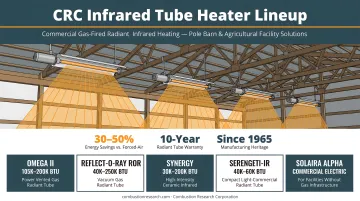
CRC's product lineup for pole barn applications spans three families:
- Serengeti-IR (40,000–60,000 BTU/hr): compact power-vented system for smaller pole barn installations
- Omega II (40,000–200,000 BTU/hr): pre-engineered power-vented packages for standard footprints, including a dual-modulating 9K Series with two-stage gas and air modulation
- Reflect-O-Ray (40,000–250,000 BTU/hr): custom-engineered vacuum-fired systems for larger or complex pole barn configurations; multiple units can share a single roof penetration
All three share a set of practical advantages for pole barn use:
- CSA certified to ANSI/CGA standards
- 10-year limited warranty on combustion and heat exchanger tubes (internally created corrosion)
- 30–50% documented energy savings vs. conventional forced-air heating in high-bay applications
- No combustion air filters required — a meaningful maintenance advantage in dusty agricultural or woodworking environments
The Omega II 9K Series True Dual Modulating system is worth noting for pole barns with variable occupancy or wide temperature swings. It modulates both gas flow and combustion air simultaneously, adjusting output to match demand rather than cycling at full capacity. That reduces fuel waste during shoulder-season or partial-use periods.
CRC also offers an oil-fired Reflect-O-Ray variant for sites without natural gas or propane infrastructure.
For new construction or retrofit projects, CRC's engineering team provides heat-loss calculations, system layout, and venting configuration review. To start the planning process, contact CRC at 888-852-3611 or visit combustionresearch.com/find-a-rep to connect with a local representative.
Conclusion
The best pole barn heater is the one that matches your barn's actual conditions: its volume, insulation level, fuel infrastructure, venting constraints, and what you're using the space for. Picking based on price alone leads to one of two outcomes: undersized units that run constantly without hitting target temperatures, or oversized units that cycle rapidly and wear out early.
Total cost of ownership matters as much as the purchase price. Fuel efficiency, maintenance requirements, warranty terms, and certification status all determine whether a heater pays for itself or becomes an ongoing expense. As barn use or insulation conditions change — adding livestock, expanding operations, or upgrading insulation — revisit your heating setup. What worked for open storage rarely meets the same standard once the space is occupied full-time.
For commercial pole barns and agricultural facilities, Combustion Research Corporation's radiant tube heaters are CSA-certified and engineered for exactly these environments. Contact CRC at 888-852-3611 or info@combustionresearch.com to spec the right system for your barn's conditions.
Frequently Asked Questions
What size propane heater do I need for a 30x40 pole barn?
A 30×40 barn at a 12-foot ceiling height is 14,400 cubic feet. Using the standard formula with a 35°F temperature rise, the minimum BTU requirement is approximately 67,000 BTU/hr. For an uninsulated barn in a cold climate, most buyers size up to a 75,000–100,000 BTU unit to account for heat loss through the building envelope.
Can I use a propane heater in a pole barn?
Yes — propane-fired heaters are widely used and well-suited to rural pole barns without utility gas access. Permanently mounted, vented infrared tube heaters are the safest and most efficient option. Proper clearances, adequate tank sizing for continuous operation, and local code compliance for venting all apply.
How long will a 30,000 BTU propane heater run on a 20 lb propane tank?
A 20-pound cylinder holds approximately 4.76 gallons of propane (at 4.2 lb/gal per PERC Technical Pocket Guide). At ~91,500 BTU/gallon, that's roughly 435,000 BTU total — enough for approximately 14–14.5 hours at full 30,000 BTU/hr input. Actual runtime varies with thermostat cycling and ambient temperature.
Are infrared tube heaters better than forced air for pole barns?
For uninsulated, high-ceiling, or drafty pole barns, yes. Infrared heats surfaces and occupants directly rather than air that rises and pools at the ceiling. Forced air is more effective in tighter, well-insulated buildings where the heated air stays where it's needed.
Do pole barn heaters need ventilation?
Gas-fired heaters must exhaust combustion byproducts safely — no exceptions. Power-vented systems push exhaust out via a blower at the burner end; vacuum-vented systems draw exhaust out via a blower at the far end. Both require vent termination per manufacturer specs and local building code.
What is the most energy-efficient way to heat a pole barn?
Ceiling-mounted low-intensity infrared tube heaters running on natural gas or propane are the most practical high-efficiency option for large pole barns. Pairing them with even basic roof and wall insulation, a programmable thermostat, and correctly sized equipment can reduce fuel consumption by 30–50% compared to conventional forced-air systems.